
Buying a share in a bitcoin treasury company is not the same as buying bitcoin, and the distance between the two is the point of the company. These are listed businesses that raise money in the stock market, spend it on coin, and report how much coin stands behind each share. Whether that pays a shareholder or costs one comes down to a single ratio that can turn while the coin price does nothing at all.
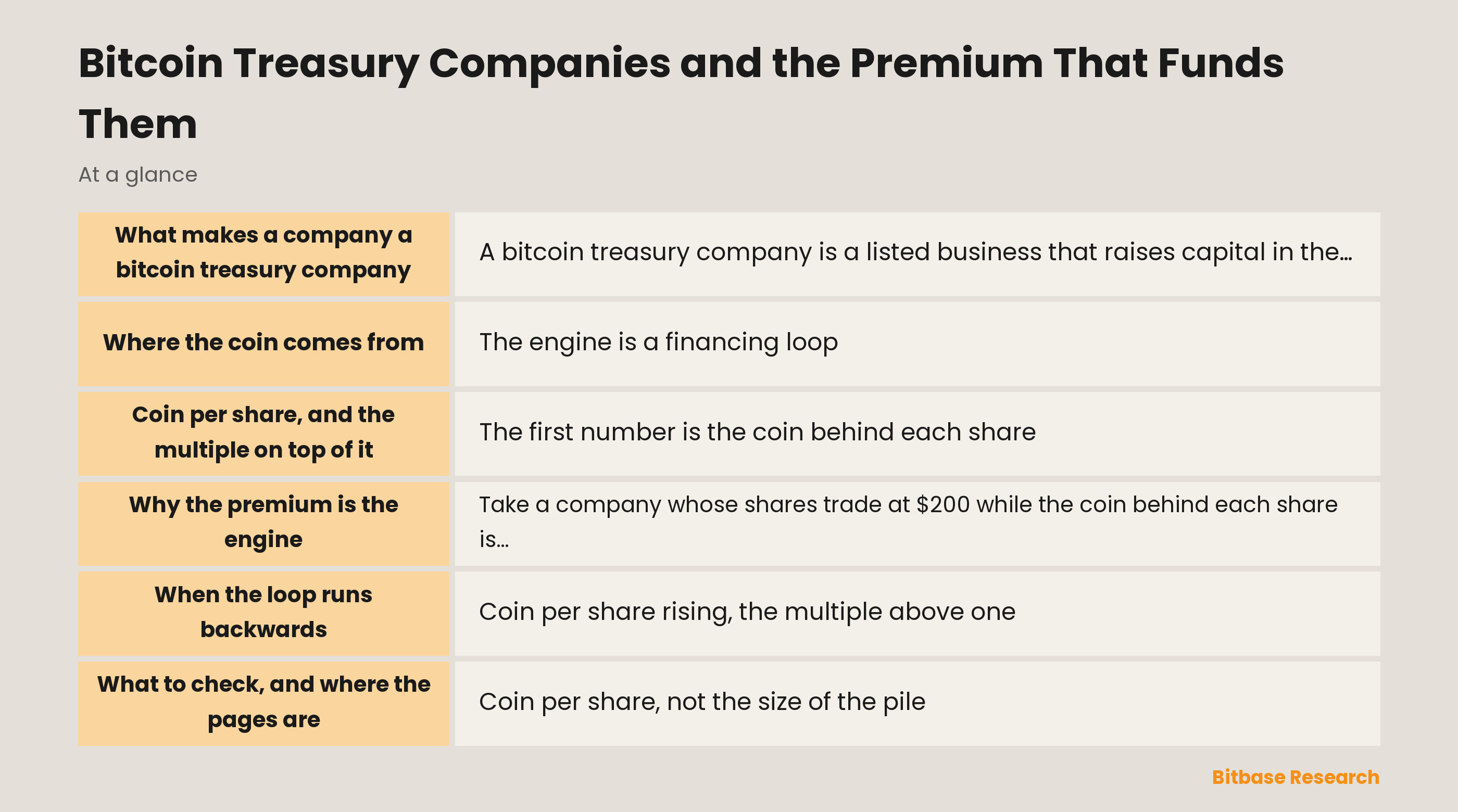
What makes a company a bitcoin treasury company
A bitcoin treasury company is a listed business that raises capital in the public markets in order to hold a crypto asset on its balance sheet, and that reports its progress in coin per share rather than in revenue. Holding some coin is not enough; the distinguishing feature is that raising money to buy more is what the equity gets priced on.
That separates it from a protocol or DAO treasury, which shares the word and none of the mechanics: those hold assets on-chain, are funded by a token the protocol itself issued, and are spent by governance vote. The asset also need not be bitcoin. A company running the same structure around another coin is a digital asset treasury company, shortened to DAT, and the substitution is not cosmetic, because each coin brings its own volatility, custody arrangements and yield mechanics.
Where the coin comes from
The engine is a financing loop, not an operating one: the company sells securities, converts the proceeds into coin, and publishes the result, which is part of what supports the price of the next tranche.
An at-the-market equity programme drips new shares into the open market over time at whatever price is available, instead of pricing one large block in advance. Strategy's filings set this out: the company may issue and sell shares of its class A common stock through sales agents up to an agreed aggregate offering price, and then reports how much bitcoin the net proceeds bought.
Preferred stock sits between debt and common equity: it carries a stated dividend and ranks ahead of the common shares, and in its perpetual form it has no maturity, so it puts no repayment date in the calendar. Strategy has preferred stock listed alongside its common stock under separate tickers, and its filings put preferred claims to dividends and to assets in a liquidation ahead of the common equity. Convertible notes work the other way round, since a low coupon buys the holder an option to turn the bond into shares at a set price, and whether it ends as stock or as cash is decided by the share price on a date fixed years in advance.
Coin per share, and the multiple on top of it
The first number is the coin behind each share: holdings divided by the fully diluted share count. Strategy defines Bitcoin Per Share as the ratio between its bitcoin holdings and its assumed diluted shares outstanding, and calls the change in that ratio over a period BTC Yield. Metaplanet publishes BTC Yield too, as the percentage growth in bitcoin per share.
The second number is what the market pays for the share. Divide the second by the first and you have the multiple the market is applying to the coin, written mNAV for multiple of net asset value. Above one is a premium, below one a discount, and the comparison is borrowed from funds, where the same ratio is measured against net asset value.
The resemblance stops there. A spot bitcoin ETF has a creation and redemption mechanism, so when the share drifts away from the assets behind it, participants able to create or redeem baskets can act on the gap, which tends to pull the price back. A treasury company has no equivalent: nothing entitles a shareholder to swap a share for the coin behind it, so nothing mechanically closes a premium or a discount, and the multiple can sit far from one in either direction.
Why the premium is the engine
Take a company whose shares trade at $200 while the coin behind each share is worth $100. It issues one new share for every four already outstanding and spends the proceeds on coin. The four original shares carried $100 of coin each; the fifth brought in $200 and bought that much coin. Spread the total across five shares and the coin behind each is $120. That is a gain of 20% for everyone already there, with the coin price unchanged.
Run it the other way. Shares at $80 against $100 of coin behind each is a discount. Issue one new share for every four, buy coin with the proceeds, and the coin behind each share lands at $96 instead. The identical action that added 20% at a premium subtracts 4% at a discount.
So the flywheel is not a return on the coin and not investment skill. It is a transfer: new shareholders pay more per share than the coin already there is worth, and the difference spreads across the shares that existed before them. It is also the one thing a fund cannot do, because a fund's coin per share only shrinks, by the sponsor fee.
When the loop runs backwards
Coin per share rising, the multiple above one, and a bid for whatever the company sells next are not independent of each other, which makes the model reflexive rather than simply leveraged. Let the multiple fall below one and issuing shares moves coin per share away from the people who already own it, so the options narrow to stopping, funding another way, or selling coin, which is the thing the structure exists in order not to do.
Now put the calendar on top. If the share price is above the conversion price when a convertible note matures, the note becomes stock and no cash leaves. If it is below, it is an ordinary bond to be repaid or refinanced in cash, and a put date can pull that demand forward. Preferred dividends are a running claim ahead of the common shares whatever the coin is doing. The cash for all of it comes from issuing more securities, at the price that has just fallen.
Three companies, three playbooks
The label covers structures that differ in listing, in currency, and in what they actually hold.
| Company | Listing | Holds | How it describes itself |
|---|---|---|---|
| Strategy | Nasdaq, with preferred stock listed beside the common stock | Bitcoin | The world's first and largest bitcoin treasury company |
| Metaplanet | Tokyo Stock Exchange, securities code 3350, plus a United States over-the-counter line | Bitcoin | Japan's first and only publicly listed bitcoin treasury company, still running a Tokyo hotel |
| BitMine Immersion Technologies | New York Stock Exchange, ticker BMNR | Ether | A bitcoin miner deploying excess capital to become the leading Ethereum treasury company in the world |
Metaplanet raises and reports in yen, which places a currency between the shareholder and the coin: a holder of the Tokyo line takes bitcoin, share count and yen exposure at once, and the three need not move together.
BitMine breaks the label in both halves, since by its own description it is a bitcoin miner and what it accumulates is ether. The arithmetic above applies unchanged, because it does not care which coin sits in the numerator. Everything downstream does care, from the asset's volatility to whether it can be staked.
What to check, and where the pages are
Coin per share, not the size of the pile, because a headline holdings figure can rise in a period when coin per share falls. The diluted share count, including warrants and unconverted notes, which are share count that has not arrived yet. Where the multiple is today, since the same purchase announcement means opposite things above and below one. The repayment calendar, the dates on which the company needs cash rather than coin. And what else moves the share, because these are equities carrying company risk the coin does not, and how much of a move is broader risk appetite is a question to measure rather than assume.
On Bitbase, Strategy has a price page, a spot pair and a perpetual futures market, and those are three different instruments. The spot pair trades a tokenized stock issued by Dinari, a dShare, backed one for one by a security and minted or burned only after the corresponding broker order fills through Alpaca. Most dShares follow United States market hours, only some tickers have a round-the-clock channel, and they are not offered to United States persons. The perpetual holds nothing at all: it references a price, applies leverage, and can be liquidated. The tokenized stock lineup shows which faces exist for a given name.
The bottom line
A bitcoin treasury company is a machine for converting a share premium into coin per share, and it runs in that direction only while the premium exists. Read it that way and the reporting sorts itself out: the holdings headline is marketing, coin per share is the result, the diluted share count is the denominator that decides it, and the multiple says whether the next raise helps a shareholder or costs one. The rest is company risk with dates attached, and none of it goes away because the coin does well. To keep working through the fundamentals, follow more from Bitbase Academy.
Related reading
Other Bitbase articles on this topic:
- ARKK Explained: What an Actively Managed ETF Actually Is
- BAC Stock Explained: Lending, Trading and the Token
- Bullish Stock (BLSH): An Exchange, an Index, and a Media Business
- Auto Compounding vs Manual Staking: What the Difference Is Worth
- Floor Price Manipulation on Non-Fungible Token Marketplaces
Disclaimer: This article is educational content from Bitbase Academy, provided for information only. It does not constitute investment, trading, tax, or financial advice. Crypto assets are volatile; assess your own risk. Written as of September 2026; refer to the latest official information.
References
[1] Strategy, Form 8-K exhibit: the company's own description, and its definitions of Bitcoin Per Share and BTC Yield www.sec.gov
[2] Strategy, Form 8-K: the at-the-market sales agreement for class A common stock, and the bitcoin bought with the net proceeds www.sec.gov
[3] Metaplanet, company page: its listing on the Tokyo Stock Exchange, its hotel business, and its definition of BTC Yield metaplanet.jp
[4] BitMine Immersion Technologies, Form 8-K exhibit: the New York Stock Exchange ticker and the description of a bitcoin miner building an Ethereum treasury www.sec.gov