Because it runs a trading venue, licenses benchmarks to outside firms, and holds digital assets on its own books, Bullish collects revenue from sources that answer to different things. BLSH is the single line on the New York Stock Exchange where all of it is added up. On Bitbase those letters carry something else again: a tokenized stock issued by Dinari, on terms written by that issuer rather than by the company.
What Is Bullish (BLSH)?
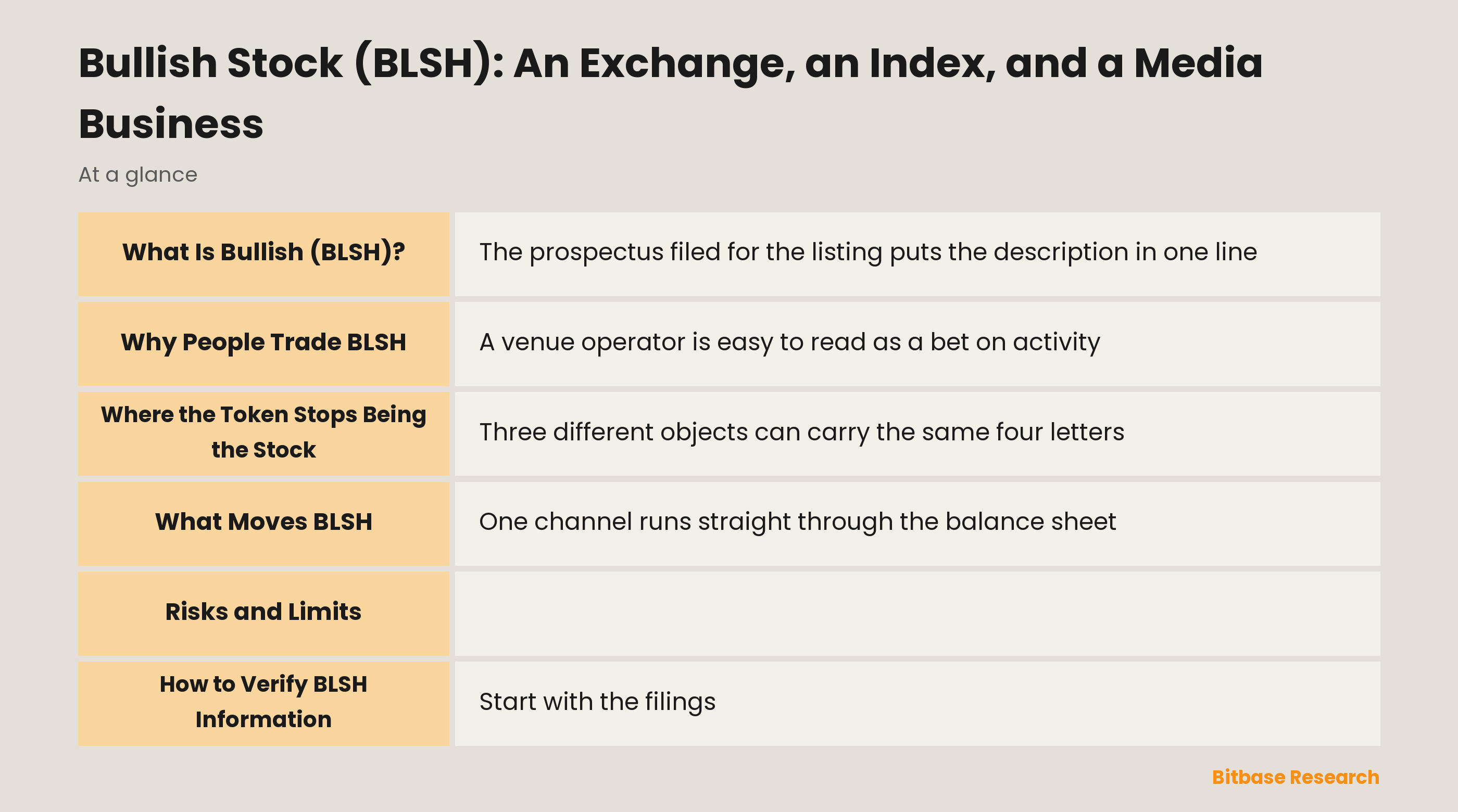
The prospectus filed for the listing puts the description in one line: "an institutionally focused global digital asset platform that provides market infrastructure and information services". The infrastructure half is Bullish Exchange, a regulated digital assets exchange business aimed at institutions. The information half is CoinDesk, acquired in 2023 and still run under its own name.
How the exchange is built decides how it earns. The prospectus describes it as integrating "a high-performance central limit order book matching engine with automated market making", so the venue does not only match orders that other firms bring to it. That shows up in how the business is paid: "The Exchange charges transaction and other service fees and earns spreads." A fee is billed for a service; a spread is what market making earns for standing on the other side of a trade, with the risk that comes with that seat.
CoinDesk itself is three businesses. CoinDesk Indices publishes benchmarks that track digital assets, and the prospectus says the company earns "licensing fees, which may be based on the licensee's AUM". CoinDesk Data sells market data and analytics on subscription and service fees. CoinDesk Insights is the media and events side, paid through advertising, sponsorship and event fees.
The legal shape is a holding company. The prospectus states that "Bullish is a Cayman Islands exempted company that acts as a holding company with operations primarily conducted through its subsidiaries in the Cayman Islands, Hong Kong, the United States, Singapore, the United Kingdom, Germany, and Gibraltar", and that its ordinary shares were approved for listing on the New York Stock Exchange under the symbol BLSH. There is one class of shares, and each ordinary share carries one vote.
The permissions live in those subsidiaries rather than in the parent: a virtual asset trading platform licence from Hong Kong's Securities and Futures Commission, crypto custody, proprietary trading and principal brokerage licences from Germany's BaFin, a distributed ledger technology licence from the Gibraltar Financial Services Commission, and money transmitter licences in several US states. CoinDesk Indices is separately regulated by the UK's Financial Conduct Authority as an authorised benchmark administrator.
Why People Trade BLSH
A venue operator is easy to read as a bet on activity: fees arrive when customers transact, whichever way the price went. Bullish is only partly that. It also holds digital assets on its own books, and its financial statements carry a line for the change in their fair value, so coin prices reach the reported result without passing through a single customer order.
That combination is what makes BLSH sit awkwardly among crypto-linked equities. Miners carry the coin price through what they produce, treasury companies through what they hold, fee businesses not at all. Bullish is a fee business with a digital asset balance sheet behind it, and the two halves answer to different questions.
The index business is a third reason, and it works through somebody else's balance sheet. When an outside manager licenses a CoinDesk benchmark, the fee can scale with that manager's assets under management, so inflows into a fund Bullish does not run still land in Bullish revenue. That is exposure to the digital asset fund industry rather than to trading on the company's own venue.
Where the Token Stops Being the Stock
Three different objects can carry the same four letters, and only the first of them is the company's share.
The share is an ordinary share, bought through a broker with access to the New York Stock Exchange. It is an ownership interest in a Cayman Islands exempted company, it carries one vote, and it brings whatever the company's constitution and the listing rules provide.
A tokenized stock is a token issued by a third party, and the third party is named on the page. The Bitbase price page for this ticker reads Bullish (Dinari Tokenized Stock), so the issuer here is Dinari, and Dinari's terms are Dinari's alone. Its documentation describes a dShare as a token backed one-for-one by a security, with tokens created or destroyed only after the corresponding brokerage order settles through its broker partner. Dividends are calculated and distributed once the cash arrives, with a floor below which nothing is paid out. The documentation also states that the tokens have not been registered under the US Securities Act and may not be offered or sold in the United States or to a US person. Trading is split into sessions instead of running continuously: regular US hours, pre-market, post-market and overnight sessions that accept limit orders only, and a round-the-clock session covering a limited set of tickers, where liquidity is thinner.
None of that carries over to another issuer. Two tokenized stocks sitting side by side can differ on backing, on how a dividend reaches the holder, on who may hold them, and on when they trade. The issuer named on the page is the part to read first.
A perpetual futures contract is the third object, and it holds nothing at all. It tracks a price with leverage, and the cost of holding a perpetual is a funding payment that keeps it near that price rather than anything the company distributes. It can also be liquidated. Which tickers carry a spot market or a perpetual is a property of the venue's lineup rather than of the company, and the TradFi listings page keeps that current.
What Moves BLSH
One channel runs straight through the balance sheet. Because the company holds digital assets and reports the change in their fair value, a period in which coin prices fall can subtract from results even if customers transacted more than ever, and the same line adds when prices rise. This is the part of BLSH that behaves like a coin position rather than like a business.
Volume and volatility drive the fee side, and direction does not: a violent week in either direction produces more transacting than a calm one, and transacting is what gets billed. The wrinkle specific to this venue is that quoting is part of the product. With automated market making integrated into the order book, revenue from spreads and revenue from fees are not independent of each other.
Assets under management at other firms feed the index line. A benchmark licence priced off a licensee's assets turns somebody else's fund flows into revenue here, on a schedule set by that fund's investors and by whatever regulators allow such funds to exist. An approval that lets a new digital asset fund launch in a large market is therefore a Bullish story as well as a fund story.
The data and events businesses run on a different clock. Subscription revenue is contracted rather than transacted, so it lags the trading cycle going up and going down, and conference revenue arrives when conferences do rather than when markets are busy.
The licence map is the map of the addressable market. Each permission held by a subsidiary defines which customers that entity may serve and with which products, so a new authorisation widens the business unevenly, and a rule change lands on the entity holding that licence rather than on the group at once.
Risks and Limits
Issuer risk is separate from company risk. Holding a tokenized stock exposes you to the issuer's structure, eligibility rules and redemption terms as well as to the company's business. Those terms sit in the issuer's documentation, a different document from anything the company or the venue publishes, and the issuer can change them.
Sessions do not line up. The primary listing trades during New York Stock Exchange hours. A token that trades outside those hours can move while the market setting the reference price is shut, and liquidity outside regular hours is thinner by construction. Sessions also differ by ticker for this issuer, so availability has to be checked for the ticker in front of you.
Leverage, where it applies. A perpetual holds no underlying asset, exchanges funding, and can be liquidated. Treating a share, a token and a contract as one position is how people end up with exposure they never intended.
The balance sheet cuts both ways. Digital assets held on the company's own books add to reported results when prices rise and subtract when they fall, and that swing is not something customer activity can offset.
The business itself. Institutional customers can move to another venue, licence conditions can be tightened, and a holding company spread across several jurisdictions depends on permissions it does not grant itself. Governance is simpler here than under a dual-class structure, since one share carries one vote, but a tokenized version of that share sits a step further away: it is governed by the issuer's terms, not by the company's constitution.
How to Verify BLSH Information
Start with the filings, because that is where the company is legally obliged to be accurate. As a foreign private issuer it files an annual report on Form 20-F and furnishes current reports on Form 6-K, rather than the Form 10-K and Form 10-Q of a US domestic filer; the registration statement on Form F-1 and the prospectus filed for the offering carry the business description, the licence list and the share capital. All of it sits on the SEC's EDGAR system under the registrant name, and the risk factor section shows which variables the company itself treats as material.
The investor relations pages carry results releases and the calendar of when they appear. That calendar is worth having for a foreign private issuer, because disclosure arrives less often and more of the year's repricing lands on fewer days.
For the token, go to the issuer. Dinari's documentation is the authority on backing, on how and when dividends are handled, on the trading sessions, and on who may hold the product. It answers questions the company's filings do not address at all.
For what exists on Bitbase under this ticker, the price page is the reference, and the lineup page shows which tickers carry a spot market or a perpetual.
Conclusion
BLSH is a share in a company that sells access to markets, publishes benchmarks other people trade against, and carries digital assets on its own books. Those three parts do not move together, which is what makes the ticker harder to summarise than a pure exchange or a pure media business. On Bitbase it appears as a tokenized stock issued by Dinari, giving economic exposure on that issuer's terms rather than a share and the vote attached to it. Knowing which object you hold comes before every other question.
Related market pages
Bitbase pages for the tokenized stocks named in this article:
- BLSH: View price
Related reading
Other Bitbase articles on this topic:
- ARKK Explained: What an Actively Managed ETF Actually Is
- BAC Stock Explained: Lending, Trading and the Token
- Bitdeer (BTDR): The Bitcoin Miner That Builds Its Own Chips
- Nasdaq-100 Futures and What NQ Settles Against
Disclaimer: This article is educational content from Bitbase Academy, provided for information only. It explains what a company or fund does and how the instruments referenced here differ from one another; it does not constitute investment, trading, tax, or financial advice, and it is neither a recommendation nor an endorsement of any security, token, or trading strategy. A tokenized stock is issued by a third party and is designed to give economic exposure to an underlying asset: it is not a share, it carries no shareholder rights, and it depends on the issuer's structure, eligibility rules, and redemption terms, which the issuer can change. Perpetual futures are leveraged derivatives that hold no underlying asset and can be liquidated, and trading hours, product availability, and eligibility differ by instrument and by jurisdiction and can change at any time. Written as of September 2026; verify everything yourself through company filings, the issuer's own documentation, and the product pages of the venue you trade on.
References
[1] Bullish prospectus filed with the SEC: business description, NYSE listing and symbol, Cayman Islands holding structure and subsidiaries, single share class, licences and revenue lines www.sec.gov
[2] Dinari documentation: what a tokenized share is, one-for-one backing, how tokens are created and redeemed, and who may hold them docs.dinari.com
[3] Dinari documentation on trading hours: regular, pre-market, post-market and overnight sessions, and the round-the-clock session that covers only some tickers docs.dinari.com