Bitdeer designs its own mining hardware, builds the data centres that house it, mines bitcoin with it, and sells the same machines to the operators it competes against. That last item separates BTDR from a pure hashrate company: a chip order book and a mining fleet answer to the same bitcoin price on different schedules, sometimes with opposite signs.
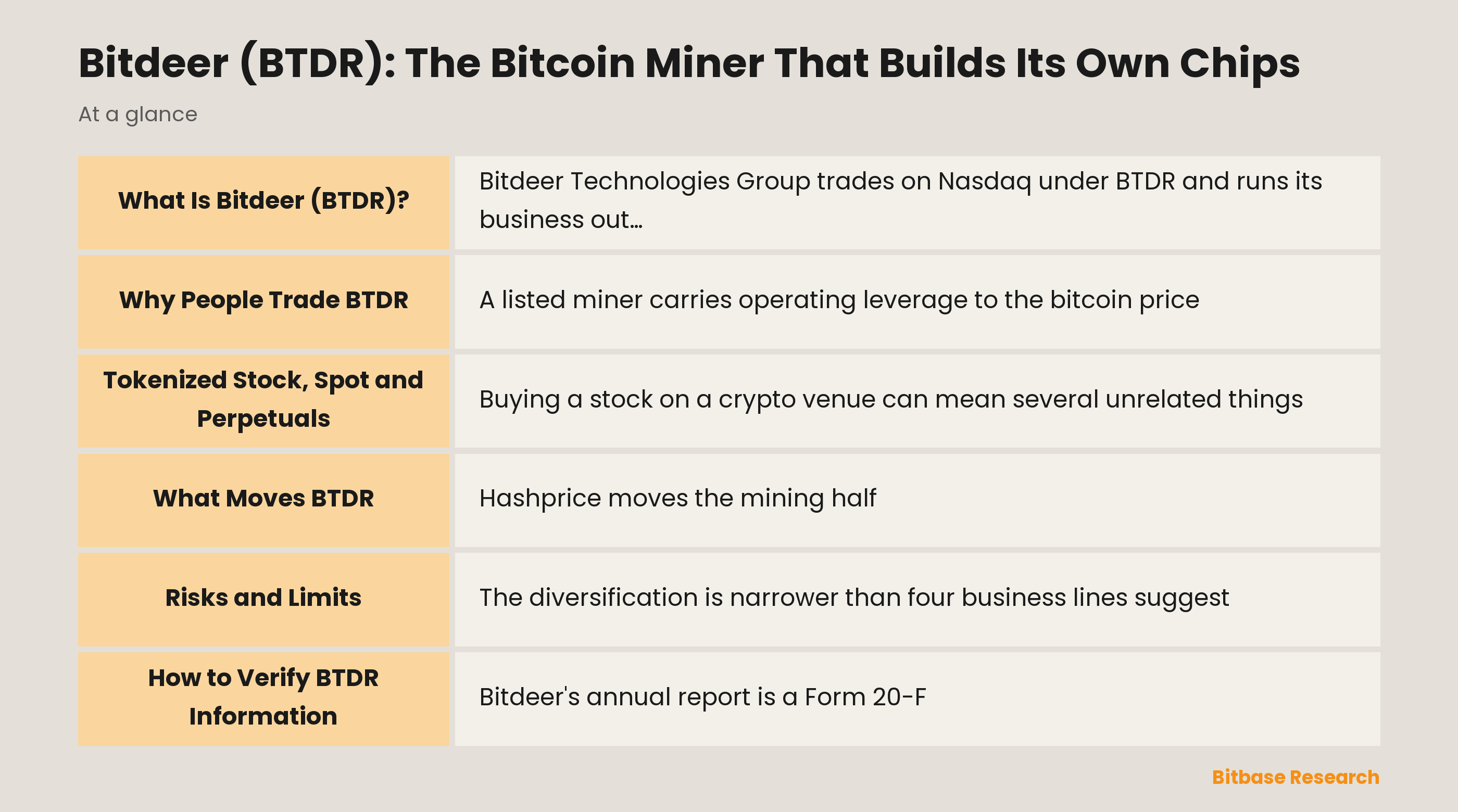
What Is Bitdeer (BTDR)?
Bitdeer Technologies Group trades on Nasdaq under BTDR and runs its business out of Singapore. It was spun out of the mining-hardware maker Bitmain and reached the public market through a merger with a special purpose acquisition company.
It calls its own structure vertical integration, and here the phrase is literal: chip design and manufacturing at one end, data centre construction in the middle, mining and cloud services at the other. That is four businesses with four sets of customers — a self-mining fleet whose output is bitcoin, the SEALMINER hardware line sold to other operators, hosted hashrate rented to people who want the output without the machines, and an AI cloud business selling compute from the same buildings, which sit in the United States, Canada, Norway and Bhutan.
One detail shapes what a reader can learn. Bitdeer is a foreign private issuer with the SEC: its annual report arrives on Form 20-F, interim material on Form 6-K, and there is no quarterly Form 10-Q.
Why People Trade BTDR
A listed miner carries operating leverage to the bitcoin price, and that is the first of three exposures bundled into this ticker. Costs are largely fixed in fiat while revenue is denominated in bitcoin, so the equity amplifies moves in the underlying both ways.
The second is easy to miss: part of BTDR is a chip company. Its hardware line is a product sold to other mining operators, and it runs on a semiconductor cadence of design cycles, foundry capacity and efficiency, not on the fleet's clock.
The third is optionality on something else. Powered and cooled data centre space is an input the artificial intelligence build-out competes for, and owning some of it is valued on a different basis from hashrate. None of that makes the stock cheap or dear. It means a buyer of the first exposure holds the other two as well.
Tokenized Stock, Spot and Perpetuals
Buying a stock on a crypto venue can mean several unrelated things. A share bought through a broker makes you a shareholder of the company; the other routes do not.
A tokenized stock is a token issued by a third party, and it is a category rather than a product. Issuers disagree on the basic questions. Some back each token one-for-one with the underlying security held in regulated custody. At least one explicitly does not: it states that one token does not necessarily represent the value of one share, because the token is built as a total return tracker with dividends reinvested net of withholding tax. At least one is not a token of a share at all but a derivative contract between holder and issuer, priced off the underlying without granting rights to it. Hours diverge too: continuous in one description, a weekday window in another.
Dividends have no general answer either: one issuer reinvests them into the token's value, another passes a cash amount to eligible holders, a third pays nothing below a minimum threshold. Some issuers state plainly that the token confers no shareholder rights; where an issuer says nothing, silence is not evidence either way. A token is not a share, and the issuer's documentation defines the instrument.
A perpetual futures contract is the third structure, and the simplest: it holds nothing — no share, no token, no claim on the company. It tracks a price, settles in stablecoin, charges or pays a periodic funding rate between longs and shorts, and can be liquidated.
Which tickers exist in which of these forms changes over time; the tokenized stock lineup is where to read it rather than infer it.
What Moves BTDR
Hashprice moves the mining half, and hashprice is not the bitcoin price. Revenue per unit of computing power is what the price leaves after network difficulty takes its share, and difficulty rises whenever competitors plug in more machines. Some of those machines are Bitdeer's: it earns a margin selling the hardware that compresses the margin of the fleet next door.
The chip roadmap moves the stock on days when bitcoin does nothing. Each hardware generation is a semiconductor product with a design cycle, a foundry allocation and an efficiency target. Arriving on schedule lifts the order book and lowers the fleet's cost base together; a slip does both in reverse.
The halving hits both halves at once, in opposite directions. Cutting the block subsidy compresses mining margin immediately, while the industry's response — retiring older machines for more efficient ones — is a demand event for the hardware line.
Power and jurisdiction are company-specific and invisible in crypto market data. Electricity price, curtailment rules and local policy toward large industrial loads differ across the countries it operates in, and a rule change in one of them is a company event no market-wide indicator shows.
Capital allocation is the last. Converting capacity from bitcoin mining to graphics processing for AI workloads removes hashrate and adds a contracted revenue stream, so each such announcement is also an argument about what kind of company this is.
Risks and Limits
The diversification is narrower than four business lines suggest: mining margin, hardware demand and hosting demand all depend on the same bitcoin cycle, so they are lagged versions of one exposure and they turn together.
Capital intensity is the second limit. Data centres and chip designs are paid for long before they earn, out of cash flow, debt or new shares, and shareholders carry that choice. The hardware line competes with entrenched incumbents, including the company it was separated from.
Disclosure cadence is a risk rather than a technicality. An annual 20-F plus discretionary 6-K reports is a thinner mandatory stream than quarterly reporting, so more of what a holder knows depends on what the company publishes and when.
The instruments add a layer of their own: a tokenized stock stacks the issuer's structure, eligibility rules and redemption terms on top of the company's risks, and the issuer sets those terms. A token trading outside the primary market's session can reprice while that market is shut. A perpetual adds funding cost that accrues whether or not the direction is right, and a liquidation price a scheduled company event can reach in one gap.
How to Verify BTDR Information
Bitdeer's annual report is a Form 20-F, filed with the SEC under Bitdeer Technologies Group and retrievable from the EDGAR database; interim disclosures are furnished on Form 6-K. The investor relations site carries the same material plus the updates published between filings.
Network-level facts do not come from the company. Difficulty, the block subsidy and the halving schedule are properties of the bitcoin network, readable from any full node.
For a tokenized instrument, the issuer's documentation is the authority on backing, hours, dividends, eligibility and redemption. For the products a trading venue offers, its own pages carry the quotes and the contract specifications. Both change, which is why they are checked rather than remembered.
Conclusion
BTDR is not a clean proxy for one thing. It is a mining fleet, a hardware vendor, a landlord for other people's computing, and a wager that the buildings may outlast the machines inside them. Which of those the trade is about, and by which route, is worth settling before the order.
Related reading
Other Bitbase articles on this topic:
- ARKK Explained: What an Actively Managed ETF Actually Is
- BAC Stock Explained: Lending, Trading and the Token
- Bullish Stock (BLSH): An Exchange, an Index, and a Media Business
- How to Buy and Trade NFLX: Netflix Without a Subscriber Count
Disclaimer: This article is educational content from Bitbase Academy, provided for information only. It explains what a company or fund does and how the instruments referenced here differ from one another; it does not constitute investment, trading, tax, or financial advice, and it is neither a recommendation nor an endorsement of any security, token, or trading strategy. A tokenized stock is issued by a third party and is designed to give economic exposure to an underlying asset: it is not a share, it carries no shareholder rights, and it depends on the issuer's structure, eligibility rules, and redemption terms, which the issuer can change. Perpetual futures are leveraged derivatives that hold no underlying asset and can be liquidated, and trading hours, product availability, and eligibility differ by instrument and by jurisdiction and can change at any time. Written as of September 2026; verify everything yourself through company filings, the issuer's own documentation, and the product pages of the venue you trade on.
References
[1] US Securities and Exchange Commission, EDGAR: Bitdeer Technologies Group filings (annual report on Form 20-F; no Form 10-K or 10-Q) www.sec.gov
[2] Bitdeer: company overview of its mining, data centre and AI cloud businesses www.bitdeer.com