A project moves to a new token contract, announces a swap window, and the window closes. Months later you open an old wallet and the legacy balance is still sitting in it. Whether that balance can still be converted is not one question with one answer. Three different things expire in a migration, each is enforced in a different place, and only one of them is enforced by code.
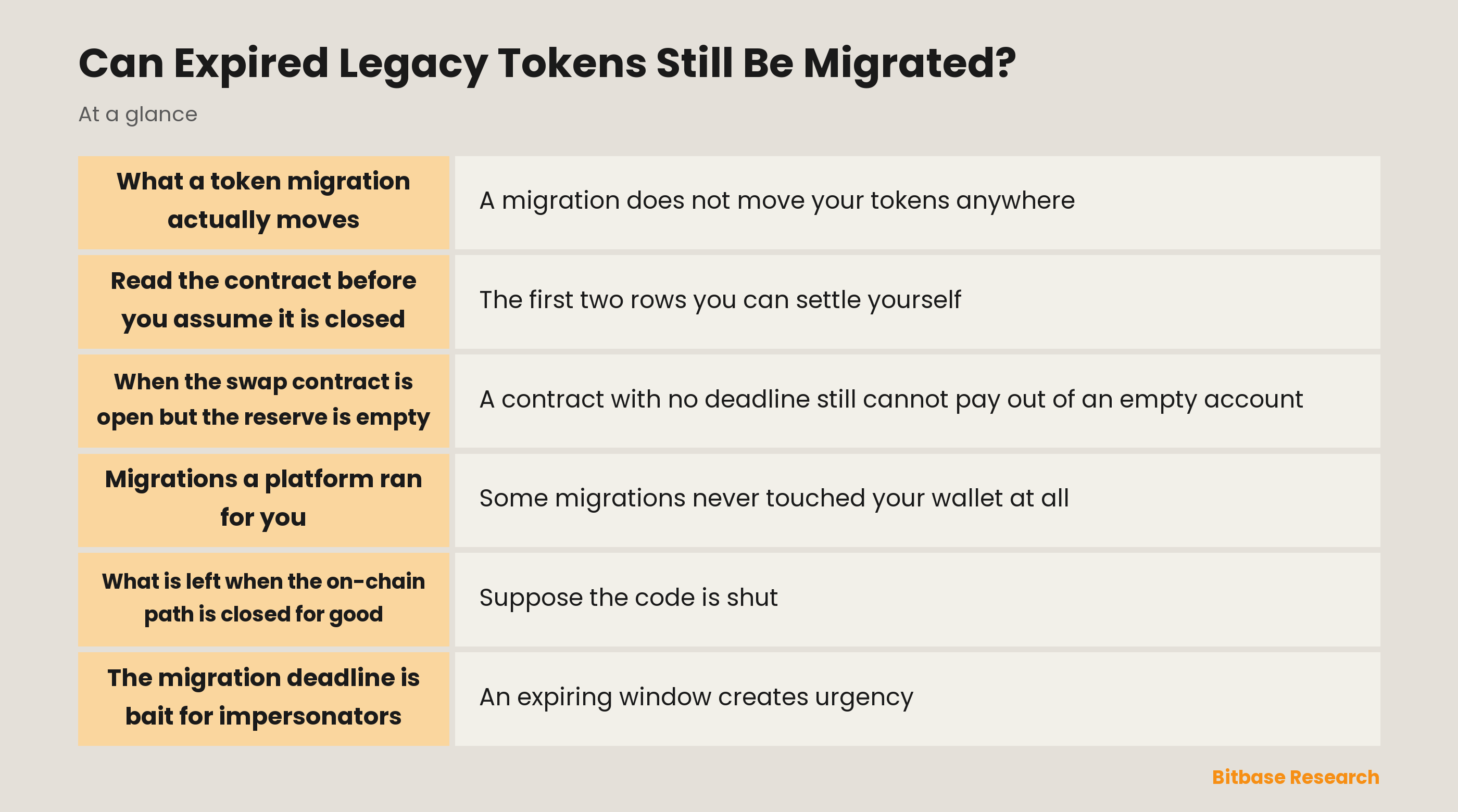
What a token migration actually moves
A migration does not move your tokens anywhere. The legacy contract keeps running at its own address, and your balance stays in its ledger for as long as the chain does. What a migration offers is an exchange: you hand old units to a swap contract or to a platform, and it credits you the equivalent claim in a new ledger.
That exchange runs on ordinary token plumbing. In the ERC-20 standard, `approve` allows a spender to withdraw from your account up to a set amount, and `transferFrom` moves tokens from one address to another; the standard presents the pair as a withdraw workflow that lets contracts transfer tokens on your behalf. A swap contract is one of those spenders, and the chain gives it no special status.
Two consequences follow. Your legacy balance does not decay or lapse on its own, and the deadline is never a property of the tokens you hold. The deadline belongs to whatever stands on the other side of the exchange, ready to pay out. So the question is not whether your tokens expired. It is what happened to the counterparty.
Three things can expire, and they are not the same thing
The word deadline is doing too much work in a typical migration announcement. Pull it apart and there are separate clocks, each enforced somewhere else.
The first is the announced date itself, a line in a blog post or a banner in an app. Nothing on chain reads it. The second is a check written into the swap contract, which refuses to run once the current block timestamp passes a value fixed in the code. The third is the reserve of new tokens the contract pays out of, which whoever funded it can withdraw once the project considers the migration finished.
| What expired | Where it is enforced | What reopening it would take |
|---|---|---|
| The announced date | Nowhere on chain | Nothing, because the contract never checked it |
| A timestamp check in the swap contract | The contract code | An upgrade path, if one was built in |
| The reserve of new tokens | An on-chain balance | Somebody refunding the contract |
| A migration desk at a platform | That platform's internal policy | A decision by that platform |
Everything below is how to work out which row you are in.
Read the contract before you assume it is closed
The first two rows you can settle yourself, for nothing. Open the swap contract on a block explorer and read its verified source. If the swap function contains no comparison against a block timestamp, there is no deadline in the code, and the announced date was only ever a communication. In that case a swap sent a year late runs exactly as one sent on the first day.
If there is a timestamp check, that is a different finding and a firm one. Contract code does what was written into it, and a condition that reverts after a set time will keep reverting. No support ticket changes that, because there is nobody in the loop to persuade: the refusal is a line of code executing as intended.
The one qualification is upgradeability. If the swap sits behind a proxy whose logic can be replaced, the deadline can in principle be lifted by whoever holds that power. That is a decision by the project rather than a right you hold, but it is the difference between a closed door and a sealed one, and reading the contract is how you tell the two apart.
When the swap contract is open but the reserve is empty
A contract with no deadline still cannot pay out of an empty account. The new tokens have to come from a reserve held at the swap address, and if the project wrote a function to sweep what is left once the window ends, it can empty that reserve. After that sweep, the swap function may still accept your legacy tokens and still fail, because the payment leg has nothing behind it.
Work an example. A project consolidates at one new unit for every ten legacy units, and a wallet holds 25,000 legacy units, so the claim is 2,500 new ones. Suppose 96% of the legacy supply came through during the window; the remaining 4% is what latecomers are claiming against, and whether the contract can still honour those claims is simply the new-token balance held at the swap address. That balance is public. Check it before you send anything.
This is the case that punishes optimism. Sending legacy tokens into a contract that cannot pay you back does not leave you where you started: the old units are gone into an address that was never written to hand them out again, and you hold nothing new. Read the reserve first, and if it is empty, do not send.
Migrations a platform ran for you
Some migrations never touched your wallet at all. If you held the legacy token on a centralised platform during the swap, the platform converted its own pooled balance and rewrote your account entry, so the migration showed up in your account as a ticker change and nothing else.
That path has its own clock, and it is a policy rather than a rule of the chain. A platform announces a conversion window, credits balances that arrive inside it, and at some point stops. The shape is familiar from token delisting: a notice, a window, and then closed access, with recovery afterwards depending on whether that firm still runs a manual process for stragglers.
So there are two questions here, not one, and they have different answers. Whether the platform will still credit a late deposit of legacy tokens is a support question. Whether the on-chain swap contract will still pay is a code question. Answer them separately, because a no from one says nothing about the other.
What is left when the on-chain path is closed for good
Suppose the code is shut, the reserve is swept, and no desk will process a late claim. The legacy token has not stopped existing. It is a balance in a contract that still runs, and it can still be transferred, so it can still be sold to anyone willing to buy it, at whatever the market for an abandoned ledger turns out to be.
Do not go looking for a workaround by sending the old units somewhere hopeful. Sending them to the new token contract, or to the legacy contract itself, is the same class of mistake as sending crypto to the wrong address: a contract has no private key, and unless someone wrote a function to move stray tokens back out, nobody can. The ERC-223 standard was written around exactly this failure, noting that tokens sent to a contract with a plain transfer arrive as a balance the contract never learns about.
The honest summary of this case is that the loss is already fixed in size, and every further transaction can only add to it. Holding the position costs nothing. Guessing at a rescue can cost the rest.
The migration deadline is bait for impersonators
An expiring window creates urgency, a supply of confused holders, and a legitimate reason for a project to ask people to connect a wallet. Attackers do not have to invent any of that. They only need a lookalike site. That is the shape of impersonation, and it is why a search result is the wrong way to reach a migration portal.
The mechanism a fake portal is after is the same one a real swap uses. A genuine migration asks for an allowance so the contract can pull your legacy tokens, and token approvals granted to an attacker do exactly what they say: they let that address take the balance you approved. Grant a limited allowance rather than an unlimited one, check the contract address against the project's own published announcement, and reach the site through your own bookmark.
One rule cuts through the whole category. Every fact you need in a late migration is readable on a public explorer for free: the contract source, the timestamp check, the reserve balance. Anyone charging a fee to reopen a closed migration, or asking for a recovery phrase to do it, is selling you the second loss rather than a fix for the first.
The bottom line
Legacy tokens do not expire. Counterparties do. An announced date binds nobody on chain, a timestamp check in the swap contract binds everybody including the project, and a swept reserve closes the door just as firmly while leaving the door handle in place. Those three cases look identical from a wallet screen and are completely different underneath.
The order of work is fixed. Read the swap contract on an explorer, look for a timestamp check, then read the reserve balance at that address, then ask the platform separately if a platform was involved. If all of those come back closed, the legacy balance is still yours and still transferable, and no amount of urgency should move you to send it somewhere that cannot send anything back. To keep learning the fundamentals, follow more from Bitbase Academy.
Related reading
Other Bitbase articles on this topic:
- How to Revoke a Governance Delegation
- Why a Token Migration Asks for a Wallet Approval
- Token Migration Completed but New Tokens Are Not in Your Wallet
- How to Calculate a Token Treasury Runway
- Coin-Margined vs USDT-Margined Futures: Which Contract to Trade
Disclaimer: This article is educational content from Bitbase Academy, provided for information only. It does not constitute investment, trading, tax, or financial advice. Crypto assets are volatile; assess your own risk. Written as of September 2026; refer to the latest official information.
References
[1] Ethereum Improvement Proposals, ERC-20: Token Standard, the approve and transferFrom methods (status: Final) eips.ethereum.org
[2] Ethereum Improvement Proposals, ERC-223: Token with transaction handling model, Motivation (status: Final) eips.ethereum.org