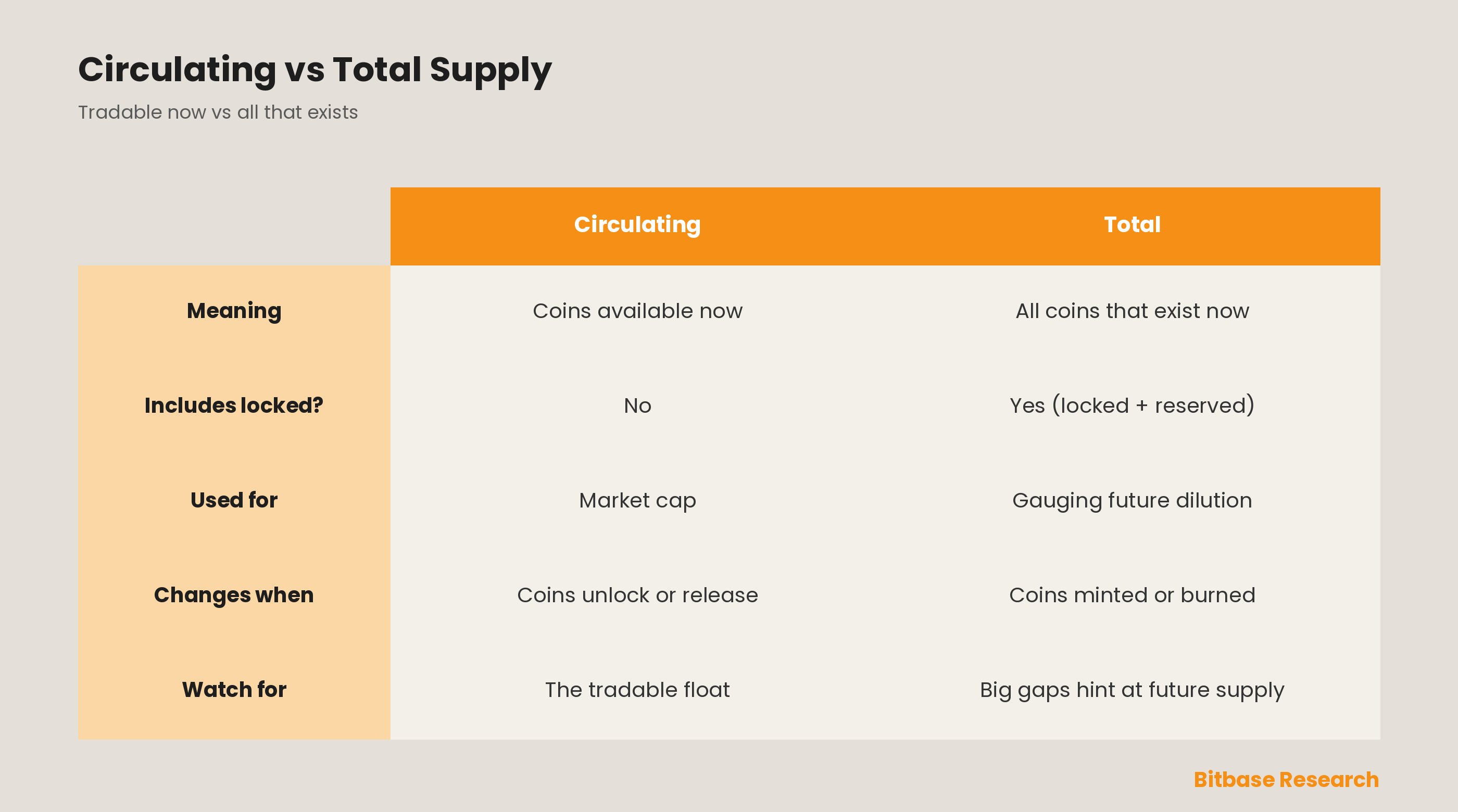
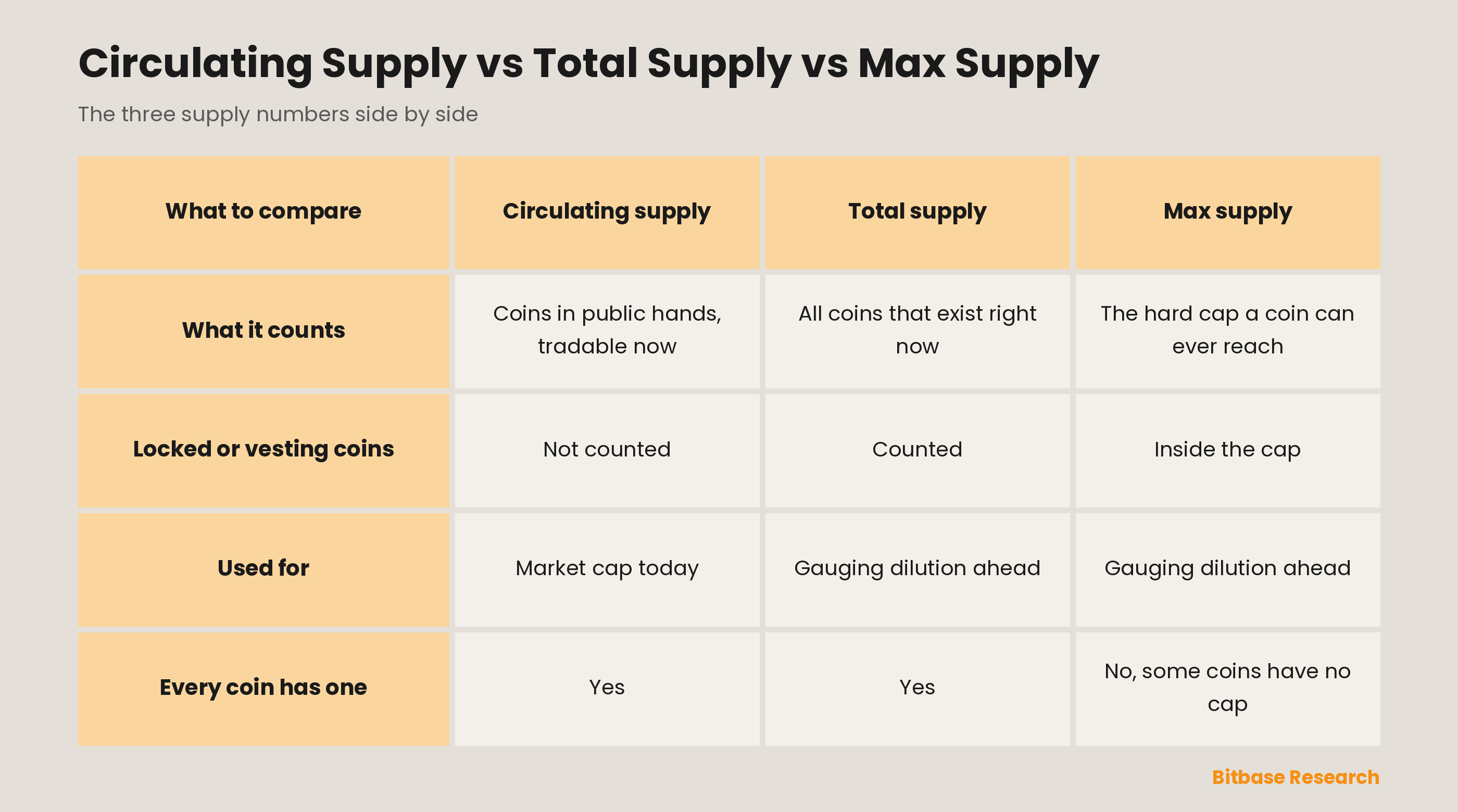
Circulating supply is the amount of a token currently available in the market. Total supply generally includes tokens that exist but may not be circulating, while max supply is the maximum number of tokens that can ever exist if the protocol defines a limit.
What each number means
Circulating supply counts the coins actually out in public hands and tradable — it's the figure used to calculate market cap [1]. Total supply counts all coins that currently exist, including tokens that are locked, reserved for the team, or vesting, but not coins that have been permanently burned. A separate figure, max supply, is the hard cap a coin can ever reach; some coins have one and others don't [2].
Reading the gap
The three supply numbers side by side
What Changes Token Supply?
Several things move a token's supply over time: scheduled unlocks that release locked coins, new issuance, burns that remove coins permanently, treasury releases, and protocol inflation built into the design.
Market Cap Example
If a token trades at $2 and has 100 million tokens in circulating supply:
Market Cap = $2 × 100,000,000 = $200 million
If the token has a maximum supply of 500 million, a simplified fully diluted valuation at the same price would be:
FDV = $2 × 500,000,000 = $1 billion
The bottom line
Circulating supply tells you what's tradable now; total supply tells you how much exists in all, including coins waiting to be released. A big gap between the two is a signal to look closer: if lots of locked tokens will unlock later, that future supply can dilute holders even if demand stays flat. Use circulating supply to judge market cap today, and the total or max to gauge possible dilution ahead. To keep learning the fundamentals, follow more from Bitbase Academy.
Frequently asked questions
Is total supply the same as max supply?
No. Total supply counts every coin that exists right now, including locked, reserved and vesting tokens but not coins that have been permanently burned. Max supply is the hard cap a coin can ever reach, and not every coin has one.
Does lower circulating supply mean a token is better?
No. The number of coins on its own says nothing about value: price multiplied by circulating supply is what gives market cap, and a small circulating supply can sit next to a much larger total supply that is still waiting to unlock. Read the two numbers together rather than either one alone.
Why can market cap rise after token unlocks?
Market cap is price multiplied by circulating supply, so releasing locked tokens raises the circulating figure and can push market cap up even when the price has not moved. It is the same arithmetic as the example above: at an unchanged price, more coins in circulation means a larger market cap and a smaller share of the total for existing holders.
What is the difference between market cap and FDV?
Market cap uses the circulating supply, while a fully diluted valuation uses the maximum supply. In the example above the same token at the same price is worth $200 million by market cap and $1 billion on a fully diluted basis, which is why the gap between the two is a quick way to see how much dilution is still ahead.
Related reading
Other Bitbase articles on this topic:
- Buyback, Burn, and Flow Signals
- Pre-Market Trading and Launch Valuation
- Token Fungibility and Standards
Disclaimer: This article is educational content from Bitbase Academy, provided for information only. It does not constitute investment, trading, tax, or financial advice. Crypto assets are volatile; assess your own risk. Written as of June 2026; refer to the latest official information.
References
[1] Coinbase, "What is market cap?" coinbase.com
[2] Kraken, "Circulating, total and max supply." kraken.com