Spending the bitcoin it mines is now part of how CleanSpark pays for itself: the company's latest annual report says it has begun to use a substantial portion of what it produces to fund operations and capital expenditures. The same filing calls the company a data center developer that was until recently focused exclusively on bitcoin mining. Both statements change what the ticker is a claim on, and on Bitbase those four letters appear as a Dinari tokenized stock, which is a different thing again.
What Is CleanSpark (CLSK)?
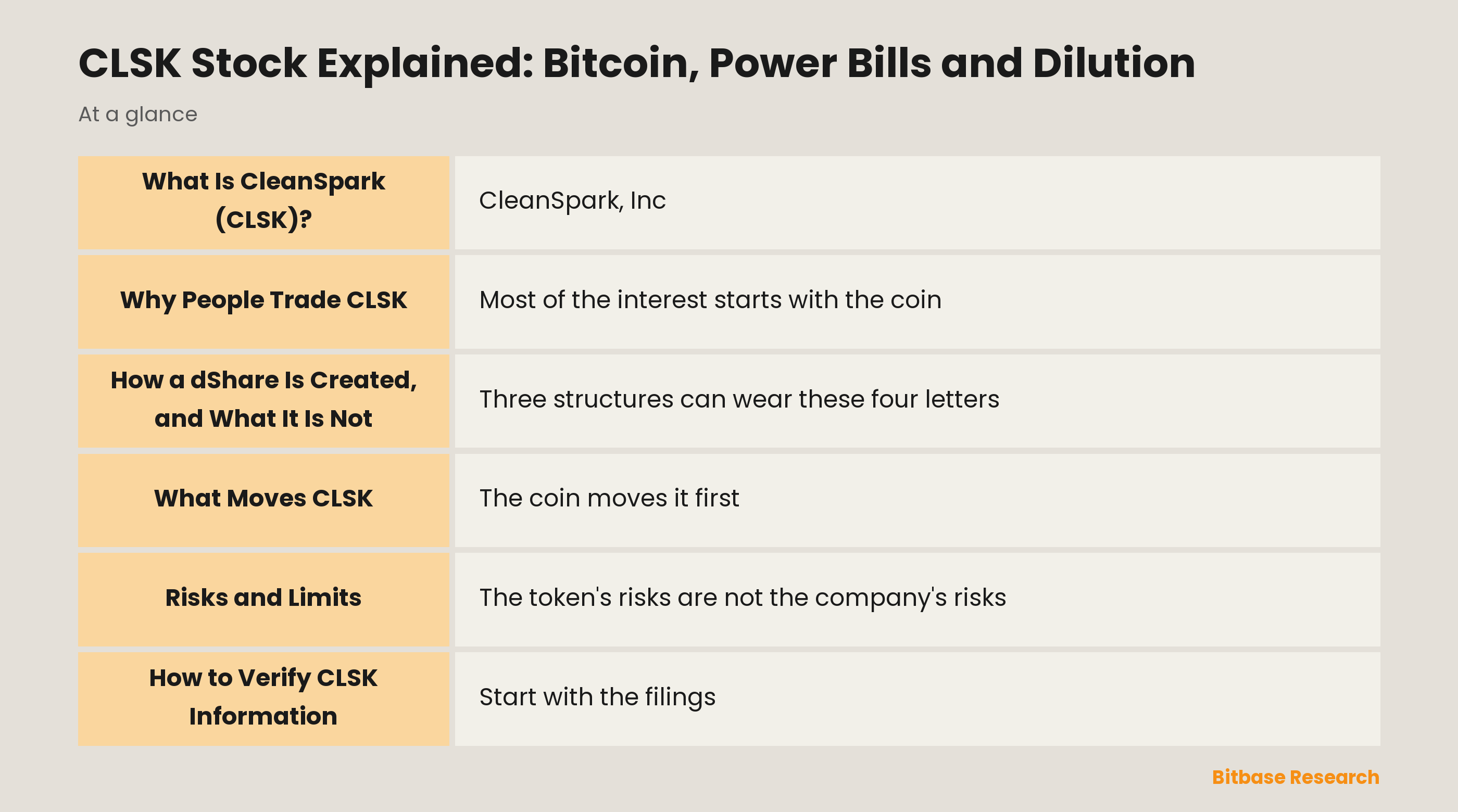
CleanSpark, Inc. is incorporated in Nevada and its shares trade on the Nasdaq Stock Market under the ticker CLSK. Its annual report calls the company a data center developer "until recently focused exclusively on bitcoin mining," and says mining "has historically been our principal revenue generating business activity."
What separates it from several companies it gets compared with is who runs the machines. CleanSpark says it owns and operates its own facilities and does not lease them to other mining companies or to individuals who mine. It mines for its own account, so the revenue line is the asset itself rather than rent paid by whoever mines it.
The sites are physical and unevenly spread. The most recent annual report places its data centers in Georgia, Tennessee, Mississippi and Wyoming, with Georgia carrying much the largest share of developed capacity, and a Texas site was acquired in October 2025. The power comes off the grid: the company says it purchases energy from the electrical grid and that its energy mix varies from period to period.
The newest piece is an intention rather than a business. CleanSpark says it has been actively pursuing opportunities to develop portions of its sites and power pipeline for AI and high-performance computing hosting and leasing, which is a claim about land and megawatts it already controls rather than a second revenue line that has arrived.
Why People Trade CLSK
Most of the interest starts with the coin. A company doing bitcoin mining for its own account earns in an asset whose price nobody at the company sets, which is why miner equities get bought as a way to hold that exposure inside an ordinary brokerage account. The proxy is imperfect in ways the asset is not: a miner can issue shares, lose a site, or watch its margin close from the electricity side while the coin does nothing at all.
The second argument has nothing to do with the coin. Energised sites, land and a power pipeline are scarce in their own right, and a company that controls them holds an option on whatever else wants to run there.
The third is the treasury question, which here has a documented answer. CleanSpark says it sells bitcoin from time to time to support operations and strategic growth, and that it has begun to use a substantial portion of what it mines to fund operations and capital expenditures. A holder is buying a producer that spends part of its production rather than a vehicle that accumulates it, and those are different positions even when the underlying asset is the same.
How a dShare Is Created, and What It Is Not
Three structures can wear these four letters, and they are made of different material.
A share is the registered instrument. Bought through a broker on Nasdaq, it makes you a shareholder of CleanSpark, Inc., with whatever that carries.
The Bitbase price page lists this company as a Dinari tokenized stock. Dinari calls its product a dShare and defines it as a token backed one for one by a security, commonly a US equity. The backing is not asserted after the fact: tokens are minted or burned only once the corresponding brokerage order has filled, with those orders routed through Alpaca, so the token supply is tied to completed orders in the underlying market. Backing describes what stands behind the token; what your position carries beyond that is written in the issuer's own documents rather than implied by the word "stock."
The trading calendar is where a dShare and a share come apart. Dinari runs several windows: the regular US session, pre-market and post-market windows that accept limit orders only, and an overnight window that also accepts limit orders only. A continuous window exists too, but the documentation confines it to a subset of tickers, describes it as on-chain, and notes that liquidity there is lower. A market order placed outside the regular session is converted into a marketable limit order, which may fill in full, in part, or not at all.
A perpetual futures contract is the third structure and it holds nothing: no share, no token, no claim on the company. It tracks a price with leverage, pays or receives funding between the two sides of the book, and can be liquidated. Issuers and instruments differ in exactly the places that decide what you are holding, so the answer for one name is not the answer for the next, and the tokenized stock listings page is where to look rather than assume.
What Moves CLSK
The coin moves it first, because the coin is the revenue. A self-mining operation turns electricity into an asset at a price nobody at the company controls, with no contracted rent underneath to smooth the result from one period to the next.
The halving is the scheduled shock in that revenue line. It cuts the per-block reward by 50%, and CleanSpark's own annual report attributes a fall in the number of coins it mined to the April 2024 halving rather than to anything that went wrong on its sites.
Electricity is the other half of the margin and runs on its own calendar. The company states that it has exposure to market fluctuations in energy prices through its power providers, so the spread between what it earns and what it pays can close from either end.
The share count is a driver here rather than a footnote. CleanSpark says it has financed its strategic growth primarily by issuing new shares of common stock, which dilutes the ownership interests of current stockholders. Capacity is built before it earns, so the money arrives ahead of the revenue, and the instrument that raises it is the one you are holding. Bitcoin spent on the business is capital that does not have to be raised that way, which is where the treasury policy meets the share count.
Anything concrete on the computing side would reprice a part of the company the coin does not reach. Until then the filings describe opportunities being pursued, so what is priced is a probability rather than a contract.
Finally, the labels on the calendar are offset. CleanSpark's fiscal year ends on September 30, so its annual report lands in late autumn and its first fiscal quarter is the stretch running from October to December. A miner that closes its books in December calls that same stretch its fourth quarter, so a quarter-to-quarter comparison between the two needs the dates checked before the numbers.
Risks and Limits
The token's risks are not the company's risks. A dShare depends on the issuer's structure and on terms the issuer sets and can change, and its creation and destruction depend on a brokerage rail behaving as documented. None of that is a claim on CleanSpark, and the questions it raises are answered in the issuer's documentation rather than on any venue's listing page.
Session structure creates gaps in both directions. The token's windows and the Nasdaq session are not the same clock, and outside the regular session the order types available are narrower, so news can be priced at a moment when your usual instructions are not accepted. The continuous window covers only part of the issuer's lineup and is described as the thinner one.
Perpetuals add a running cost and a forced exit. Funding accrues in whichever direction the crowd leans, so a position that is right about direction can still lose to it over time, and leverage shortens the distance to liquidation.
The company's own risks are concentrated and easy to name. One asset supplies most of the revenue and one input, electricity, supplies much of the cost at market prices. Developed capacity sits mostly in a single state, which concentrates weather, grid and permitting exposure. Growth has been financed primarily by issuing shares. And the computing ambition is, in the company's own words, an opportunity being pursued, which is not the same as a business being reported.
How to Verify CLSK Information
Start with the filings, because the sentences quoted above come from them. The annual report on Form 10-K carries the business description, the site list, the energy language and the risk factors; the reports filed between them carry the updates. Mind the timing: with a fiscal year ending on September 30, the annual report arrives in late autumn rather than in the spring where readers used to calendar-year filers go looking. The investor relations site carries the same documents alongside the releases that land between filings.
For the token, go to the issuer rather than the venue. Dinari's documentation is the authority on what a dShare is, how it is created and destroyed, and which sessions apply to which tickers. For the quote and the market data on this ticker, the Bitbase price page is the reference.
Conclusion
CLSK is a bitcoin miner that has begun describing itself more broadly, and both halves of that sentence carry weight. The mining produces the revenue today, which is why the coin, the power bill, the halving calendar and the share count explain most of what this stock does. The broader description is an option on land and megawatts that may or may not convert, and the filings rather than the language are where that gets settled. On Bitbase the ticker resolves to a Dinari tokenized stock, a token backed by a security and not the security itself.
Related market pages
Bitbase pages for the tokenized stocks named in this article:
- CLSK: View price
Related reading
Other Bitbase articles on this topic:
- ARKK Explained: What an Actively Managed ETF Actually Is
- BAC Stock Explained: Lending, Trading and the Token
- Bullish Stock (BLSH): An Exchange, an Index, and a Media Business
- How to Buy and Trade NVDA: Tokenized Stock, Spot and Perpetuals
Disclaimer: This article is educational content from Bitbase Academy, provided for information only. It explains what a company or fund does and how the instruments referenced here differ from one another; it does not constitute investment, trading, tax, or financial advice, and it is neither a recommendation nor an endorsement of any security, token, or trading strategy. A tokenized stock is issued by a third party and is designed to give economic exposure to an underlying asset: it is not a share, it carries no shareholder rights, and it depends on the issuer's structure, eligibility rules, and redemption terms, which the issuer can change. Perpetual futures are leveraged derivatives that hold no underlying asset and can be liquidated, and trading hours, product availability, and eligibility differ by instrument and by jurisdiction and can change at any time. Written as of September 2026; verify everything yourself through company filings, the issuer's own documentation, and the product pages of the venue you trade on.
References
[1] SEC EDGAR: CleanSpark annual filings, including the business description, the site list, the energy language, the halving and the share issuance quoted here www.sec.gov
[2] CleanSpark investor relations: the quarterly and annual reports plus the releases that land between filings investors.cleanspark.com
[3] Dinari documentation: what a dShare is, how it is minted and burned, and which sessions apply to which tickers docs.dinari.com