Two traders can open the same bet on the same coin at the same price and still get stopped out at different levels. The reason is not the trade — it is the contract. Crypto futures come in two settlement styles: coin-margined, also called inverse, and USDT-margined, also called linear. They differ in what you post as collateral, and that one difference quietly changes how much room your position has.
What settlement currency means
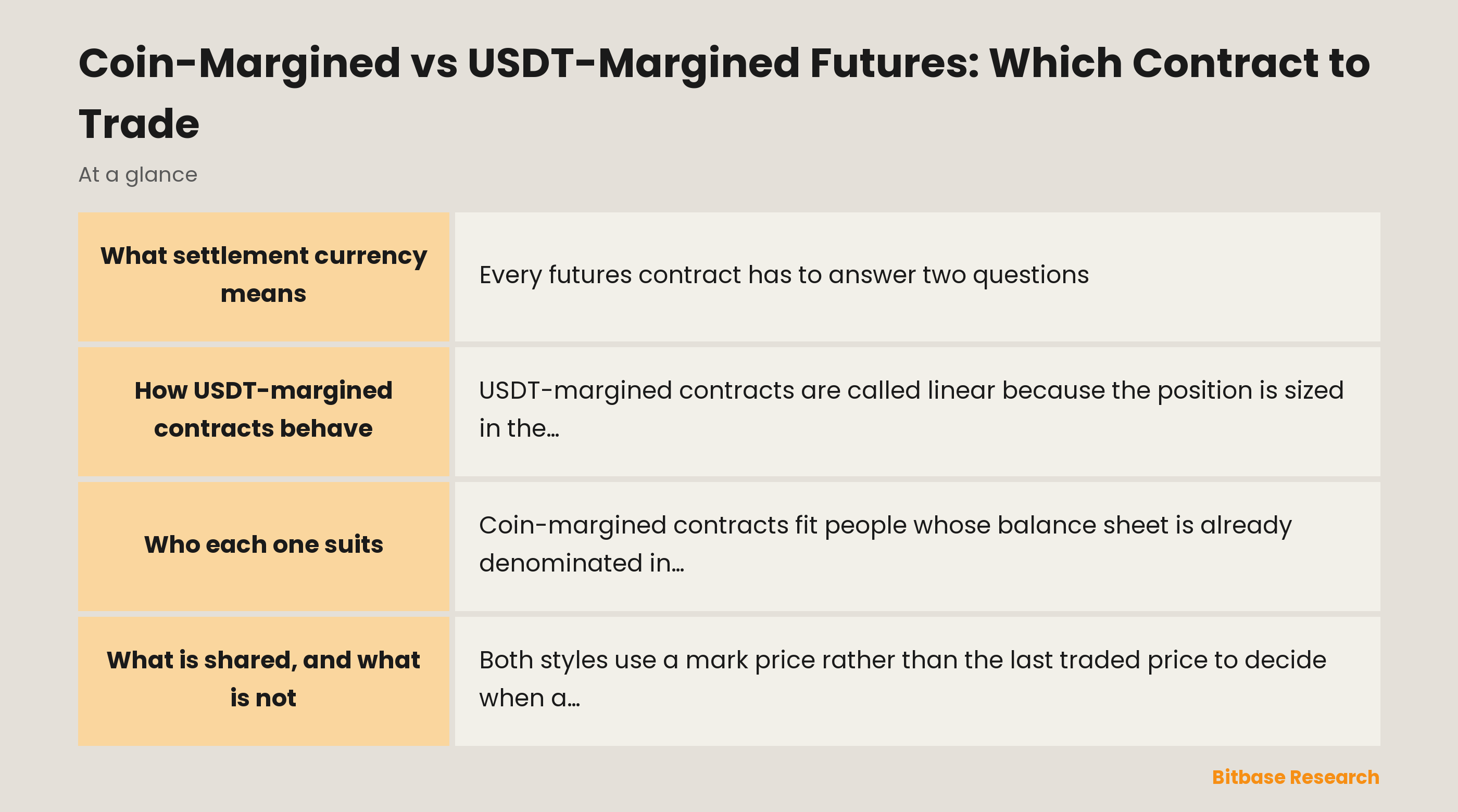
Every futures contract has to answer two questions: what you deposit to open the position, and what you receive when you close it. In a USDT-margined contract, both answers are a stablecoin. In a coin-margined contract, both answers are the crypto itself — you post BTC to trade a BTC contract, and your profit or loss arrives in BTC.
That sounds like a bookkeeping detail. It is not, because in a coin-margined contract your collateral is also the thing you are trading.
How USDT-margined contracts behave
USDT-margined contracts are called linear because the position is sized in the coin and settled in dollars, so your profit and loss reads directly in dollars. Post 1,000 USDT at ten times leverage and you control a 10,000 USDT position; a five percent move in your favour is 500 USDT — half your margin back, from a five percent move. That is what leverage does, and it is worth seeing the number before you use it.
The collateral is a stablecoin, so its value is designed to hold near a dollar while the trade is open. Your margin is a fixed quantity of dollars, and the only thing moving is the position.
How coin-margined contracts behave
Coin-margined contracts are called inverse because the position is sized in dollars and settled in the coin. Each contract is a fixed dollar amount, so the number of coins it is worth falls as the price rises and rises as the price falls.
The consequence that matters is not the payoff — measured in dollars, an equivalent position pays almost exactly the same as a linear one. It is the collateral. Your margin is denominated in the same asset you are trading, so its dollar value moves while the position is open, and it moves *with* the position.
For a long that removes room. As the price falls you lose coin, and the coin still backing the position is worth less, so the margin buffer shrinks at the same time the loss grows. For a short it adds room: as the price rises you lose coin, but the coin backing the position is worth more.
This is measurable, not a feeling. Same notional, same leverage, same 1% maintenance margin, a long gets liquidated on a smaller move:
| Leverage | Coin-margined long | USDT-margined long |
|---|---|---|
| 5x | 15.8% | 19.2% |
| 10x | 8.2% | 9.1% |
| 20x | 3.8% | 4.0% |
The gap is widest at low leverage — so the cautious setting is exactly where the two contracts differ most. The table holds the maintenance margin fixed on purpose, to isolate the contract type; in practice venues raise it as a position grows, which moves both columns but not the gap between them.
Side by side
| What differs | Coin-margined (inverse) | USDT-margined (linear) |
|---|---|---|
| Collateral you post | The coin itself, such as BTC or ETH | A stablecoin, such as USDT |
| Profit and loss paid in | The same coin | The stablecoin |
| Your collateral's dollar value | Moves with the market | Designed to hold near a dollar |
| Room before a long is liquidated | Smaller, because the collateral falls with the position | Larger, because the collateral stays put |
| Position size is quoted in | Dollars, while your margin sits in coin | Coin, while your margin sits in a stablecoin |
| Commonly suits | Holders and miners who count in coin | Most traders, and anyone starting out |
Who each one suits
Coin-margined contracts fit people whose balance sheet is already denominated in crypto. A miner earning BTC, or a long-term holder with no intention of selling, can hedge without converting to a stablecoin first, and the result accumulates in the asset they want to hold anyway. The tighter long liquidation is a real cost, and it is one they accept knowingly.
USDT-margined contracts fit almost everyone else. If you think about gains in dollars, want your margin to mean the same thing tomorrow as it does today, and do not want your collateral moving underneath the position, the linear contract does what you expect. It is also the safer place to learn, because one fewer thing is moving.
What is shared, and what is not
Both styles use a mark price rather than the last traded price to decide when a position is in trouble, so on either one you can be liquidated before the visible price reaches the level you had in mind. Both apply a funding rate on perpetual contracts — a periodic payment between longs and shorts that you pay or receive depending on which side the rate favours, settled in whatever the contract settles in. And both let you choose cross or isolated margin, a decision made independently of settlement currency.
What is not shared is how far the price can move before that mark price reaches you. As the table above shows, an equivalent long has less room on a coin-margined contract. Do not carry a liquidation estimate from one style over to the other.
The bottom line
The choice is about what your collateral is, not about which contract is better. USDT-margined contracts keep the margin still and the arithmetic in dollars, which is why most traders and nearly all beginners should start there. Coin-margined contracts are a tool for people who already hold the asset and want to stay in it — useful, but with a second moving part and less room on the long side.
Check which style a contract uses before you open it. The ticker is sometimes the clue — the two can differ by a single letter in an otherwise identical symbol — but naming is not standardised across venues, so a pattern you learned in one place can mislead you in another. If you are unsure, open the contract details and look at which asset the margin is denominated in — that is the answer, and it is never ambiguous. To keep learning the fundamentals, follow more from Bitbase Academy.
Related reading
Other Bitbase articles on this topic:
- What Is Margin Trading in Crypto? Borrowing to Trade Bigger
- Crypto Futures Risk Mechanics: Insurance Funds and ADL
- What Are Crypto Options? Calls, Puts, Strikes and Expiry
- Dormant Wallet Activated: What the Alert Actually Means
- Nonce Too High and Other Wallet Transaction Errors
Disclaimer: This article is educational content from Bitbase Academy, provided for information only. It does not constitute investment, trading, tax, or financial advice. Crypto assets are volatile; assess your own risk. Written as of September 2026; refer to the latest official information.
References
[1] He, Manela, Ross & von Wachter, "Fundamentals of Perpetual Futures" (arXiv:2212.06888) arxiv.org
[2] Alexander, Chen & Imeraj, "Inverse and Quanto Inverse Options in a Black-Scholes World" (arXiv:2107.12041) arxiv.org
[3] Deribit Insights, "Deribit Inverse Contracts: Calculating Profit in BTC and USD" insights.deribit.com
[4] Kraken, "Inverse Crypto-Collateral Perpetual Contract Specifications" support.kraken.com
[5] Kraken, "Liquidation FAQ (Derivatives)" support.kraken.com