A company account on a regulated exchange is not a personal signup with a company name typed into the box. The platform has to establish that the entity legally exists, that the natural persons behind it are identified, and that the value moving through the account has a traceable origin. That is three separate files rather than one, and it is why a corporate application is a document exercise rather than a form.
What a corporate account has to establish
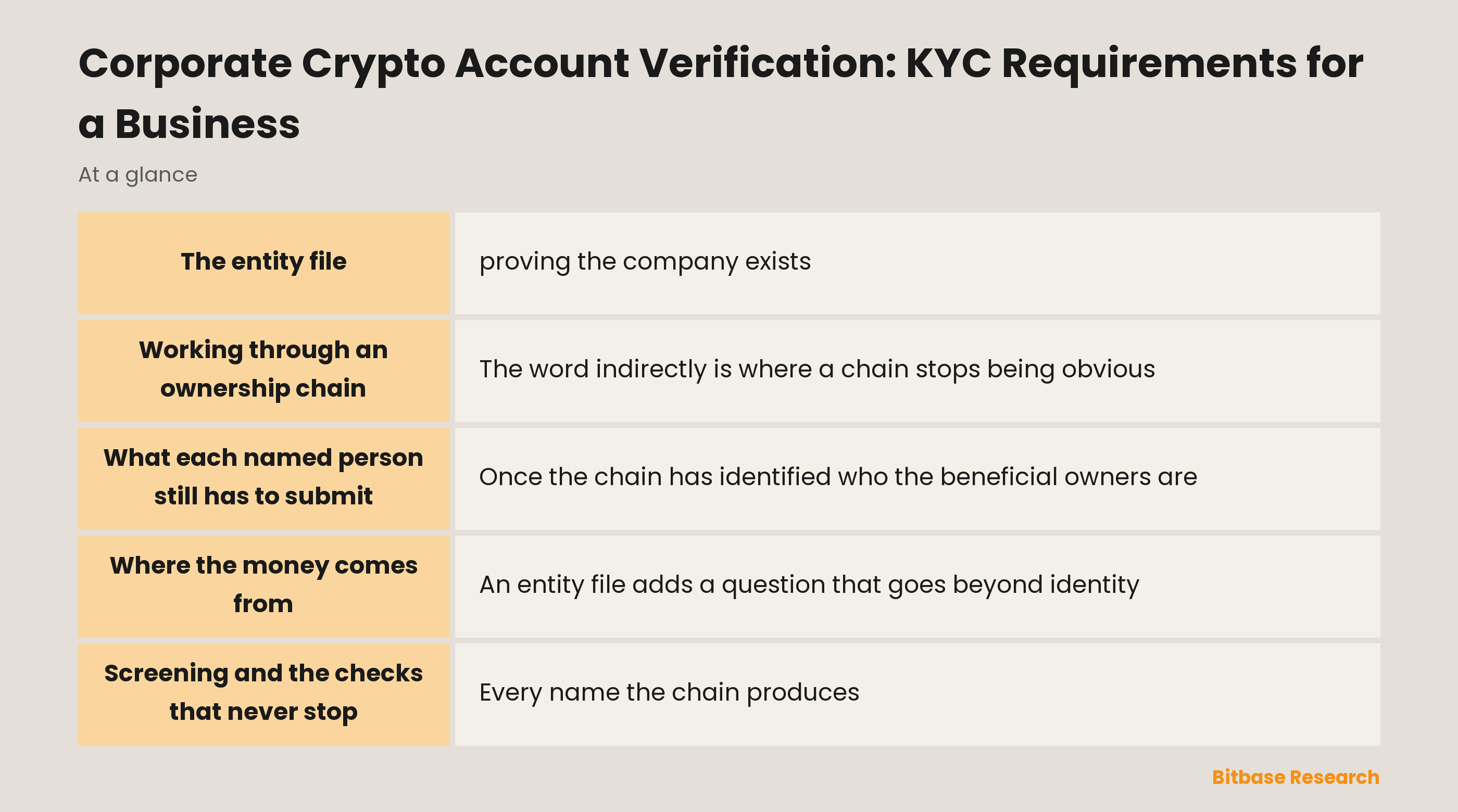
An individual signup answers one question: is this person who they say they are. A corporate application answers three, and each one can stall the file on its own. Does the entity exist and is it in good standing. Which natural persons own or control it. Where the funds it intends to trade with came from.
The file cannot stop at the company itself, because a company cannot be interviewed, cannot hold a passport, and can be owned by another company that is owned by a third. Rulebooks therefore look through the entity to the natural persons behind it. That look-through is the structural difference between individual and corporate KYC, and it is why a corporate pack asks for documents an individual applicant never sees.
It helps to read the request list as three layers rather than one long checklist. Each layer answers a different question, and a document that satisfies one layer often says nothing about the other two.
| Layer | What it establishes | Documents that speak to it |
|---|---|---|
| The entity | That the company exists and is in good standing | Certificate of incorporation, company register extract, articles of association |
| The people | Which natural persons own or control it | Ownership chart, register of members, board resolution |
| The money | Where the value comes from and where it is going | Financial statements, bank references, counterparty contracts |
The entity file: proving the company exists
The entity layer is the mechanical part of the file. A certificate of incorporation proves the company was formed; it does not prove the company is still active today. A register extract dated within a recent window does both, which is why the request is for a current extract rather than the founding document.
Articles of association matter for a different reason. They say who is authorised to bind the company, and that has to be settled before an application signed by any particular person can be accepted at all. A board resolution naming the person who may open and operate the account closes the same gap where the articles are silent.
Registered address, trading address, and tax residence are collected separately because they can legitimately differ, and the combination is what determines which rulebook applies to the account. An entity incorporated in one jurisdiction, managed from a second, and trading with counterparties in a third is assessed against the strictest of the three.
Who counts as a beneficial owner
A beneficial owner is the natural person standing at the end of the ownership chain. Rulebooks define the term through two separate tests, and one entity can trigger both.
Under the United States customer due diligence rule, the ownership test names each individual who, directly or indirectly, owns 25% or more of the equity interests of a legal entity customer. The control test names a single individual with significant responsibility to control, manage, or direct the entity, such as a chief executive officer, chief financial officer, managing member, general partner, or any other individual who regularly performs similar functions.
| Test | Who it names | What it looks at |
|---|---|---|
| Ownership | Each individual holding 25% or more of the equity interests | A share of equity, held directly or indirectly |
| Control | One individual with significant responsibility to control, manage, or direct the entity | A role, not a stake |
The two tests do not always name the same people, and that is the point of having two. A founder who has been diluted below the ownership threshold but still runs the company is caught by the control test. An investor who never attends a board meeting is caught by the ownership test. The regulatory figure is also a floor rather than a ceiling: guidance from the Financial Crimes Enforcement Network, which wrote that rule, states that a covered financial institution may choose to collect such information on natural persons who own a lower percentage of the equity interests, as well as information on more than one individual with managerial control.
Working through an ownership chain
The word indirectly is where a chain stops being obvious, so it is worth walking one from end to end.
Suppose the entity opening the account is owned 60% by a holding company and 20% each by two founders. Read one level deep, neither founder reaches the threshold and the holding company is not a natural person, so nobody is named at all. That reading is wrong, because the chain has not been followed to its end.
Follow it. An individual who owns 50% of the holding company owns 30% of the trading entity indirectly, because half of a 60% stake is 30%. That figure clears the threshold, so this person is a beneficial owner of the account even though the name appears nowhere on the trading entity's own register of members.
This is why the request is for an ownership chart rather than a shareholder list. A list shows one level. A chart shows the path, and the path is what the calculation runs along. Where a layer of the chain is a trust, a foundation, or a nominee arrangement, expect the request to widen again, because those structures need their own settlors, trustees, and beneficiaries identified before the chain can be closed.
What each named person still has to submit
Once the chain has identified who the beneficial owners are, each of them re-enters individual onboarding. The same guidance is specific about the elements: covered financial institutions must identify each beneficial owner by obtaining their name, date of birth, address, and identifying number, and verify their identities.
In practice that means every named individual goes through the same account verification steps a retail applicant does, including a government-issued identity document and, where the platform requires it, a liveness check. A corporate application is therefore not one verification but several running in parallel, and it completes only when the slowest of them completes.
The authorised operators of the account are a separate list again. The people who will actually log in, place orders, and request withdrawals have to be named, verified, and tied to a document that grants them that authority. Owners and operators can be the same people in a small company and entirely different people in a large one.
Where the money comes from
An entity file adds a question that goes beyond identity: the economic story behind the account. Source of funds concerns the immediate origin of the value about to be deposited, while the wider question concerns how the business came to hold assets at all.
For a company, the evidence is business evidence rather than personal evidence. Financial statements, an auditor's report, invoices, and contracts with named counterparties describe an operating history that a bank balance on its own does not. A newly formed entity has no such history to show, which is why a young company is asked instead about capital contributions and about the wealth of the people who made them.
Expected activity is collected at the same time and for the same reason. Declared volumes, funding currencies, counterparty types, and intended products give the monitoring system a baseline. Without a baseline, a later transaction is either unremarkable or alarming with nothing to compare it against.
Screening and the checks that never stop
Every name the chain produces, the entity itself included, is run through sanctions screening and against politically exposed person databases. A hit on a common name is a review trigger rather than a finding, and it is resolved by supplying the identifying details that separate one person from another.
Approval is not the end of the file. Ownership changes, directors resign, addresses move, and a structure that was accurate at onboarding stops being accurate without anyone at the platform being told. A corporate file is therefore refreshed rather than filed away, and a change in the ownership chart is a reportable event rather than an administrative detail.
That refresh cycle is where corporate accounts meet the account controls a regulated platform runs. A file that has gone stale, a deposit from an unexpected counterparty, or a beneficial owner who now appears on a list can put a company account under review exactly as it would an individual one.
The bottom line
Corporate onboarding asks three questions where retail onboarding asks one: does the entity exist, who stands behind it, and where does its money come from. The ownership and control tests decide which individuals have to be named, and the ownership test follows equity through holding companies rather than stopping at the first register. Each named person then completes individual verification, so the corporate file closes only when the last individual file does.
Prepare it in that order. Current register documents first, then a complete ownership chart down to natural persons, then identity documents for everyone the chart names, then the financial evidence behind the funding. To keep learning the fundamentals, follow more from Bitbase Academy.
Related reading
Other Bitbase articles on this topic:
- Crypto Dust Conversion and the Records It Leaves
- Missed the Withdrawal Deadline on a Delisted Token
- How to Appeal a Crypto Exchange Account Restriction
- How Funding Payments Affect Your Profit and Loss on a Perpetual
- Prediction Markets versus the Alternatives
Disclaimer: This article is educational content from Bitbase Academy, provided for information only. It does not constitute investment, trading, tax, or financial advice. Crypto assets are volatile; assess your own risk. Written as of September 2026; refer to the latest official information.
References
[1] 31 CFR § 1010.230, Beneficial ownership requirements for legal entity customers (Legal Information Institute, Cornell Law School) law.cornell.edu
[2] Financial Crimes Enforcement Network, FIN-2018-G001, Frequently Asked Questions Regarding Customer Due Diligence Requirements for Financial Institutions, issued April 3, 2018 fincen.gov