
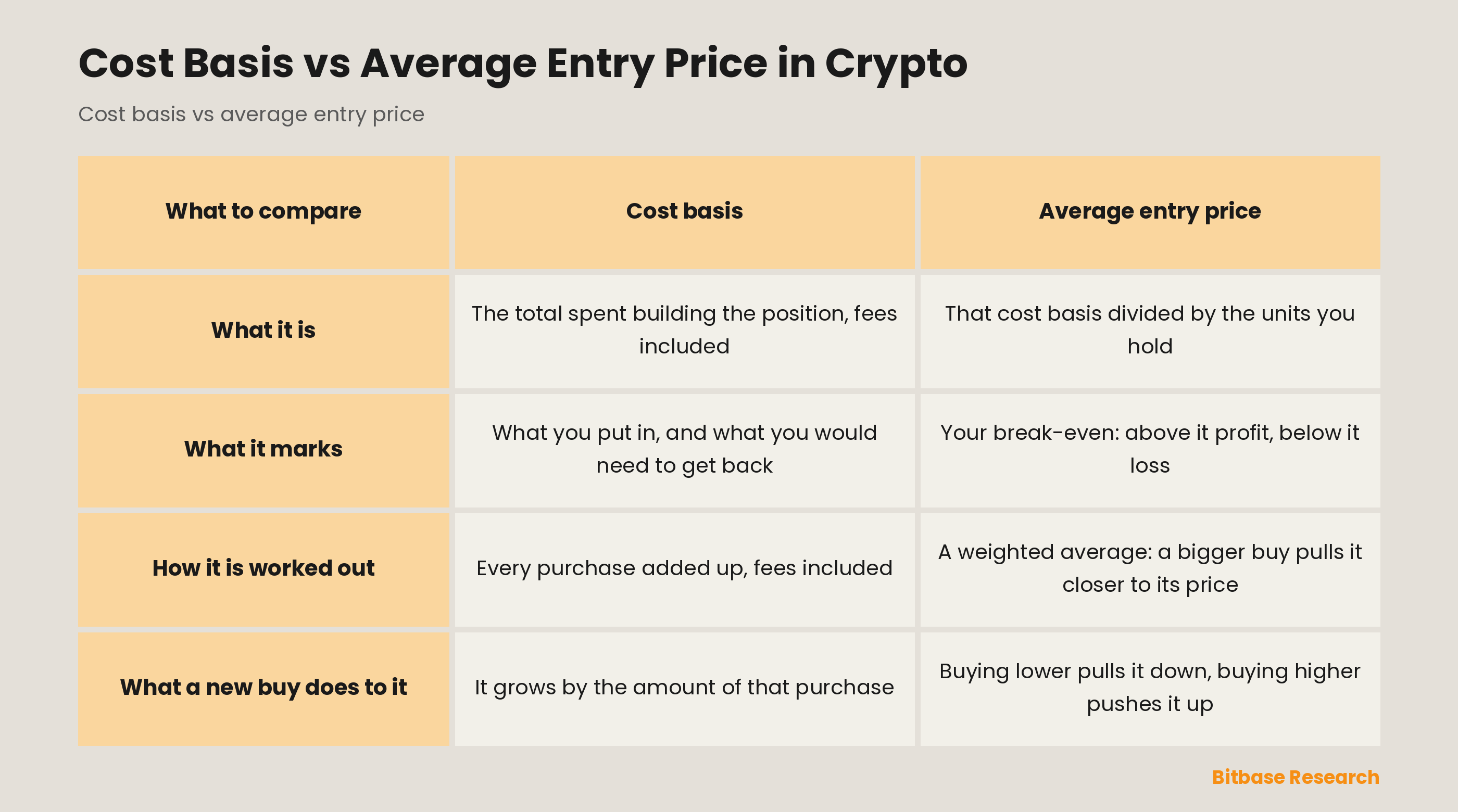
Average entry price is the weighted average price paid to build a position, while cost basis is the total amount spent building it, fees included. Average entry is that cost basis divided by the number of units held, which is why it also marks the break-even price of the position.
What cost basis and average entry are
Your cost basis for a position is the total amount you spent to build it, adding up every purchase including fees. Your average entry price is that total cost basis divided by the total number of units you hold. It answers a simple question: on average, what did each unit cost me? Even if you bought at many different prices, the average entry collapses them into one figure that represents your overall entry into the position.
Why it is a weighted average
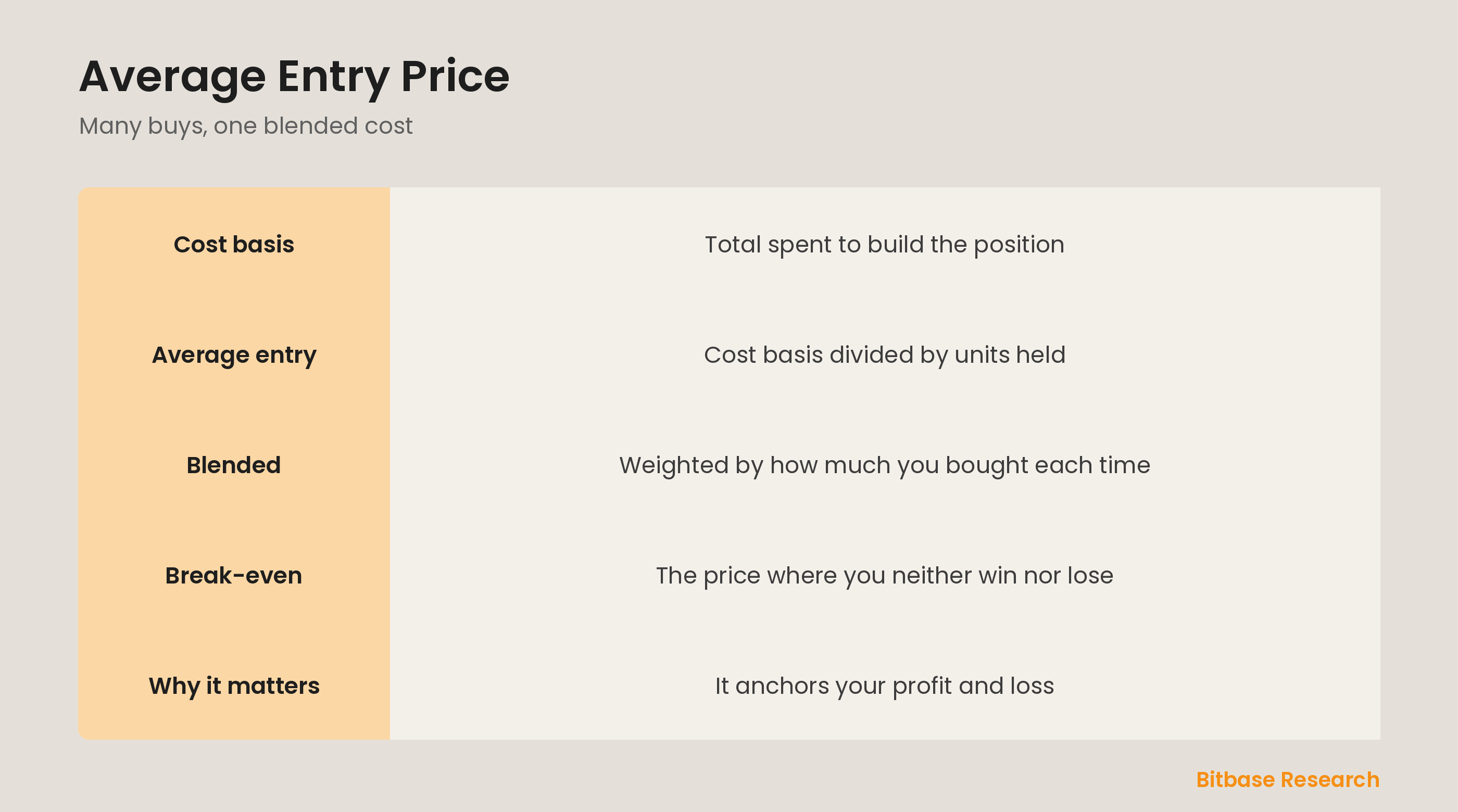
The average entry is a weighted average, not a simple one, because it accounts for how much you bought at each price. If you buy a large amount at one price and a small amount at another, the large purchase pulls the average closer to its price. So it is not just the midpoint of the prices you paid; it is weighted by the size of each buy. This is why buying more at lower prices lowers your average more than a small purchase would.
Break-even and profit
Your average entry price is your break-even point: the price at which selling would return exactly what you put in, no profit and no loss. Above it, the position is in profit; below it, in loss. This makes the average entry the single most important reference for the position, since every gain or loss is measured from it. Knowing your break-even also helps you set targets and judge whether the position is currently working.
How adding to a position changes it
Each new purchase changes your average entry. Buying more at a price below your current average pulls the average down, a practice often called averaging down, which lowers your break-even but increases your position and risk. Buying more at a higher price raises your average, averaging up. Understanding this lets you see exactly how a new buy will shift your break-even before you make it, which is essential for managing a position deliberately rather than by feel.
A weighted average entry price example
Say you buy three units at $40,000 and later one more at $65,000. Your cost basis is $185,000 across four units, so your average entry price — and your break-even — is $185,000 ÷ 4 = $46,250, not the $52,500 midpoint of the two prices, because three of the four units were bought at the lower one.
How fees affect the result
If trading fees are included in your cost basis, the effective cost of the position is higher than the purchase price shown on the order. That is exactly why the cost basis is defined as the total you spent building the position, every purchase and its fees added up, rather than as the prices you see on the chart.
Cost basis vs average entry price
The bottom line
Your cost basis is the total you spent building a position, and your average entry price is that cost basis divided by the units you hold, a weighted average that accounts for how much you bought at each price. This average is your break-even: above it you are in profit, below it in loss. Every new purchase shifts it, so knowing your average entry is essential for tracking profit and managing a position deliberately. To keep learning the fundamentals, follow more from Bitbase Academy.
Frequently asked questions
Is cost basis the same as average entry price?
Cost basis and average entry price are two views of one position, not the same number. The cost basis is the total amount you spent building the position, fees included, while the average entry price is that total divided by the number of units you hold. Dividing by your units is what turns the total into a per-unit figure, and that figure is your break-even.
How do I calculate average entry price after buying more?
Add the new purchase to your cost basis and the new units to your unit count, then divide again. Buying below your current average pulls the average down and lowers your break-even, while buying above it raises both, so you can work out where a new buy would leave your break-even before you place it.
Are trading fees included in cost basis?
Trading fees belong in the cost basis, because the cost basis is the total amount you actually spent building the position. Counting them makes the effective cost higher than the purchase price shown on the order, and different exchanges may calculate and display the average entry price differently, so check what your platform includes.
Related reading
Other Bitbase articles on this topic:
- Crypto Scalping Strategies and Indicators Explained
- Grid Trading Strategy Explained
- Backtesting Crypto Trading: Test a Strategy on the Past
Disclaimer: This article is educational content from Bitbase Academy, provided for information only. It does not constitute investment, trading, tax, or financial advice. Crypto assets are volatile; assess your own risk. Written as of June 2026; refer to the latest official information.
References
[1] Investopedia, "Cost Basis: Definition, Formula, and Example" investopedia.com
[2] Investopedia, "Capital Gain: Definition, How It Works, and Taxation" investopedia.com
[3] Investopedia, "Unrealized Gain: Definition, How It Works, and Example" investopedia.com