
A dozen tiny balances become one token, the balance screen finally looks tidy, and the accounting behind that one click is not tidy at all. A dust conversion is not a cleanup operation. It is a batch of disposals and one acquisition, and every leg of it has to survive into your records. Here is what the operation actually does, which record it lands in, and what to capture before you press the button.
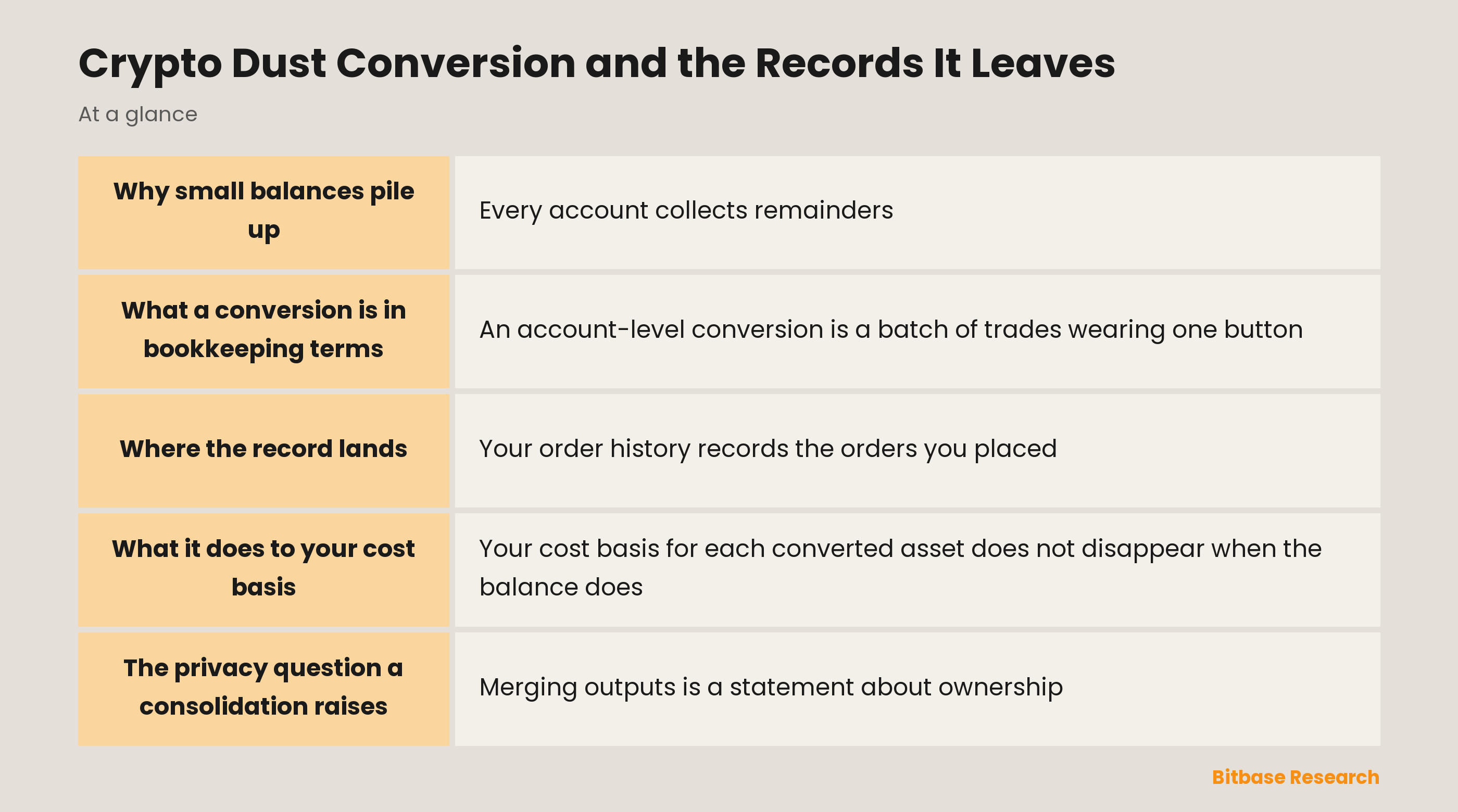
Why small balances pile up
Every account collects remainders. A partial fill leaves a fraction of the asset you were buying, a staking reward arrives in an amount too small to trade, an airdrop drops a speck of a token you never asked for, and change from an on-chain payment comes back as an output smaller than the fee needed to move it. None of these is a mistake. They are the arithmetic residue of ordinary activity.
What turns a remainder into dust is the cost of moving it. Bitcoin Core defines the threshold in terms of a relay fee rate rather than as a fixed amount: an output counts as dust when spending it would cost more in fees than the output is worth. The line is therefore a moving one, and it moves against you when fees rise.
Inside an exchange account the mechanism differs but the outcome rhymes. There is no unspent output to spend, only a ledger row, and the row is stuck because it falls under the minimum order size for every pair that asset trades in. It is not uneconomical to move; it is ineligible to trade. Both kinds of leftover end up in the same place, which is a list of balances you can do nothing with one at a time.
Two operations both called converting dust
The first is on-chain consolidation. You spend many small outputs in a single transaction and send the total to one address you control. There is a real transaction, a real network fee, and a transaction hash that anyone can look up. Nothing is exchanged: you hold the same asset afterwards, in fewer and larger pieces.
The second is an account-level conversion. The venue takes small balances sitting in your account and credits you one nominated asset in exchange, without touching a blockchain at all. Several assets go in, one comes back, and the movement exists only in the venue's internal ledger.
The two are not variants of one feature, and which one you did decides what evidence exists afterwards.
| What differs | On-chain consolidation | Account-level conversion |
|---|---|---|
| What moves | The same asset, into fewer outputs | Several assets out, one asset back |
| Where it happens | On the chain, in a broadcast transaction | In the venue ledger, off chain |
| What it costs | A network fee | A conversion fee set by the venue |
| Public evidence | A transaction hash and its inputs | None, only your account records |
| Does the asset change | No | Yes |
What a conversion is in bookkeeping terms
An account-level conversion is a batch of trades wearing one button. Each small balance is disposed of, one asset is acquired, and a fee is charged somewhere in the middle. That is the shape your records have to reproduce, however few lines the interface chooses to show you.
The arithmetic is small but not trivial. Say three leftovers are worth 4.20 USDT, 1.50 USDT, and 0.30 USDT at the moment you convert, for a total of 6.00 USDT. Put the conversion fee at 5% for this example and you receive 5.70 USDT. One click, three disposals, one acquisition, one fee, and several amounts that all have to stay attributable afterwards.
Whether that batch is a taxable event depends on where you file, and this is education rather than tax advice. The framing worth knowing is that swapping one asset for another can itself be a disposal: the United States tax agency treats digital assets as property rather than currency, lists exchanging one digital asset for another among the dispositions you report, and asks you to keep records of every purchase, receipt, sale, exchange, or other disposition. Nothing there carves out an exemption for amounts that are merely small.
Where the record lands
Your order history records the orders you placed, and your trade history records what executed. A conversion is neither of those things: you placed no order, and there may be no matched trade in the ordinary sense. The first thing to establish is which record type your venue files it under, because a line you cannot find is a line your accounting will silently miss.
The second thing to establish is granularity. One conversion can be written as a single summary row or as one row per asset disposed of. A summary row is easier to read and harder to use, because it collapses several separate disposals, each with its own acquisition date and its own basis, into one figure. If only the summary exists, the per-asset detail has to come from somewhere else or be reconstructed.
An on-chain consolidation has the opposite shape. The evidence is public and permanent: one transaction hash, many inputs, one output. But a consolidation moves value between addresses you control, so nothing is exchanged and no gain is realised. What matters in the record there is the network fee you paid and the fact that the outputs are now merged.
What it does to your cost basis
Your cost basis for each converted asset does not disappear when the balance does. Each leg closes a position that had a basis, and the asset you receive opens one at the value credited to you. If the three leftovers above cost 9.00 USDT to acquire in the first place, converting them for 5.70 USDT realises a loss of 3.30 USDT spread across three separate disposals.
That figure is only recoverable if the acquisition side was recorded. Those leftovers came from rewards, refunds, partial fills and airdrops, and such credits arrive without an order to attach them to, so by the time they are converted the original amounts may sit several exports back in a history that only reaches so far.
Precision is the other trap. Small balances carry many decimal places and record exports round. A rounded basis on an amount worth a fraction of a unit produces an error you will not notice on its own and cannot reconcile in aggregate. Take the export at full precision where the venue offers the choice.
The privacy question a consolidation raises
Merging outputs is a statement about ownership. Every input in a consolidating transaction is being spent by the same key holder, and that link is precisely what a dusting attack is set up to obtain. If unexpected dust arrived from a source you cannot account for, sweeping it together with the rest of your coins does the sender's work for them.
An account-level conversion broadcasts nothing, so it creates no such on-chain link. It creates a different kind of irreversibility instead: the small balances are gone, the asset you received is fungible with everything else in that balance, and the operation cannot be run backwards to find out what went into it. Whatever you failed to record before converting is not recoverable after.
What to capture before you convert
Export first, convert second. The record you want exists in full before the operation and in summary afterwards, so the cheap version of this is one export taken while the balances are still itemised.
| What to capture | Why it matters |
|---|---|
| Each balance and its amount at full precision | The disposal side of every leg |
| The value of each balance at the moment of conversion | The proceeds attributed to that leg |
| How each balance was acquired, and when | The basis and the holding period |
| The fee, and which asset it was charged in | It changes what you actually received |
| The identifier the venue assigns the operation | The one handle that ties the legs together |
One more thing is worth checking before rather than after: whether the venue lets you exclude an asset from the batch. A conversion that sweeps every small balance will also sweep the unexpected dust you were deliberately leaving alone, and the decision to leave that balance untouched is worth more than the fraction of value it would have added.
The bottom line
A dust conversion trades a tidy balance screen for a record that is harder to reconstruct than the mess it replaced. On chain it is a consolidation: the same asset, fewer outputs, a network fee, and a public link between addresses you control. In an account it is a batch of disposals and one acquisition, priced at the moment you press the button and charged a fee.
Decide which of the two you are doing, find out which record it lands in and at what granularity, and export the itemised balances while they are still itemised. The amounts involved are small, and the work of reconstructing them afterwards is not proportional to that. To keep learning the fundamentals, follow more from Bitbase Academy.
Related reading
Other Bitbase articles on this topic:
- Corporate Crypto Account Verification: KYC Requirements for a Business
- Missed the Withdrawal Deadline on a Delisted Token
- How to Appeal a Crypto Exchange Account Restriction
- How to Switch RPC Endpoints Safely
- Trends, Ranges, and Breakouts
Disclaimer: This article is educational content from Bitbase Academy, provided for information only. It does not constitute investment, trading, tax, or financial advice. Crypto assets are volatile; assess your own risk. Written as of September 2026; refer to the latest official information.
References
[1] Bitcoin Core source, src/policy/policy.cpp at tag v28.0, GetDustThreshold github.com
[2] Internal Revenue Service, Digital assets irs.gov