Buying a share in a crypto exchange is not the same trade as buying crypto. You are buying an operator: a company paid when other people transact, paid to hold assets, and paid interest on the cash that sits in between. This guide takes that revenue apart using the line items these companies actually file, and shows why two tickers from the same corner of the market can behave nothing alike.
What you are actually buying
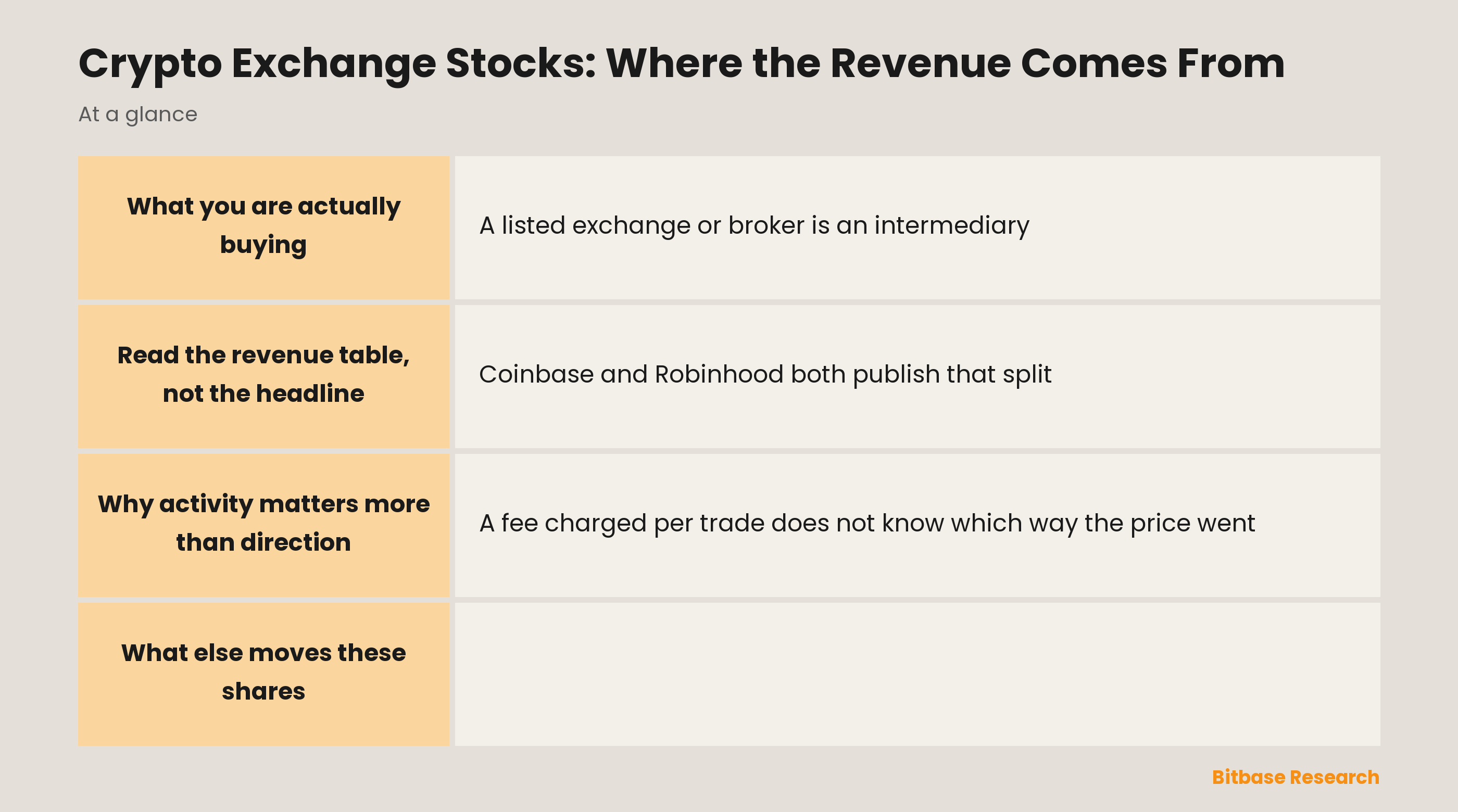
A listed exchange or broker is an intermediary. It does not need the price of any asset to rise in order to be paid. It needs people to transact, to leave balances on the platform, and to keep paying for services. That is a different exposure from holding the asset itself, and it is the thing to settle before treating one of these shares as a stand-in for crypto.
The difference between a broker and an exchange sets the shape of the revenue. An exchange matches one customer against another and takes a fee on the match. A broker stands between the customer and the market, and is paid out of the route the order takes. Several of the listed names do both, through different subsidiaries in different countries, so the labels on the income statement tell you more than the label on the company.
Where the revenue comes from
Four sources run through the filings quoted in this guide. They respond to different inputs, so a company leaning on one will not move like a company leaning on another.
| Revenue leg | What it is paid for | What makes it move |
|---|---|---|
| Trading fees | Each completed trade, as a commission or a spread | How much customers trade |
| Order routing | Sending customer orders to a venue or a market maker | Order volume and the terms of the routing arrangement |
| Custody and services | Holding assets, staking them, paid subscriptions | Assets held on the platform, and subscriber counts |
| Interest | Cash balances, margin loans, securities lending, stablecoin reserves | Policy rates, and how much cash sits on the platform |
Coinbase states the first of these plainly in its annual report: "We charge fees from consumers trading on our platform, including through volume-based transaction fees and a spread depending on the type of trade." The custody leg carries a wrinkle, because the same filing says the company charges institutions "a separate fee based on the total assets stored in custody on our platform", and that it does "not charge our consumers a separate fee to securely store their crypto assets on our platform". The same activity is a revenue line for one kind of customer and a cost of doing business for the other.
Robinhood's description of routing rewards a slow read. Writing about its crypto business, the company says: "Customers trading in the Robinhood app can choose to have orders routed to market makers commission-free or through partner exchanges via smart exchange routing for a fee." Two routes, two ways the trade gets paid for, and only one appears as a charge to the customer. Routing on the securities side answers to a separate rulebook: for stocks and options in the United States, routing arrangements are disclosed under the SEC's Rule 606 of Regulation NMS, which requires a discussion of the material aspects of a broker's relationship with each venue it routes to, and a report of the payment for order flow it receives.
Read the revenue table, not the headline
Coinbase and Robinhood both publish that split, and the two do not resemble each other.
Coinbase Global reports transaction revenue — consumer, institutional and other — and then a second block called subscription and services, which holds stablecoin revenue, blockchain rewards, interest and finance fee income, and other subscription and services revenue. Only the first block is trading; everything under the second heading is billed for something other than a completed trade.
Robinhood breaks its transaction-based revenues out by asset class instead: options, cryptocurrencies, equities and other. Beneath that sits net interest revenues, itself split into margin interest, interest on segregated cash and deposits, cash sweep, securities lending, interest on corporate cash and investments, and credit card. Other revenues carry the Gold subscription line and proxy revenues.
Two things follow from reading the labels. Crypto is one line among several in a broker built this way, not the business itself. And the interest block is cut into more pieces than the trading block, which is a statement about where the company thinks the detail belongs.
Why activity matters more than direction
A fee charged per trade does not know which way the price went. It is calculated from what was traded, so churn pays and calm does not, whichever way the week ended. Price direction and fee revenue are two separate series, and one does not read off the other.
Interest loosens the link further. Balances and policy rates set that leg, and neither has to wait for a customer to place an order. When rates move, a business carrying a large interest block reprices without anybody trading at all, and the trigger is a central bank rather than a candle.
Five listed names, five different filers
The names in this guide are not a single kind of company, and the paperwork shows it before the business description does.
| Company | Ticker | Listed on | Incorporated in | Annual report |
|---|---|---|---|---|
| Coinbase Global, Inc. | COIN | Nasdaq | Texas | Form 10-K |
| Robinhood Markets, Inc. | HOOD | Nasdaq | Delaware | Form 10-K |
| Galaxy Digital Inc. | GLXY | Nasdaq | Delaware | Form 10-K |
| eToro Group Ltd. | ETOR | Nasdaq | British Virgin Islands | Form 20-F |
| Bullish | BLSH | New York Stock Exchange | Cayman Islands | Form 20-F |
The last column is not a formality. A domestic filer also files quarterly on Form 10-Q; a foreign private issuer files current reports on Form 6-K instead. That sets how often the revenue tables above are refreshed, which matters when reading them is the whole method.
The registration details carry information too. Galaxy Digital is classified on EDGAR under the industry code for security brokers, dealers and flotation companies. eToro Group is organised under British Virgin Islands law and listed on Nasdaq. Bullish appears on EDGAR under that single word, incorporated in the Cayman Islands and listed in New York. None of this tells you what a business does. All of it tells you which document to open next, and under which name to look for it.
What else moves these shares
Rates. Any leg computed on balances follows the policy rate down as well as up, and customer behaviour does not have to change for that to happen.
Permission to serve a market. Groups that operate through separately licensed subsidiaries absorb rule changes unevenly. A restriction lands on the entity it applies to and the users that entity serves, not on the whole group at once, so a headline about one country is not automatically a group event.
Product mix. An operator that adds equities, subscriptions, custody or data is adding legs that answer to something other than crypto volume. That widens the business and blurs the ticker as a crypto proxy at the same time.
The calendar. Annual reports, quarterly filings and current reports arrive on dates that are published ahead of time. Repricing concentrates on those dates, and a filer that reports less often concentrates it harder.
The bottom line
A crypto exchange stock is a claim on activity and on balances, not on the price of any coin. To tell one of them from another, open the annual report, find the revenue disaggregation table, and read the labels: how much of the top line is trading, how much is interest, how much is billed for holding assets rather than moving them. That table answers a question the ticker cannot.
Two habits make the rest easier. Check which form the company files, because that sets how often you will hear from it. And keep the instrument separate from the company: a share, a tokenized stock and a perpetual future on the same ticker are three different objects with three different sets of rules, and the TradFi markets page is where that lineup is kept. To keep learning the fundamentals, follow more from Bitbase Academy.
Related reading
Other Bitbase articles on this topic:
- ARKK Explained: What an Actively Managed ETF Actually Is
- BAC Stock Explained: Lending, Trading and the Token
- Bullish Stock (BLSH): An Exchange, an Index, and a Media Business
- Automatic Margin Addition Explained: What It Does to Your Liquidation Price
- NFT Wash Trading Warning Signs Explained
Disclaimer: This article is educational content from Bitbase Academy, provided for information only. It does not constitute investment, trading, tax, or financial advice. Crypto assets are volatile; assess your own risk. Written as of September 2026; refer to the latest official information.
References
[1] Coinbase Global, Inc., Form 10-K for the fiscal year ended December 31, 2025, filed with the SEC: fees charged to consumers, custody fees charged to institutions, and the disaggregation of revenue www.sec.gov
[2] Robinhood Markets, Inc., Form 10-K for the fiscal year ended December 31, 2025, filed with the SEC: order routing to market makers and partner exchanges, and the disaggregation of transaction-based, net interest and other revenues www.sec.gov
[3] SEC EDGAR entity data for Galaxy Digital Inc. (CIK 1859392): ticker, exchange, industry classification, state of incorporation and the forms it files data.sec.gov
[4] SEC EDGAR entity data for Bullish (CIK 1872195): registrant name, ticker, exchange, place of incorporation and the forms it files data.sec.gov
[5] eToro Group Ltd. prospectus filed with the SEC: place of incorporation and the Nasdaq listing under the symbol ETOR www.sec.gov
[6] SEC staff guidance, Responses to Frequently Asked Questions Concerning Rule 606 of Regulation NMS: what a broker-dealer must disclose about each routing venue and about payment for order flow www.sec.gov