Type a crypto share price into a search box and a number comes back, but it is not a price per share. Per share is a rate: a figure divided by a count of shares that an issuer created and a register maintains. A coin has neither. What it has is a quoted unit that the software named, a supply figure that is tracked rather than filed, and a market cap that puts the two together. This page separates the three, and says where a real per-share number sits nearby.
What the phrase per share is asking for
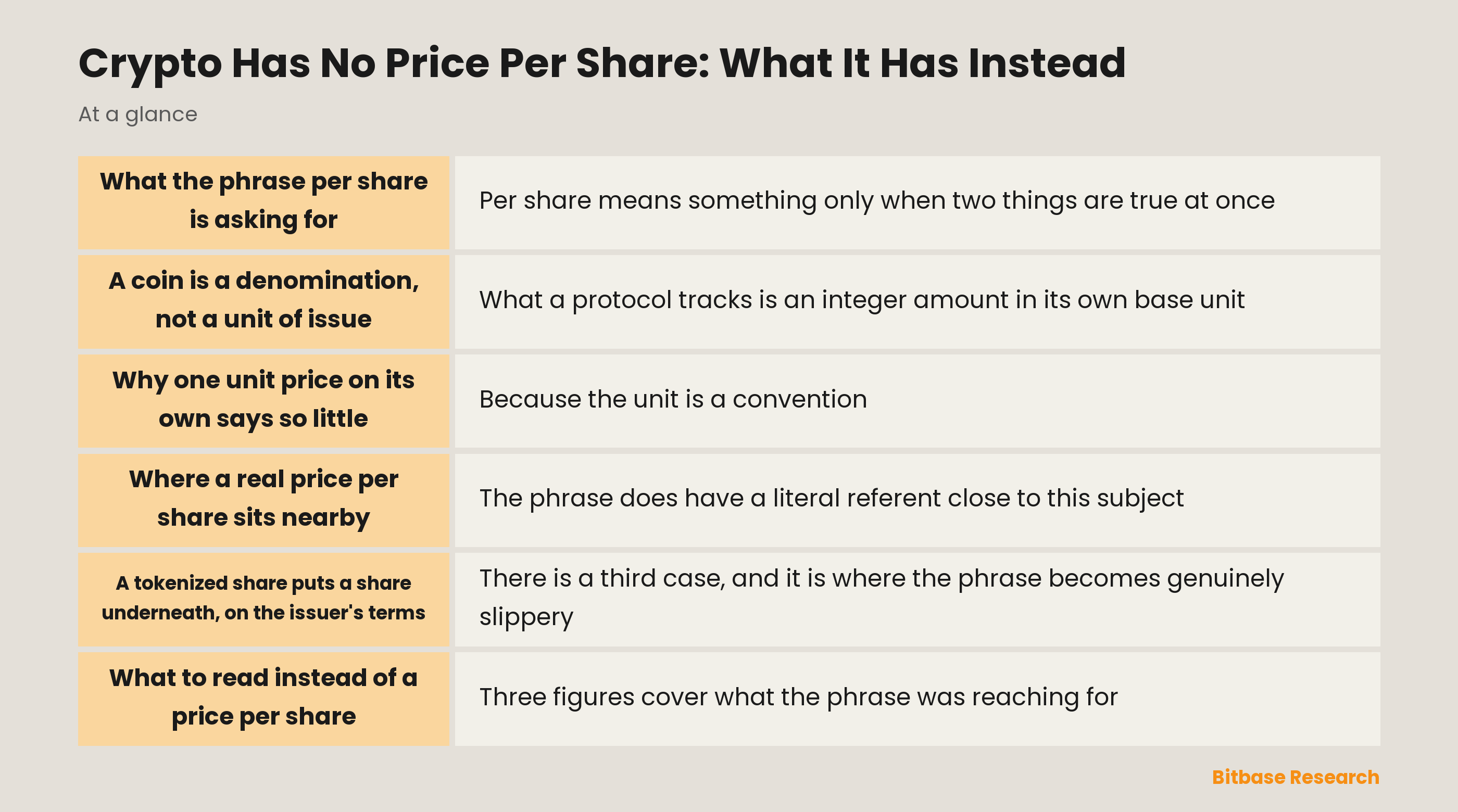
Per share means something only when two things are true at once: an issuer created a countable unit called a share, and a record of how many exist is kept and published.
Listed companies satisfy both, and the evidence sits on the first page of an annual report. The cover of a Form 10-K states the number of shares outstanding of each class of common stock as of a stated date, and above it the aggregate market value of the common equity held by non-affiliates, based on the last reported sale price on the exchange. Price on one line, share count on another: that pair is what the phrase per share exists to serve.
One pair of words in that sentence carries weight: each class. A company can have more than one class of common stock, and the cover reports each count separately, as of a date, because the number moves. Even in equities the share count is a record an issuer maintains, published because a rule requires it.
Crypto supplies neither condition. No issuer created a share, nothing is denominated in shares, and no register holds the count. The number a search returns is a coin price standing in for a share price. That is a narrower point than whether a cryptocurrency is a stock, which asks about the instrument; this page asks only about the quantity.
A coin is a denomination, not a unit of issue
What a protocol tracks is an integer amount in its own base unit, and the round-numbered coin is a label placed over that. Bitcoin Core's consensus code carries the constant with a comment that states it plainly — “The amount of satoshis in one BTC” — and sets it to 100,000,000. Balances, fees and transaction outputs are all denominated in satoshis.
Ethereum is built the same way at a different scale. Its developer documentation calls wei “the smallest denomination of ether” and puts one ether at ten to the eighteenth power wei.
So the one in one coin is a naming decision taken when the software was written. It is not a minimum purchase, and it is not an indivisible object handed over at settlement. You acquire an amount, carried to as many decimal places as the base unit allows.
That is where how much is one share of cryptocurrency stops having an answer in the form it asks for. A quote for one unit is easy to find. The step that cannot be taken is the division, because there is no share count to divide by.
Two multiplications that look like the same one
Both markets produce a headline value the same way, a price times a count, and that resemblance is where the vocabulary crosses over. Laid out side by side, the terms do not match.
| The term | A listed share | A crypto asset |
|---|---|---|
| What gets priced | One share of one class of common stock | One whole coin, as the software names it |
| Smallest amount you can hold | The share, as the register counts it | One base unit: a satoshi on Bitcoin, a wei on Ethereum |
| The count in the multiplication | Shares outstanding, stated on the filing cover | Circulating supply, maintained rather than filed |
| How many counts exist | One per class of stock | Three tracked apart: circulating, total and max |
| What the product is called | Market capitalization, or public float over the non-affiliate part | Market cap, or a fully diluted valuation on the max supply |
The first row is the one that closes the per-share question. The third and fourth are the ones that keep the two arithmetics apart even after the analogy is granted: a share count is filed, while circulating supply is an assessment of how much is out and tradable, sitting beside a total and, where the protocol sets one, a maximum. Change which supply figure enters the multiplication and the headline value changes with it.
Why one unit price on its own says so little
Because the unit is a convention, unit prices do not compare between assets. Two projects can choose base units and issuance schedules that differ by orders of magnitude, and their per-unit quotes will differ by orders of magnitude for that reason alone.
The figure that does compare is crypto market cap, because multiplying the unit price by the supply cancels the choice of denomination out of the answer. A unit price is one term of that product, and it is the term carrying the arbitrary part.
Equities have the same structure from a different cause, which is why the cover page reports both numbers rather than one. A share price on its own does not size a company either. What differs is what stands behind each count: a legal artefact in one case, an output of the protocol's rules in the other.
Where a real price per share sits nearby
The phrase does have a literal referent close to this subject. Companies whose results depend on crypto issue ordinary shares, and those have a price per share in the full sense: an issuer, a class, a count on a filing cover, a quote from an exchange session.
Those businesses are not one kind of thing. Venues, miners, treasury companies, stablecoin issuers and larger firms with a single crypto-facing line all end up under the same heading, and crypto stocks sorts out what each is exposed to. The relevant part here is narrower: every one of them has a share count, so every question the phrase per share can pose has an answer.
A symbol on a stock exchange has a price per share. A symbol on a crypto market has a price per unit. They are not two names for one quantity.
A tokenized share puts a share underneath, on the issuer's terms
There is a third case, and it is where the phrase becomes genuinely slippery. A tokenized stock references a listed share, so a per-share figure is somewhere inside the arrangement. What reaches the holder is decided by whoever wrote the instrument, and the issuers wrote them differently from one another.
At one end, xStocks states on its official site that “Each xStock is backed 1:1 by the underlying asset held in regulated custody”. One token, one share, on that issuer's own description.
Ondo documents the opposite for its own product: “One token does not necessarily represent the value of one share, and the price of one token will not always match the price of the underlying asset.” Robinhood's European product moves further still, describing Classic Stock Tokens as “derivative contracts between you and Robinhood”, priced at the prices of the underlying securities “without granting rights to them”.
Three issuers, three answers to what one token is worth in shares. Which names have which surfaces, and who issues each, is set out on the tokenized stock lineup. With these instruments the terms are the product, so the terms come before the price.
What to read instead of a price per share
Three figures cover what the phrase was reaching for, and they read in order.
The unit price, with its denomination in mind. It answers what one of these costs right now, and it stops there.
The supply figure, and which one it is: circulating for what is out and tradable, total for what exists, maximum for the ceiling where the protocol defines one. The distance between them is the dilution still to come.
The market cap, the first two multiplied together, and the only one of the three that survives a comparison between assets. If the question underneath was whether this is large or small, that is the number it was asking for.
The bottom line
Crypto has no price per share because it has no shares. Nobody issued a countable unit, no register maintains a count, and the one coin that gets quoted is a denomination chosen in software — a round number of satoshis on Bitcoin, of wei on Ethereum — rather than a unit anyone was granted.
The question behind the phrase is a fair one, and it splits into three that do have answers. If it means how big is this, read market cap and check which supply figure went into it. If it means what a share of this company costs, the subject is a listed company and the number exists in the ordinary way. If it means what one token of a tokenized share is worth, read the issuer's terms first. To keep working through the fundamentals, follow more from Bitbase Academy.
Related reading
Other Bitbase articles on this topic:
- Bitdeer (BTDR): The Bitcoin Miner That Builds Its Own Chips
- CLSK Stock Explained: Bitcoin, Power Bills and Dilution
- Crypto Exchange Stocks: Where the Revenue Comes From
- Coin-Margined vs USDT-Margined Futures: Which Contract to Trade
- NVT Ratio Explained: Network Value to Transactions
Disclaimer: This article is educational content from Bitbase Academy, provided for information only. It does not constitute investment, trading, tax, or financial advice. Crypto assets are volatile; assess your own risk. Written as of September 2026; refer to the latest official information.
References
[1] Bitcoin Core v28.0, src/consensus/amount.h: the constant COIN, carrying the comment “The amount of satoshis in one BTC” github.com
[2] ethereum.org developer documentation, Intro to Ether: wei is described as the smallest denomination of ether, with one ether equal to ten to the eighteenth power wei ethereum.org
[3] SEC EDGAR: Strategy Inc, annual report on Form 10-K for the fiscal year ended December 31, 2025 — cover page stating the shares of class A and class B common stock outstanding as of a given date, and the aggregate market value of the common equity held by non-affiliates based on the last reported sale price www.sec.gov
[4] xStocks official site: what an xStock is, 1:1 backing in regulated custody, issuer and eligibility xstocks.com
[5] Ondo Stocks overview: backing, shareholder rights and trading hours (Ondo official documentation) docs.ondo.finance
[6] Robinhood Europe: Classic Stock Tokens described as derivative contracts between the customer and Robinhood, granting no rights to the underlying shares robinhood.com