A listed bitcoin miner sells one product, and it is not bitcoin. It sells computing work, is paid for that work in newly issued coin, and pays for the work in electricity. Almost everything that moves one of these shares sits between those two facts. This guide walks through the levers in between, and through a change in the sector you can read straight off the companies' own front pages.
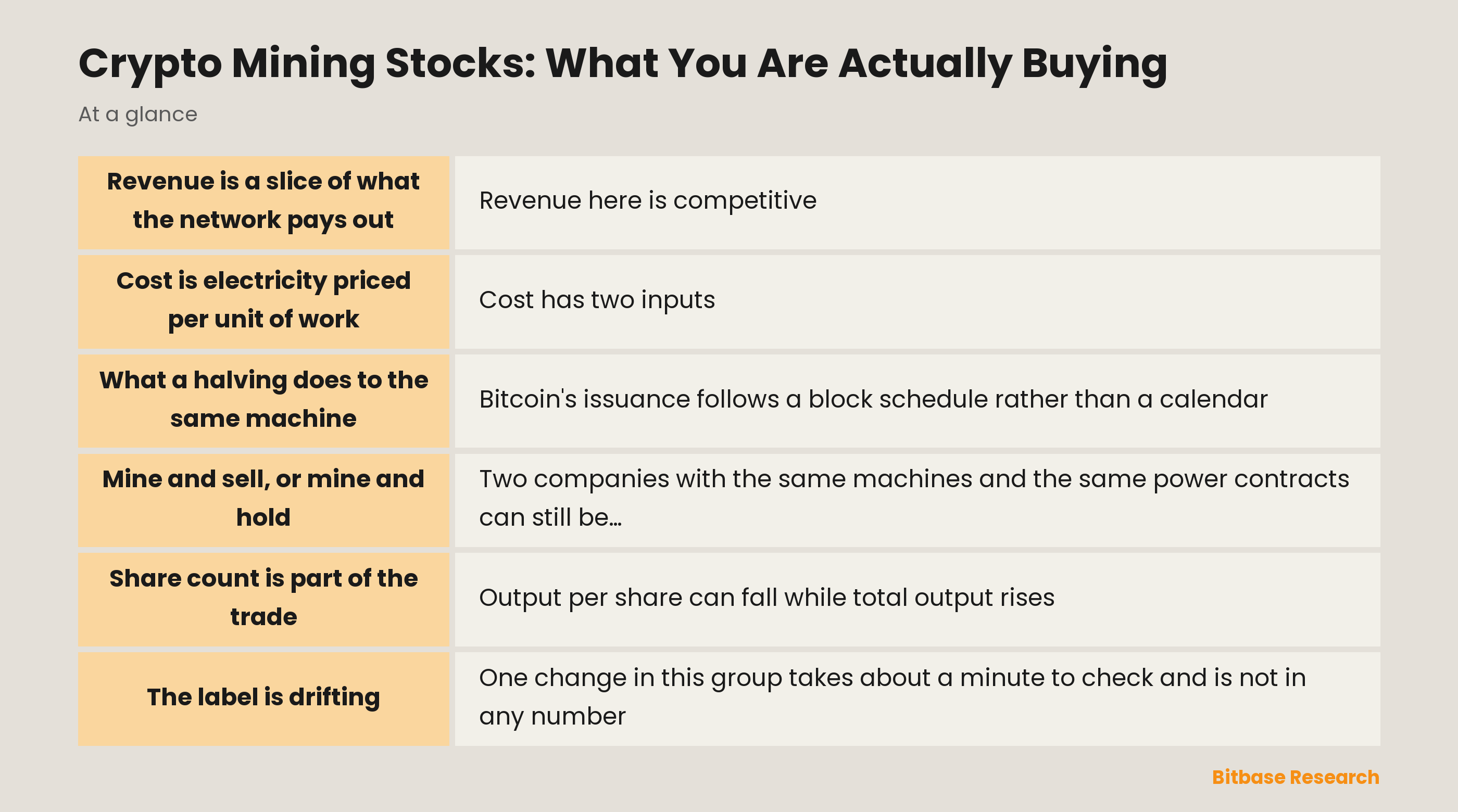
Revenue is a slice of what the network pays out
Revenue here is competitive, not mechanical. Bitcoin mining pays a fixed amount to whoever finds each block, so a company earns roughly its share of the network's total computing power multiplied by what the network hands out in block subsidy and fees. Doubling a fleet does not double income if everyone else is expanding too. The denominator moves as well.
The industry compresses that into one number. Hashprice, a term Luxor coined in 2019, quantifies how much a miner can expect to earn from a given quantity of hashrate, stated as the expected value of one petahash per second of hashrate per day [1]. It moves on the block subsidy, transaction fees and network difficulty, and in dollar terms on the coin price as well [1]. Carry the idea rather than the day's figure: it is revenue per unit of machine before any cost at all.
Cost is electricity priced per unit of work
Cost has two inputs. One is the price the company pays for power. The other is how much power its machines draw to do a given amount of work, quoted in joules per terahash, where a lower number means the same work costs less electricity.
Multiply the two and you have a cost per coin produced. That is why these companies behave like power businesses with a commodity attached: they sign long-dated supply contracts, build next to generation, and switch machines off whenever power is worth more than the coin those machines would produce. An idle machine earns nothing that hour, which is a cost too, just one that never appears on a power bill.
The distance between cost per coin and hashprice is the margin the business runs on. When it closes, the least efficient machines stop being worth their electricity and switch off, network difficulty adjusts down in response, and the fleets still running collect a larger share of the same payout. The shakeout is built into the arithmetic.
What a halving does to the same machine
Bitcoin's issuance follows a block schedule rather than a calendar. A halving arrives every 210,000 blocks — roughly four years — and the most recent one, in April 2024, reduced the reward from 6.25 BTC to 3.125 BTC per block [2].
Nothing about the machines changes on that day. The same fleet, drawing the same power, earns half the subsidy per block found, and fees plus the coin price have to carry whatever is left. Costs do not halve alongside it. This is the one margin compression in the sector that arrives on a schedule anyone can read years in advance.
Mine and sell, or mine and hold
Two companies with the same machines and the same power contracts can still be different holdings, because they do different things with the coin they produce.
Sell as you mine, and the coin becomes cash on a rolling basis: the balance sheet stays close to the cost of running the business, and revenue tracks the coin price with a lag of days.
Hold what you mine, and the company is two businesses stacked on each other, an industrial one that produces coin and a treasury that is long every coin already produced. The share price then answers to the coin price twice, once through revenue and once through the value of the stack. That is a wider swing in both directions, not a better one.
Which one a company is doing is a reported figure, not a matter of tone. Look at how much coin it produced and how much of it is still on the books, rather than at how it describes its strategy.
Share count is part of the trade
Output per share can fall while total output rises. Building data centres and buying machines takes capital, and one route to that capital is issuing new stock, which spreads the same production across more shares.
The filings say so in plain language. TeraWulf's prospectus supplement for a registered direct offering of common stock warns buyers they may experience immediate and substantial dilution in the net tangible book value per share of the stock they are buying [11]. That is ordinary wording for an equity raise, and it is why hashrate can climb for years while hashrate per share does not.
So read growth per share, not growth. A company that adds capacity by adding shareholders has not necessarily added anything for the shareholders it already had.
The label is drifting
One change in this group takes about a minute to check and is not in any number. It is in how these companies describe their own business.
TeraWulf, which trades as WULF on Nasdaq, leads with energy infrastructure for next-generation AI and high-performance computing [8]. IREN calls its facilities purpose-built for high-performance, power-dense compute [6]. CleanSpark puts it as energy native, proven in mining, positioned for compute [5]. MARA Holdings says it operates at the intersection of energy, compute and digital capital [3]. Hut 8 describes an integrated portfolio of power, digital infrastructure and compute assets [7]. Riot Platforms keeps mining as a named service and lists data centres for AI and high-performance computing as a separate one [4]. HIVE Digital Technologies describes building and operating next-generation data centers powered by clean energy across Canada, Sweden and Paraguay [10]. One company took the shift as far as its own name: the filer behind the ticker CIFR was registered with the SEC as Cipher Mining Inc. from 2021 and has been Cipher Digital Inc. since February 2026 [9].
The engineering underneath is what makes that possible. A site with contracted power, cooling and a shell can house graphics processors instead of mining machines, and the revenue changes shape when it does: a mining site is paid by a network at whatever hashprice happens to be that day, a hosting site by a counterparty under a contract. One company can hold both, which is why the phrase crypto mining stock now does less work than it used to.
What to check before you compare two of them
Start with what the company says it sells today, in its own words, and decide whether mining is the business or one line inside a larger one. Then three mechanical things: what it pays for power and how efficient its machines are, which together set cost per coin; what it does with the coin it mines, which decides whether you are buying an operator or an operator plus a treasury; and whether share count is growing faster than production.
Bitbase's TradFi section carries price pages for MARA Holdings, Riot Platforms, CleanSpark, IREN and Hut 8. What trades there is a tokenized instrument rather than a share on the company's home exchange, and these five pages do not all come from the same issuer: the legal form, the backing and the trading week differ from one issuer to the next, so the terms on one page do not carry over to the next. One issuer's own documentation states that one token does not necessarily represent the value of one share, and that its price will not always match the underlying asset [12]. Read the instrument page for the name in front of you before you read the chart.
The bottom line
A mining stock is an industrial business whose selling price is set by a public network and whose cost is set by an electricity contract. Hashprice describes the first, joules per terahash and the power price describe the second, the halving schedule moves the first on a known date, and the share count decides how much of it reaches you.
The group is also splitting: some of these companies still lead with mining, others now lead with data centres for AI, and one has changed its registered name. Before treating two of them as the same trade, read what each says it does, then check the reported figures against it. To keep learning the fundamentals, follow more from Bitbase Academy.
Related reading
Other Bitbase articles on this topic:
- Bitdeer (BTDR): The Bitcoin Miner That Builds Its Own Chips
- CLSK Stock Explained: Bitcoin, Power Bills and Dilution
- Crypto Exchange Stocks: Where the Revenue Comes From
- FIFO vs LIFO for Crypto Cost Basis
- Optional NFT Royalties Explained
Disclaimer: This article is educational content from Bitbase Academy, provided for information only. It does not constitute investment, trading, tax, or financial advice. Crypto assets are volatile; assess your own risk. Written as of September 2026; refer to the latest official information.
References
[1] Luxor documentation: what hashprice measures and the inputs it moves on docs.luxor.tech
[2] Kraken Learn: the halving interval and the block reward before and after the most recent halving www.kraken.com
[3] MARA Holdings official website: how the company describes its own business www.mara.com
[4] Riot Platforms official website: mining and data centres presented as separate services www.riotplatforms.com
[5] CleanSpark official website: how the company describes its own business www.cleanspark.com
[6] IREN official website: how the company describes its data centres iren.com
[7] Hut 8 official website: how the company describes its own business hut8.com
[8] TeraWulf official website: how the company describes its own business, with the ticker and listing venue www.terawulf.com
[9] US Securities and Exchange Commission, EDGAR filer data for Cipher Digital Inc.: current name, former names and ticker data.sec.gov
[10] HIVE Digital Technologies official website: how the company describes its data centres and where it operates www.hivedigitaltechnologies.com
[11] TeraWulf prospectus supplement on SEC EDGAR: the dilution disclosure in a registered direct offering of common stock www.sec.gov
[12] Ondo documentation on tokenized stocks: one token does not necessarily represent the value of one share docs.ondo.finance