
A company can put crypto in its name and hold no coin, and a company can run a crypto business under a name that mentions none of it. A ticker does not sort the two apart, and neither does a search result. This page takes four registrants whose names share one word, shows what the public record says about each, and turns that into three checks: where it trades, what its registrant record carries, and where the revenue comes from.
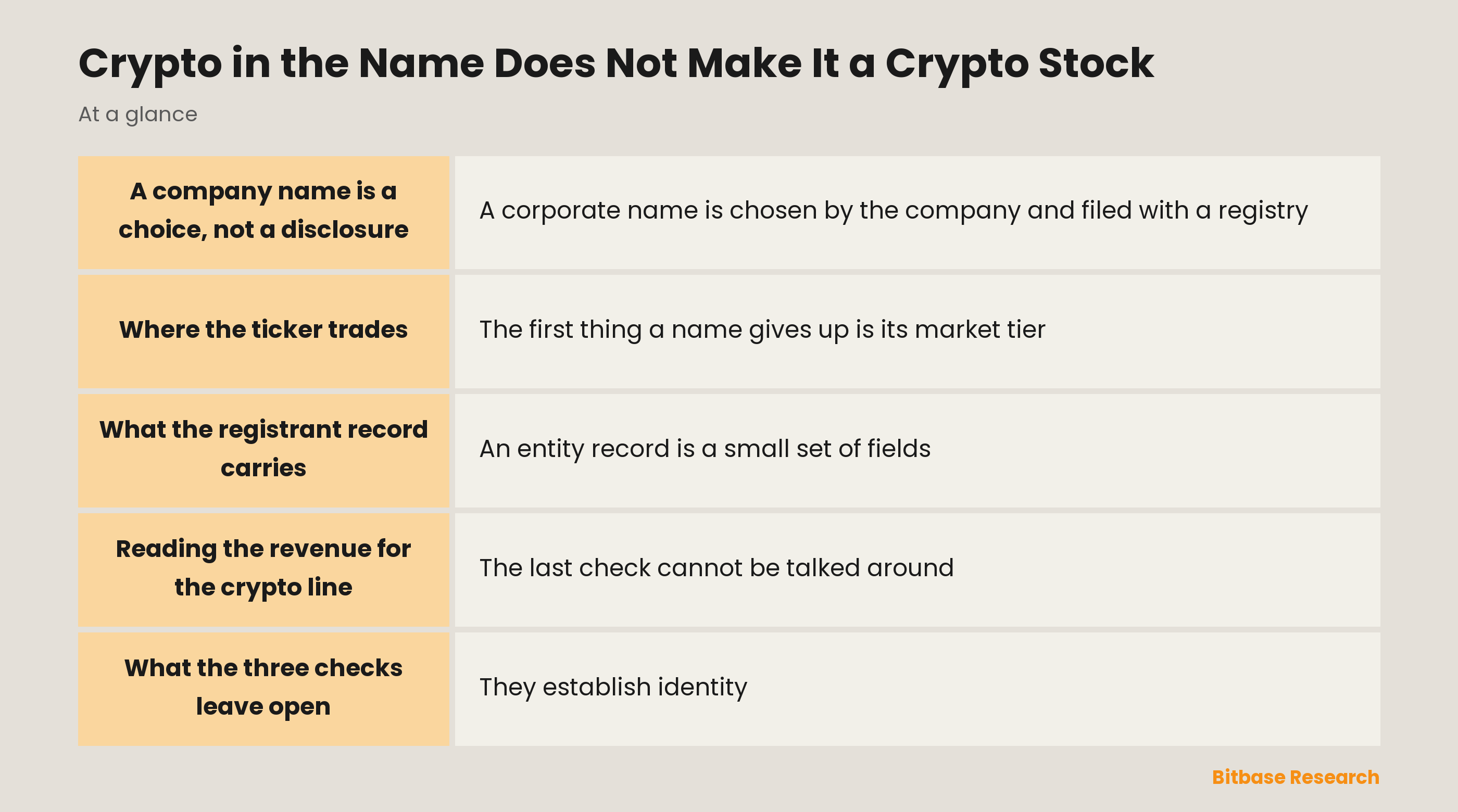
A company name is a choice, not a disclosure
A corporate name is chosen by the company and filed with a registry. A ticker is a short code assigned so that an order reaches the right security. Neither says where the business earns money, and neither is examined for accuracy on that question. The description of the business is filed separately.
So a name and a business can come apart in three unrelated ways. A company can rename itself toward an industry it has recently entered. A name can be older than the industry it now appears to name, and describe something else. And two companies with no connection to each other can carry the same name in different decades, which is why one search returns a history and another returns a live quote.
None of this is hidden. It is simply invisible from the outside, which is why what a crypto stock is has to be settled from filings rather than from the label on the front.
One word, four different companies
Four registrants whose names share the same root sit in the public record with unrelated histories.
| The name | What it did, in its own filings | Where the listing went |
|---|---|---|
| The Crypto Company | Building infrastructure, a proprietary investment portfolio and alliances in the digital asset market | Files with the SEC as Crypto Co under CRCW, with OTC in its exchange field |
| CryptoLogic Limited | A developer and supplier of internet gaming software, founded in 1995 | Listed in Toronto, then Nasdaq, then London; a 2012 cash offer took it off Nasdaq and Toronto |
| Cryptologic Corp. | A dedicated cryptocurrency mining operation at a leased site in Lachute, Quebec | Bought outright by a listed miner in 2020 |
| CryptoGlobal Corp. | Cryptocurrency datacentres in North America | Acquired in 2018; the buyer began trading under the symbol HYPR |
The Crypto Company is the case where the name arrived late. Its annual report for that year states that it was incorporated in 2013 under the name Croe, Inc., and the registrant record still carries that former name with the dates it applied. The same report discloses that on December 19, 2017 the SEC temporarily suspended trading in the stock under Section 12(k) of the Exchange Act until January 3, 2018, and that when the halt expired, OTC Markets discontinued the display of quotes and moved the common stock to its Grey Market. Every clause of that is the company's own filed language.
CryptoLogic Limited is the case where the filings describe a different business entirely. Founded in 1995, it described itself as a developer and supplier of internet gaming software, licensed to third-party gaming operators. It listed in Toronto in 1998, on Nasdaq in 2000 and in London in 2003. A cash offer that became wholly unconditional in March 2012 ended that: the last day of Nasdaq trading fell on or about 26 June that year, the shares came off the Toronto exchange at the close of business on 30 July, and its SEC record closes with a filing that terminates registration.
Cryptologic Corp. is a different company altogether, and it is the one that actually mined. A listed miner's annual filing records that it completed the acquisition, on April 8, 2020, of a dedicated cryptocurrency mining operation at a leased facility in Lachute, Quebec. Same word, different country, different decade, and no relation to the software company that carried the name before it.
CryptoGlobal Corp. is a fourth shape: a crypto business that stopped existing under its own name. Its buyer announced on July 10, 2018 that the acquisition had completed, and that the combined company would begin trading on the Canadian Securities Exchange the following day under the symbol HYPR. The old name finds a business; a search for its price finds nothing current, because the security was replaced.
Where the ticker trades
The first thing a name gives up is its market tier. The guide for investors published by the SEC describes microcap stocks as trading in the over-the-counter market rather than on a national securities exchange such as the New York Stock Exchange or Nasdaq, and treats that as a difference in how much information reaches the buyer.
Which is why the exchange field on a registrant record is worth reading first. For the registrant that files as Crypto Co it reads OTC. For a company on a national exchange it names the exchange. A listing carries continuous requirements that an over-the-counter quotation does not, so the field tells you which set of obligations applies.
A third possibility is that the tier is empty, which is the answer for a name whose listing has ended. The price you find for it is the last one printed rather than a current one, which makes where a quote on a screen comes from the more useful question here.
What the registrant record carries
An entity record is a small set of fields, and four of them carry the check: the conformed name the company files under, the former names with the dates they applied, the industry classification code, and the date of the latest filing.
Former names answer the rename question outright. The registrant behind CRCW carries Croe, Inc. as a former name along with the period it covered, so the sequence needs no reconstructing. The industry code is a blunter second signal: the code on that registrant is a computer processing and data preparation services code rather than a financial one. Codes of that kind are self-reported, which makes a mismatch informative in one direction only.
The date of the last filing is the field people skip. A registrant that stopped filing years ago is not a company you can research; it is a closed file. CryptoLogic Limited is the clean example, its record ending in 2012 with the termination notice.
Reading the revenue for the crypto line
The last check cannot be talked around. An annual report describes the business and then breaks revenue into its components, and a company whose income does not touch crypto has no line there that does. That is what separated CryptoLogic Limited from the asset its name resembled: the software was licensed to gaming operators, and licensing fees are what the accounts show.
The check runs in the other direction as well. A name with no crypto in it can sit on top of a substantial crypto revenue line, and the accounts are where that becomes visible. What a listed miner earns and coin held on a balance sheet appear as identifiable items regardless of what the company calls itself.
There is also the business that is early. A company can announce a crypto plan before any revenue exists, and the accounts show that honestly: an intention in the business section, nothing beneath it in the revenue breakdown. That is a legitimate stage to be in, and a mistake only when read as a line that already exists.
What the three checks leave open
They establish identity, not merit. Knowing that a ticker belongs to the company you meant, that it trades where you think, and that its revenue comes from where it says tells you nothing about whether the share is worth its price.
They also stop at a border. Companies registered outside the United States file with their own regulators under their own form names, so the fields change while the questions do not. A private company has no ticker at all. If a name exists here in tokenized or perpetual form, the stock names carried on Bitbase answers that separately from whether the underlying share is listed.
And a check is not a substitute for care about the category itself. The SEC published a reminder alongside one set of trading suspensions: “investors should give heightened scrutiny to penny stock companies that have switched their focus to the latest business trend, such as cryptocurrency, blockchain technology, or initial coin offerings.” The three checks are how that scrutiny gets carried out, not a replacement for it.
The bottom line
A name is the one part of a listed company that costs nothing to change, and the record is built so that changing it leaves a trace. Three checks read that trace: the exchange field says where the ticker trades or that it no longer trades anywhere; the registrant record carries former names and the date of the last filing; and the revenue breakdown says whether any of the money touches crypto.
Run them in that order and each can end the search early. The four names above share a word and nothing else. One renamed itself into the industry, one filed as a gaming software business, one was in it under a name another company had used first, and one was in it until a buyer replaced the security. The label was the same in all four cases. The filings were not.
Related reading
Other Bitbase articles on this topic:
- Bitdeer (BTDR): The Bitcoin Miner That Builds Its Own Chips
- CLSK Stock Explained: Bitcoin, Power Bills and Dilution
- Crypto Exchange Stocks: Where the Revenue Comes From
- How Funding Payments Affect Your Profit and Loss on a Perpetual
- Fill or Kill, Immediate or Cancel, and All or None Explained
Disclaimer: This article is educational content from Bitbase Academy, provided for information only. It does not constitute investment, trading, tax, or financial advice. Crypto assets are volatile; assess your own risk. Written as of September 2026; refer to the latest official information.
References
[1] The Crypto Company, Form 10-K for the fiscal year ended December 31, 2017, filed with the SEC: incorporation in 2013 under the name Croe, Inc., the name change in 2017, the Section 12(k) trading suspension of December 19, 2017 to January 3, 2018, and the move to the OTC Grey Market www.sec.gov
[2] SEC EDGAR entity data for Crypto Co (CIK 1688126): conformed name, ticker CRCW, exchange field OTC, SIC code 7374 for computer processing and data preparation services, and the former name CROE, INC. with the dates it applied data.sec.gov
[3] CryptoLogic Limited, Schedule 14D-9 filed with the SEC in 2012: the company was founded in 1995 as a developer and supplier of internet gaming software licensed to third-party operators, and listed on the Toronto Stock Exchange in 1998, on NASDAQ in 2000 and on the London Stock Exchange in 2003 www.sec.gov
[4] SEC EDGAR entity data for CRYPTOLOGIC LTD (CIK 1094036): empty ticker and exchange fields, the former name CRYPTOLOGIC INC, and a filing history whose most recent entry is a Form 15-12G terminating registration, filed June 27, 2012 data.sec.gov
[5] Exhibit to CryptoLogic Limited Schedule TO-T/A, dated 26 June 2012: CryptoLogic expected the last day of trading of its shares on NASDAQ to be on or about 26 June 2012, and planned to file a Form 15 to terminate registration under Section 12(g) after the NASDAQ delisting took effect www.sec.gov
[6] Recommended Cash Offer for CryptoLogic Limited by Amaya Gaming Group Inc., regulatory announcement of 31 July 2012: the offer became wholly unconditional on 29 March 2012, and the CryptoLogic Shares were delisted from the Toronto Stock Exchange at the close of business on 30 July 2012 www.globenewswire.com
[7] HIVE Blockchain Technologies Ltd., financial statement exhibit filed with the SEC: on April 8, 2020 the company completed its acquisition of Cryptologic Corp., which ran a dedicated cryptocurrency mining operation at a leased facility located in Lachute, Quebec www.sec.gov
[8] HyperBlock Inc. news release of July 10, 2018: the company completed its acquisition of CryptoGlobal Corp., and the combined company would begin trading on the Canadian Securities Exchange on July 11, 2018 under the ticker symbol HYPR www.newswire.ca
[9] SEC press release 2018-20, February 16, 2018, announcing trading suspensions: investors should give heightened scrutiny to penny stock companies that have switched their focus to the latest business trend, such as cryptocurrency, blockchain technology, or initial coin offerings www.sec.gov
[10] Microcap Stock: A Guide for Investors, published by the SEC Office of Investor Education and Advocacy: microcap stocks trade in the over-the-counter market rather than on a national securities exchange such as the New York Stock Exchange or NASDAQ, and information about microcap companies can be difficult to find www.sec.gov