
The question arrives as a choice between two nouns, and neither noun is something you can measure. It becomes answerable once both sides are named and you decide what to compare them on. Six measures cover the ground: the size of the moves, how far down and how long back, when you can act, what the rulebook covers, what tax leaves you with, and how the two behave together. This guide is about computing those six for yourself.
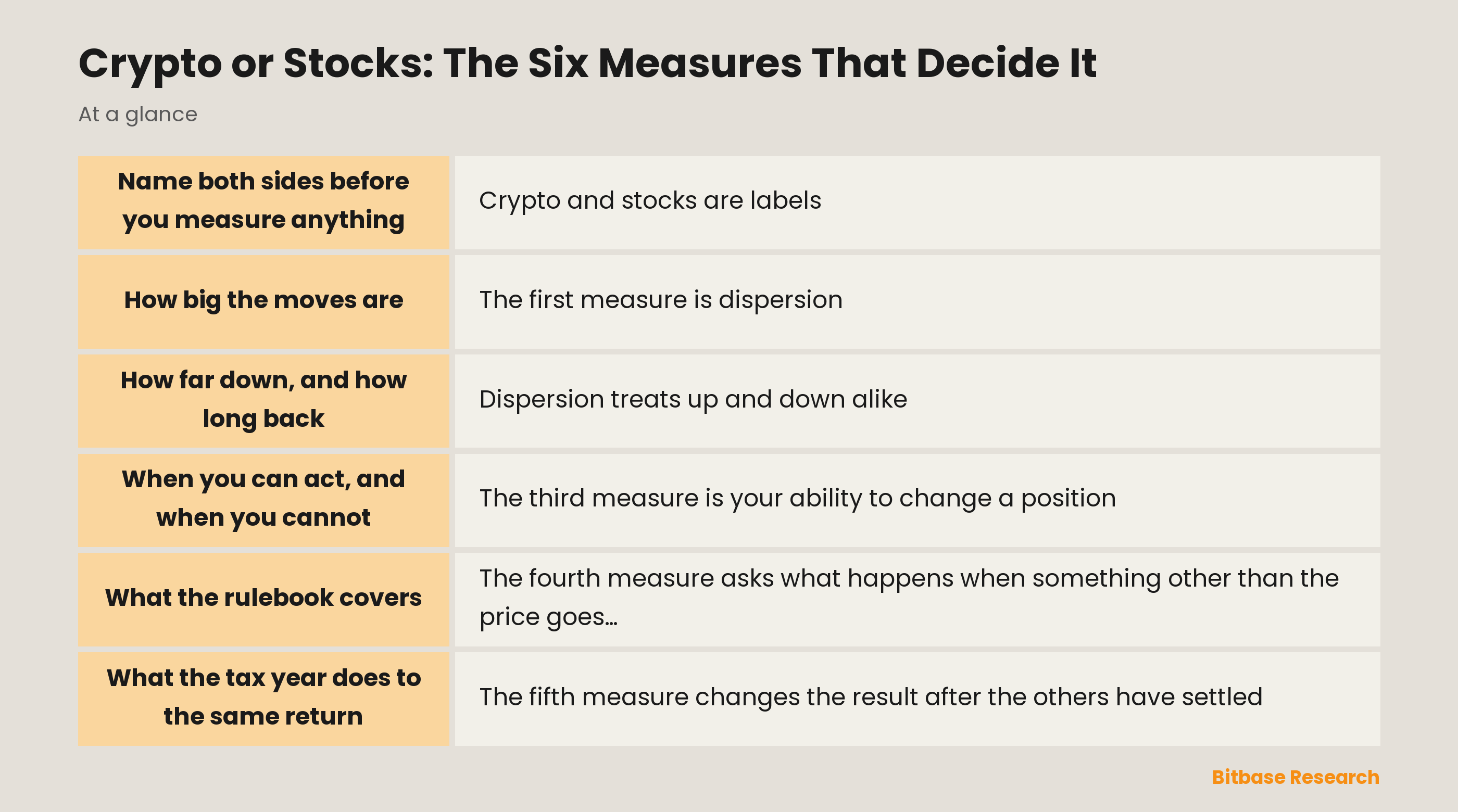
Name both sides before you measure anything
Crypto and stocks are labels, and each covers many series that behave differently. A single large coin is not the same object as a basket of small ones, and SPY and QQQ are two different references with two different histories: a figure computed against one is not the same figure computed against the other.
So the first step is clerical. Write down the two series, the quote currency, the frequency, and the start and end dates before anything gets computed. Compare one coin's last twelve months against one equity reference while somebody else compares three years against another, and you have two different answers rather than a disagreement. Every measure below sits on that footing.
How big the moves are
The first measure is dispersion: how far the returns in your window land from their own average. Compute it identically on both sides, with the same frequency, currency and annualization rule. A comparison that varies any of those compares two calculations rather than two markets.
One structural difference shows up immediately. A crypto series has an observation on every calendar day, while an equity series has gaps where the venue was closed. Dropping those gaps, carrying the last price across them, or trimming the crypto series to the equity calendar are three treatments producing three numbers. Pick one and reuse it.
What comes out is the size of the moves, not the reason for them. The drivers behind why crypto is volatile are a separate subject; for a decision, the output you need is the magnitude you would have to live with.
How far down, and how long back
Dispersion treats up and down alike. A drawdown does not, which is why the second measure is the deepest peak-to-trough decline in your window, paired with the time the series then took to reach a new high. Those two figures are independent: a fall recovered in weeks and a fall recovered in years can be the same depth and a completely different experience.
Compute both on the series you named, and record the date of the trough as well as its depth. The question underneath is whether you would still have been holding on that date: a decline you would have sold into is not one you sat through. State the window alongside the figure, because a longer sample can contain a deeper fall and a shorter one can miss it.
When you can act, and when you cannot
The third measure is your ability to change a position, which is separate from the price of it. An equity position can be adjusted only during the sessions your broker supports; outside them, whatever happens arrives at the next open as one move you had no chance to answer. A crypto position can be changed at any hour, and that same property means it is never parked: it stays exposed while you sleep.
Depth belongs inside this measure too. Being able to trade at three in the morning is not the same as trading well at three in the morning. Look at the order book at the hour you would realistically place an order, not at the hour the market is busiest, and size the position against what is there then.
The two halves pull against each other, and which binds is personal: a plan that needs an exit at any hour and a plan that works better when the market takes your hands off the wheel overnight are served by opposite sides.
What the rulebook covers
The fourth measure asks what happens when something other than the price goes wrong. In the United States, SIPC protects "cash and securities" held by a customer "at a financially-troubled SIPC-member brokerage firm". Its limit is $500,000 and that includes a $250,000 limit for cash.
Read the boundary rather than the figure. The same source states that "SIPC does not protect against the decline in value of your securities." The scheme answers for the firm failing, not for the market falling. Other countries run their own arrangements with their own limits, and it is the exclusion that transfers: nowhere is there a scheme that refunds a price.
The rulebook attaches to the instrument rather than to the company behind it. The same listed name reached through a different wrapper can carry different rights, and Ondo's documentation states that holders "do not receive shareholder voting rights, statutory information rights or other shareholder rights". So the stock side is a choice of instrument as much as of company, and which ones exist for a given name is set out in the tokenized stock lineup.
What the tax year does to the same return
The fifth measure changes the result after the others have settled. Two positions with an identical pre-tax return do not finish with an identical after-tax return when they fall under different parts of the tax code, so the comparison worth running is the after-tax one.
Classification is what to look up first. The IRS states that "For U.S. tax purposes, digital assets are considered property, not currency", which puts a crypto disposal under different rules from a share sale in the same year. The paperwork is moving too: the IRS states that broker reporting "is required to be made on Form 1099-DA beginning with transactions on or after Jan. 1, 2025".
None of that carries across a border. Rates, holding periods, the treatment of losses and what counts as a disposal are set locally and revised regularly, which makes this the one measure a general article cannot compute for you. Look it up where you live before a tax assumption decides an allocation.
Where each one sits next to the other
The sixth measure exists only if you hold both. Adding a position changes the dispersion of the whole portfolio, and how much depends on how the two series moved together across your window rather than on either one's volatility alone.
That co-movement is a measurement, and a conditional one. Whether a coin is correlated with stocks depends on which equity series, which frequency, which window, and how two trading calendars were aligned. A coefficient describes the sample it came from, so a diversification case built on one window is a case about that window.
The useful form of this measure is a question rather than a coefficient. If both sides fall on the same day, is the combined figure something you can hold without acting? Compute that decline at the weight you are considering, instead of reading the two separate ones and assuming they arrive apart.
Six measures against your own constraints
Put side by side, the six do not name a winner. They produce a profile of each side, and your own constraints select from it.
| Measure | The number you compute | The choice hidden inside it |
|---|---|---|
| Size of the moves | Dispersion of returns in one named window | The frequency, and what you did with closed days |
| Depth and recovery | Peak to trough, and the time back to a new high | The window, and whether you would still have held |
| When you can act | The venue's hours, and the depth at your hour | Your hour, or the busiest one |
| What the rulebook covers | The scheme on your account, and its limit | The firm failing, or the price falling |
| Tax on the result | The after-tax figure at your own rates | The jurisdiction, and the class it lands in |
| Correlation with the rest | The coefficient on that same window | A sample, not a fixed trait |
The constraints doing the selecting are yours to state plainly: when you need the money back, how deep a fall you can sit through without acting, and how much attention the position is allowed to take. Each maps onto a row above, and a row no constraint of yours touches can be set aside for now.
How you enter is a separate question from what you enter. Spreading purchases across time and putting a lump sum in at once trade expected return against timing risk in opposite directions, whichever side you land on.
The bottom line
Crypto or stocks resolves into six smaller questions with computable answers: the size of the moves, the depth of the falls and the time back, the hours you can act in and the depth at those hours, what a protection scheme covers and what it excludes, what tax leaves you with, and how the two behave together. Name both series first, keep the window and frequency fixed across all six, and let your own constraints pick the row that decides it. To keep learning the fundamentals, follow more from Bitbase Academy.
Related reading
Other Bitbase articles on this topic:
- CLSK Stock Explained: Bitcoin, Power Bills and Dilution
- Crypto Exchange Stocks: Where the Revenue Comes From
- Crypto Has No Price Per Share: What It Has Instead
- How to Appeal a Crypto Exchange Account Restriction
- Realized PnL Report vs Transaction History: Which Record Your Taxes Need
Disclaimer: This article is educational content from Bitbase Academy, provided for information only. It does not constitute investment, trading, tax, or financial advice. Crypto assets are volatile; assess your own risk. Written as of September 2026; refer to the latest official information.
References
[1] SIPC, What SIPC Protects: scope of protection, the $500,000 limit including $250,000 for cash, and the exclusion of decline in value www.sipc.org
[2] IRS, Digital Assets: digital assets are treated as property and not currency for U.S. tax purposes, and broker reporting on Form 1099-DA from transactions on or after Jan. 1, 2025 www.irs.gov
[3] Ondo Stocks overview: holders do not receive shareholder voting rights, statutory information rights or other shareholder rights (Ondo official documentation) docs.ondo.finance