Three or four letters look like an identifier. On a stock exchange they are one, because a plan filed with the Securities and Exchange Commission makes them one: a symbol is reserved before anything trades under it, and while it is reserved nobody else may allocate it. Crypto has no equivalent step. Whoever deploys a token contract writes a ticker into it, wallets and price sites read that ticker back out, and two unrelated projects can wear the same letters at the same time. This guide sets out who allocates what, where the collisions land, and what to read instead of the ticker.
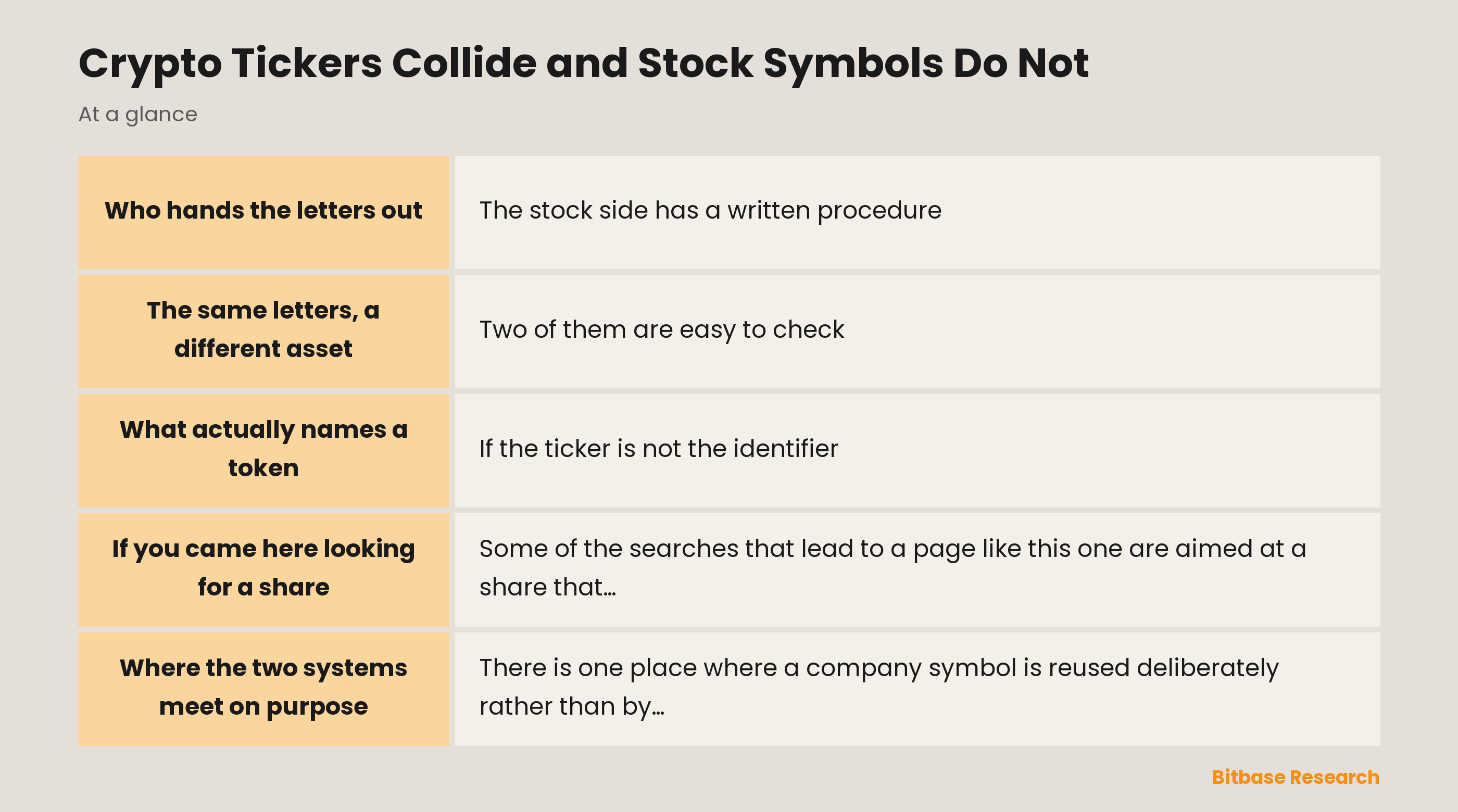
Who hands the letters out
The stock side has a written procedure. The self-regulatory organizations behind US equity markets, the exchanges together with FINRA, jointly operate a National Market System plan for the selection and reservation of securities symbols, and under that plan they act together as the Intermarket Symbols Reservation Authority. The plan describes itself as the exclusive means of allocating and using symbols of one to five characters in length, and its Symbol Reservation System covers the allocation of all symbols used to identify the securities in scope [1].
Two details in it matter more than the acronym does. A party reserves a symbol through the system before it puts the symbol to use, so allocation happens ahead of the listing rather than as a by-product of it. And the plan governs the root symbol only, the letters before any suffix or conditional identifier, which is how a share class marker can hang off the end without touching the reservation underneath.
Crypto has no counterpart to that procedure. A ticker is a field inside a token contract. The person deploying the contract fills the field in, everything downstream copies what it finds there, and no registry has to agree. Nothing stops a second project from filling in the same field with the same letters, because there is nothing in between with the standing to refuse.
Two naming systems side by side
| Stock symbol | Crypto ticker | |
|---|---|---|
| Who allocates it | Exchanges and FINRA acting jointly under a plan filed with the SEC | Whoever deploys the contract |
| Reserved in advance | Yes, before trading | No |
| Held by one holder at a time | Yes, within the scope of the plan | No |
| What it identifies on its own | A security admitted to trading | Nothing |
| The identifier that does the work | The symbol | The chain plus the contract address |
| Where you confirm it | The listing venue | The project documentation |
The right-hand column is not a defect in crypto so much as a different design. Nobody set out to build a naming authority, so there is none, and the consequences follow from that rather than from any particular project behaving badly.
The same letters, a different asset
Two of them are easy to check, because both sets of letters exist on each side of the line.
DIA is the ticker of the State Street SPDR Dow Jones Industrial Average ETF Trust, listed on NYSE Arca since 1998 [2]. DIA is also the ticker of a crypto token, so entering those three letters on a crypto venue returns the token rather than the fund, and the price page under that path belongs to the token.
VIX is the same problem in a different shape. It is the Cboe Volatility Index, described by Cboe as a measure of market expectations of near-term volatility conveyed by S&P 500 Index option prices [3]. It is an index rather than a security, so there is no share of it to buy in the first place. A token nonetheless trades under VIX.
Both cases have one shape: the letters carried over and the asset behind them did not. A ticker that matches the one you had in mind is not evidence that you have found the thing you were looking for.
What actually names a token
If the ticker is not the identifier, something else has to be, and it is the pair of a chain and a contract address.
Chainlink shows the problem inside one project rather than between two. LINK is the native digital asset of the Chainlink Network and the standard unit of payment for Chainlink services, and Chainlink's own documentation lists a different LINK contract address for Ethereum, Arbitrum, Base and Avalanche, telling developers to use the address that matches the network they are building on [4]. One project, one set of four letters, a different address on each network it runs on.
That is why the token standard a token follows is part of its identity rather than a technicality: the standard tells you which network the token lives on, and the network plus the address is what a wallet acts on when you approve a transfer. The ticker is a label printed on top of that pair, and labels are cheap.
The habit that follows is short. Take the contract address from the project documentation rather than from a search result, and compare it against the address the interface in front of you is about to use. Treat a matching ticker as the start of that check and never as the end of it.
If you came here looking for a share
Some of the searches that lead to a page like this one are aimed at a share that does not exist.
Chainlink is one of them. LINK is a token and nothing was ever issued as equity alongside it, so no venue reserved a symbol for it and there is no LINK share price to find. What exists is a token price, and it sits on the price page.
Compound is another. Compound's documentation describes Compound III as a decentralized protocol governed by holders and delegates of COMP [5]. Voting weight inside a protocol is a governance right rather than a shareholding, so the quote to look for is again a token price and not a stock quote.
A brand name that returns no symbol at all is a third case, and the explanation is structural. Symbols are reserved by listing venues for securities admitted to trade there, so a company that has never sold shares to the public has nothing to reserve and no symbol to find. Either the name belongs to a token, which carries a ticker and no listing, or it belongs to a private company, which carries neither. In both cases the absence is the answer and not a gap in your search.
Where the two systems meet on purpose
There is one place where a company symbol is reused deliberately rather than by accident, and that is tokenized equities. A token is issued to track a listed company, and it borrows the company letters so that people can find it.
That borrowing is governed by whoever issued the token, not by any symbol plan, which is why the conventions differ from issuer to issuer and why reading tokenized stocks symbols is a subject of its own.
The same company can also reach you through more than one surface, each writing the name its own way. NVIDIA appears on its price page as NVDAON, on the spot market as the base asset of NVDAB against a stablecoin, and on the perpetual market under the bare company code. Three strings, one company, three different instruments behind them, which inverts the rule that governs the primary listing, where one symbol means one security. Which names carry which surfaces is set out on the tokenized stock lineup.
The bottom line
A stock symbol identifies a security because an institution stands behind the allocation and reserves the letters before anything trades under them. A crypto ticker identifies nothing on its own because no institution allocates it, and the same letters can sit on unrelated assets at the same moment. Read a ticker as a nickname and the chain plus contract address as the name. When a search for a crypto stock symbol comes back empty, check whether the thing you are looking at is a token or a private company, because neither of those has a symbol to give you. To keep learning the fundamentals, follow more from Bitbase Academy.
Related reading
Other Bitbase articles on this topic:
- CLSK Stock Explained: Bitcoin, Power Bills and Dilution
- Crypto Exchange Stocks: Where the Revenue Comes From
- Crypto Has No Price Per Share: What It Has Instead
- How to Switch RPC Endpoints Safely
- RPC Rate Limit Exceeded and How to Stop Hitting It
Disclaimer: This article is educational content from Bitbase Academy, provided for information only. It does not constitute investment, trading, tax, or financial advice. Crypto assets are volatile; assess your own risk. Written as of September 2026; refer to the latest official information.
References
[1] New York Stock Exchange, National Market System Plan for the Selection and Reservation of Securities Symbols nyse.com
[2] State Street Global Advisors, SPDR Dow Jones Industrial Average ETF Trust, fund page ssga.com
[3] Cboe Global Markets, The VIX Index cboe.com
[4] Chainlink, documentation, LINK Token Contracts docs.chain.link
[5] Compound, documentation, Governance docs.compound.finance