
A share and a coin reach you the same way: a name, a symbol, a moving price, an account that will hold it. That is why the question keeps getting asked, and the one-word answer is no. The longer answer is the useful one, because a share is not a single thing but a bundle — a claim on a company, a vote, a defined place in the queue if that company fails, and an instrument the law names outright. Take the bundle apart and hold each piece next to a crypto asset. Almost every piece reads differently.
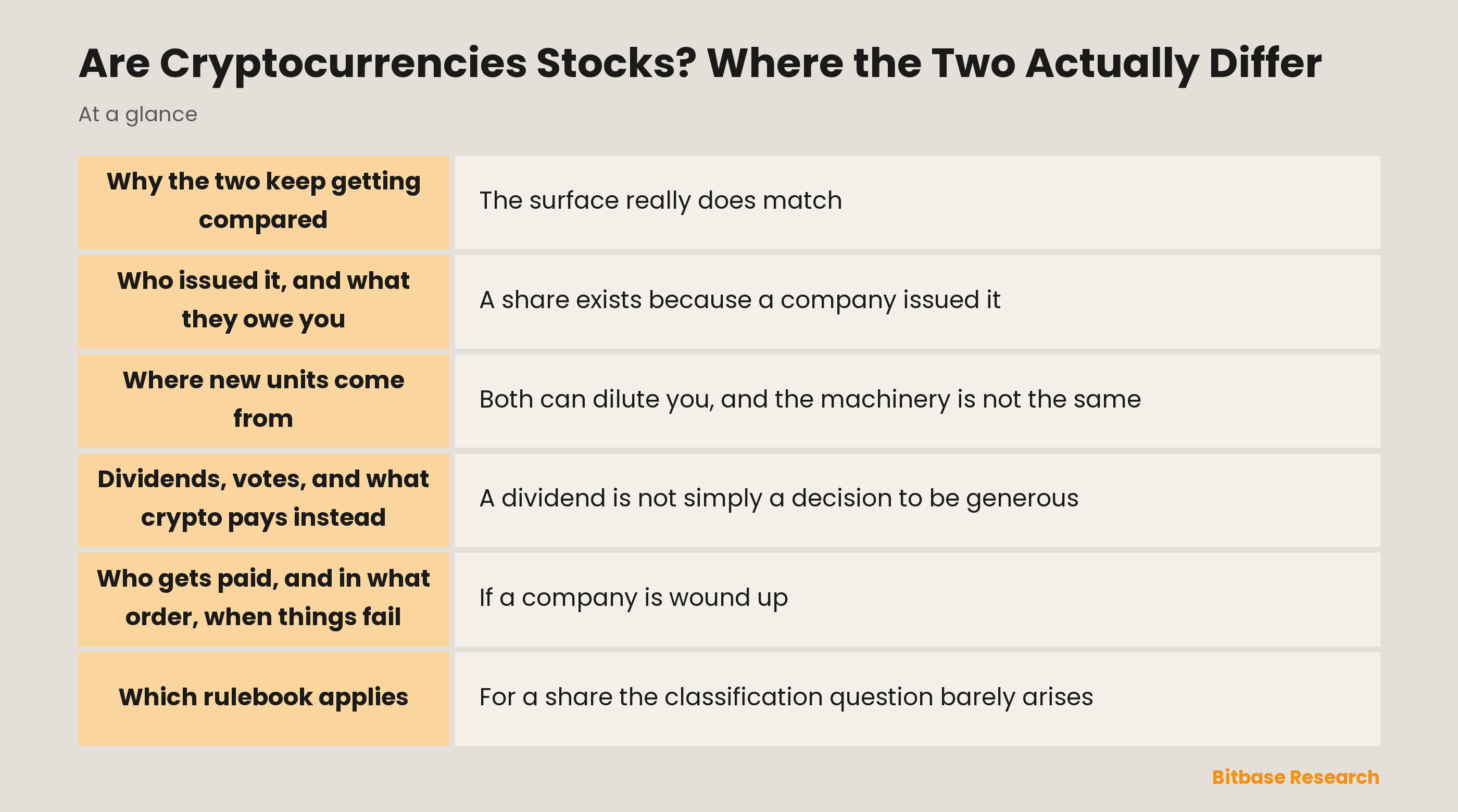
Why the two keep getting compared
The surface really does match. Both quote in a currency, both carry a symbol, and the same screen will show you one beside the other. Search behaviour follows the surface, which is how a coin ends up filed as a stock.
Three instruments sit in the middle and blur the line further. Companies whose business is crypto issue ordinary shares, so there are real stocks whose revenue comes from the crypto market. Funds hold crypto and trade as listed products. And a tokenized stock follows a listed share but is written by a firm that sets its own terms, which is why those terms differ from one issuer to the next — the tokenized stock lineup is the list of the ones you can reach here. None of the three turns a coin into a share.
Who issued it, and what they owe you
A share exists because a company issued it, and that company stays on the other side of it for as long as the share exists. There is a legal person there, with a board, accounts, auditors and duties owed to holders. It can be taken to court.
Bitcoin has no such counterparty. Its founding paper set out to let payments be “sent directly from one party to another without going through a financial institution”, and new units arrive on a schedule the software enforces rather than by anyone's decision — the same paper compares “the steady addition of a constant of amount of new coins” to gold miners adding gold to circulation. Nobody is obliged to publish accounts, and nobody can be asked to make you whole. That is the design, and it is also the price of the design.
Plenty of tokens do have an identifiable team behind them, and that changes who you can talk to. It does not turn the token into ownership of that team's company. Equity is its own instrument, created by its own paperwork.
Where new units come from
Both can dilute you, and the machinery is not the same. A company's share count changes by corporate action: a board, and where the rules require it the shareholders, decide to issue more, and the new count becomes a matter of record.
A token's supply moves for reasons written into the protocol and the allocation plan — issuance paid out to validators, scheduled unlocks, burns that remove units permanently. That is why circulating supply and total supply are tracked as two separate figures. A token has no share register; the chain itself records the units, and the chain is public: dilution can be watched as it arrives rather than read about afterwards.
Dividends, votes, and what crypto pays instead
A dividend is not simply a decision to be generous. Under Delaware corporate law the directors “may declare and pay dividends upon the shares of its capital stock” out of surplus or, where there is no surplus, “out of its net profits for the fiscal year in which the dividend is declared and/or the preceding fiscal year”. Something has to have been earned or accumulated first. No source, no dividend.
Staking rewards can look like the crypto edition of that, and structurally they are not. They are paid by the protocol out of newly issued units and transaction fees, not by a business handing part of its earnings to its owners. The payment is real; what stands behind it is different, and so is what it tells you.
Voting splits the same way. Delaware's default is that “each stockholder shall be entitled to 1 vote for each share of capital stock held by such stockholder”, unless the certificate of incorporation says otherwise, and what those votes elect is a board that runs a company. A governance token vote decides parameters of a protocol. Both are votes. They are votes over different objects, and only one of them arrives attached to ownership.
Who gets paid, and in what order, when things fail
If a company is wound up, the order of payment is set by statute rather than negotiated. In a liquidation under Chapter 7 of the US Bankruptcy Code, the estate pays priority claims first, then general unsecured claims, then claims filed late, then fines and penalties, then interest, and “sixth, to the debtor”. Shareholders do not appear on that list at all. Their claim reaches only what returns to the company at the end of it. Standing behind everyone else is not a flaw in the instrument; it is what an equity claim is.
A coin has no capital structure for you to stand at the back of. There is no estate behind bitcoin waiting to be distributed. What that removes in one place it adds in another: the risk moves to whoever is holding the asset on your behalf, and an exchange bankruptcy turns on the account terms and the records rather than on the balance shown in an app. Holding your own keys removes that layer and hands you a different set of problems instead.
Which rulebook applies
For a share the classification question barely arises. The US securities statutes define the term to mean “any note, stock, treasury stock, security future, security-based swap, bond, debenture” and a long list besides. Stock is named in the definition. Nobody analyses an ordinary share to find out whether securities law reaches it.
Crypto assets are not named that way, so where the question comes up it is settled by applying a test to the facts of a particular arrangement. The Supreme Court's formulation asks whether there is “a contract, transaction or scheme whereby a person invests his money in a common enterprise and is led to expect profits solely from the efforts of the promoter or a third party”, and the Court called that “a flexible rather than a static principle”. A test applied to facts answers one asset at a time, and it can answer differently for two assets that look alike on a screen.
That is the United States framing, and other jurisdictions write their own definitions. The structural point survives the move: with a share you can look up the rules from the instrument; with a crypto asset you have to look at the arrangement. Check which framework applies where you live before assuming either answer.
Side by side
One row deserves a sentence of its own. A listed share trades in a session its exchange sets, while crypto runs 24/7 — that changes when news reaches the price, not what the instrument is.
| What differs | A share of stock | A crypto asset |
|---|---|---|
| Who issued it | A company, which stays on the other side of it | For bitcoin, nobody; a team is still not an issuer of equity |
| What your claim reaches | The company behind the share | The asset itself, and nothing beyond it |
| Where new units come from | Corporate action, recorded in the register | Protocol issuance, scheduled unlocks and burns |
| Cash paid to holders | A dividend, declared out of surplus or net profits | No equivalent; staking pays from issuance and fees |
| What a vote decides | The board that runs a company | Parameters of a protocol, where a governance token exists |
| If it fails | A statutory queue, owners last | No issuer estate; the risk sits with whoever holds it for you |
| How the law reaches it | Named in the statute as a security | Decided by applying a test to the facts |
| When you can trade | The session the exchange sets | Around the clock |
The bottom line
No, a cryptocurrency is not a stock, and the reason is not that one is digital and the other is not. A share is a bundle of legal claims on a company — its residual value, a vote over its board, a defined place in the queue when it fails — and the law names the instrument outright. A crypto asset gives you the asset. Where crypto appears to offer the same things, the mechanism underneath is different: rewards come from issuance rather than profits, votes decide parameters rather than boards, and counterparty risk sits with whoever holds the asset for you.
None of that says which is worth owning. It is the list you need in front of you before that question is worth asking, and the entries with no counterpart are the ones to read first.
Related reading
Other Bitbase articles on this topic:
- CLSK Stock Explained: Bitcoin, Power Bills and Dilution
- Crypto Exchange Stocks: Where the Revenue Comes From
- Crypto Has No Price Per Share: What It Has Instead
- How to Buy ORCL: Oracle Cloud, the Token and the Perpetual
- Small Balance Conversion After a Token Delisting
Disclaimer: This article is educational content from Bitbase Academy, provided for information only. It does not constitute investment, trading, tax, or financial advice. Crypto assets are volatile; assess your own risk. Written as of September 2026; refer to the latest official information.
References
[1] Satoshi Nakamoto, Bitcoin: A Peer-to-Peer Electronic Cash System, abstract and Incentive section bitcoin.org
[2] Delaware General Corporation Law, title 8, section 170, Dividends delcode.delaware.gov
[3] Delaware General Corporation Law, title 8, section 212, Voting rights of stockholders delcode.delaware.gov
[4] United States Code, title 11, section 726, Distribution of property of the estate, Legal Information Institute law.cornell.edu
[5] United States Code, title 15, section 78c(a)(10), definition of security, Legal Information Institute law.cornell.edu
[6] SEC v. W. J. Howey Co., 328 U.S. 293 (1946), Legal Information Institute law.cornell.edu