A treasury that holds only the token its own votes control is one position, not a portfolio, and the market that prices it is the same market that decides whether the organization can pay next quarter. Diversification is the work of converting part of that position into assets whose value does not depend on the organization that holds them. This guide covers the routes out, how the size of the conversion gets decided, and what the sale costs.
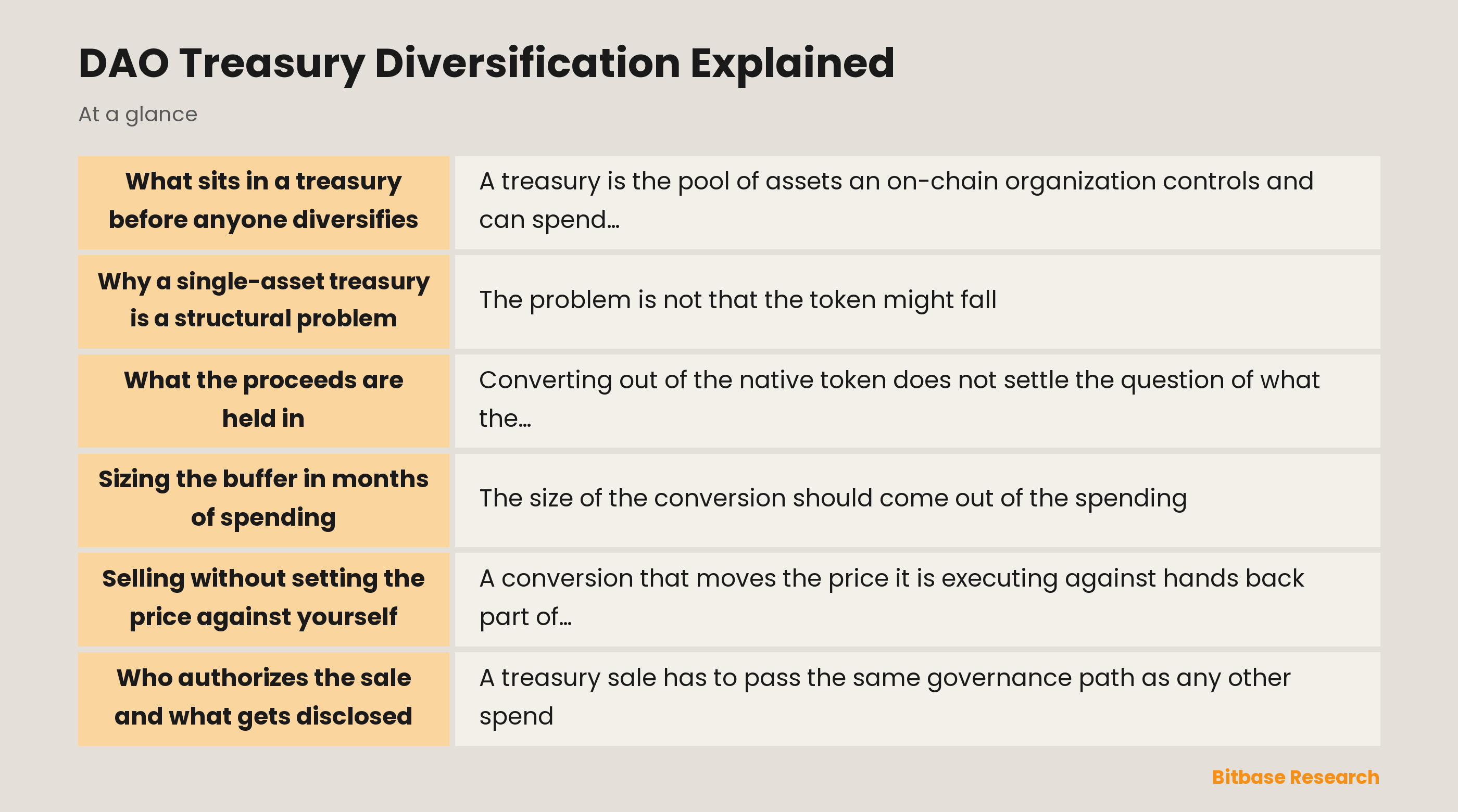
What sits in a treasury before anyone diversifies
A treasury is the pool of assets an on-chain organization controls and can spend only through a passing vote. In a DAO the balance is public, the spending rule is a contract, and the composition is whatever earlier decisions left behind.
That composition follows from how the assets arrived. A reserve carved out of supply at launch, together with the ecosystem allocation, enters the treasury as newly created tokens rather than as anything that was bought. Tokens that were minted rather than purchased arrive denominated in the project's own unit, and nothing converts them by itself.
So the starting point is not a decision anyone made. An organization that has never sold anything holds a single asset, and that concentration is a residue of issuance rather than a view on the asset. Diversification is the first moment at which the composition becomes a choice.
Why a single-asset treasury is a structural problem
The problem is not that the token might fall. It is that the token falls at the same time as everything the organization depends on. Contributor pay, audits, servers, and legal fees are denominated outside the token and do not shrink when it does, so spending power drops in exactly the conditions that make spending necessary.
The same correlation shows up in the sale itself. An organization that has to raise cash during a drawdown sells more tokens for the same budget, and sells them into a book that has already thinned. The sale then delivers to the market the supply the market was worried about. A buffer built beforehand breaks that loop, because the selling was finished at a time when nothing depended on it.
It also distorts the figure the organization reports about itself. A treasury quoted at its full mark looks like years of funding when the part that can actually settle an invoice is far smaller. That is why treasury runway is measured on the non-native part alone: it is the number that holds without anyone selling.
The routes out of the native token
There are four ways a treasury converts its own token into something else, and they differ mainly in who absorbs the price impact and when.
| Route | What leaves the treasury | What comes back | What it costs |
|---|---|---|---|
| Programmatic open-market sale | Native tokens, in tranches over a fixed period | Non-native assets at prevailing prices | Price impact, plus a schedule everyone can read |
| Over-the-counter block sale | Native tokens in one lot, with a lock attached | Non-native assets at a negotiated price | A discount to market, and a holder whose lock will end |
| Swap with another organization | Native tokens | Another organization's token | Nothing spendable, and a second concentration |
| Sale of unissued supply | Nothing already held | Non-native assets | Dilution of holders instead of a sale by the treasury |
A block sale trades visibility for certainty. The whole amount clears at one agreed price, so there is no schedule for the market to trade against, and the discount is the payment for that. The lock attached to it does not remove the tokens from the float, it dates them, and a lock that ends in a quarter when the treasury also intends to sell puts both supplies on the market at once.
A swap between two organizations converts nothing. Each side ends up holding an asset it did not issue, which removes the reflexive link between a token and the budget it funds, but neither side gains anything it can pay an invoice with. It is a governance alignment tool that is sometimes described as diversification, and the distinction matters when the buffer is what you are trying to build.
Selling unissued supply looks cheaper than selling from the treasury because no existing balance goes down. The cost has simply moved: holders absorb it as dilution rather than the treasury absorbing it as a lower balance. Which one is preferable is a real question, but it should be asked out loud, since the version that leaves the treasury figure untouched is the one that reads better in a report.
What the proceeds are held in
Converting out of the native token does not settle the question of what the treasury holds; it opens it. The instrument on the other side has to survive the drawdown that made the buffer necessary, which rules out anything whose value depends on the same conditions.
An operating buffer is held in stablecoins when the obligations it will settle are denominated the same way. Matching the unit of the liability to the unit of the buffer removes one variable from the problem, and it is the reason a buffer denominated in the project's own token was never a buffer at all.
Matching does not remove risk, it relocates it. A stablecoin carries the collateral and issuer risk behind its peg, an off-chain reserve carries the risk of the bank and the jurisdiction holding it, and any yield-bearing position carries the risk of the contract it sits in. The question to answer is not whether the buffer is safe but which failure it is now exposed to, and whether that failure would arrive at the same moment as a fall in the native token.
Sizing the buffer in months of spending
The size of the conversion should come out of the spending, not out of a view on the price. Start from what leaves the treasury each month in non-native assets, decide how many months of that must be covered without any further sale, and the gap between the two is the amount to convert.
Take a treasury marked at $12,000,000 in total, of which $1,800,000 sits outside the project's own token. That leaves $10,200,000 in the token itself, or 85% of the total. Monthly spending is $150,000 and goes out in non-native assets, so the buffer covers twelve months whatever the headline figure suggests.
Set the target at thirty months of spending. Thirty months at $150,000 comes to $4,500,000 in all. The buffer falls short of that by $2,700,000 in value, which is 22.5% of the treasury at today's mark. That is the size of the conversion, and it was derived from an invoice schedule rather than from an opinion about the token.
Stating the target in months rather than as a share of the treasury matters because a share moves when the token moves. A buffer defined as a fixed percentage of the mark shrinks during a drawdown and calls for a larger sale at a worse price, while a buffer defined in months of spending stays the same size in the unit the bills are settled in.
This is also why the rule is worth publishing before it binds. One large ecosystem foundation sets an annual operating budget as a share of its current total treasury and a buffer expressed in years of that budget, and states that the product of the two determines its target fiat-denominated reserves, which in turn informs the size and the cadence of its native-asset sales. A rule fixed in advance means the sale is not being argued about during the drawdown that provoked it.
Selling without setting the price against yourself
A conversion that moves the price it is executing against hands back part of what it raised. The treasury is selling into the same book that prices its remaining holding, so the impact is paid twice: once on the tokens sold, and again on the mark of everything still held.
One way to bound that is to cap each tranche at a share of recent traded volume, say 5%, and to run the schedule regardless of where the price is. A cap tied to volume adapts on its own, slowing the sale when depth disappears, which is where discretionary selling does its damage. Running it regardless of price is the harder half, because the times a schedule looks wrong are the times it is doing its job.
The alternative is to pay the cost up front as a negotiated discount rather than spread it across the book. Neither approach is free, and choosing between them is a question about which cost the organization would rather explain afterwards: a visible discount, or an execution price nobody can reconstruct.
Who authorizes the sale and what gets disclosed
A treasury sale has to pass the same governance path as any other spend: a proposal, a vote, and an account that executes it. Where that account is a multisig, it publishes its signer list and the threshold needed to move funds, so the authority behind the transaction is readable rather than asserted.
A timelock sits between the passed vote and the transaction. The operation is scheduled, a minimum delay has to elapse before it becomes executable, and execution then moves it to a completed state. The delay is what gives token holders a window to see a treasury sale coming and react before it settles, and it is only worth what the window is long enough to allow.
Disclosure is the part that makes any of this checkable from outside. Published treasury addresses let anyone confirm the balance and the split between native and non-native assets; a published schedule lets them confirm that the sale followed the rule rather than the market; a report afterwards closes the loop on what was sold and at what average price. Without the addresses, every other figure in this article is a claim rather than a measurement.
The bottom line
A treasury full of the token it issued is concentrated by default, and the concentration is dangerous because it correlates with the obligations the treasury exists to meet. Diversification converts part of that holding into assets denominated the way the bills are, and the routes available differ in whether the cost shows up as price impact, as a discount, or as dilution.
Size the conversion from the spending, express the target in months rather than as a percentage of a moving mark, and write the rule down before the market makes it urgent. Then publish the addresses and the schedule, because a treasury policy that cannot be verified from the chain is a statement of intent. To keep learning the fundamentals, follow more from Bitbase Academy.
Related reading
Other Bitbase articles on this topic:
- How to Revoke a Governance Delegation
- Why a Token Migration Asks for a Wallet Approval
- Token Migration Completed but New Tokens Are Not in Your Wallet
- Liquidity Mining Dilution: Why the Same APR Pays You Less
- Wallet Address vs Public Key: What's the Difference?
Disclaimer: This article is educational content from Bitbase Academy, provided for information only. It does not constitute investment, trading, tax, or financial advice. Crypto assets are volatile; assess your own risk. Written as of September 2026; refer to the latest official information.
References
[1] Ethereum Foundation Blog, Ethereum Foundation Treasury Policy, June 4, 2025 blog.ethereum.org
[2] OpenZeppelin Contracts 5.x Documentation, Governance, TimelockController docs.openzeppelin.com