A delisting notice does not set one deadline. It sets a chain of them, and the date that is easiest to see is not the one that decides anything. Trading closing is visible: the pair greys out. Withdrawals closing is not visible at all, and it is the date that determines whether you still hold a usable asset or a line item in someone else's ledger. If that second date has already gone by, what happens next is set by the notice and the user agreement, not by anything left for you to click.
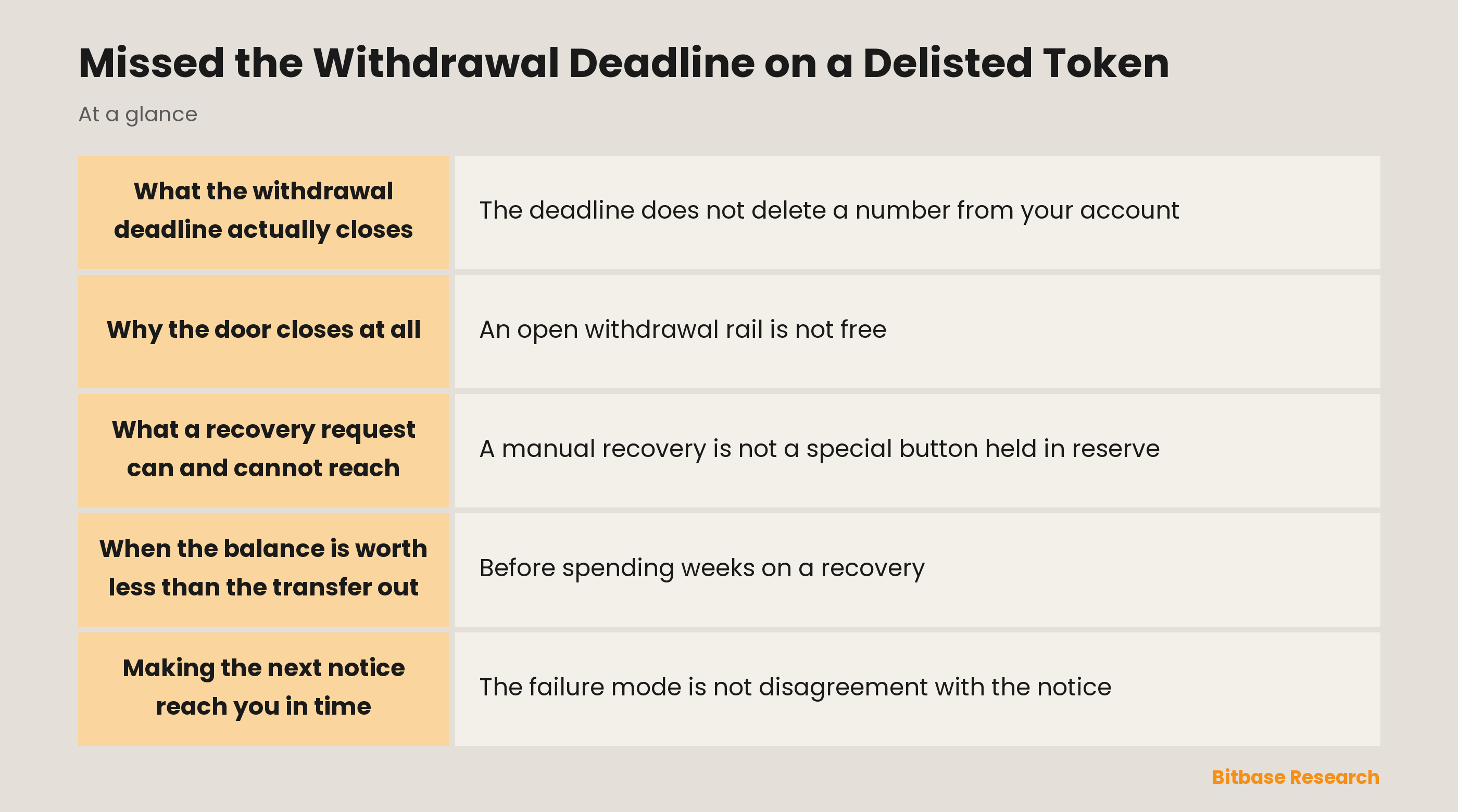
A delisting notice carries more than one deadline
A token delisting is not one switch being thrown. It is a sequence, and each step closes a different door. Reading the notice as a single date is what puts people on the wrong side of the one that counts.
Kraken publishes its scheduled delistings in exactly this shape. Its August 2026 notice gives one date for deposits and trading being disabled, a second date about three months later for withdrawals being disabled, and a stated window after that in which any remaining balances will be liquidated automatically. Three dates, three separate things ending, and the instruction attached to the middle one is to withdraw whatever you want to keep before it arrives.
| The date in the notice | What ends there | What is still open after it |
|---|---|---|
| Deposits and trading close | Selling on that venue, funding the position | Withdrawing the balance you already hold |
| Withdrawals close | Moving the asset out on chain | Only whatever the notice says happens next |
| Disposal or liquidation window | The balance in its original form | A claim on whatever it was converted into |
The gap between the first two dates is the actual grace period, and it can be long. Someone who reads only the trading date concludes the matter is settled, stops paying attention, and misses a withdrawal window that was still open for months.
What the withdrawal deadline actually closes
The deadline does not delete a number from your account. The balance can still be displayed, still labelled with the ticker, still apparently yours. What closed is the route out.
That distinction only makes sense once you separate the two things a balance can be. An on-chain balance is a set of keys you control. An exchange balance is a claim on a custodian, and the withdrawal button is the mechanism that converts the claim into the asset. This is the practical content of the difference between a custodial wallet and one you hold yourself. When the button is gone, the claim remains and the conversion mechanism does not.
The token itself is unaffected. It still exists on its chain, other venues may still list it, and holders who withdrew in time are trading it somewhere else. None of that reaches a balance sitting behind a closed withdrawal rail, which is why the deadline is a custody event rather than a market event.
Why the door closes at all
An open withdrawal rail is not free. Behind it sits a node for that chain, a signing setup, a hot balance funded from cold storage, address screening, and an on-call team for when a send fails. The whole of withdrawal processing has to keep running for one asset that no longer trades and generates no fees.
Sometimes the reason is upstream instead. A chain gets deprecated, a project migrates to a new contract and stops honouring the old one, or the team behind the asset goes quiet and no longer answers when something breaks. In those cases the venue is closing a door that was already jammed.
Either way the closure is planned, dated, and announced in advance. That separates it from a market simply going out of reach for a while: when a spot market is suspended short of a delisting, the cause is resolved and the market comes back. A withdrawal deadline does not reverse on its own.
What can happen to a balance left behind
There is no single answer here, and that is the point: the answer is written in your notice, not in a general rule. Three shapes recur, and they lead to very different actions on your side.
| What the notice provides for | What you are left holding | What you have to do |
|---|---|---|
| Automatic conversion into cash or a stablecoin | A balance in the converted asset | Nothing, then withdraw the proceeds |
| Balance retained pending a manual request | The original asset, frozen | Open a request and prove the account |
| Support ends with no stated path | Possibly no recoverable claim | Read the user agreement before assuming |
Find the notice before you write to anyone. The exact sentence that names the outcome determines whether your message is a request for a conversion payout, a request for a manual recovery, or a question about a clause you have already agreed to. Sending the wrong one costs a round trip you may not have time for.
What a recovery request can and cannot reach
A manual recovery is not a special button held in reserve. It is a person constructing an on-chain send by hand, from a venue wallet that still holds the asset, on a chain the venue still runs infrastructure for. Every one of those conditions has to hold, and each one can fail independently of the others.
Where they hold, the request is administrative: identity checks, a destination address you control, sometimes a fee, and a queue measured in weeks rather than minutes. Where they do not, no amount of correspondence changes the outcome. If the token migrated to a new contract and the migration window closed, the old units are not convertible by anyone. If the chain was deprecated, there is no network to send on. If the notice provided for liquidation and the liquidation happened, the original asset no longer exists in the venue's hands to return.
Ask for the outcome the notice describes, and ask early. If a recovery path exists, the announcement that set the deadline you missed is where it is spelled out.
When the balance is worth less than the transfer out
Before spending weeks on a recovery, price it. Suppose the stranded position is 250,000 units and the last price you saw was $0.002, which puts the holding at $500 on paper. If a manual recovery is available and the network fee for the send is $40 then you clear $460 and the paperwork is plainly worth doing.
Move that price two decimal places down and the same fee is larger than the entire balance it would rescue. Once the send costs more than it delivers, the recovery runs into the arithmetic that makes on-chain dust unspendable: the balance is still yours in a bookkeeping sense, and still not worth the cost of moving. Recovering it is a decision about principle, not about money, and it is fine to make it on that basis as long as you know which decision you are making.
Making the next notice reach you in time
The failure mode is not disagreement with the notice. It is not seeing it. Announcement emails land in promotional folders, in-app banners get dismissed on reflex, and a small position in a fading token is not what makes you open the app.
Two habits address this directly. Keep announcement emails out of any filter that hides them, and once a delisting notice does arrive, write the withdrawal date into a calendar rather than trusting yourself to remember the trading date and infer the rest. The dates in the notice are the only ones that matter, and they are already written down.
The structural fix is different: assets you intend to hold for a long time do not need to sit on a trading venue at all. A balance you have already withdrawn cannot have a withdrawal deadline.
The bottom line
A delisting notice sets a trading date, a withdrawal date, and a date for whatever happens to what is left. Missing the withdrawal date does not erase the balance, but it does close the mechanism that turns an exchange balance into an asset you control.
What happens next is not a general rule; it is a clause. Find the notice, read what it provides for, and ask for that outcome specifically. Then check whether the balance is worth the effort of recovering it, because sometimes it is not. To keep learning the fundamentals, follow more from Bitbase Academy.
Related reading
Other Bitbase articles on this topic:
- Corporate Crypto Account Verification: KYC Requirements for a Business
- Crypto Dust Conversion and the Records It Leaves
- How to Appeal a Crypto Exchange Account Restriction
- Maximum Transaction Fee Exceeded: What That Wallet Warning Means
- Wallet Signing and Permissions
Disclaimer: This article is educational content from Bitbase Academy, provided for information only. It does not constitute investment, trading, tax, or financial advice. Crypto assets are volatile; assess your own risk. Written as of September 2026; refer to the latest official information.
References
[1] Kraken Support, Notice of Scheduled Asset Delistings, August 2026 support.kraken.com
[2] Kraken Support, Delistings (announcement index) support.kraken.com