
Every so often a headline announces that coins untouched for a decade have moved, and the price chart gets blamed on it before anyone has checked where the coins went. The alert itself is mechanical and reliable: something old moved. Almost everything read into it afterwards is inference — and the most common inference is the wrong one.
What dormancy is measured from
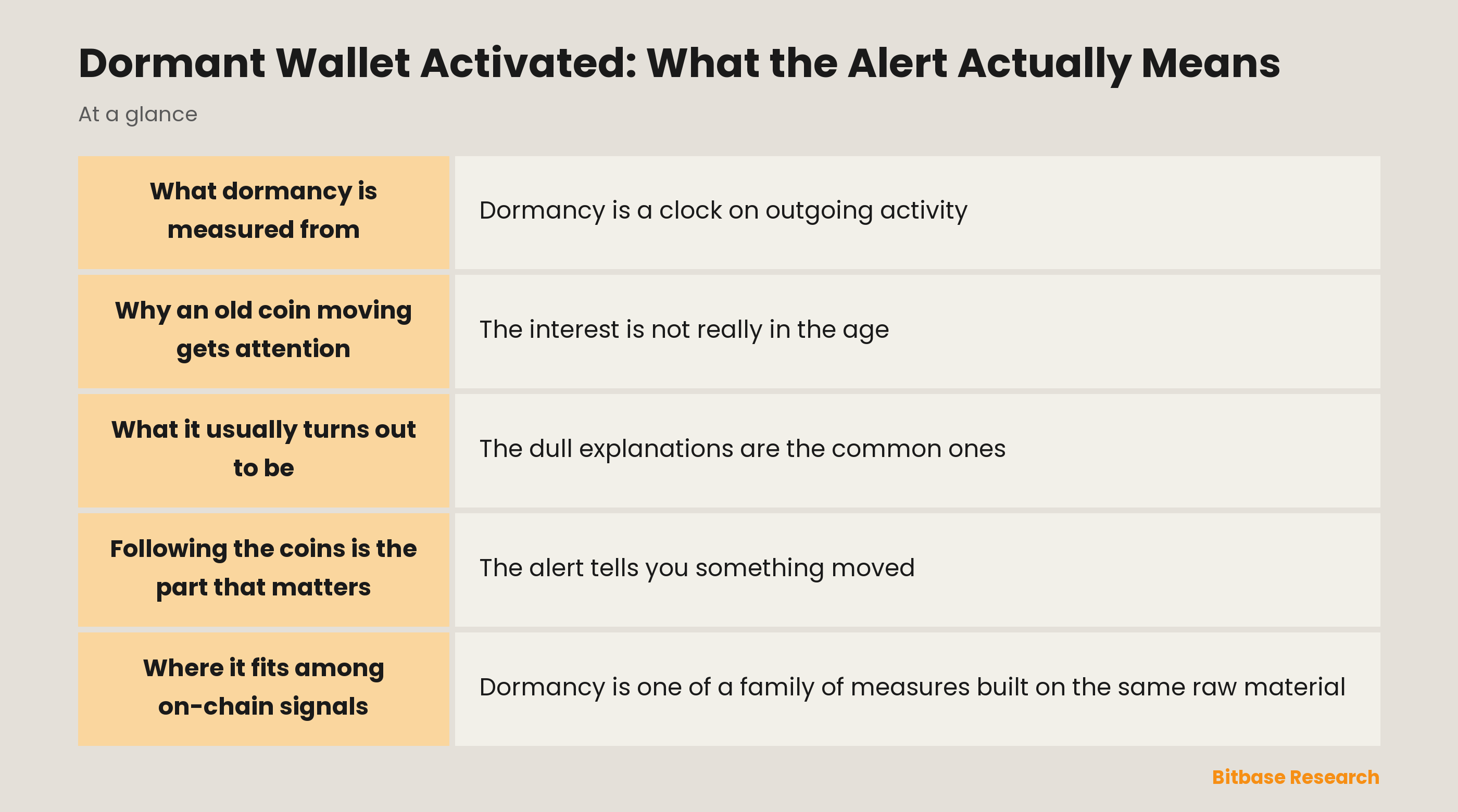
Dormancy is a clock on outgoing activity. It starts when coins arrive somewhere and it keeps running until they leave. Money coming in does not reset it, and neither does the price of the asset, the owner checking a balance, or the wallet software being reinstalled. Nothing that happens off the chain touches the clock, because the chain only records movement.
What exactly the clock attaches to depends on how the chain keeps its books. On a chain that tracks individual coins, age belongs to each coin — one address can hold a piece received last week next to a piece received years ago, and moving the new piece leaves the old one asleep. On a chain that tracks account balances, there are no individual pieces, so the clock is a property of the account: it measures when that account last sent anything. The difference between those two models is the reason two analytics dashboards can disagree about whether the same holder is dormant.
Why an old coin moving gets attention
The interest is not really in the age. It is in the assumption that whoever has sat still through several market cycles is unusually well informed or unusually patient, so a change of behaviour must mean something.
That assumption is doing a lot of work. It requires that the address still has the same owner it had years ago, that the owner chose the moment deliberately, and that the destination tells you their intention. Each of those can fail on its own, and they fail often.
What it usually turns out to be
The dull explanations are the common ones, and they look identical on the chain to the dramatic ones.
Custodians reorganise. A business that holds coins for other people periodically consolidates, splits, or rotates its storage, and each rotation wakes up whatever was sitting in the old location. Nothing was bought or sold; the same entity now holds the same amount somewhere else.
People upgrade. A holder who set up a wallet years ago and has since moved to better hardware has to send the coins to the new one. The move looks exactly like a sale being prepared, right up until the coins settle in another address that then goes quiet again.
Estates and companies change hands. Inheritance, a business restructuring, or a divorce settlement all produce a transfer of long-idle coins that has nothing to do with anyone's price view.
And sometimes the coins were never really dormant in the intended sense. An address may have been holding on behalf of many people the whole time, in which case its stillness never reflected one person's conviction.
Following the coins is the part that matters
The alert tells you something moved. The destination is where the actual information is, and reading it is a job for a block explorer rather than for the headline.
Coins that land on an address belonging to a trading venue have at least been placed where selling is possible. That is a meaningfully different picture from coins that move to a fresh address and stop, which is what a security upgrade looks like, or coins that split into many pieces, which is what a distribution to several recipients looks like.
Two cautions apply to all of it. The labels that tell you an address belongs to a particular business are inferred, not published by the chain, so they carry the confidence of whoever built the heuristic. And a deposit is not a sale — coins can sit on a venue for a long time, or be withdrawn again, without anything being sold.
Where it fits among on-chain signals
Dormancy is one of a family of measures built on the same raw material: which coins moved, how old they were, and how much they were worth when they last moved. Read together with the rest of on-chain analysis, the family is useful for describing what long-term holders as a group are doing over months.
Read as a single-event alarm about one address, it is much weaker. One large holder moving coins is an anecdote, and the chain does not record why.
The bottom line
"Dormant wallet activated" is a fact about the chain and an invitation to guess about everything else. The fact is narrow: coins that had not moved in a long time moved.
Before treating it as a signal, look at where they went, remember that address labels are inferences rather than records, and keep in mind that the most frequent reason for old coins to move is housekeeping rather than conviction. To keep learning the fundamentals, follow more from Bitbase Academy.
Related reading
Other Bitbase articles on this topic:
- Sentiment and Developer Activity
- Coin-Margined vs USDT-Margined Futures: Which Contract to Trade
Disclaimer: This article is educational content from Bitbase Academy, provided for information only. It does not constitute investment, trading, tax, or financial advice. Crypto assets are volatile; assess your own risk. Written as of September 2026; refer to the latest official information.
References
[1] Meiklejohn, Pomarole, Jordan, Levchenko, McCoy, Voelker & Savage, "A Fistful of Bitcoins: Characterizing Payments Among Men with No Names" (IMC 2013) cseweb.ucsd.edu
[2] Glassnode Docs, "Coin Days Destroyed (CDD)" docs.glassnode.com
[3] Bitcoin Developer Guide, "Transactions" developer.bitcoin.org
[4] ethereum.org, "Ethereum accounts" ethereum.org