The business of a brokerage is getting paid when customers transact, so eToro Group's results read as a measure of how busy retail investors are rather than of whether markets are rising. On Bitbase the ticker does not appear as a share at all: it appears as a tokenized stock issued by Dinari, and that is a third object with rules of its own.
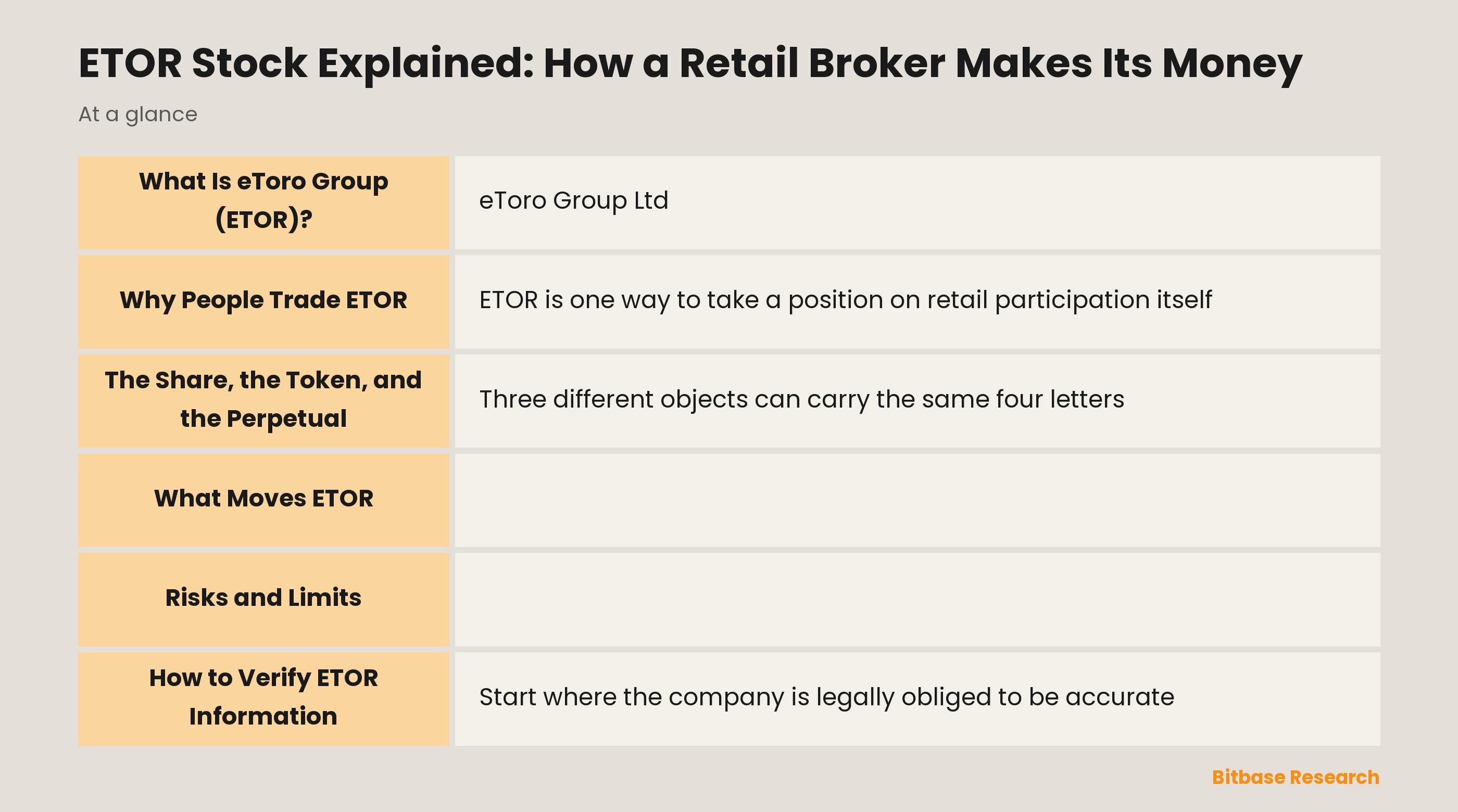
What Is eToro Group (ETOR)?
eToro Group Ltd. runs a retail trading and investing platform. Users hold stocks, ETFs, cryptoassets, commodities, currencies and index products in one account, and the feature the platform is built around is social: users can publish their positions, and other users can copy them automatically. That design is why the company describes itself as an investment community rather than an order-routing service.
The listed entity is a foreign issuer. Its prospectus describes "eToro Group Ltd., a company organized under the laws of the British Virgin Islands", with operations run from Israel, and states that its Class A common shares were approved for listing on the Nasdaq Global Select Market under the symbol ETOR. It registered the offering on Form F-1 and files current reports on Form 6-K, the forms a foreign private issuer uses rather than the quarterly Form 10-Q of a US domestic filer.
The revenue definition rewards reading directly, because it is broader than the word commission suggests. In the company's wording: "Our Total Commission represents commission from trading activities (the gross commission, fees and other forms of income collected from users while engaging in trading activity on our platform) and also includes interest income, fees generated through eToro Money, and fees from other services." Trading spreads, interest earned on client balances and service fees all land in the same line.
The group does not operate as a single regulated entity. It runs through separately licensed subsidiaries, among them eToro (Europe) Ltd under the Cyprus Securities and Exchange Commission, eToro (UK) Ltd under the Financial Conduct Authority, and eToro AUS Capital Limited under the Australian Securities and Investments Commission. Each licence defines what that entity may offer and to whom.
Why People Trade ETOR
ETOR is one way to take a position on retail participation itself. The distinction between a broker and an exchange matters here: a broker sits in the path of its customers' orders and is paid out of that flow, so the variable driving it is how much people trade, not what they conclude about any single asset.
Cryptoassets are part of that flow, which is why the ticker gets discussed alongside crypto-linked equities. Whether a listed company's crypto exposure runs through fees earned on customer activity, through assets it holds on its own balance sheet, or through both, is the first question to ask about anything described as a crypto proxy. eToro's own definition puts commission from trading activity at the centre of its top line, and that is a statement about activity rather than about the price of any coin.
The share structure is the third reason the ticker draws attention, and it cuts both ways. The prospectus states that each Class A common share is entitled to one vote, while each Class B common share is entitled to ten votes and is convertible at any time into one Class A common share. The class that trades is the low-vote class, and the holders of the high-vote class keep control. Traders who care about float dynamics watch that structure; anyone who cares about governance reads it as a limit.
The Share, the Token, and the Perpetual
Three different objects can carry the same four letters, and only one of them is the company's share.
The share is a Class A common share, bought through a broker with access to Nasdaq. It is an ownership interest in a British Virgin Islands company, it carries one vote, and it brings whatever rights that company's constitution and the listing rules provide.
A tokenized stock is a token issued by a third party. The Bitbase price page for this ticker names it eToro Group (Dinari Tokenized Stock), so the issuer here is Dinari, and Dinari's structure is specific to Dinari. Its documentation describes a dShare as a token backed one-for-one by a security, with tokens created or destroyed only after the corresponding brokerage order settles through its broker partner. Dividends are calculated and distributed once the cash reaches the issuer, with a minimum below which nothing is paid out. The documentation also states that the tokens have not been registered under the US Securities Act and may not be offered or sold in the United States or to a US person. Trading is not one continuous market: regular US hours, extended pre-market and post-market sessions that accept limit orders only, an overnight session, and a session running around the clock that covers a limited set of tickers with thinner liquidity.
This is the point at which a general description of tokenized securities stops being enough. Backing, dividend handling, eligible holders and trading sessions differ from issuer to issuer, and a sentence that is true of one issuer's product can be false of another's. Read the issuer named on the page in front of you.
A perpetual futures contract is the third object, and it holds nothing at all. It tracks a price with leverage, charges or pays funding to stay near that price, and can be liquidated. Which tickers carry a spot market or a perpetual is a property of the venue's lineup rather than of the company, and the tokenized stock lineup is where that list is kept current.
What Moves ETOR
Copying, not just individual decisions. Commission from trading activity is the top line, and on a platform built around copying, that activity does not arrive one account at a time: when a widely copied trader opens or closes a position, the mirrored orders land together, so volume concentrates instead of spreading out. What the line responds to is volume and volatility rather than the sign of the move. A violent week in either direction can produce more of it than a calm week of gains. The chart of the market and the chart of a broker's revenue are not the same chart.
Interest rates. Interest income sits inside that same Total Commission line, so the policy rate reaches the company through client balances rather than through trading at all. When rates fall, that component falls with them, and nothing about customer behaviour has to change for it to happen.
The regulatory perimeter, one licence at a time. Because the group operates through separately licensed subsidiaries, rule changes arrive unevenly. A leverage cap, a restriction on how cryptoasset products may be marketed, or a new authorisation regime affects the entity it applies to and the users that entity serves, not the whole group at once. A headline about a rule in one jurisdiction is therefore not automatically a group-wide event.
Share supply. A dual-class structure changes the size of the traded class over time. Class B shares are convertible at any time into Class A shares, and registered sales by existing holders add to the class that trades. Supply that arrives this way has nothing to do with how the business is performing, and it shows up in filings before it shows up in the news.
Reporting rhythm. A foreign private issuer files current reports on Form 6-K and an annual report on Form 20-F rather than following the quarterly cadence of a US domestic filer. Longer gaps between disclosures mean more of a year's repricing lands on fewer days, and the calendar of those days is something you can look up in advance.
Risks and Limits
Issuer risk is not company risk. Holding a tokenized stock exposes you to the issuer's structure, eligibility rules and redemption terms as well as to the company's business. Those terms are set by the issuer and can be changed by the issuer, in documentation separate from anything the company or the venue publishes.
Session mismatch. The primary listing trades during Nasdaq hours. A token that can trade outside those hours can move on news while the market that sets the reference price is shut, and liquidity outside regular hours is thinner by construction. Sessions also differ by ticker for this issuer, so availability has to be checked per ticker.
Leverage, where it applies. A perpetual holds no underlying asset, charges funding, and can be liquidated. That is a different risk profile from either the share or the token, and treating three instruments as one position is how people end up with exposure they did not intend to take.
The business itself. Retail brokerage revenue is cyclical, price competition on commissions is real, and the group's ability to serve users in a given country depends on permissions it does not control. A long, quiet market is a headwind that never announces itself as bad news.
Governance. With ten votes attached to one class and one vote to the other, the shares that trade carry limited influence over decisions. A tokenized version of those shares sits a further step away, and it is the issuer's documentation, not the company's, that defines what a token holder actually has.
How to Verify ETOR Information
Start where the company is legally obliged to be accurate. Its filings sit on the SEC's EDGAR system under its registrant name: the Form F-1 filed for the offering carries the business description, the risk factors and the share-class mechanics, and the Forms 6-K that follow carry the reporting after it. The risk factor section shows which variables the company itself treats as material.
The company's investor relations pages carry results releases and the calendar of when they appear. For a foreign private issuer that calendar is worth having, because disclosure arrives less often than it does from a quarterly filer.
For the token, go to the issuer. Dinari's documentation is the authority on backing, on how and when dividends are handled, on the trading sessions, and on who may hold the product. It is a separate document from anything the company publishes, and it answers different questions.
For what exists on Bitbase under this ticker, the price page is the reference, and the lineup page shows which tickers carry a spot market or a perpetual.
Conclusion
ETOR is a share in a brokerage, and a brokerage is exposed to activity rather than to direction. The company is incorporated in one place, run from another, regulated through several licensed subsidiaries, and listed on Nasdaq with two share classes that vote differently. On Bitbase the ticker is a tokenized stock issued by Dinari, which gives economic exposure on that issuer's terms rather than a share and the vote attached to it. Knowing which of the three objects you are holding comes before every other question you might ask about it.
Related market pages
Bitbase pages for the tokenized stocks named in this article:
- ETOR: View price
Related reading
Other Bitbase articles on this topic:
- Crypto Has No Price Per Share: What It Has Instead
- Crypto in the Name Does Not Make It a Crypto Stock
- Crypto or Stocks: The Six Measures That Decide It
- How to Trade PLTR: Palantir Without Owning the Share
Disclaimer: This article is educational content from Bitbase Academy, provided for information only. It explains what a company or fund does and how the instruments referenced here differ from one another; it does not constitute investment, trading, tax, or financial advice, and it is neither a recommendation nor an endorsement of any security, token, or trading strategy. A tokenized stock is issued by a third party and is designed to give economic exposure to an underlying asset: it is not a share, it carries no shareholder rights, and it depends on the issuer's structure, eligibility rules, and redemption terms, which the issuer can change. Perpetual futures are leveraged derivatives that hold no underlying asset and can be liquidated, and trading hours, product availability, and eligibility differ by instrument and by jurisdiction and can change at any time. Written as of September 2026; verify everything yourself through company filings, the issuer's own documentation, and the product pages of the venue you trade on.
References
[1] eToro Group Ltd. prospectus filed with the SEC: place of incorporation, Nasdaq listing and symbol, share classes and the definition of Total Commission www.sec.gov
[2] Dinari documentation: what a tokenized share is, one-for-one backing, how tokens are created and redeemed, and who may hold them docs.dinari.com
[3] Dinari documentation on trading hours: regular, pre-market, post-market and overnight sessions, and the round-the-clock session that covers only some tickers docs.dinari.com