A perpetual position can show a gain on screen while the account balance moves the other way. Funding is what separates the two numbers: a cash transfer that arrives on a schedule of its own, measured against the size of the contract rather than the money you put up, and indifferent to whether the price moves at all. Here is where the payment lands, what it is charged on, and how far it shifts the price at which you break even.
Two numbers that move for different reasons
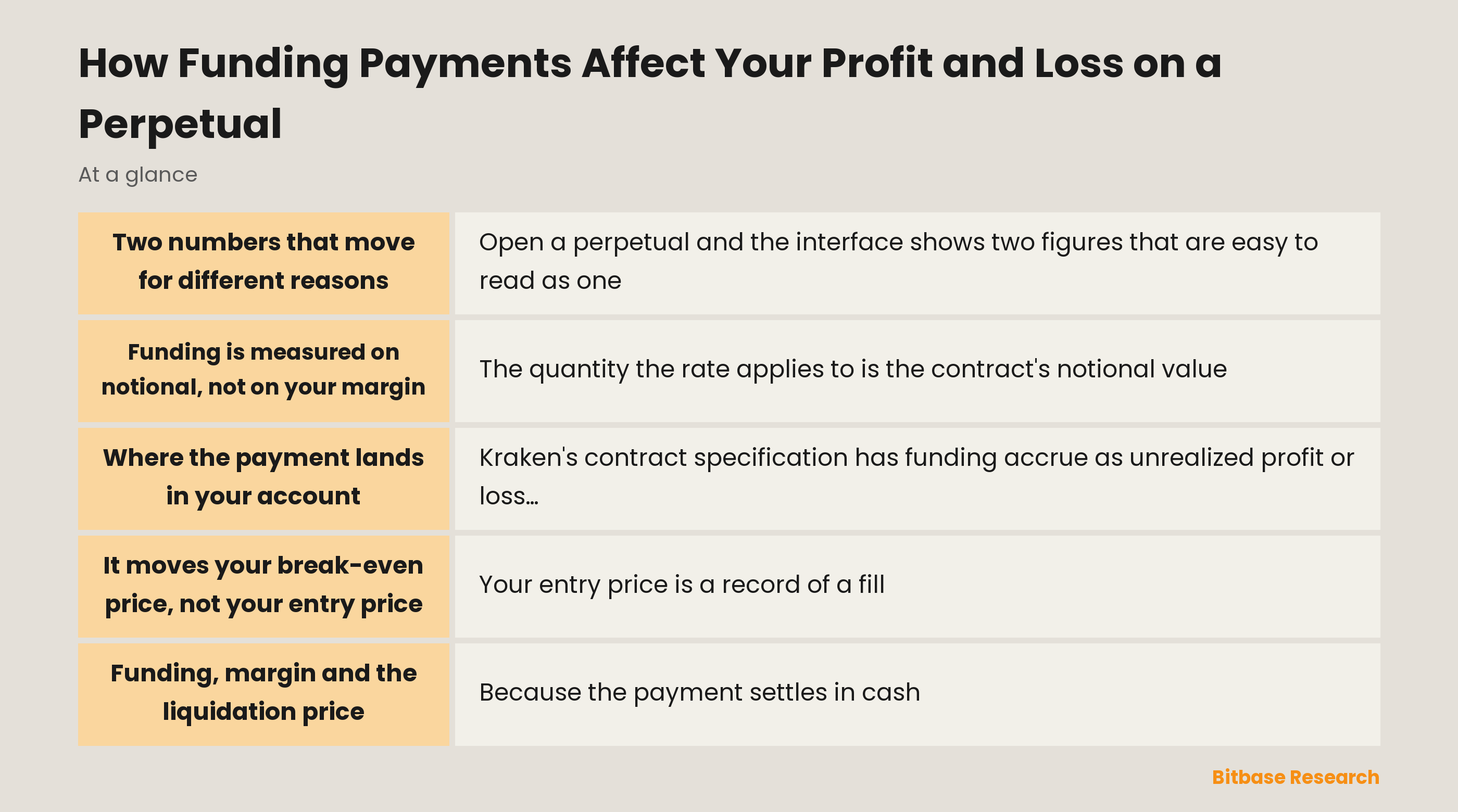
Open a perpetual and the interface shows two figures that are easy to read as one. The first is the position's unrealized PnL, the gain or loss the open contract currently carries. The second is the account balance, the cash that is actually sitting there. Price moves the first. Funding moves the second, on a clock of its own.
The funding rate is a periodic payment exchanged between the long side and the short side of the same contract. Deribit describes the arrangement as a zero sum game, where longs receive all funding from shorts, or shorts receive all funding from longs, and states that it does not charge any fees on funding. The accounting consequence is that the money leaves one trader and arrives at another; it is not a charge the venue keeps.
Because it is a transfer rather than a valuation, funding does not wait for you to do anything. A price move stays provisional until the position is closed. A funding payment is assessed at its own moment and then it is settled.
Funding is measured on notional, not on your margin
The quantity the rate applies to is the contract's notional value, not the collateral you posted. Kraken's contract specification writes the absolute funding payout as the number of contracts multiplied by the absolute funding rate and by the time elapsed within the funding period without position alteration. Nothing in that expression refers to your margin.
That is why the same rate bites harder at higher leverage. Post 1,000 USDT at 10x and the notional is 10,000 USDT. The rate is applied to the 10,000 USDT figure, while the effect is felt against the 1,000 USDT figure. Leverage does not change the rate; it changes the ratio between the amount being charged and the amount you have at risk.
Read the other way, this also says what funding is not. It is not interest on a borrowed portion of the position, and it is not a fee for the use of margin. A position of the same notional held without leverage pays exactly the same amount.
A worked example over ten days
Take that 10,000 USDT position and suppose funding is assessed at 0.01% of notional, three times a day, and stays there. Each assessment is 1 USDT. That is 3 USDT a day, and 30 USDT after ten days.
The same 30 USDT can be quoted against two different denominators, and the two answers feel very different.
| What the payment is measured against | Total paid | As a share of that base |
|---|---|---|
| Notional of 10,000 USDT | 30 USDT | 0.3% |
| Margin of 1,000 USDT | 30 USDT | 3% |
Both rows are arithmetically correct. The second row is the one that describes what happened to your account. A constant rate was assumed here to keep the example readable; a real schedule differs from one assessment to the next, and the rate can change sign.
Where the payment lands in your account
Kraken's contract specification has funding accrue as unrealized profit or loss through the hour and settle at the end of the funding period, or when the trader changes the net open position, whichever comes first. Which line a given statement files it under is a reporting choice; the cash movement it records is the same either way.
That makes the line names on your own statement worth reading once, carefully. If funding is folded into a position's realized result, trading performance and carrying cost are being reported as one number. If it sits on its own line, the two are separable and you can see which of them produced the result.
The distinction has one blunt consequence. A position opened and closed at the same price is not a flat outcome if it was held across assessments. The price contributed nothing and the funding line contributed the entire result.
It also means the total cost of holding a perpetual is a function of how many assessments you sit through, not of how many calendar days the position was open. Those two coincide only when the schedule is even and the position is held right across it.
It moves your break-even price, not your entry price
Your entry price is a record of a fill. Nothing later edits it, and funding does not. What funding edits is the price at which closing the position leaves you level.
Continue the example. A long that has paid 30 USDT needs the contract to gain 30 USDT before the round trip is level, which on a 10,000 USDT notional is 0.3% of price movement. The break-even price has drifted 0.3% away from you, and it keeps drifting for as long as the position sits on the paying side.
Reverse the sign and the same arithmetic runs the other way. A short in that market collects the 30 USDT, so its break-even price drifts toward it: the position can be closed 0.3% below the entry price and still come out level. That is the entire content of the word carry.
The side you are on decides the sign
Direction is fixed by the sign of the rate and the side you hold. Kraken states it plainly: if the funding rate is positive, long positions pay short positions; if negative, short positions pay long positions.
| Funding rate | If you are long | If you are short |
|---|---|---|
| Positive | You pay | You receive |
| Negative | You receive | You pay |
Two readings of that table are worth resisting. Receiving funding is not evidence that the position is correct; it says only that you are on the side the mechanism is currently paying. And paying funding is not a verdict that it is wrong: a position can pay funding for weeks and still close in profit, or collect it for weeks and still close in loss.
Funding, margin and the liquidation price
Because the payment settles in cash, it changes the equity supporting the position, and equity is what the liquidation price is measured from. Each payment made shortens the distance to that level; each payment received lengthens it.
The valuation side is a separate mechanism. An open position is marked against the mark price, and your own funding payments do not move it. Funding acts on the equity in that comparison, not on the price in it.
So the number to recompute is the liquidation level, not the entry. A liquidation price written down when the position was opened is out of date after the first assessment, and by the end of the ten days above the margin behind it is 3% smaller.
The bottom line
Funding is a cash transfer between the two sides of a perpetual, charged against notional and assessed on a schedule that has nothing to do with when you choose to close. It leaves your entry price alone, it moves the price at which you break even, and it shrinks or grows the equity your liquidation level is measured from.
Run the arithmetic before opening rather than after closing: at 10x, an assessment of 0.01% three times a day comes to 3% of margin over ten days while the price does nothing at all. Read the funding line separately from the price line, and the two numbers on the screen stop contradicting each other. To keep learning the fundamentals, follow more from Bitbase Academy.
Related reading
Other Bitbase articles on this topic:
- Automatic Margin Addition Explained: What It Does to Your Liquidation Price
- Coin-Margined vs USDT-Margined Futures: Which Contract to Trade
- What Is Margin Trading in Crypto? Borrowing to Trade Bigger
- Floor Price Manipulation on Non-Fungible Token Marketplaces
- What Is a Watch-Only Wallet?
Disclaimer: This article is educational content from Bitbase Academy, provided for information only. It does not constitute investment, trading, tax, or financial advice. Crypto assets are volatile; assess your own risk. Written as of September 2026; refer to the latest official information.
References
[1] Kraken Support, Linear Multi-Collateral Derivatives Contract Specifications (funding rate section) support.kraken.com
[2] Deribit Insights, Perpetual Swap Funding insights.deribit.com