Galaxy Digital sells two things that do not move together: institutional access to digital asset markets, and computing capacity on a campus in Dickens County, Texas. GLXY is the single ticker sitting on top of both. This profile covers what the company does, what drives the stock, and why the token carrying this ticker on a crypto venue is not a share.
What Is Galaxy Digital (GLXY)?
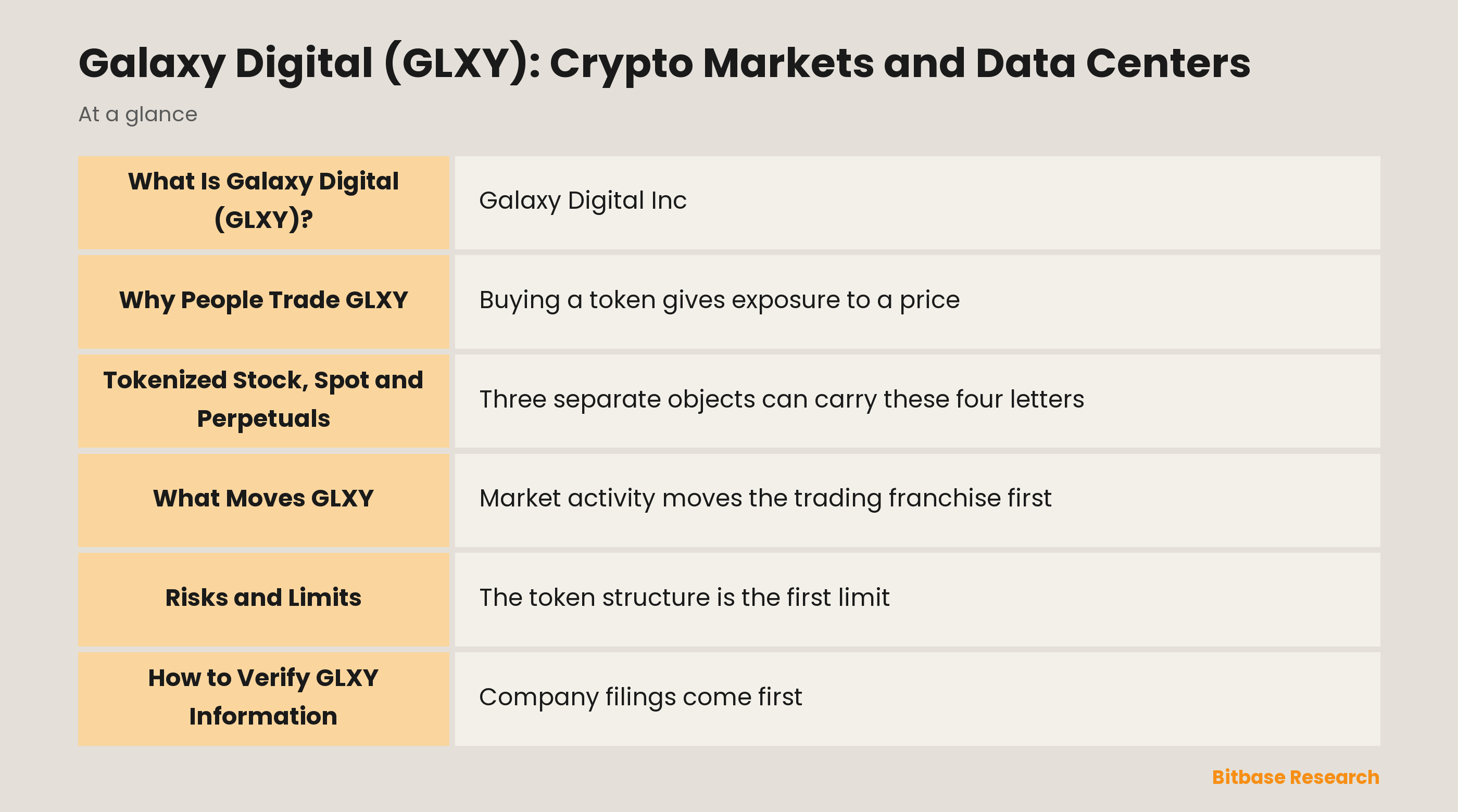
Galaxy Digital Inc. is incorporated in Delaware and its stock trades on Nasdaq under GLXY. Its filing record with the Securities and Exchange Commission classifies it under security brokers and dealers, which is a fair first approximation of one of the three businesses below.
The company describes three segments. Global Markets is that intermediary business: spot and over-the-counter execution, derivatives, secured lending and structured products, investment banking, and staking services. It is the part of Galaxy that belongs in the same conversation as prime brokers and OTC desks, on the sell side of trades institutions want done away from a public order book.
Asset Management and Infrastructure Solutions holds the fund business — private funds, exchange-traded funds and venture vehicles — alongside the on-chain plumbing: staking, tokenization and custody technology.
Data Centers is the segment that has nothing to do with either of those. Galaxy's Helios campus in Dickens County, Texas started life as a bitcoin mining facility and is being rebuilt for artificial intelligence and high-performance computing workloads.
Why People Trade GLXY
Buying a token gives exposure to a price. Buying GLXY gives exposure to a business that earns from other people trading tokens, through spreads, financing and fees, which is a different shape of exposure: it does not need the market to rise, only to be busy.
The data center segment is the second reason. Power capacity contracted to computing tenants prices off a demand curve with no crypto in it, and it ended up inside a crypto company because the land, the grid connection and the buildings were already there from mining.
The third reason is that the two can be weighted against each other. Someone who thinks power-dense computing capacity is scarce reads this ticker differently from someone who wants a listed proxy for the crypto cycle, and both buy the same share.
Tokenized Stock, Spot and Perpetuals
Three separate objects can carry these four letters, and only the first is the company's stock.
A share of Galaxy Digital is registered equity bought through a broker, and holding it makes you a shareholder.
A tokenized stock is issued by a third party, and the structure differs by issuer: the phrase covers several legal forms rather than one. The Bitbase price page for this ticker names a Robinhood Token, and Robinhood's own description is explicit. Its stock tokens are "derivative contracts between you and Robinhood," priced at the prices of the underlying securities "without granting rights to them." The underlying assets are owned by Robinhood and held with a US-licensed institution, and the holder receives no rights to the underlying shares. When the underlying pays a dividend, Robinhood passes a corresponding amount to eligible holders in cash rather than as a shareholder entitlement. Trading runs from Monday 2 AM to Saturday 2 AM Central European Time: long, but not continuous. The issuing entity is Robinhood Europe, UAB, supervised by the Bank of Lithuania.
That is one issuer's answer. Other tokenized securities are built on different structures, and they differ exactly where it matters: backing, rights and hours.
A perpetual futures contract is the third object. It holds nothing at all, tracks a price with leverage, and can be liquidated. Which tickers carry a spot market or a perpetual differs by name, and the tokenized stock lineup is where that is set out.
What Moves GLXY
Market activity moves the trading franchise first. Revenue there follows volumes, spreads and financing demand rather than the direction of any one token, so a violent quarter can be a good one and a quiet rally can be a poor one.
Fee income moves more slowly. Assets under management in funds and exchange-traded products rise and fall with the prices of what they hold, so that line follows the crypto cycle with a lag the trading line does not have.
Data center milestones move the stock on a separate clock. Energization, tenant contracts and the pace at which approved power becomes usable capacity are construction questions, and news on them can reprice the shares on a day when crypto has not moved at all.
The conversion itself is a driver. Every megawatt redirected from mining to hosting swaps an income stream priced in bitcoin economics for one priced in leases, and the market re-rates that swap as it happens.
Counterparty conditions matter more here than at an operating company. A business that lends, borrows and faces institutions across derivatives is exposed to who fails, not only to what prices do.
Risks and Limits
The token structure is the first limit. A derivative contract with an issuer is not a claim on Galaxy Digital, and eligibility rules, contract terms and the treatment of corporate actions are set by that issuer and can change.
Session mismatch is the second. The token trades on a weekly window that runs well past the close of the market where the underlying stock trades, so news breaking outside those hours is priced into the token first, with no way to act in the primary market until it reopens. A perpetual, where one exists, adds funding cost and a liquidation price on top of that.
The business risks come last, and they do not cancel each other out. Crypto intermediation is cyclical; a data center build is capital-intensive and depends on power, permitting and tenants. Holding both inside one share spreads the revenue mix and concentrates the execution risk.
How to Verify GLXY Information
Company filings come first. Galaxy Digital Inc. files with the Securities and Exchange Commission, and its EDGAR record carries the annual and quarterly reports where the segment breakdown and the risk factors are stated in the company's own words.
For the token, go to the issuer. Robinhood publishes the terms of its stock tokens on its own European site, and that document, not the company's filings and not the venue's listing, is the authority on what the instrument is and when it trades.
For what exists on the venue itself, the price page carries the quote, and the lineup of tokenized listings shows which tickers carry a spot market or a perpetual.
Conclusion
GLXY is two businesses in one ticker: an institutional digital asset franchise that earns from activity, and a data center campus that earns from leases. The first makes it a crypto-linked equity; the second makes it something else, and the balance between them is the thing to have a view on. On a crypto venue the same four letters appear as a token issued by a third party, and under this issuer that token is a derivative contract rather than a share: no shareholder rights, cash in place of dividends, and a trading week set by the issuer. Knowing which object an order actually buys is the first decision, not the last.
Related market pages
Bitbase pages for the tokenized stocks named in this article:
- GLXY: View price
Related reading
Other Bitbase articles on this topic:
- Crypto Has No Price Per Share: What It Has Instead
- Crypto in the Name Does Not Make It a Crypto Stock
- Crypto or Stocks: The Six Measures That Decide It
- Russell 2000 Futures Trading: How RTY Tracks a Rebuilt Index
Disclaimer: This article is educational content from Bitbase Academy, provided for information only. It explains what a company or fund does and how the instruments referenced here differ from one another; it does not constitute investment, trading, tax, or financial advice, and it is neither a recommendation nor an endorsement of any security, token, or trading strategy. A tokenized stock is issued by a third party and is designed to give economic exposure to an underlying asset: it is not a share, it carries no shareholder rights, and it depends on the issuer's structure, eligibility rules, and redemption terms, which the issuer can change. Perpetual futures are leveraged derivatives that hold no underlying asset and can be liquidated, and trading hours, product availability, and eligibility differ by instrument and by jurisdiction and can change at any time. Written as of September 2026; verify everything yourself through company filings, the issuer's own documentation, and the product pages of the venue you trade on.
References
[1] Galaxy: company overview, with the three business segments in the company's own words www.galaxy.com
[2] Galaxy: the Helios campus in Dickens County, Texas, and its conversion from bitcoin mining www.galaxy.com
[3] Robinhood Europe: the terms of its stock tokens, including their status as derivative contracts and the trading week robinhood.com
[4] SEC EDGAR company search: the filing record for Galaxy Digital Inc., with the annual and quarterly reports www.sec.gov