A proposal closes with 6,000,000 votes recorded, against a circulating supply of 100,000,000 tokens. Is that a 6% turnout, a 30% turnout, or simply a proposal that passed? All three descriptions can be true of the same vote, because a participation rate is a division and the denominator is picked by whoever quotes the number.
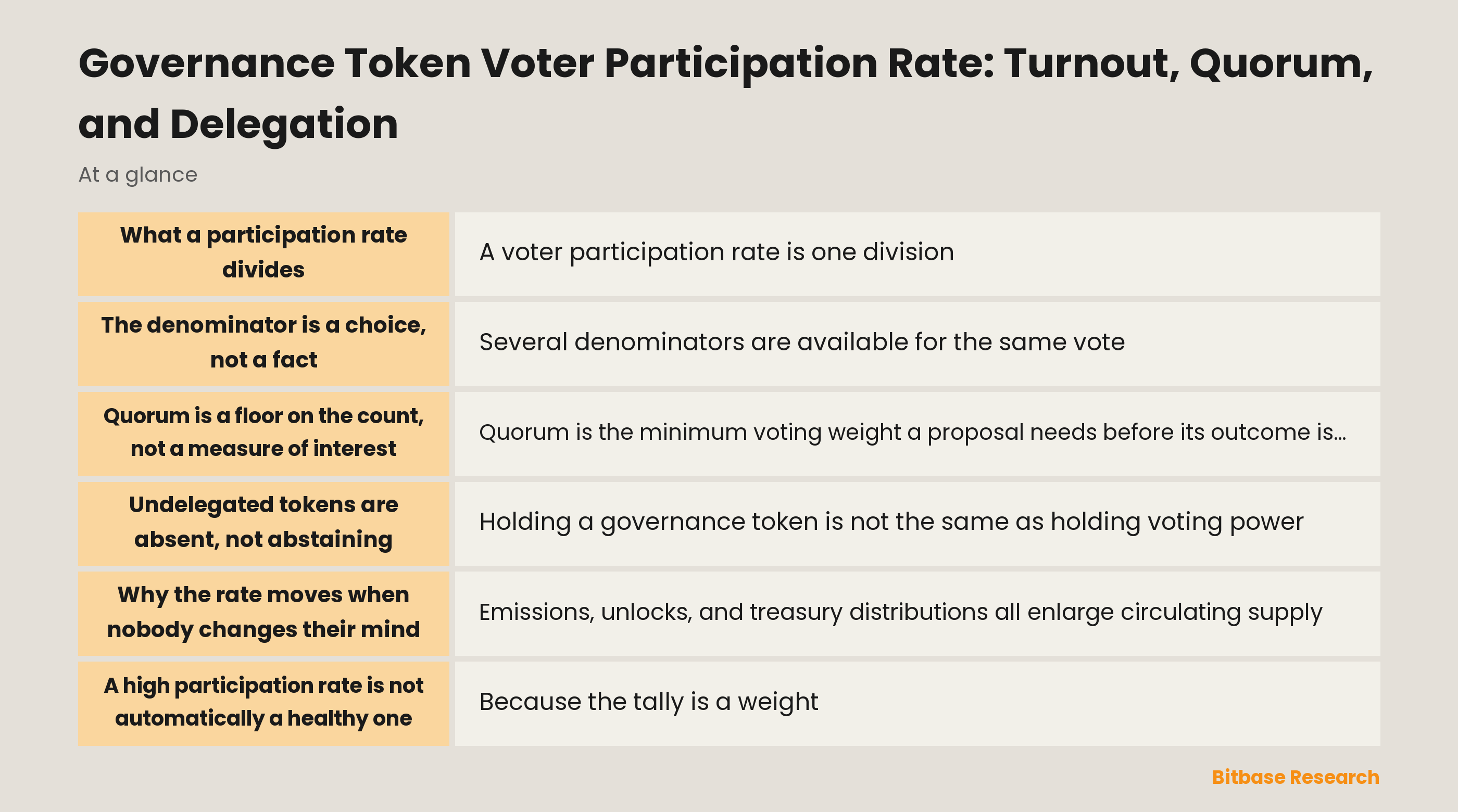
What a participation rate divides
A voter participation rate is one division: the voting weight recorded on a proposal, over the voting weight that could have been recorded. Neither half arrives from the chain as a single ready-made field. Both are constructed, and the construction is where two dashboards can report different figures for the same proposal without either of them being wrong.
The numerator looks like the settled half, and it is not. A system that counts one token as one vote produces a weight; a system that counts one address as one vote produces a headcount. Those answer different questions, and a governance token design fixes which of the two you are measuring long before any proposal is written.
The numerator also depends on which ballot options get added up. In OpenZeppelin's simple counting module, voters are offered three options, for, against, and abstain, and only the for and abstain votes are counted toward quorum. A participation figure that sums all three options and a quorum figure that sums two of them are therefore different numbers pulled from the same tally.
The denominator is a choice, not a fact
Several denominators are available for the same vote. Circulating supply asks what share of tradeable tokens took part. Total supply asks the same question of every token that exists, including those locked or held by the treasury. Delegated voting power asks what share of the weight that was actually able to vote did so. A count of holding addresses drops weight entirely and asks how many participants showed up.
These are not variations on one measurement. Moving from circulating supply to delegated voting power can multiply the reported rate several times over, because the second denominator has already excluded every token that was never wired up to vote. Quoting a rate without naming its denominator hands the reader a number that cannot be checked and cannot be compared with the next one.
The denominator is also fixed in time. OpenZeppelin's quorum module defines quorum as a percentage of the total supply at the block a proposal's voting power is retrieved, and voting power itself is read from past snapshots rather than from current balances, which prevents the same tokens from voting twice. Tokens bought after that block carry no weight on that proposal, so the denominator stops moving while the market does not.
Quorum is a floor on the count, not a measure of interest
Quorum is the minimum voting weight a proposal needs before its outcome is allowed to stand. Set at 4% of a circulating supply of 100,000,000, it is a threshold of 4,000,000 votes, and a tally of 6,000,000 clears it. The participation rate implied by that same tally against that same supply is still 6%.
Quorum is enforced by the governance smart contracts rather than by convention, so a proposal that falls short does not become a weakly supported decision. It becomes no decision at all, and the state the contracts were asked to change stays as it was.
What a quorum does not do is raise participation. It converts a thin turnout into a failed proposal instead of a passed one, which protects the protocol from a handful of votes rewriting its parameters, and leaves the underlying question of who is voting exactly where it was.
Undelegated tokens are absent, not abstaining
Holding a governance token is not the same as holding voting power. OpenZeppelin's documentation is explicit that it is delegates who carry voting power: a holder who wants to participate can set a trusted representative as their delegate, or become a delegate themselves by self-delegating. Compound's documentation describes the same step, with token holders delegating their voting rights to themselves or to an address of their choice.
The consequence for the metric is direct. A balance that was never delegated is not a vote against and not an abstention. It sits outside the tally on both sides, which means a participation rate measured against circulating supply is quietly reporting two separate failures at once: holders who never delegated, and delegates who received power and then did not use it.
Delegation is also a transaction, with a fee to pay and a deadline to meet, since it has to be recorded before the proposal's snapshot block. A holder who delegates the day after a controversial proposal opens has done everything right and still carries no weight on it. That timing gap is one reason a rate measured against supply can stay low while interest in a particular vote is high.
The same vote read three ways
Suppose that of the 100,000,000 tokens circulating, 20,000,000 have been delegated to an address able to cast them, which is 20% of the supply. The 6,000,000 votes recorded on the proposal are then 6% of circulating supply and 30% of the weight that could actually be cast.
| Denominator | What it answers | This example |
|---|---|---|
| Circulating supply | Share of tradeable tokens that voted | 6% |
| Delegated voting power | Share of votable weight that voted | 30% |
| Holding addresses | How many participants voted, weight ignored | Not derivable from weight |
| Quorum threshold | Whether the outcome stands at all | Cleared, at 4,000,000 |
Read together, the two rates say something the headline figure alone cannot. The distance between 6% and 30% is a delegation gap rather than apathy among delegates, and the two gaps call for different responses: one is a wiring problem in how holders connect to the vote, the other is a question of whether delegates are doing the job they were given.
The row that resists arithmetic is the third one. A weight-based tally cannot tell you how many distinct participants stood behind it, because 6,000,000 votes is the same number whether it came from one delegate or from thousands. If you want the headcount, it has to be counted separately from the weight.
Why the rate moves when nobody changes their mind
Emissions, unlocks, and treasury distributions all enlarge circulating supply. Hold the number of active voters and the weight they control constant, enlarge the denominator underneath them, and the reported participation rate falls. Nothing about voter behaviour changed; the supply schedule set out in the project's tokenomics did the work.
The reverse also happens. A large holder who self-delegates adds nothing to the number of participants and a great deal to the votable weight, which lifts a supply-based rate and can lower a delegation-based one at the same time. A DAO comparing participation across quarters therefore has to hold its denominator definition fixed, or the trend line it draws will be describing its own supply curve.
A high participation rate is not automatically a healthy one
Because the tally is a weight, a single delegate holding a large share can carry a proposal past quorum on their own and produce a participation figure that looks like broad engagement. The rate rises, the number of people involved does not, and the two facts are perfectly compatible.
That is a concentration question rather than a turnout question, and it needs its own measurement. A concentration metric such as the nakamoto coefficient asks how few independent entities would be enough to reach a stated threshold, which is precisely the question a participation rate leaves untouched. Reporting turnout beside concentration keeps a strong number from standing in for an answer it never contained.
The bottom line
A governance token voter participation rate is a ratio, and the ratio is only as informative as its two halves. Ask what the numerator counted, whether abstentions were included, which denominator was used, and at which block that denominator was frozen. When two figures are quoted for one proposal, check whether they are answers to two different questions before treating them as a contradiction.
Quorum tells you whether the result stands, not how many people wanted it. Delegation decides which tokens were eligible to appear in the tally at all. And a rate measured on weight says nothing about how many hands that weight sat in, which is why turnout and concentration belong in the same report. To keep learning the fundamentals, follow more from Bitbase Academy.
Related reading
Other Bitbase articles on this topic:
- How to Revoke a Governance Delegation
- Why a Token Migration Asks for a Wallet Approval
- Token Migration Completed but New Tokens Are Not in Your Wallet
- Fractional Ownership of a Non-Fungible Token and Where the Risk Sits
- What Is ATH (All-Time High)?
Disclaimer: This article is educational content from Bitbase Academy, provided for information only. It does not constitute investment, trading, tax, or financial advice. Crypto assets are volatile; assess your own risk. Written as of September 2026; refer to the latest official information.
References
[1] OpenZeppelin Contracts Documentation 5.x, Governance docs.openzeppelin.com
[2] Compound Documentation, Governance (Compound v2) docs.compound.finance