The withdraw button stops working, a message says the account is under review, and the reply from support says less than you asked. An appeal is the move that exists here, and it works only if you know what it is. It is not a request to reconsider a decision. It is a submission of evidence into a process that is obliged to weigh evidence, and the failures start with a misreading of that one sentence.
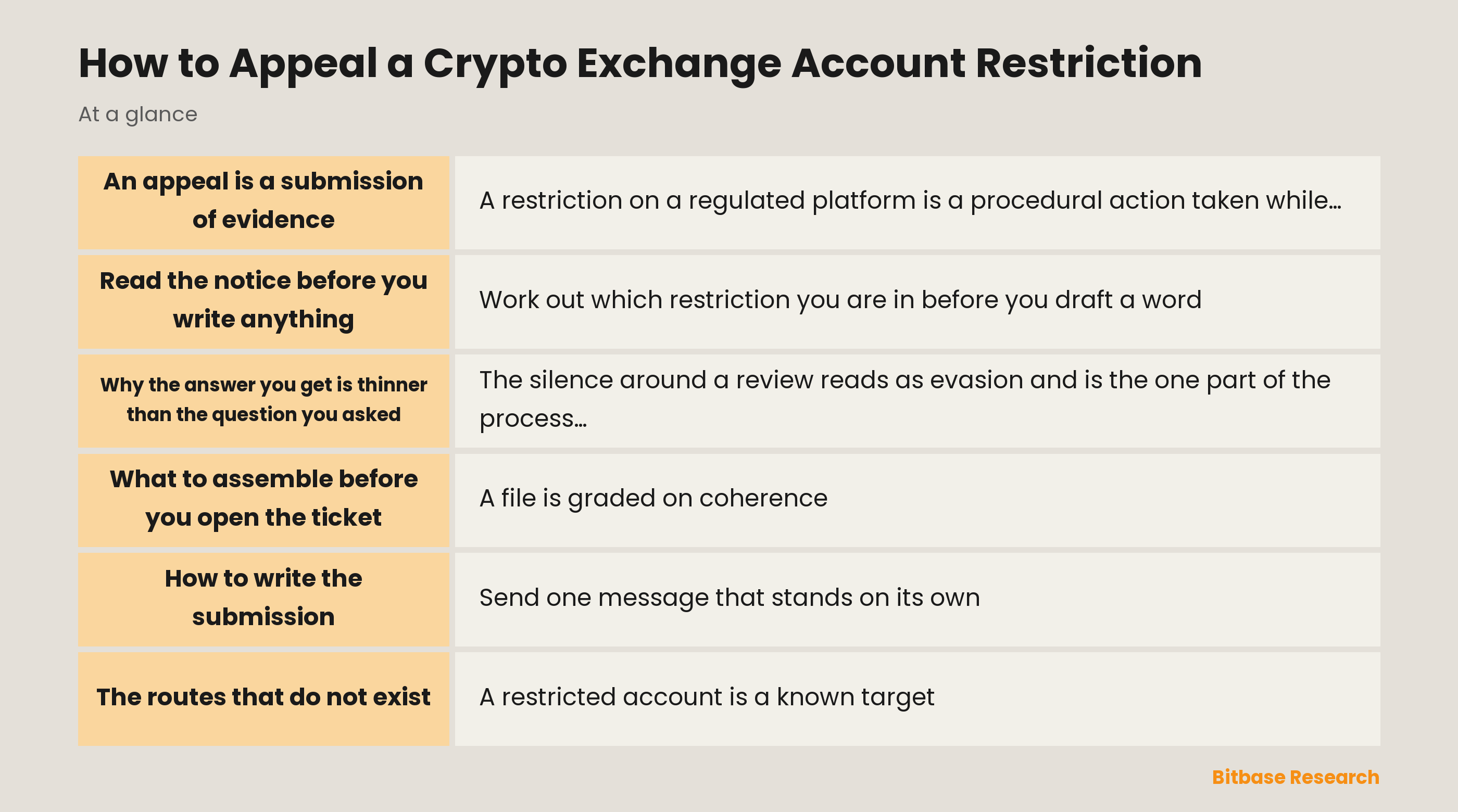
An appeal is a submission of evidence
A restriction on a regulated platform is a procedural action taken while something is settled, not a finding against you. Identity checks, monitoring and holds are obligations the platform inherits, which is why strict account controls sit outside the range of things a platform decides for itself. The reviewer who reads your appeal is not the system that imposed the restriction. What they have in front of them is a file: the account record, the activity that raised a question, and whatever you have supplied.
European data protection law puts the shape of the right plainly. Where a decision produces legal or similarly significant effects and was taken by automated processing alone, the person affected has the right to obtain human intervention on the part of the controller, to express his or her point of view and to contest the decision. Read those three parts separately. You are entitled to a human reader, to state your case, and to dispute the outcome. You are not entitled to a particular result, and no framework promises one.
That is why the register you write in changes nothing and the documents you attach change everything. An appeal adds to the file; it cannot subtract from it. Urgency, indignation and a threat to go public are each readable by a reviewer as none of the things a review is required to consider.
Read the notice before you write anything
Work out which restriction you are in before you draft a word, because the answer decides whether an appeal is even the right instrument. The notice carries two pieces of information: what it names, and whether it names an end.
A notice that names a ticker rather than your account is not about you. A funding suspension attached to an asset closes deposits and withdrawals for every holder while a contract or a chain is replaced, and it ends when that work finishes. Nothing you submit moves its timing.
A notice that names your account and a waiting period is a security hold placed behind a change to a credential or a withdrawal destination. It exists because the platform cannot separate you from someone holding your password, and it ends by elapsing. Appealing it asks the platform to do the one thing the control was built to refuse.
A notice that names your account, says services are limited pending review, and gives no end date is the case an appeal is built for. Kraken words its own version of this as a determination that it is necessary to restrict certain account services and features to keep the account secure and remain compliant with regulatory requirements, with funding unavailable until a member of its team has completed a review of the account.
That last sentence contains the whole strategy. The review is the thing that ends the restriction, and evidence is the only input a review takes.
Which restrictions an appeal can move
| What the notice describes | What put it there | What actually ends it |
|---|---|---|
| Withdrawals paused after a settings change | A timed security hold | The waiting period elapsing |
| Deposits and withdrawals closed in one asset | A migration or a chain upgrade | The migration completing |
| Sign in blocked, codes sent to a device you lost | An authenticator you no longer control | A recovery request, not an appeal |
| Services limited pending review, no end date | A compliance review | The review, which your evidence feeds |
| An account closed | A decision already taken | A request for a second review |
The third row is the one people misfile. If the obstacle is a code arriving somewhere you cannot reach, the queue you need is account recovery, where the platform detaches one authenticator and attaches another after grading your request against the identity record it already holds. Filed as an appeal, it lands with a team that has nothing to action.
Why the answer you get is thinner than the question you asked
The silence around a review reads as evasion and is the one part of the process that is not discretionary. In the United Kingdom, section 333A of the Proceeds of Crime Act 2002 makes it an offence for a person in the regulated sector to disclose that an investigation into an alleged money laundering offence is being contemplated or carried out, where that disclosure is likely to prejudice the investigation, and where the information came to them in the course of regulated business. Conviction on indictment carries up to two years imprisonment. Where a comparable prohibition applies under another national law, the consequence for your appeal is the same.
A support agent working under that rule cannot tell you which transfer raised the question, cannot confirm whether a report of suspicious activity was made, and cannot commit to a date. None of those refusals carries information about your case. Reading the thin answer as bad faith, and writing the next message on that assumption, spends the only resource an appeal has, which is a reviewer's attention.
What to assemble before you open the ticket
A file is graded on coherence, not on volume. The reviewer is asking whether identity information, the stated purpose of the account, the timing of the activity, and an explanation of the money can describe the same story without contradicting each other. Four things carry that weight: identity documents that match what was submitted at sign-up, a dated account of the activity in question written in plain language, records from the counterparty side of the transfers in view, and evidence of the source of funds behind them.
Keep the last two apart, because they answer different questions. A transaction record shows that value moved at a particular time. A source explanation says what economic event generated that value. Sending a wall of transfer confirmations in place of an explanation answers a question nobody asked.
Assemble the set before you open the ticket rather than after. A review that reopens each time a further document arrives is a review that keeps restarting, and every restart is another reading queue.
How to write the submission
Send one message that stands on its own. Give the account identifier, the date the restriction appeared, the text of the notice you received, a chronological account of the activity, and a list of what is attached with each file named for what it shows. A reviewer who has to reconstruct the sequence from six messages is reconstructing rather than deciding.
Answer the question that was asked. If the request names one transfer, the reply is about that transfer, with the surrounding context stated once. Broad statements about your intentions are not evidence, and volunteering unrelated financial history widens the review instead of closing it.
Use one channel. The same request pushed through a web form, an email thread and a social media reply becomes several tickets that each hold part of the answer, and the reviewer sees whichever fragment reaches them first.
The routes that do not exist
A restricted account is a known target. Impersonation accounts on social platforms and messaging apps appear around exactly this moment, offering the thing the real process refuses to offer, which is speed. Any request to pay a release fee, move funds to a holding address, share a seed phrase or read out a login code is fraud in progress, and Bitbase customer service does not ask for any of those.
There is no faster route on the inside either. There is no person to negotiate with, no signal to have removed, and no paid service that can act on a review it is not party to. The system is built to weigh evidence, and the matching response is to supply it.
When to escalate, and to whom
Escalation is a separate process from an appeal, not a quicker version of it, and it opens after the platform's own process has produced an answer you disagree with. Filing a complaint while the review is still running does not add a reviewer; it adds a queue.
Published timetables tell you when that point has arrived. Kraken's complaint handling page commits to confirming receipt within 5 business days, contacting you within 10 business days if more information is needed, and responding within 15 business days, with 30 to 35 business days for complex matters. The same platform notes that restrictions applied for scam prevention can only be lifted after a period of 90 days, which is a case where the answer to an appeal is a date rather than a decision.
Beyond the platform, the route depends on where it is authorised. Kraken's own page names the Financial Ombudsman Service in the United Kingdom, the Financial Services and Pensions Ombudsman and the FIN-NET network in the European Union, the Australian Financial Complaints Authority, the Ombudsman for Banking Services and Investments in Canada, and state regulators or the Consumer Financial Protection Bureau in the United States. Check which body covers the entity you actually hold an account with, because a platform operating through several licensed entities does not answer to one authority everywhere.
The bottom line
An appeal against an account restriction is an evidence submission with a human reader at the end of it. Establish which restriction you are in first, because a timed security hold and an asset-level suspension both end on their own and neither takes input. For a review, assemble identity, activity, counterparty records and a source explanation, send them once, in order, through one channel.
Expect the answer to be thinner than the question, because the law that governs a reporting institution makes it so. Expect the process to take the time its published timetable says it takes, and treat that timetable as the marker for when a complaint becomes the right next step rather than a second copy of the same one. To keep learning the fundamentals, follow more from Bitbase Academy.
Related reading
Other Bitbase articles on this topic:
- Corporate Crypto Account Verification: KYC Requirements for a Business
- Crypto Dust Conversion and the Records It Leaves
- Missed the Withdrawal Deadline on a Delisted Token
- The NFT Reveal Process Explained: What Changes and When
Disclaimer: This article is educational content from Bitbase Academy, provided for information only. It does not constitute investment, trading, tax, or financial advice. Crypto assets are volatile; assess your own risk. Written as of September 2026; refer to the latest official information.
References
[1] Regulation (EU) 2016/679 (General Data Protection Regulation), Article 22, Automated individual decision-making, including profiling gdpr-info.eu
[2] Proceeds of Crime Act 2002, section 333A, Disclosing information likely to prejudice investigation, United Kingdom legislation legislation.gov.uk
[3] Kraken Support, Why is my account restricted? support.kraken.com
[4] Kraken Support, Complaint Handling Process: A Complete Guide support.kraken.com