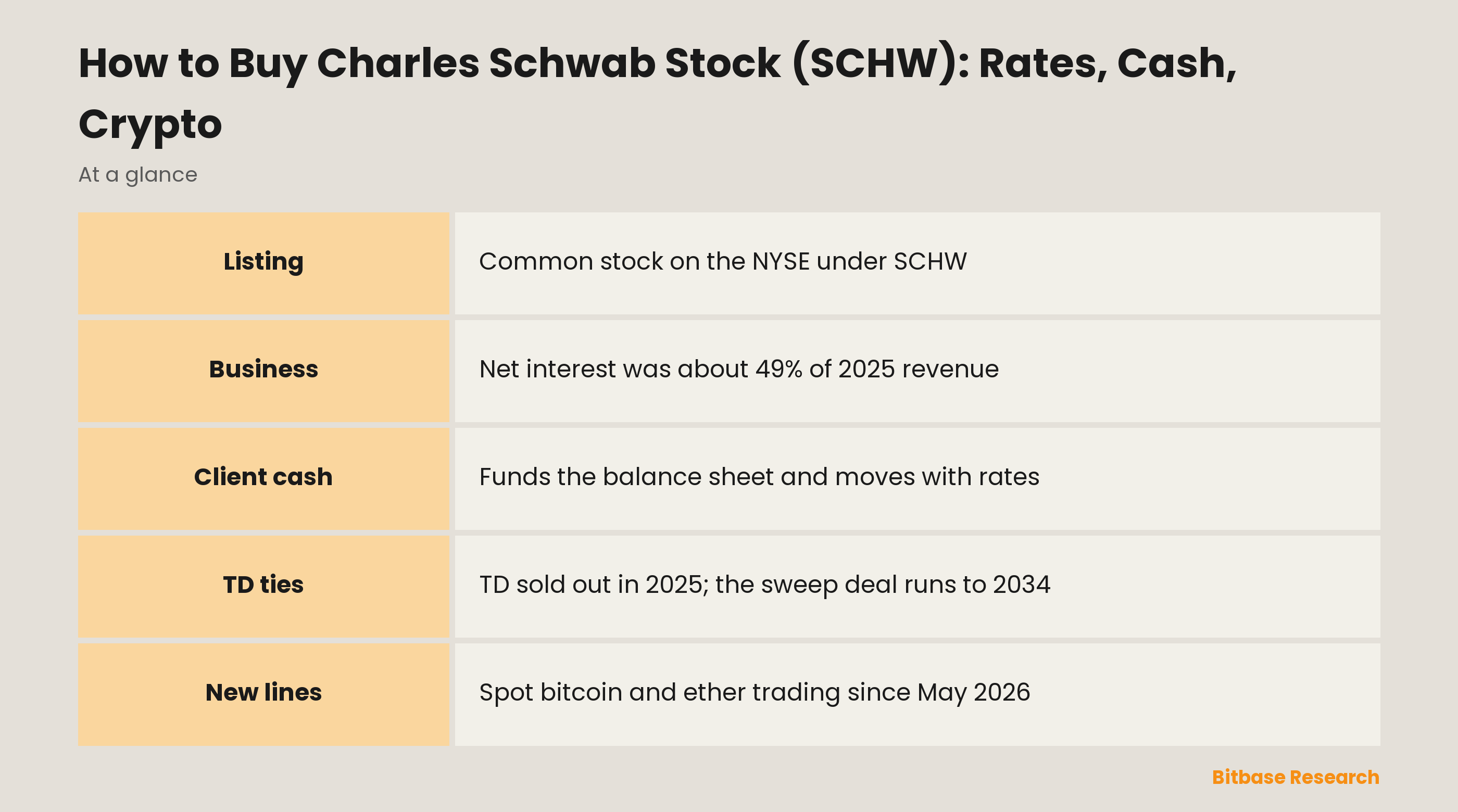
You need nothing more than a brokerage account with New York Stock Exchange access to buy Charles Schwab stock, which trades there as SCHW, and that account can be at any broker, Schwab's own included. The business behind it earns less from trading than its name suggests: in 2025, net interest revenue, earned largely on cash clients leave uninvested, was about 49% of net revenues. This guide covers how Schwab makes money, how to place the order, and what its filings flag, from rates and client cash to a TD deposit deal running to 2034 and a crypto offer launched in May 2026.
What Does Charles Schwab Do?
The Charles Schwab Corporation owns a broker, a bank and an asset manager; its annual report calls it "a savings and loan holding company" engaged, through its subsidiaries, "in wealth management, securities brokerage, banking, asset management, custody, and financial advisory services." The broker-dealer, Charles Schwab & Co., was incorporated in 1971 and the parent in Delaware in 1986. Since 1 January 2021 the designated headquarters has been Westlake, Texas, not San Francisco.
Charles Schwab Bank, SSB, the principal bank, lends through first mortgages, home equity lines and pledged asset lines backed by clients' portfolios, and Charles Schwab Investment Management advises the Schwab Funds and Schwab ETFs, among them the dividend fund covered in the SCHD guide.
Two segments divide the clients. Investor Services serves individuals, from newer investors using Schwab Stock Slices to wealthy families, plus workplace retirement and stock plans. Advisor Services gives independent registered investment advisers (RIAs) custody, trading, banking and support. There, the 10-K says, Schwab earns money "predominantly through net interest revenue and asset management and administration fees" and does "not charge the RIA or end client a custody fee."
One deal set today's shape. Schwab completed its acquisition of TD Ameritrade Holding Corporation on 6 October 2020, issuing common stock and a newly created nonvoting class, part of it to TD Bank and its affiliates. More than 17 million client accounts moved onto Schwab's platform in five groups, the last in May 2024; the Ameritrade name survives in Schwab Trading Powered by Ameritrade, home of the thinkorswim platform. On 12 February 2025 a TD affiliate sold its Schwab common shares in a secondary public offering and Schwab bought back the remaining nonvoting shares directly. TD has held no Schwab stock since, and none of the offering proceeds went to Schwab.
Two newer lines are being added: Forge Global, a marketplace for shares in pre-IPO companies, acquired on 2 March 2026, and Schwab Crypto, a phased rollout of spot bitcoin and ether trading for retail clients that began in May 2026.
How Charles Schwab Makes Money
Net revenues grew 22% in 2025, at the same rate in both segments; Investor Services produced about 79.4% and Advisor Services about 20.6%. By type of income:
| Revenue line | Share of 2025 net revenues | Change from 2024 | What drives it |
|---|---|---|---|
| Net interest revenue | 49.1% | Up 28% | Yields on bonds, margin loans and bank loans, minus funding costs |
| Asset management and administration fees | 27.2% | Up 14% | Money market funds, mutual funds, ETFs, managed portfolios |
| Trading revenue | 16.4% | Up 20% | Commissions, order flow payments, fixed income trading |
| Bank deposit account fees | 4.1% | Up 34% | Client cash swept to TD's US banks |
| Other | 3.2% | Up 2% | Income outside the four main lines |
Shares are calculated from the 10-K's dollar amounts and rounded to one decimal.
Cash is the base of the largest line. The 10-K states that "Schwab's primary funding source for interest-earning assets is uninvested client cash balances held on our balance sheet." That money is lent out or invested, mostly in high-quality bonds, and because Schwab sets the rate it pays on the cash, the spread between the two drives earnings. The 28% rise in 2025 came mainly from paying down expensive borrowing and cheaper funding.
Asset management fees follow the value of client holdings; the company tied their 14% rise to higher balances from market gains, new assets and growth in managed investing and money market funds. Trading revenue rose 20%, "due primarily to higher trading volume." About 8.1% of total net revenues came from order flow revenue, defined in the 10-K as "payments received from trade execution venues to which our broker-dealer subsidiary sends equity and option orders"; it grew 31%.
The deposit fees rest on a contract. Under the 2023 insured deposit account (IDA) agreement, uninvested cash in eligible brokerage accounts is swept off Schwab's balance sheet to TD Bank USA and TD Bank, N.A., and Schwab earns a service fee of 15 basis points on it. The agreement runs through 1 July 2034 and keeps the balances between a set minimum and maximum. All told, the pre-tax profit margin was 47.9% in 2025.
SCHW Stock at a Glance
| Field | SCHW |
|---|---|
| Exchange | New York Stock Exchange (NYSE) |
| Ticker | SCHW |
| Security | Common stock of The Charles Schwab Corporation |
| Other listed securities | Two series of depositary shares in preferred stock, SCHW PrD and SCHW PrJ |
| Sector | Financials: brokerage, wealth and asset management, banking, custody |
| Regulator | Federal Reserve, which supervises it as a savings and loan holding company |
| Index membership | S&P 500 |
| Headquarters | Westlake, Texas |
| Incorporated | Delaware, 1986 |
| Fiscal year | Calendar year, ending 31 December |
| Dividend policy | Quarterly cash dividend, last raised in January 2026 |
| SEC identifier | CIK 316709 |
For the live price, market value and yield, open the Charles Schwab stock page on Bitbase.
How to Buy Charles Schwab Stock
SCHW is itself the common stock of a US company, with no depositary receipt in between. Any broker that reaches the NYSE can fill the order, Schwab's own brokerage among them; owning the shares does not require a Schwab account, and this guide does not compare brokers. The steps:
1. Confirm market access. Outside the United States, use a local broker that offers US shares or an international one, and learn which company keeps your assets and under which regulator.
2. Open the account and settle your tax status. Non-US individuals generally give the broker IRS Form W-8BEN, which certifies foreign status for US withholding.
3. Add money. A currency conversion has its own price, so weigh the FX spread next to the trading fee.
4. Find the right line. Search SCHW and check that the result is The Charles Schwab Corporation common stock on the NYSE. SCHW PrD and SCHW PrJ are preferred depositary shares, a different security with its own dividend terms.
5. Set the order type. Investor.gov reminds investors that "the last-traded price is not necessarily the price at which a market order will be executed." A limit order names the worst price you accept and fills only at that price or better.
6. Decide whole or fractional. Fractions let you invest a fixed sum, but Investor.gov notes that not every firm offers them, some take only market orders for them, and a fraction may carry no vote.
7. Save the records. Confirmations and statements are your evidence of cost basis and dividends.
Non-US residents face withholding on US dividends. The IRS puts most US-source income paid to foreign persons at 30%, with a lower rate or exemption where a tax treaty applies, and the W-8BEN is how that rate reaches your account. Your home country may tax the payout as well.
Through a fund, you hold Schwab alongside hundreds of other companies: S&P 500 index funds include it, as the FAQ shows.
What Moves SCHW Stock
Interest rates and client cash. With about half of revenue from net interest, rates feed straight into earnings. Schwab's simulation on a static balance sheet from 31 December 2025 shows net interest revenue over the next twelve months rising 4.1% if rates climb gradually by one percentage point and falling 4.4% if they drop by as much. Behavior counts too: when short-term rates jumped in 2022 and 2023, clients moved money out of sweep cash into higher-yielding products, and "the Company extensively utilized higher-cost funding sources, which negatively impacted the Company's net income." Most of that borrowing is gone: bank supplemental funding fell 90% during 2025. Client cash was 9.7% of client assets at the end of 2025, against 10.5% two years earlier, a ratio worth checking every quarter.
Markets and asset gathering. Client assets ended 2025 up 18%, lifted by markets and by core net new assets that grew 42%. A long market slide would shrink the base that fees are charged on even if no client left.
Trading and order routing. Clients' daily average trades rose 31% in 2025, as fast as order flow revenue. The 10-K names "rules relating to order routing and order-related revenues" among changes that could hit profitability. On 12 June 2025 the SEC withdrew proposals including its Order Competition Rule and Regulation Best Execution. Broker revenue tables show how listed firms separate trading income from interest.
The TD agreement. The IDA contract binds part of Schwab's cash until 2034. Its balance commitments "limit our ability to respond to changes in interest rates," the 10-K says, and its fees "may be less than the net interest revenue that we could have earned" on Schwab's own balance sheet. Since 10 September 2025 Schwab may withdraw balances above the minimum, and it has started moving some back.
Capital and payouts. As a Category III banking organization, Schwab may leave most unrealized bond losses, held in accumulated other comprehensive income (AOCI), out of regulatory capital; a 2023 proposal would make it count them. It already manages to an adjusted Tier 1 leverage ratio that includes AOCI, targeting 6.75% to 7.00% over the long term, and the ratio was 7.1% at the end of 2025. Capital above that range funds dividends, raised twice since early 2025, and buybacks under an authorization from July 2025 with no expiration date.
New products. Charles Schwab Premier Bank holds Schwab Crypto clients' assets as custodian, with Paxos Trust Company providing sub-custody and trade execution, and the third-quarter 2026 release said more digital assets are planned. The June 2026 quarterly report lists the risks, from custody failures to how client crypto would be treated in an insolvency.
Risks to Weigh Before Buying SCHW
These headings from Item 1A of the 10-K speak most directly to a shareholder:
Client cash. "A significant change in client cash allocations could negatively impact our income." The 2022 and 2023 shift above is the company's own example.
Interest rates. "Significant interest rate changes could affect our profitability." Falling rates squeeze asset yields; rising rates lift funding costs and can add unrealized bond losses, which "can reduce market or client confidence in us."
Security. "Security breaches of our systems, or those of our clients or third parties, may subject us to significant liability and damage our reputation." For a custodian, safekeeping is the product.
Regulation. "Extensive regulatory supervision of our businesses may subject us to significant penalties or limitations on business activities." Banking, securities and futures regulators all oversee parts of the group.
Competition. "Our industry is highly competitive and characterized by aggressive price competition." The filing names rivals only by type, from banks to fintech firms.
Digital assets. Crypto exposes the company to "new and uncertain financial, operational, legal, and regulatory risks," and the June 2026 quarterly report adds that client crypto held through Schwab Crypto "is not a deposit or a security and is not protected by the FDIC or the Securities Investor Protection Corporation (SIPC)."
Litigation. A 2022 class action alleged the TD Ameritrade deal harmed competition in executing retail orders. A settlement of non-monetary commitments and fees the company calls immaterial won final court approval on 24 November 2025; some objectors have appealed.
Then the share itself. The 10-K counts "sales of a substantial number of shares by large stockholders" among things that can move the price, the kind of event TD's 2025 exit was. One stock concentrates your outcome in one company, every dividend needs board approval within capital rules, and for anyone counting returns in another currency, the dollar rate shifts both price and payout.
How to Research SCHW Yourself
Schwab files with the SEC under CIK 316709 and reposts the reports on aboutschwab.com. The 10-K is annual, 10-Qs cover the first three quarters, and 8-Ks carry events in between, including each earnings release; the third-quarter 2026 release was filed on 15 October 2026.
In the 10-K, Item 1 explains the segments and the four main revenue sources, Item 1A the risks, and the MD&A breaks revenue down by line and segment. The rate simulation sits in the risk management section, the IDA terms in the commitments note, and the shareholder return graph benchmarks SCHW against the S&P 500 and the Dow Jones U.S. Investment Services Index.
Two checks help. The 2025 report's structured cover, R1.htm, lists three registered securities, and only the common stock is plain SCHW. And the rate simulation holds the balance sheet fixed, so, as the 10-K concedes, it "does not capture changes to client cash allocations"; read it beside each quarter's cash figures. For other companies, browse the US stock pages on Bitbase.
Charles Schwab Stock FAQ
Does Charles Schwab pay a dividend?
Yes, quarterly in cash. On 29 January 2026 the board declared a 19% increase, following an 8% rise in early 2025. Under the terms of its Series L preferred stock, Schwab's ability to pay common dividends is restricted if the preceding preferred dividend has not been paid or set aside. Each declaration, with its amount and payment date, is filed on Form 8-K.
Can I buy Charles Schwab stock with crypto?
Not directly. SCHW is bought through a brokerage account in US dollars, so crypto must be sold and the cash deposited first, and that sale may be taxable where you live. Schwab began offering spot bitcoin and ether trading to retail clients in May 2026, but its quarterly report stresses that crypto held through Schwab Crypto is not a security, so the coins and the shares stay separate holdings. An ownership stake that pays dividends and votes is how stocks differ from crypto.
Is Charles Schwab a bank?
The parent is a savings and loan holding company that has elected financial holding company status under Federal Reserve supervision. It owns three banks: Charles Schwab Bank, SSB and Charles Schwab Premier Bank, SSB, both Texas-chartered savings banks, and the Nevada-chartered Charles Schwab Trust Bank. The brokerage, Charles Schwab & Co., is a separate SEC-registered broker-dealer.
Does TD Bank still own Schwab stock?
No. On 12 February 2025 a TD affiliate sold its common shares in a secondary offering and Schwab repurchased the remaining nonvoting shares; the 10-K says TD "disposed of all of its common shares" and no nonvoting stock remains. The IDA agreement still links the two until 2034.
Is SCHW in the S&P 500?
Yes. SCHW appeared in the 16 October 2026 holdings of SPY, State Street's S&P 500 trust, and of XLF, its Financial Select Sector SPDR ETF, as one position among many. Weights shift daily; the fund files show the current figure.
Has Charles Schwab stock ever split?
Yes. Schwab's 2001 proxy statement says its share data reflect "the May 2000 three-for-two stock split," so older per-share prices and dividends need adjusting before comparison.
Conclusion
Placing the order is simple: a broker with NYSE access, the common stock instead of a preferred line, a market or limit order. Knowing what you own takes longer. SCHW is largely a claim on client cash and client assets, with about half its revenue riding on the spread it earns on cash. Read the latest 10-K and quarterly release, watch where client cash is heading, and weigh SCHW as one company whose results ride on rates and on what clients do with their cash.
Related reading
Other Bitbase articles on this topic:
- How to Buy Anheuser-Busch InBev Stock (BUD): ADS, Brussels, Corona
- How to Buy ATT Stock (T): Dividend, Fiber Push and Mexico Sale
- How to Buy Danaher Stock (DHR): Bioprocessing, Masimo, Spin-offs
- How to Buy Novo Nordisk Stock (NVO): ADR, Wegovy and Ozempic
- How to Buy Qualcomm Stock (QCOM): Chips, Royalties and Perps
Disclaimer: This article is educational content from Bitbase Academy, provided for information only. It explains what a company or fund does and how the instruments referenced here differ from one another; it does not constitute investment, trading, tax, or financial advice, and it is neither a recommendation nor an endorsement of any security, token, or trading strategy. A tokenized stock is issued by a third party and is designed to give economic exposure to an underlying asset: it is not a share, it carries no shareholder rights, and it depends on the issuer's structure, eligibility rules, and redemption terms, which the issuer can change. Perpetual futures are leveraged derivatives that hold no underlying asset and can be liquidated, and trading hours, product availability, and eligibility differ by instrument and by jurisdiction and can change at any time. Written as of October 2026; verify everything yourself through company filings, the issuer's own documentation, and the product pages of the venue you trade on.
References
[1] The Charles Schwab Corporation Form 10-K, fiscal 2025: business, segments, revenue, risk factors and capital (SEC EDGAR) www.sec.gov
[2] Charles Schwab Form 10-Q for the quarter ended 30 June 2026: Schwab Crypto, Forge, dividend and crypto risk factors (SEC EDGAR) www.sec.gov
[3] Charles Schwab third-quarter 2026 results release, 15 October 2026 (Form 8-K, Exhibit 99.1) www.sec.gov
[4] Charles Schwab Form 10-K, fiscal 2021: completion of the TD Ameritrade acquisition and headquarters designation (SEC EDGAR) www.sec.gov
[5] Charles Schwab Form 8-K, April 2026: Series L preferred stock issue and dividend restrictions (SEC EDGAR) www.sec.gov
[6] Charles Schwab proxy statement, March 2001: share data adjusted for the May 2000 stock split (Form DEF 14A) www.sec.gov
[7] State Street SPDR S&P 500 ETF Trust (SPY): fund page and daily holdings www.ssga.com
[8] State Street Financial Select Sector SPDR ETF (XLF): fund page and daily holdings www.ssga.com
[9] Investor.gov (SEC): Types of Orders www.investor.gov
[10] Investor.gov (SEC): Investor Bulletin on fractional share investing www.investor.gov
[11] IRS: NRA Withholding www.irs.gov