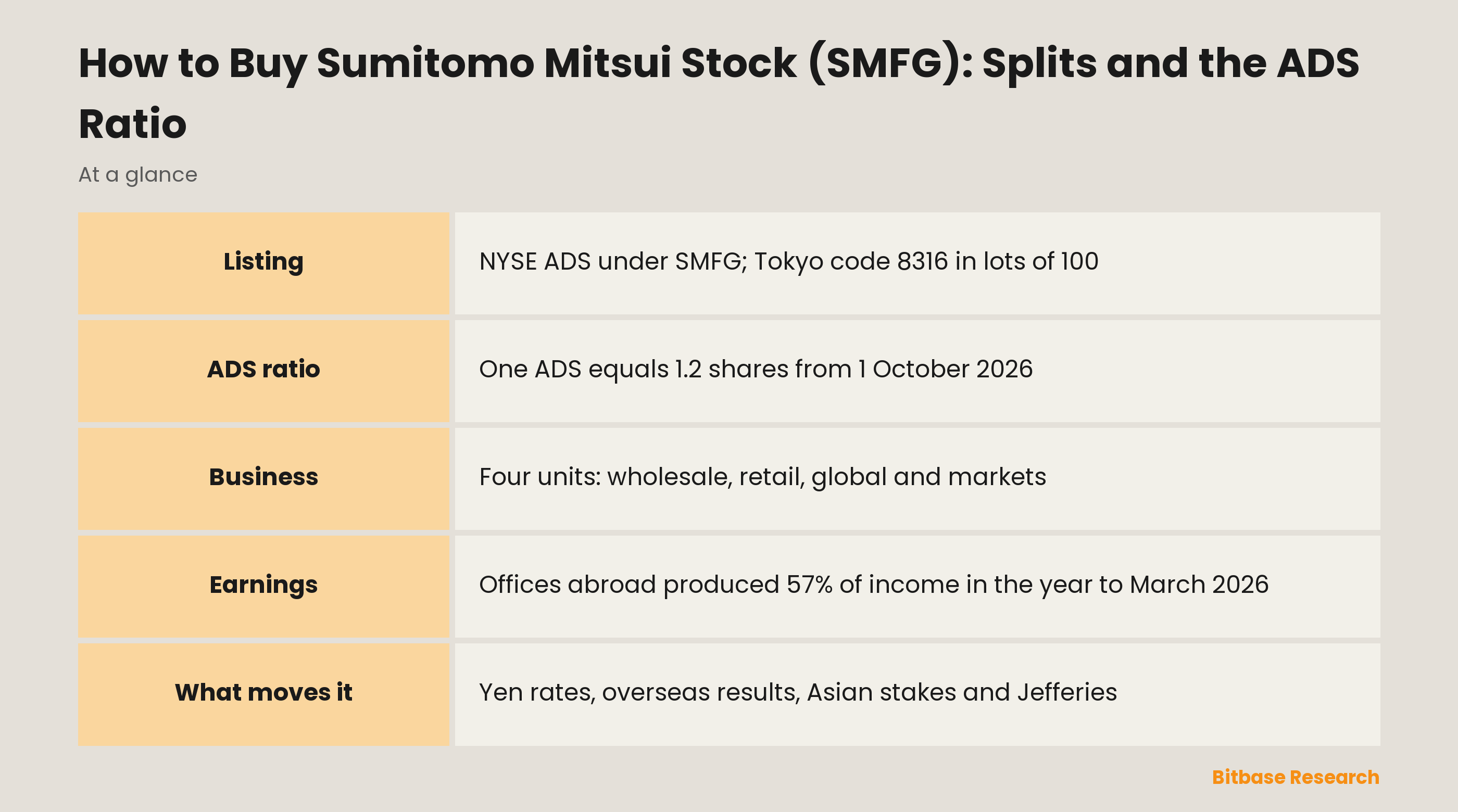
Investing in Sumitomo Mitsui Financial Group takes a brokerage account that reaches the New York Stock Exchange, where the company is quoted as an American depositary share (ADS) under SMFG, or one that reaches Tokyo, where the ordinary shares are bought in lots of 100 under code 8316. Read the ratio before the price: after a two-for-one share split on 1 October 2026, each ADS stands for 1.2 ordinary shares instead of 0.6, the second such change in two years. Behind the ticker sits the holding company of Sumitomo Mitsui Banking Corporation (SMBC), whose offices outside Japan produced 57% of its operating income in the year to March 2026.
What Does Sumitomo Mitsui Do?
Sumitomo Mitsui Financial Group sits at the top of a Japanese banking group that has used a single brand, SMBC Group, since April 2018; "Sumitomo Mitsui Financial Group" remains the name of the listed parent. It owns 100% of its main operating companies: Sumitomo Mitsui Banking Corporation (SMBC), SMBC Trust Bank, the securities house SMBC Nikko Securities, Sumitomo Mitsui Card, the lender SMBC Consumer Finance and The Japan Research Institute. It appears on the Financial Stability Board's roster of global systemically important banks (G-SIBs), which brings an extra capital requirement.
Mitsui started banking in 1876 and Sumitomo in 1895. Mitsui Bank and Taiyo Kobe Bank merged into Sakura Bank in 1990, Sakura and Sumitomo Bank combined in April 2001 to form SMBC, and in December 2002 SMFG was placed above the bank through a statutory share transfer. The ADSs joined the NYSE on 1 November 2010.
The group runs four business units. Wholesale serves companies in Japan with loans, project finance, cash management, hedging, M&A advice and leasing. Retail serves Japanese households with deposits, investment products, cards, consumer loans and mortgages, increasingly through Olive, a smartphone service launched in March 2023 that puts banking, payments, borrowing, securities and insurance in one app. Global serves Japanese companies abroad and corporations and financial institutions outside Japan through 143 overseas offices at 31 March 2026. Global Markets handles client trading in currencies, derivatives, bonds and equities and runs the group's asset-liability management.
Several growth bets sit in companies SMFG does not fully own. Leasing runs mainly through Sumitomo Mitsui Finance and Leasing (SMFL), a 50% joint venture with the trading house Sumitomo Corporation. SMFG has a strategic capital and business alliance with the US investment bank Jefferies Financial Group, and the two run their wholesale Japanese equities business through a joint venture, SMBC Nikko Jefferies Securities. In India, SMFG has fully owned the lender SMFG India Credit, formerly Fullerton India, since March 2024, and in September 2025 SMBC acquired 24.2% of YES BANK, adding 0.7% a month later. In Vietnam, SMBC acquired 15.0% of VPBank in October 2023.
Where SMFG's Profit Comes From
The 20-F is prepared under International Financial Reporting Standards (IFRS), while SMFG's results in Japan, and the business-unit figures inside the 20-F, follow Japanese accounting rules. The two do not reconcile line by line, so each figure below names its basis.
On the IFRS income statement for the year to 31 March 2026, net interest income (interest earned on loans, securities and bank deposits, less interest paid on deposits and debt) accounted for 58.5% of total operating income and rose 12.7%. Net fee and commission income, from remittances, investment trusts, loan arrangement, cards and brokerage, contributed 31.3% and grew 15.3%. Total operating income rose 26.1%, and profit attributable to shareholders more than doubled after falling the year before.
SMBC prices most domestic loans off short-term benchmarks, TIBOR or its short-term prime rate, both closely tied to Bank of Japan policy, and its average rate on domestic loans rose to 1.94% from 1.75% over the year. Offices outside Japan generated 57% of total operating income, down from 71% a year earlier, while Japan's share rose to 43%.
| Business unit | Main clients | Share of gross profit | Share of net business profit |
|---|---|---|---|
| Wholesale | Companies in Japan | 24.8% | 38.5% |
| Retail | Individuals in Japan | 30.8% | 16.5% |
| Global | Clients abroad, Japanese firms overseas | 30.7% | 25.3% |
| Global Markets | Client trading, balance sheet | 13.8% | 19.6% |
Percentages of the four units' combined total before head-office items, year to March 2026, measured the way management tracks the units, under Japanese accounting rules.
Retail books the largest slice of gross profit, but general and administrative expenses absorbed 72.9% of it, against 32.5% in Wholesale, which is why Wholesale delivered the most profit.
SMFG Stock Fact Sheet
| Item | Detail |
|---|---|
| Listed company | Sumitomo Mitsui Financial Group, Inc., a Japanese company formed in 2002 |
| US listing | ADSs on the NYSE, ticker SMFG, since 1 November 2010 |
| Shares per ADS | 1.2 from 1 October 2026 (0.6 before) |
| Tokyo listing | Prime Market of the Tokyo Stock Exchange (main market) and the Nagoya exchange; code 8316 |
| Lot size in Tokyo | 100 shares, which carry one vote |
| Depositary | Citibank, N.A., with SMBC as custodian |
| Index constituent of | Nikkei 225, TOPIX |
| Head office | Chiyoda-ku, Tokyo |
| Fiscal year | April to March; 20-F in IFRS, Japanese reports in Japanese GAAP |
| Shareholder returns | Two dividends a year, progressive policy, 40% payout ratio, buybacks |
| SEC filer number | CIK 1022837; Form 20-F each year, Form 6-K in between |
Prices, market value and yield change by the second, so they belong on Bitbase's SMFG quote page, not in an article.
How to Buy Sumitomo Mitsui Stock
SMFG's common stock is "not listed on any stock exchange outside of Japan," so the US line is the ADS, while the shares themselves trade in Tokyo. The steps:
1. Choose the market. A broker with NYSE access buys the ADS in US dollars; code 8316 needs one with access to the Tokyo exchange, trading in yen.
2. Complete the account checks. Expect identity and tax-residence documents; a treaty rate on Japanese dividend tax is simplest to get with forms lodged before payment.
3. Fund the account. Currency conversion carries a spread that can cost more than the commission.
4. Confirm the line. On a US screen, SMFG should read as American depositary shares of Sumitomo Mitsui Financial Group; in Tokyo, look up 8316.
5. Pick an order type. A market order fills at the prevailing price and a limit order sets your ceiling; the guide to how market orders execute and fill shows why that matters when quotes move fast.
6. Size it in the right units. Tokyo trades in 100-share units, and since 1 October 2026 every five ADSs represent six shares.
7. Keep the records. Trade confirmations and dividend statements are what a tax return will ask for.
ADS or Tokyo shares. Citibank, N.A. is the depositary and SMBC holds the underlying shares as custodian. The ADS description is blunt: "As an ADS holder, we will not treat you as one of our shareholders and you will not have shareholder rights." You can tell Citibank how to vote only if SMFG asks it to collect instructions. Dividends arrive in dollars after the depositary's fees and withholding tax. Cancelling ADSs for shares delivers only the portion that makes up whole units; ADSs covering the remainder come back to you. The two markets' regular hours do not meet: Tokyo's morning session runs from 9:00 to 11:30 and its afternoon session from 12:30 to 15:30, which is night-time in New York, while the NYSE core session lasts from 9:30 in the morning to 4:00 in the afternoon, New York time.
Why the ratio keeps moving. SMFG split each share into three on 1 October 2024 and into two on 1 October 2026, both times to lower the price of a trading unit and "expand the investor base." The ADS ratio moved alongside, from 0.2 to 0.6 and then to 1.2 shares, to keep the "current level of ADR unit price": holders received no extra ADSs, and each existing ADS came to represent more shares.
Small holdings in Tokyo. Fewer than 100 shares carry no vote and generally cannot be sold on a Japanese exchange, but a holder can ask SMFG to buy them back, or to sell enough shares to complete a unit.
Tax on dividends. Japan withholds tax on dividends paid to non-residents. For listed shares such as SMFG's, the 20-F puts the rate at 15.315% for payments due up to the end of 2047, unless an individual holds 3% or more. Treaties generally lower it to 10% for portfolio investors in the United States, the United Kingdom, France and Hong Kong; the claim goes in before payment, through the depositary for ADSs, and excess tax can be reclaimed later if that step is missed. Capital gains that portfolio investors realise outside Japan are generally free of Japanese tax, though your home country may tax them, and the dividends too.
Through an index fund. Code 8316 appears in the 19 October 2026 creation baskets of two Nomura Asset Management funds, the NEXT FUNDS Nikkei 225 ETF and the NEXT FUNDS TOPIX ETF, so a tracker of either benchmark gives a small, indirect position; the guide to ETF NAV, premiums, discounts and tracking error explains how such a fund can drift from its index.
What Moves the SMFG Share Price
Yen interest rates. The Bank of Japan ended negative rates in March 2024 and has since raised its guidance for the overnight call rate in steps, to around 1.0% in June 2026. The 20-F adds a caveat: "interest spreads may temporarily decrease immediately after an increase in interest rates because it may take time for banks to increase lending rates correspondingly, in contrast to their funding rates." Higher yields also cut the value of its bond holdings.
The overseas book. Foreign offices supplied 57% of operating income in the year to March 2026, the Americas the largest share of it, so the exchange rate moves the reported yen figures. SMFG has also been selling low-profit loans in the Americas, taking losses on those sales, to improve profitability and capital efficiency.
Stakes and alliances. Equity-method holdings tie SMFG's earnings to other banks' share prices: a fall in VPBank's stock forced an impairment in the year to March 2025, and its recovery allowed a reversal a year later. SMFG also booked a loss on selling part of its stake in Hong Kong's Bank of East Asia in May 2025. With Jefferies, the group plans to place SMBC Nikko Securities and their Japanese-equities joint venture under a new intermediate holding company, a step scheduled for around October 2026.
Tokyo share prices. SMFG still holds shares in many client companies, though it is cutting those stakes. Over the twelve months to 31 March 2026 the Nikkei Stock Average gained 43.4%, lifting unrealised gains on domestic equities; a falling market would push capital the other way. The filing flags a feedback loop as well: further sales "could in turn cause our customers to dispose of their equity holdings of investments in us, which could adversely affect the market price of our shares."
Capital and buybacks. At 31 March 2026 its common equity tier 1 (CET1) ratio was 12.41%, with 8.19% as the required minimum. SMFG repurchased and cancelled shares under programmes approved in May 2025 and November 2025 and approved another in May 2026. Buybacks are weighed against the capital position.
Risks SMFG Lists in Its 20-F
Of the many risk factors, five bear most directly on a shareholder:
Japan and the markets. "We may be adversely affected if Japanese and global economic conditions and financial markets deteriorate." The filing names tariffs, the conflicts in Ukraine and the Middle East and China's property crisis among the sources of uncertainty, and warns that falling share prices could bring "realized and unrealized losses on our equity securities portfolio."
Capital requirements. "Failure to satisfy capital adequacy requirements could constrain our and SMBC's operations." The ratio can fall if securities lose value or risk-weighted assets grow through expansion, investments or borrower downgrades.
Acquisitions and alliances. SMFG warns that "failure of our business strategies through our subsidiaries, affiliates and other business alliance partners" could bring "impairment losses on goodwill or investments," and that it may have to give partners financial support.
Consumer lending. "We are exposed to the industry specific risks of the consumer finance industry." After Japan banned so-called gray-zone interest on consumer loans, borrowers kept filing refund claims; Sumitomo Mitsui Card and SMBC Consumer Finance hold provisions, and further losses are possible if those prove insufficient.
Rights as an ADS holder. ADS holders "have fewer rights than a shareholder of record in our shareholder register because you must act through the depositary to exercise these rights." Only the depositary, as the holder of record, can sue on the company's behalf, inspect its accounting records or seek appraisal rights, and a separate item warns that US court judgments may be hard to enforce against SMFG.
Beyond these come the risks of any single stock: one company can grow into too large a share of a portfolio, a bank's price can fall on fears about lenders in general, and every dividend depends on a fresh decision.
Where to Verify SMFG Information
EDGAR lists SMFG under CIK 1022837. A Form 20-F covering the year to 31 March arrives each June, the latest on 26 June 2026; between annual reports, Form 6-K brings quarterly results, buyback notices and the split announcements described above. SMFG also posts the 20-F on smfg.co.jp. In the 20-F, the operating review carries the segment table and a reconciliation to Japanese accounting.
Watch for two traps. The first is the accounting basis: SMFG's quarterly results, filed on Form 6-K, are prepared under Japanese GAAP (the release of 31 July 2026 covering April to June is labelled "Under Japanese GAAP"), and the 40% payout target is measured on Japanese GAAP profit, while the 20-F uses IFRS, so profit figures will not match. The second is the share count: the 2026 split doubles the number of ordinary shares from 1 October 2026, and per-share figures in a 20-F published before then are on the old basis. For live prices use the SMFG quote page linked in the fact sheet, and for other listed companies Bitbase's US stock directory.
Questions About Buying SMFG Stock
How many Sumitomo Mitsui shares does one SMFG ADS represent?
From 1 October 2026, one ADS represents 1.2 ordinary shares, so five ADSs equal six shares. The ratio was 0.2 until 1 October 2024 and 0.6 between the two splits, so check the date on any per-ADS figure before comparing it.
Is SMFG the same company as SMBC?
Not quite. Sumitomo Mitsui Financial Group is the listed holding company, set up in December 2002; Sumitomo Mitsui Banking Corporation (SMBC) is its commercial bank and a wholly owned subsidiary. The whole group has used SMBC as its brand since April 2018, but the shares you can buy, in New York or Tokyo, are SMFG's.
Does Sumitomo Mitsui pay a dividend?
It does, in two instalments a year. The year-end dividend goes to holders of record on 31 March and needs shareholder approval in June; the interim dividend uses a 30 September record date. SMFG aims to raise the dividend every year under a progressive policy, with a payout ratio of 40% of Japanese GAAP profit; the full-year payout per share for the twelve months to March 2026 came in 28.7% above the previous year's, adjusted for the 2024 split.
Can I buy Sumitomo Mitsui stock with crypto?
Not directly. The ADS settles in US dollars and the Tokyo shares in yen, both through a broker, so any crypto has to be sold for one of those currencies first and the cash moved to the brokerage account; that sale may be taxable where you live. The two holdings also differ in kind, and the guide on how to decide between crypto and stocks walks through what separates them.
Which stock indices include SMFG?
Japan's two main benchmarks. Two Nomura Asset Management funds that track the Nikkei 225 and TOPIX held code 8316 in their creation baskets dated 19 October 2026. Weights shift every trading day, and the funds' own pages show them.
Conclusion
Buying SMFG is a two-step decision. First comes the line: the NYSE ADS, priced in dollars and currently worth 1.2 shares, or code 8316 in Tokyo, priced in yen and traded in units of 100. Then comes what you are buying into: a banking group whose domestic lending is repricing as the Bank of Japan lifts rates, whose earnings still lean heavily on business abroad, and whose stakes in India and Vietnam and alliance with Jefferies add both reach and risk. Read the latest 20-F and the 6-K filings since, check every per-share figure against the current ratio, and size the position to what one bank should weigh in a portfolio.
Related reading
Other Bitbase articles on this topic:
- How to Buy Anheuser-Busch InBev Stock (BUD): ADS, Brussels, Corona
- How to Buy ATT Stock (T): Dividend, Fiber Push and Mexico Sale
- How to Buy Charles Schwab Stock (SCHW): Rates, Cash, Crypto
- How to Buy Petrobras Stock (PBR): PBR vs PBRA, State Control
- How to Buy Santander Stock (SAN): One ADS, One Madrid Share
Disclaimer: This article is educational content from Bitbase Academy, provided for information only. It explains what a company or fund does and how the instruments referenced here differ from one another; it does not constitute investment, trading, tax, or financial advice, and it is neither a recommendation nor an endorsement of any security, token, or trading strategy. A tokenized stock is issued by a third party and is designed to give economic exposure to an underlying asset: it is not a share, it carries no shareholder rights, and it depends on the issuer's structure, eligibility rules, and redemption terms, which the issuer can change. Perpetual futures are leveraged derivatives that hold no underlying asset and can be liquidated, and trading hours, product availability, and eligibility differ by instrument and by jurisdiction and can change at any time. Written as of October 2026; verify everything yourself through company filings, the issuer's own documentation, and the product pages of the venue you trade on.
References
[1] SMFG, Form 20-F for the year to 31 March 2026 (SEC EDGAR) www.sec.gov
[2] SMFG, stock split and change in the ADR ratio (Form 6-K, 13 May 2026) www.sec.gov
[3] SMFG, resolutions of the June 2026 shareholders' meeting (Form 6-K, 26 June 2026) www.sec.gov
[4] SMFG, stock split and change in the ADR ratio (Form 6-K, 15 May 2024) www.sec.gov
[5] SMFG, description of its ADSs (exhibit to the 20-F filed 27 June 2025) www.sec.gov
[6] SMFG, results for April to June 2026 under Japanese GAAP (Form 6-K, 31 July 2026) www.sec.gov
[7] SMFG, SMBC Nikko Securities Holdings and the Jefferies joint venture (Form 6-K, 29 September 2026) www.sec.gov
[8] SMFG investor relations: Shareholder Return and Dividend Information www.smfg.co.jp
[9] Nomura Asset Management, NEXT FUNDS Nikkei 225 ETF (1321): creation basket, 19 October 2026 nextfunds.jp
[10] Nomura Asset Management, NEXT FUNDS TOPIX ETF (1306): creation basket, 19 October 2026 nextfunds.jp
[11] Japan Exchange Group: trading hours for domestic stocks www.jpx.co.jp
[12] NYSE: hours and calendars www.nyse.com