
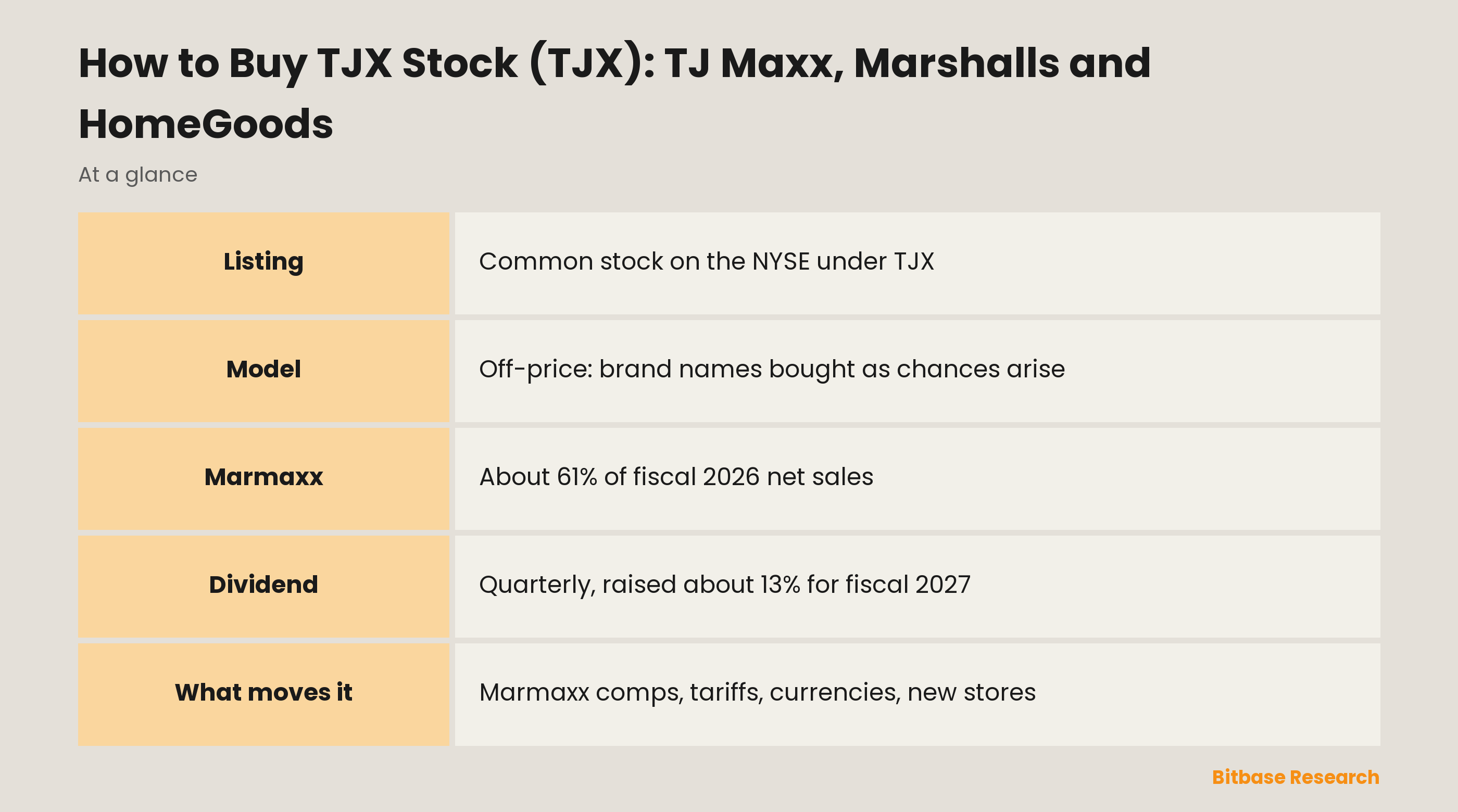
No separate listing exists for TJ Maxx, Marshalls or HomeGoods: all three belong to one New York Stock Exchange company, TJX, and its stock can be bought through any brokerage account that offers NYSE-listed shares. The business behind them is off-price retail: TJX buys brand-name closeouts, overruns and cancelled orders, then sells them at prices the company puts generally 20% to 60% below what full-price retailers normally charge. Its US Marmaxx segment, TJ Maxx and Marshalls plus the outdoor chain Sierra, brought in about 61% of fiscal 2026 net sales. This guide explains how that model earns its money, how to place an order, and what the filings say moves the stock: comparable sales at Marmaxx, tariffs, currencies and store growth.
What Does TJX Do?
The TJX Companies, Inc. calls itself "the leading off-price apparel and home fashions retailer in the United States and worldwide." It is incorporated in Delaware, is based in Framingham, Massachusetts, and ended fiscal 2026 with 5,214 stores and six branded e-commerce sites. On the shelves are family clothing and footwear, accessories such as jewelry and beauty, and home fashions ranging from rugs and lighting to cookware and furniture.
One point about dates first: TJX names each fiscal year after the year in which it ends, so fiscal 2026 is the 52-week year that closed on 31 January 2026 and covers mostly calendar 2025.
The company reports four segments.
Marmaxx is TJ Maxx and Marshalls in the United States, which the annual report calls "collectively the largest off-price retailer in the United States." TJX founded TJ Maxx in 1976 and bought Marshalls in 1995. The chains are kept distinct on purpose: TJ Maxx leans on jewelry, accessories and a designer department called The Runway, while Marshalls carries a full line of footwear and a wider men's range. Sierra, an outdoor and activewear chain acquired in 2012, is reported inside Marmaxx.
HomeGoods runs two US home chains: HomeGoods itself, introduced in 1992, and Homesense, launched in the US in 2017.
TJX Canada operates Winners, acquired in 1990, alongside HomeSense and a Canadian version of Marshalls.
TJX International operates TK Maxx and Homesense in Europe and TK Maxx in Australia. TK Maxx opened in 1994, trades in the United Kingdom, Ireland, Germany, Poland, Austria and the Netherlands, and added Spain from March 2026. The Australian stores came from the 2015 purchase of Trade Secret, which took the TK Maxx name in 2017.
TJX also holds stakes in businesses it does not run: 49% of Multibrand Outlet Stores, an off-price chain in Mexico, through a joint venture with Grupo Axo, and a 35% minority position in Brands for Less, which operates mainly in the United Arab Emirates and Saudi Arabia. Both investments closed in fiscal 2025.
How TJX Makes Money
Almost all of TJX's revenue is merchandise sold in physical stores; its e-commerce sites together accounted for about 2% of net sales in fiscal 2026. What makes the stores work is a buying method the company calls opportunistic buying. A buying organization of more than 1,400 Associates sources from roughly 21,000 vendors in more than 100 countries, picking up "closeouts from brands, manufacturers and other retailers; special production direct from brands and factories; order cancellations and manufacturer overruns."
The difference from a department store is timing. A traditional retailer orders most of a season far in advance; TJX's buyers stay in the market all year and buy close to need, which the 10-K says gives them better sight of trends and prices and less exposure to markdowns. Some goods are bought early and stored for a later season, a practice the company calls packaway.
The pricing rests on that supply rather than on promotional events: the company's stated "practice is to not engage in promotional pricing activity such as sales or coupons." Stores have no walls between departments, so a department can grow or shrink with whatever the buyers found, and pricing and markdown decisions are made centrally.
The segments differ sharply in size and profitability:
| Segment | Chains | Stores at 31 January 2026 | Share of fiscal 2026 net sales | Segment profit margin, fiscal 2026 |
|---|---|---|---|---|
| Marmaxx | TJ Maxx, Marshalls and Sierra (US) | 2,748 | 60.6% | 15.1% |
| HomeGoods | HomeGoods and Homesense (US) | 1,042 | 16.8% | 12.2% |
| TJX Canada | Winners, HomeSense and Marshalls | 589 | 9.3% | 13.4% |
| TJX International | TK Maxx and Homesense (Europe), TK Maxx (Australia) | 835 | 13.2% | 7.0% |
Sales shares are calculated from the segment figures in the fiscal 2026 10-K. The margins include a one-off: in the fourth quarter of fiscal 2026 TJX settled credit card interchange fee litigation in which it was a plaintiff, and the gain lifted the two US segments while related bonus costs were charged to all four.
Marmaxx matters even more for profit than for sales: its segment profit was about 68% of the four segments' combined total in fiscal 2026.
By product, clothing including footwear made up 44% of fiscal 2026 revenue, accessories including jewelry and beauty 20%, and home fashions 36%. By geography, the United States contributed 78%, Canada 9%, Europe 12% and Australia 1%.
For fiscal 2026 as a whole, net sales grew 7% and comparable sales 5%, which the company attributed to "a higher average basket and an increase in customer transactions." The pre-tax profit margin rose to 12.1% from 11.5%.
TJX Stock at a Glance
| Item | Detail |
|---|---|
| Ticker | TJX |
| Listed on | New York Stock Exchange (NYSE) |
| Security | Common stock, the only security registered on the 10-K cover |
| Sector | Off-price apparel and home fashions retail |
| Index membership | S&P 500 |
| Headquarters | Framingham, Massachusetts |
| Incorporated | Delaware |
| Fiscal year | Ends on the Saturday closest to the last day of January (52 or 53 weeks) |
| Stores | 5,214 at the end of fiscal 2026 (31 January 2026) |
| Segments | Marmaxx, HomeGoods, TJX Canada, TJX International |
| Dividend policy | Quarterly cash dividend, raised about 13% for fiscal 2027 |
| Stock splits on record | Two-for-one in February 2012 and in November 2018 |
| SEC identifier | CIK 109198 |
For the current share price, market capitalization and yield, open the TJX quote page on Bitbase.
How to Buy TJX Stock
TJX is an American company with its common stock listed in New York, so what you buy is the share itself, with no depositary receipt in between. The steps run through a broker:
1. Choose a broker that reaches the NYSE. Outside the United States, that can be a domestic firm with access to US markets or one that serves clients in many countries. Confirm which legal entity will hold your account and which regulator oversees it.
2. Complete the account checks. Investors who are not US persons usually sign IRS Form W-8BEN, which certifies foreign status and lets the broker apply any treaty rate on US dividends.
3. Add money. Funding in another currency means a conversion, and the exchange rate is a cost just like the commission, so compare both.
4. Find the correct listing. Search for TJX and confirm that the result reads The TJX Companies, Inc. common stock on the NYSE.
5. Pick an order type. FINRA describes a market order as the type that "provides the most certainty that your order will be executed," with the caveat that "you might not get the price you saw or were originally quoted." A limit order is "an order to buy or sell a security at or better than a specified price."
6. Settle on the amount. Fractional shares let you put in a fixed sum, which is how many people practice dollar-cost averaging. FINRA notes that "the availability of fractional share trading varies by brokerage firm," that you "can't transfer fractional shares to another brokerage firm," and that "you might not have shareholder voting rights" on a fraction.
7. Submit the order and keep the paperwork. Confirmations and account statements are your record of what you paid and of the dividends you received.
FINRA gives normal US trading hours as 9:30 a.m. to 4 p.m. Eastern Time. For orders placed outside that window, a limit order caps what you pay when few shares are changing hands.
If you live outside the United States, US dividends paid to you are subject to withholding. According to the IRS, "most types of U.S. source income received by a foreign person are subject to U.S. tax of 30%," although "a reduced rate, including exemption, may apply" under a tax treaty or a specific provision of the tax code. That is why the broker needs Form W-8BEN on file. Your own country may tax the same dividend again.
A fund route also exists. TJX sits in the S&P 500, and State Street's SPDR S&P 500 ETF Trust (SPY) listed it among its holdings in October 2026, so funds that replicate that index own it as one position among hundreds. If that appeals, it helps to know how an index tracker decides what it holds.
What Moves TJX Stock
Comparable sales at Marmaxx. Marmaxx produced about 61% of fiscal 2026 net sales and about 68% of segment profit, so its comparable sales, or comp sales, carry the most weight in every report. TJX counts a store or website toward comp sales once it starts its third fiscal year, and measures its foreign divisions in constant currency. The divisions do not always move together. In the second quarter of fiscal 2027, Marmaxx comp sales rose 1%, and chief executive Ernie Herrman said that "sales at Marmaxx were below our expectations," while HomeGoods, TJX Canada and TJX International each reported comp growth of 6% to 7%.
Merchandise supply and margin. An off-price chain is only as good as the excess branded goods it can find. In both its February 2026 and August 2026 earnings releases, management described the availability of quality merchandise as "outstanding." The merchandise margin also moves with freight costs, markdowns and inventory shrink; in fiscal 2026, lower freight and lower shrink helped bring the cost of sales ratio down to 69.0% from 69.4%.
Tariffs and trade policy. TJX buys imported goods both directly and through vendors. On 20 February 2026 the US Supreme Court struck down tariffs imposed under the International Emergency Economic Powers Act (IEEPA), and an executive order then imposed a new global tariff. TJX received IEEPA refunds in the second quarter of fiscal 2027 and booked them in cost of sales; as of 1 August 2026 it had recorded no receivable for any further refunds. Reported earnings for that quarter therefore include a benefit the company strips out of its adjusted figures, as it did with the credit card settlement gain in fiscal 2026.
Exchange rates. Canada, Europe and Australia together supplied about 22% of fiscal 2026 revenue. Of TJX International's 11% net sales growth that year, 5 percentage points came from currency translation. Inventory hedges are also marked to market each period, so a sharp currency move can shift reported earnings even when the stores perform the same.
Store growth and the calendar. The 10-K put the long-term potential at 7,000 stores in TJX's current geographies. In August 2026 the company raised that target to 7,500 stores "in our existing retail banners in our current countries" and said it plans to lift store growth to 4% starting in fiscal 2028. Timing within the year matters too: the second half, with back-to-school and the holidays, generally produces higher sales and income, so a disappointing autumn weighs on a full year more than a weak spring does.
Risks to Weigh Before Buying TJX
The risk factor section, Item 1A, runs long. These are the headings that bear most directly on a TJX share:
Buying and inventory. "Failure to execute our opportunistic buying strategy and successfully manage our inventory could adversely affect our results."
Consumer spending. Economic conditions and uncertainty "may adversely affect consumer confidence and discretionary spending," and the company names inflation, unemployment, interest rates and housing costs among the pressures on its customers.
Trade policy. Changes to trade, tariff and import rules "may have an adverse effect on our business, financial condition, and results of operations."
Theft and shrink. "Risk of loss or theft of assets, including inventory shrinkage, is inherent in the retail business," the filing says, including theft "through organized retail crime and professional theft."
The second half. Because results lean on back-to-school and the holiday season, a serious disruption in that period "could have a disproportionately adverse effect on our operating results."
Expectations. "Failure to meet market expectations for our financial performance could adversely affect the market price and volatility of our stock." TJX's earnings releases measure results against the company's own plan, so a miss can move the shares even in a year of growth.
Two risks sit above the business itself. Owning one stock ties your money to one company's results, however many chains and countries it spans. And a dividend history is not a promise: each payment needs a board declaration, and when your home currency is not the US dollar, both the share price and the dividend are converted before they reach you.
How to Research TJX Yourself
TJX's SEC filer number (CIK) is 109198, and the same documents are free under "SEC Filings" on tjx.com. Its annual report is the 10-K, quarterly reports for the first three quarters are 10-Qs, and 8-Ks report events in between, with each quarterly earnings release attached to one.
Inside the 10-K, Item 1 holds the store table, with year-end counts for each chain and the company's estimate of long-term store potential by division; Item 1A lists the risk factors; Item 7 has the segment tables with comp sales and margins; and the segment note gives the split by product category.
Three habits will save you from misreading the numbers. Keep the fiscal labels straight: fiscal 2026 ended on 31 January 2026, and the press releases shorten it to FY26. Separate reported from adjusted results: the fiscal 2026 credit card settlement and the fiscal 2027 tariff refunds sit inside reported earnings, and the releases show both versions. Check what comp sales include: starting with fiscal 2026, e-commerce sales are counted, while earlier comp figures leave them out, and fiscal 2024 had 53 weeks instead of 52.
To compare other companies, open the full list of US stock pages on Bitbase.
TJX Stock FAQ
Are TJ Maxx, Marshalls and HomeGoods the same company?
Yes. All three belong to The TJX Companies, together with Sierra and Homesense in the United States, Winners, HomeSense and Marshalls in Canada, and TK Maxx and Homesense abroad. A TJX share gives you a stake in all of them, because the chains are divisions of TJX rather than separately listed companies.
Can I buy TJX stock with crypto?
No, not in one step. A TJX share is bought with US dollars in a brokerage account, so any crypto would first have to be converted to cash and that cash deposited with the broker. Treat the conversion as a decision of its own: depending on where you live, selling crypto can be a taxable event.
Does TJX pay a dividend?
Yes, every quarter. For fiscal 2027 the quarterly dividend was raised about 13% over the previous rate, and in February 2026 the board also approved a new share repurchase authorization. Each payment is declared by the board; check the most recent 8-K or 10-Q for the amount and payment date.
Has TJX stock ever split?
Yes. TJX's annual reports record two-for-one splits, each paid as a stock dividend, in February 2012 and in November 2018. Per-share figures from before each split are restated in later filings.
When does TJX's fiscal year end?
On the Saturday nearest the last day of January. Most years have 52 weeks, with an occasional 53-week year such as fiscal 2024, and the holiday season falls in the fourth fiscal quarter.
Conclusion
Placing the order is the easy part of owning TJX: a broker that reaches the NYSE, the common stock line, a market or limit order. Knowing what the share represents takes more work, because the business is a buying operation built on other companies' surplus, with roughly three-fifths of its sales coming from Marmaxx alone. The filings date the things that matter, from Marmaxx comp sales to tariff refunds and the 7,500-store target, so read the latest 10-K, 10-Q and earnings 8-K before deciding how much of a portfolio one retailer should hold.
Related reading
Other Bitbase articles on this topic:
- How to Buy Danaher Stock (DHR): Bioprocessing, Masimo, Spin-offs
- How to Buy John Deere Stock (DE): Tractors, Loans, Farm Cycle
- How to Buy NextEra Energy Stock (NEE): FPL, Renewables, Dominion
- How to Buy Pfizer Stock (PFE): Post-COVID Sales, Eliquis Patents
- How to Buy SAP Stock (SAP): ADR vs Xetra, Cloud Backlog
Disclaimer: This article is educational content from Bitbase Academy, provided for information only. It explains what a company or fund does and how the instruments referenced here differ from one another; it does not constitute investment, trading, tax, or financial advice, and it is neither a recommendation nor an endorsement of any security, token, or trading strategy. A tokenized stock is issued by a third party and is designed to give economic exposure to an underlying asset: it is not a share, it carries no shareholder rights, and it depends on the issuer's structure, eligibility rules, and redemption terms, which the issuer can change. Perpetual futures are leveraged derivatives that hold no underlying asset and can be liquidated, and trading hours, product availability, and eligibility differ by instrument and by jurisdiction and can change at any time. Written as of October 2026; verify everything yourself through company filings, the issuer's own documentation, and the product pages of the venue you trade on.
References
[1] The TJX Companies Form 10-K for fiscal 2026 (year ended 31 January 2026): business, segments and risk factors (SEC EDGAR) www.sec.gov
[2] TJX press release, 25 February 2026: fourth-quarter and full-year fiscal 2026 results (Form 8-K, Exhibit 99.1) www.sec.gov
[3] TJX press release, 19 August 2026: second-quarter fiscal 2027 results and long-term store target (Form 8-K, Exhibit 99.1) www.sec.gov
[4] TJX Form 10-Q for the quarter ended 1 August 2026: dividends declared and IEEPA tariff refunds (SEC EDGAR) www.sec.gov
[5] TJX Form 10-K for fiscal 2012: two-for-one stock split of February 2012 (SEC EDGAR) www.sec.gov
[6] TJX Form 10-K for fiscal 2019: two-for-one stock split of November 2018 (SEC EDGAR) www.sec.gov
[7] State Street SPDR S&P 500 ETF Trust (SPY): daily holdings file www.ssga.com
[8] FINRA: Order Types www.finra.org
[9] FINRA: Investing in Fractional Shares www.finra.org
[10] IRS: NRA Withholding www.irs.gov