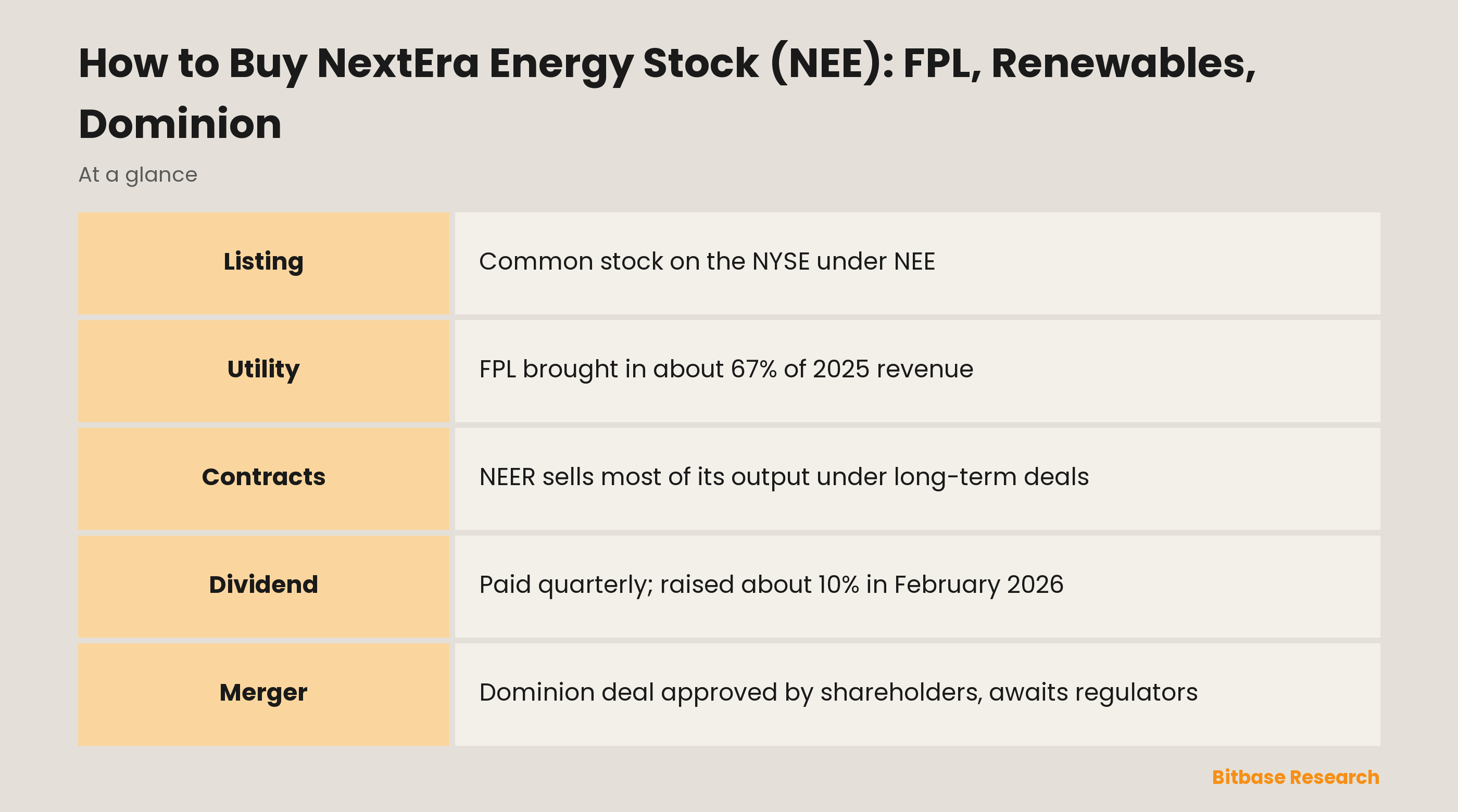
By opening an account with a broker that offers New York Stock Exchange shares, you can buy NextEra Energy stock under the ticker NEE. That one ticker holds two very different businesses: Florida Power & Light, the regulated utility that brought in about 67% of 2025 revenue, and NextEra Energy Resources, which owns and builds wind, solar, battery, nuclear and gas plants and sells most of their output under long-term contracts. A merger with Dominion Energy, approved by both companies' shareholders in September 2026, still needs regulators to sign off. This guide covers how each half earns its money, how the order works and which risks the filings put first.
What Does NextEra Energy Do?
NextEra Energy is a holding company based in Juno Beach, Florida, and incorporated in that state. Its annual report calls it "one of the largest electric power and energy infrastructure companies in North America," with approximately 80 gigawatts of net generation and storage capacity at the end of 2025, mainly natural gas, wind, solar, nuclear and batteries. Until 2010 it was named FPL Group, Inc.
The group reports two segments, and they look like two different companies.
Florida Power & Light (FPL) is a rate-regulated utility that generates, transmits, distributes and sells electricity in Florida; the 10-K describes it as "the largest electric utility in Florida and the U.S." It serves approximately 12 million people through more than six million customer accounts. At the end of 2025 it owned and operated 44 mainly gas-fired units with 24,314 MW of capacity, 108 solar facilities with 7,932 MW and four nuclear units at St. Lucie and Turkey Point. NEE owns all of FPL's common stock, so there is no separate FPL share to buy.
NextEra Energy Resources is the competitive side, reported together with the regulated transmission business NextEra Energy Transmission as the NEER segment. At the end of 2025 NEER held about 37,505 MW of net generating capacity across 44 US states and four Canadian provinces, mostly wind (about 22,404 MW) and solar (about 10,504 MW), plus about 5,177 MW of battery storage. It also owns the Point Beach nuclear units in Wisconsin, co-owns Seabrook in New Hampshire, holds stakes in gas pipelines and markets power and gas to wholesale customers.
In December 2025 NEER applied to the Nuclear Regulatory Commission to reinstate the license of Duane Arnold, an idle Iowa nuclear plant in which it holds approximately a 70% interest, with commercial operation estimated for 2029 under a 25-year power purchase agreement. It also keeps a noncontrolling stake in XPLR Infrastructure, the listed partnership formerly named NextEra Energy Partners; owning NEE stock does not make you an XPLR unitholder.
How NextEra Energy Makes Money
The segment note in the 10-K shows how differently the two halves contribute:
| Segment | What it sells | Share of 2025 revenue | Change from 2024 | Share of 2025 capital spending |
|---|---|---|---|---|
| FPL | Electricity to Florida customers at regulated rates | 66.6% | Up 7.3% | 36.3% |
| NEER | Contracted power from wind, solar, storage, nuclear and gas; transmission | 32.0% | Up 16.1% | 63.7% |
Shares are calculated from the segment note and rounded to one decimal; corporate and other activities made up the remaining 1.4% of revenue, and total revenue rose 10.7%.
FPL earns a regulated return. Its revenue comes mainly from retail customers at rates set by the Florida Public Service Commission (FPSC); wholesale and industrial customers supplied about 5% of FPL's operating revenues in each year from 2023 to 2025. Base rates recover the cost of the system plus a return on the assets in service, the rate base, while fuel passes through a separate clause. Under the 2025 rate agreement, in force from January 2026 through at least December 2029, FPL's authorized return on equity is 10.95%, within a range of 9.95% to 11.95%, on a 59.6% equity ratio. None of that is promised: "the FPSC does not provide assurance that any regulatory ROE will be achieved." The 10-K credits FPL's higher 2025 net income chiefly to new plant in service and a higher earned return.
NEER earns contract revenue. Most of its plants sell output under long-term agreements with utilities, power cooperatives, municipal providers and commercial and industrial customers. At the end of 2025 contracted assets made up about 35,627 MW of net capacity, with a weighted-average remaining contract term of about 14 years, against about 1,878 MW of merchant plants, mostly in the US Northeast. In 2025 NEER added about 1,604 MW of wind, 2,859 MW of solar and 1,799 MW of storage, and the segment accounted for 63.7% of capital spending against 32.0% of revenue.
NEER's reported revenue can also swing: it fell about 22.0% in 2024, and part of what it books as revenue is the change in fair value of hedges, which the 10-K says produces "earnings volatility." Management therefore also publishes non-GAAP "adjusted earnings," so check which figure a headline uses.
Where the profit lands. Of the 2025 net income the two segments reported, FPL contributed about 62.8% and NEER about 37.2%. Corporate and Other, which carries interest expense not allocated to the segments, then cut into the total, and net income attributable to NEE fell about 1.6% from 2024 even though both segments earned more.
NEE Stock at a Glance
| Item | Detail |
|---|---|
| Exchange | New York Stock Exchange (NYSE) |
| Ticker | NEE |
| Security | Common stock |
| Other listed securities | Two series of corporate units, NEE.PRS and NEE.PRT, on the fiscal 2025 10-K cover |
| Sector | Utilities: regulated electricity and energy infrastructure |
| Index membership | S&P 500, per SPY's holdings on 16 October 2026 |
| Headquarters | Juno Beach, Florida |
| Incorporated | Florida |
| Stock split | Four-for-one, effective 26 October 2020 |
| Fiscal year end | 31 December |
| Dividend policy | Paid quarterly; the board reviews the rate at least once a year, generally in February |
| SEC filer | CIK 753308, in a combined annual report with FPL |
Price, market value and yield change with every trade; for live figures, open the NextEra Energy stock page on Bitbase.
How to Buy NextEra Energy Stock
NEE is a US company with a US listing, so no depositary receipt is involved, and NEE common stock is the only direct way to own the group:
1. Choose a broker that reaches the NYSE. Check which entity will hold your shares and who regulates it.
2. Open and verify the account. Non-US individuals are normally asked for IRS Form W-8BEN, a certificate of foreign status.
3. Add money. If your account runs in another currency, the conversion spread is a cost on top of any commission.
4. Look up NEE and check the name. You want NextEra Energy, Inc. common stock. Symbols such as NEE.PRS are corporate units, which pair a contract to buy NEE stock by a set date with an interest in a NextEra debenture: a different investment.
5. Pick the order type. Investor.gov explains that a market order "guarantees that the order will be executed, but does not guarantee the execution price." A limit order fills only at your price or better, and may not fill at all.
6. Set the amount. Fractional shares let you invest a fixed sum, but "not every brokerage firm offers fractional share investing," and you "may not have voting rights" on a fraction.
7. Keep the paperwork. Your broker's confirmations and statements record what you paid and each dividend, and you will need them for tax.
For non-US investors, US tax is withheld from dividends before they arrive. The IRS states that "most types of U.S. source income received by a foreign person are subject to U.S. tax of 30%," and that "a reduced rate, including exemption, may apply" under a tax treaty; Form W-8BEN, the IRS certificate of foreign status for withholding, is what the broker relies on. Your home country may tax the dividend again. This is general information, not tax advice.
Through a fund, you can hold NEE without picking it. State Street's SPDR S&P 500 ETF Trust (SPY) and its Utilities Select Sector SPDR ETF (XLU) both listed NextEra Energy among their holdings on 16 October 2026, as one position among many.
What Moves NEE Stock
Florida regulation. About two-thirds of revenue depends on rates a regulator approves. The 2025 rate agreement raised retail base revenues from January 2026 but is still contested: the FPSC denied substantially all of a reconsideration motion by the Office of Public Counsel and other groups in April 2026, and their appeals, consolidated by the Florida Supreme Court in June, were still pending in the second-quarter report. The FPSC can also refuse to let FPL recover costs it considers "excessive or imprudently incurred."
Interest rates and capital markets. Growth is funded partly with debt and, at times, new shares, and the 10-K blames the 2025 decline at Corporate and Other mainly on higher interest expense and debt. Its risk factors add that turmoil in credit and capital markets "may exert downward pressure on the market price of NEE's common stock."
US clean energy tax credits. NEER's wind and solar projects lean on federal tax credits. Under the One Big Beautiful Bill Act, wind and solar facilities qualify only if construction begins before 5 July 2026 or they are in service by 31 December 2027, and none placed in service after 2030 will receive credits. NEE says it believes its current pipeline through 2030 will qualify; storage projects keep a longer window.
Large new loads. The 2025 rate agreement created tariffs for customers adding 50 MW or more at a load factor of at least 85%, aimed at users such as data centers, and NEER lists "emerging large-load opportunities" in its strategy. Where power fits among AI infrastructure stocks is a topic of its own.
Storms. FPL serves areas "that historically have been prone to severe weather events, such as hurricanes." Restoration costs can be recovered through FPSC-approved surcharges, such as the one FPL completed in 2025 for Hurricanes Debby, Helene and Milton, which remains subject to refund after a prudence review.
The Dominion merger. On 15 May 2026 NEE agreed to acquire Dominion Energy, the Richmond, Virginia, parent of utilities in Virginia, North Carolina and South Carolina. Each Dominion share is to become 0.8138 NEE shares plus a slice of a fixed cash payment, leaving existing NEE holders with about 74.5% of the combined company. Both shareholder votes passed on 3 September 2026. The deal still needs Hart-Scott-Rodino clearance and approvals from FERC, the NRC and the three states' utility commissions; on 29 September 2026 NEE said it expected to close in the second half of 2027. Either side may walk away if it has not closed by 15 November 2027, extendable to 15 August 2028 in some cases.
Risks to Weigh Before Buying NEE
The 10-K's risk factors mostly cover NEE and FPL together. These bear most directly on a NEE share:
Regulation. Results "may be materially adversely affected by the extensive regulation of their business," especially if the companies cannot recover costs or "a reasonable return on invested capital" through rates.
Tax and policy. Changes in tax law, "including but not limited to, changes in corporate income tax rates and the qualifications for clean energy tax credits," could hurt results, with NEER's renewables most exposed.
Weather. Weather shapes how much electricity customers use, and hurricanes can damage the system and force costly repairs.
Nuclear plants. Running them involves "environmental, health and financial risks that could result in fines or the closure of the facilities." When the 10-K was filed, the St. Lucie license renewals requested in 2021 were still pending, and an appeal over the Turkey Point renewals was before the NRC.
Funding and ratings. Growth depends on debt and equity markets, and losing current credit ratings could raise interest costs and slow expansion.
A holding company's dividend. NEE "has no material operations of its own," so its dividend depends on what FPL and other subsidiaries pass up.
Merger execution. The second-quarter report adds the risk that a required approval "is not obtained, is delayed or is obtained subject to conditions that are not anticipated."
Above those sit the risks of any single stock, and if you invest from another currency, the exchange rate applies to both price and dividend.
How to Research NEE Yourself
NEE files with the SEC under CIK 753308. Its annual report is combined with FPL's (CIK 37634): information about each company "is filed by that registrant on its own behalf," and FPL "makes no representations" about NEE's other operations.
In the 10-K, the business section treats FPL and NEER separately, the risk factors follow, and the segment note gives revenue, net income and capital spending by segment. Quarterly 10-Qs update the rate case and the merger, 8-Ks carry results and dividend decisions, and the joint proxy statement and prospectus sets out the Dominion terms.
Two checks prevent mix-ups. R1.htm, the machine-readable cover page of the fiscal 2025 report, lists three registered NEE securities, and only the common stock trades as plain NEE. And NEE presents results in adjusted earnings as well as GAAP net income, so compare like with like. For other companies, browse the US stock pages on Bitbase.
NextEra Energy Stock FAQ
Does NextEra Energy pay a dividend?
Yes, every quarter. In February 2026 NEE announced a rise of about 10% in the quarterly dividend, but the amount and timing "are within the sole discretion" of the board.
Can I buy NextEra Energy stock with crypto?
Not in one step. A broker sells NEE shares for US dollars, so crypto has to be sold first and the cash moved into the brokerage account, and in some jurisdictions that sale is itself taxable. A share is a registered stake with dividends and votes, which is how stocks and crypto differ at the root.
What happens to NEE stock if the Dominion merger closes?
NEE shareholders keep the shares they hold, Dominion shareholders receive new NEE shares at 0.8138 for each Dominion share, and the combined company keeps the NextEra Energy name and the NEE ticker on the NYSE. Existing NEE holders would own about 74.5% and former Dominion holders about 25.5%. In September 2026 NEE shareholders also approved raising authorized common stock from 3.2 billion to 5 billion shares.
Is NEE in the S&P 500?
Yes. NextEra Energy appeared in the holdings of SPY, the State Street fund that tracks the S&P 500, on 16 October 2026.
Has NextEra Energy stock ever split?
Yes. A four-for-one split took effect on 26 October 2020, so per-share prices and dividends from before then need dividing by four to compare with later figures.
Can I buy shares in Florida Power & Light?
No. NEE holds all of FPL's common stock, so buying NEE is how you own the utility.
Conclusion
Placing a NEE order is routine: a broker with NYSE access, the correct listing on the order ticket, a market or limit order. Knowing what you own takes longer. About two-thirds of revenue comes from FPL's regulated Florida business, while NEER's contracted plants absorb most of the capital and lean on US tax credits, and the pending merger would add Dominion's utilities in three more states. Read the latest 10-K, the second-quarter 10-Q and the merger filings before deciding how much of your money belongs in one utility stock.
Related reading
Other Bitbase articles on this topic:
- How to Buy Anheuser-Busch InBev Stock (BUD): ADS, Brussels, Corona
- How to Buy ATT Stock (T): Dividend, Fiber Push and Mexico Sale
- How to Buy Charles Schwab Stock (SCHW): Rates, Cash, Crypto
- How to Buy Danaher Stock (DHR): Bioprocessing, Masimo, Spin-offs
- How to Buy RTX Stock (RTX): Raytheon, GTF Engines, Dividend
Disclaimer: This article is educational content from Bitbase Academy, provided for information only. It explains what a company or fund does and how the instruments referenced here differ from one another; it does not constitute investment, trading, tax, or financial advice, and it is neither a recommendation nor an endorsement of any security, token, or trading strategy. A tokenized stock is issued by a third party and is designed to give economic exposure to an underlying asset: it is not a share, it carries no shareholder rights, and it depends on the issuer's structure, eligibility rules, and redemption terms, which the issuer can change. Perpetual futures are leveraged derivatives that hold no underlying asset and can be liquidated, and trading hours, product availability, and eligibility differ by instrument and by jurisdiction and can change at any time. Written as of October 2026; verify everything yourself through company filings, the issuer's own documentation, and the product pages of the venue you trade on.
References
[1] NextEra Energy and Florida Power & Light combined Form 10-K, fiscal 2025: business, segments and risk factors (SEC EDGAR) www.sec.gov
[2] NextEra Energy Form 10-Q for the quarter ended 30 June 2026: rate case appeal and merger risks (SEC EDGAR) www.sec.gov
[3] NextEra Energy Form 8-K, 18 May 2026: merger agreement with Dominion Energy (SEC EDGAR) www.sec.gov
[4] NextEra Energy and Dominion Energy joint press release, 18 May 2026: terms of the combination (filed with Form 8-K) www.sec.gov
[5] NextEra Energy Form 8-K, 3 September 2026: special meeting vote results (SEC EDGAR) www.sec.gov
[6] Dominion Energy Form 8-K, 3 September 2026: shareholder approval of the merger (SEC EDGAR) www.sec.gov
[7] NextEra Energy Form 425, 29 September 2026: merger update and expected timing (SEC EDGAR) www.sec.gov
[8] State Street SPDR S&P 500 ETF Trust (SPY): fund page and daily holdings www.ssga.com
[9] State Street Utilities Select Sector SPDR ETF (XLU): fund page and daily holdings www.ssga.com
[10] Investor.gov (SEC): Types of Orders www.investor.gov
[11] Investor.gov (SEC): Investor Bulletin on fractional share investing www.investor.gov
[12] IRS: NRA Withholding www.irs.gov
[13] IRS: About Form W-8 BEN, certificate of foreign status for withholding www.irs.gov