
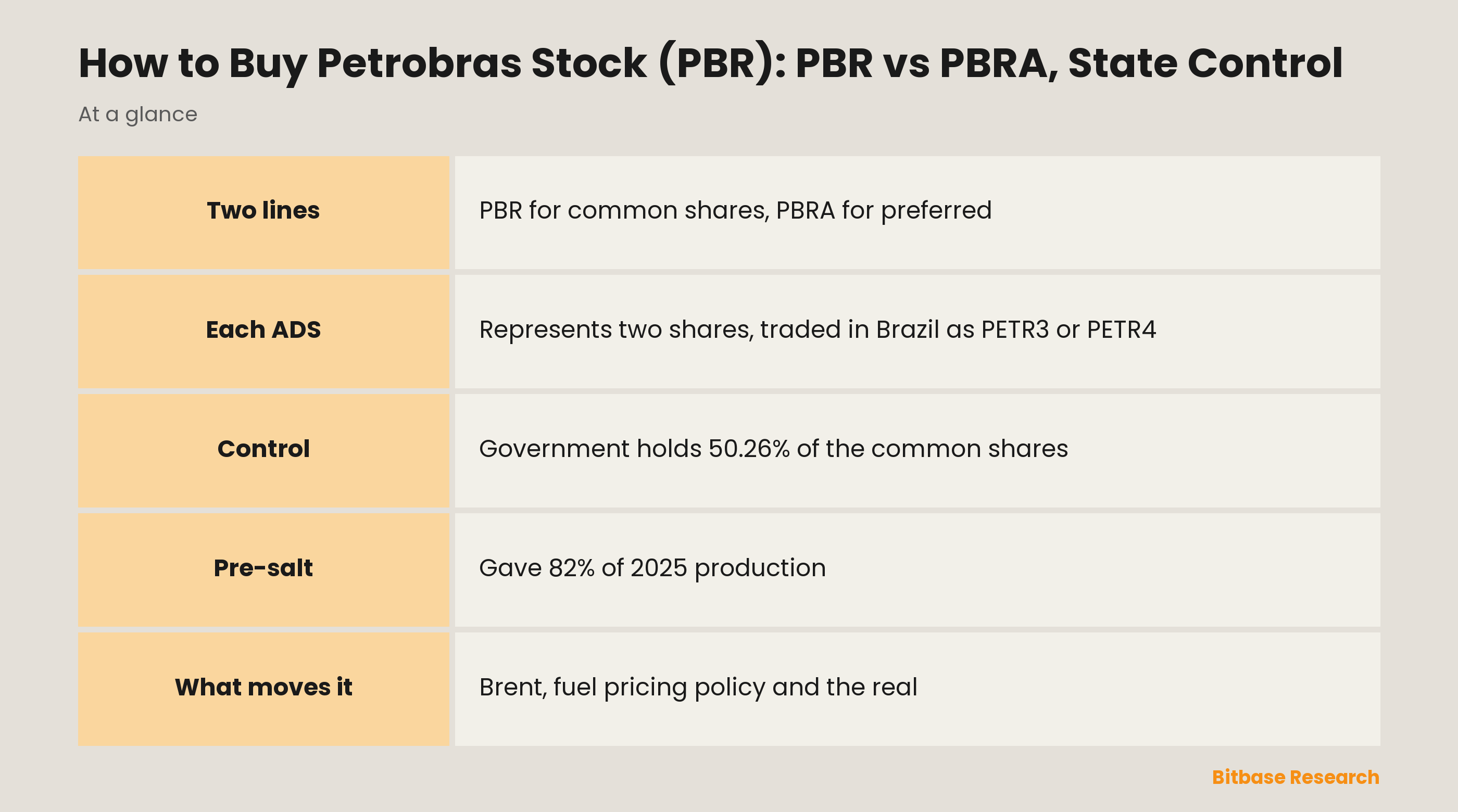
Petrobras has two lines on the New York Stock Exchange, and any broker with NYSE access can buy either: PBR, an American depositary share (ADS) representing two common shares, or PBRA, an ADS representing two preferred shares. Only the common shares carry a full vote, and Brazilian law requires the federal government to hold a majority of them, which ties the share price to decisions made in Brasília. Behind both tickers is the company that produces most of Brazil's oil and gas: pre-salt fields gave 82% of its 2025 output, and exploration and production earned about 88% of its net income.
What Does Petrobras Do?
Petróleo Brasileiro S.A. — Petrobras finds, produces, refines and sells oil and natural gas, mostly in Brazil. Its annual report calls it "a Brazilian partially state-owned company": incorporated in 1953 and headquartered in Rio de Janeiro, it produces most of Brazil's oil and gas and runs most of the country's refining capacity.
It reports three segments. Exploration & Production (E&P) produces crude oil, natural gas liquids and gas, mainly for its own refineries; deepwater and ultra-deepwater fields gave 98% of total production in 2025. Refining, Transportation & Marketing (RT&M) runs the refineries, moves and trades crude and oil products, and holds the petrochemical and fertilizer interests. Gas & Low Carbon Energies (G&LCE) processes and sells natural gas, LNG and electricity from gas-fired plants, and covers biodiesel, renewables and carbon capture.
The core asset is the pre-salt: oil reservoirs beneath a thick salt layer off south-east Brazil, mostly in the Santos Basin. Pre-salt fields supplied 82% of production in 2025, a year in which total output rose 11% as new floating production units (FPSOs) came on stream. At Búzios, which the company calls Brazil's largest field by reserves, the eighth platform, P-79, began producing on 1 May 2026, ahead of the business plan's date.
Outside Brazil it had activities in eight countries in 2025, from a share of US Gulf of Mexico production to trading offices in Rotterdam, Houston and Singapore, and in September 2026 it signed contracts for eight offshore blocks in Côte d'Ivoire, holding 90% as operator. It also owns 36.1% of the petrochemical maker Braskem, or 47% of the voting capital.
How Petrobras Makes Money
Sales and profit sit at opposite ends of the chain. RT&M books about 93% of revenue from outside customers, because E&P sells almost all of its oil and gas inside the group. Yet E&P earned about 88% of the group's net income attributable to shareholders in 2025, against about 9% for RT&M.
By product and market, 2025 sales revenues break down like this:
| Market | Product line | Share of 2025 sales revenues |
|---|---|---|
| Brazil | Diesel | 30.1% |
| Brazil | Gasoline | 13.8% |
| Brazil | Jet fuel | 5.0% |
| Brazil | Liquefied petroleum gas | 3.8% |
| Brazil | Naphtha, fuel oil and other oil products | 6.5% |
| Brazil | Crude oil | 4.9% |
| Brazil | Natural gas | 4.3% |
| Brazil | Power, renewables, nitrogen products, services and other | 2.1% |
| Abroad | Exports | 28.7% |
| Abroad | Sales by units outside Brazil | 0.8% |
Shares are calculated from the 2025 sales revenue note and rounded to one decimal.
Brazil accounted for about 71% of revenue, and diesel alone for nearly a third. Most of the rest was exports, where crude oil shipped overseas made up about 22% of all sales. Revenue fell 2.4% in 2025, mainly because Brent's 2025 average was about 14% below 2024's.
What Petrobras charges at home is therefore the main lever. The company says it seeks to "align the price of oil products with international prices while avoiding the immediate transfer of volatility of international quotations and the exchange rate."
PBR and PBRA at a Glance
| Item | Detail |
|---|---|
| PBR | NYSE-listed ADS; each represents two common shares, which carry one vote each |
| PBRA | NYSE-listed ADS; each represents two preferred shares, with dividend priority and a vote only on limited matters |
| Symbol formats | Petrobras writes PBRA or PBR/A; the SEC's EDGAR system lists PBR-A |
| Home listing | Common shares as PETR3 and preferred shares as PETR4 on B3, in its Level 2 governance segment |
| Depositary | JPMorgan, for both ADS programmes since 2 January 2020 |
| Controlling shareholder | Brazilian federal government: 50.26% of the common shares and 29.02% of all shares on 7 April 2026 |
| Legal form | Brazilian mixed-capital company, incorporated in 1953 |
| Headquarters | Rio de Janeiro |
| Accounts | Calendar year, IFRS, presented in US dollars; functional currency is the Brazilian real |
| Shareholder payouts | Dividends and interest on capital under a policy approved in July 2023, paid quarterly |
| SEC reporting | CIK 1119639; annual Form 20-F, interim Forms 6-K |
The table holds no prices. Quotes, volume and market value are on the Petrobras stock page on Bitbase.
How to Buy Petrobras Stock
For most investors outside Brazil, buying Petrobras means buying an ADS in New York. The order is routine; the choice before it is where mistakes happen.
1. Decide which line. PBR holds common shares, PBRA preferred; both trade in US dollars. If your broker reaches B3, PETR3 and PETR4 are the same two classes priced in reais.
2. Open an account with a broker that serves your country and offers NYSE stocks, and complete its identity checks.
3. Fund it. Converting into dollars costs a spread on top of commission.
4. Find the right security. Confirm the result reads Petrobras ADS, common or preferred. The 20-F cover also registers notes issued by Petrobras Global Finance; those are bonds.
5. Pick an order type. A market order executes at whatever price is available next; a limit order sets your maximum and might not execute.
6. Choose the quantity. Whole ADSs are the norm; fractional units depend on the broker.
7. Keep the records. Confirmations and dividend statements, which show any Brazilian tax withheld, are your tax record.
The preferred line is where screens disagree: Petrobras prints it as PBRA and PBR/A, while EDGAR uses PBR-A. The suffix marks a share class, a convention explained in how stock symbols are assigned.
ADS or B3 share. Each ADS holds two shares deposited with JPMorgan's custodian; at the end of 2025, about 28.2% of the common shares and 12.1% of the preferred shares were held that way. ADS holders "may only vote by means of proxy voting cards mailed to the ADR depositary bank" and pay depositary fees that can be deducted from payouts. Non-residents can buy on B3 directly, but only after appointing a representative in Brazil, registering with the CVM, the securities regulator, using an authorized custodian and registering the investment with the Central Bank. Proceeds from selling ADSs outside Brazil are free of Brazilian foreign exchange controls.
Tax on payouts. Interest on capital (juros sobre capital próprio) is subject to Brazilian withholding tax: 17.5% from 1 January 2026, up from 15%, or 25% for residents of tax havens, subject to any treaty. Dividends paid abroad were exempt until the end of 2025; from January 2026 Brazil withholds 10% on them, apart from exceptions set by law. The 20-F adds that "there is no income tax treaty between the United States and Brazil." This is a summary, not tax advice.
Through a fund. Brazil or emerging-market index funds may own Petrobras shares; check the fund's holdings list rather than assuming.
What Moves Petrobras Shares
Oil prices and new platforms. Most revenue comes from crude, oil products and gas, so Brent sets the tone, as the Exxon Mobil guide shows for a US peer. Particular to Petrobras is the platform schedule: its Business Plan 2026–30 projects oil output peaking in 2028, so FPSO start-ups such as P-79, and how fast they ramp up, are the checkpoints against the plan.
Fuel pricing in Brazil. The government, as controlling shareholder, "could affect these pricing decisions," the 20-F warns. 2026 showed the tools. On 12 March a provisional measure created a per-litre diesel subsidy and taxes of 12% on crude oil exports and 50% on diesel exports. The measure expired in July, and Petrobras's half-year statements say the foreign trade authority kept the export tax for up to 60 days, with a review after 30. The company has since joined later per-litre fuel subsidy programmes, one tied to the supply shock from the armed conflict in the Middle East, saying each time that it keeps its own commercial strategy.
The real and the debt. The functional currency is the real, yet 70.7% of finance debt at the end of 2025 was in other currencies. A weaker real usually helps operating income, because domestic prices follow dollar benchmarks while most costs are in reais, but it raises the cost of that debt. In 2025 the opposite happened: the real appreciated 11.1% and net income attributable to shareholders rose 160.8%, "mainly due to exchange rate gains."
The payout formula. The 2023 policy sets a minimum annual payment for years when Brent averages above a floor named in the policy, and 45% of free cash flow when gross debt is at or below the business plan's ceiling. Payouts therefore move with oil prices and investment, and the board can amend the policy at any time.
Frontier exploration. Petrobras is drilling in the Equatorial Margin off Brazil's northern coast, where IBAMA, the environmental regulator, authorized one exploratory well off Amapá in October 2025. That well, Morpho, in a block Petrobras holds 100% of, found hydrocarbons in August 2026 and another oil-bearing interval on 2 October 2026; evaluation continues.
Risks Petrobras Lists in Its 20-F
These risk factors bear most directly on a PBR or PBRA holder:
The controlling shareholder. "Our controlling shareholder may pursue certain objectives that may differ from those of certain minority shareholders, or that may affect our long-term strategy." The government elects most of the board and, in the filing's words, "has guided, and may continue to guide, certain macroeconomic and social policies through us."
Commodity prices. "Our cash flow and profitability are exposed to the volatility of prices of oil, gas, LNG and oil products."
Brazil itself. "Our activities are strongly concentrated in Brazil," so its economy, politics and regulation feed straight into results. The federal government owns all oil and gas below ground, and Petrobras produces under time-limited contracts.
Past corruption cases. The federal police investigation known as Lava Jato expanded in 2014 to focus on Petrobras and uncovered a payment scheme involving contractors, suppliers and former personnel. Brazilian authorities recognize the company as a victim, but related investor claims remain pending in the Netherlands, Argentina and Brazil.
Operations. Deepwater work carries risks of leaks, fires and explosions, and the company generally does not insure against business interruption in Brazil.
The ADS itself. "Holders of our ADSs do not have the same voting rights as the holders of our shares," and past payouts above the legal minimum "are not a guarantee of future payments." A single stock also ties your money to one company and, here, one country.
How to Research Petrobras on Your Own
Petrobras reports to the SEC as a foreign private issuer, CIK 1119639: an annual Form 20-F, the latest filed on 9 April 2026, and Forms 6-K for results, payouts and discoveries. In the 20-F, "Shareholder Information" covers share classes, voting and ADS terms, "Risks" holds the risk factors, and the segment note splits revenue and income by business. The same filing compares the stock with the Ibovespa (IBOV) on B3 and the NYSE Arca Oil index.
Each quarter a production and sales report precedes the financial results; for the third quarter of 2026 they are scheduled for 28 October and 10 November 2026. The investor relations site, petrobras.com.br/ir, also posts the SEC filings. To compare other companies, browse more stock pages on Bitbase.
Petrobras Stock FAQ
What is the difference between PBR and PBRA?
Both are ADSs representing two shares each: PBR holds common shares, PBRA preferred shares. Common shares carry one vote each. Preferred shares vote only on limited matters, such as electing one director, but rank first for dividends and for the return of capital in a liquidation. In the payouts approved in April and August 2026, the amount per share was the same for both classes. Neither class converts into the other.
How do PBR and PBRA relate to PETR3 and PETR4?
PETR3 is the common share and PETR4 the preferred share on B3; PBR and PBRA are their New York counterparts, each ADS representing two of those shares. The ADSs are priced in dollars and the B3 shares in reais, so comparing them means converting at the day's exchange rate.
Can I buy Petrobras stock with crypto?
Not directly. PBR and PBRA settle in US dollars at a broker, so crypto must first be converted to cash and transferred to the brokerage account. Where you are tax-resident decides whether that conversion is a taxable event.
Does Petrobras pay a dividend?
Yes, as a mix of dividends and interest on capital, declared quarterly; Brazilian law and the bylaws also set a mandatory minimum of 25% of adjusted net income. ADS holders are paid through the depositary on a later timetable: for the payout approved on 6 August 2026, payments to ADR holders are due from 1 December and 29 December 2026. Amounts follow cash flow; the latest 6-K has them.
Does the Brazilian government control Petrobras?
Yes. Brazilian law requires the federal government to hold a majority of the voting shares, so a change of control would need a change in the law. On 7 April 2026 it held 50.26% of the common shares, while the development bank BNDES and its investment arm BNDESPar together held 19.01% of the preferred shares.
Conclusion
Buying Petrobras is quick once one choice is made: PBR for the voting common shares, PBRA for the preferred, or PETR3 and PETR4 if your broker reaches B3. Either way you hold a stake in the company that produces most of Brazil's oil and gas, with pre-salt barrels behind most of its profit and a controlling shareholder that also sets fuel and tax policy. Check the newest 20-F and 6-Ks, above all on pricing, export taxes and payouts, before deciding how much one state-controlled oil company should weigh in your holdings.
Related reading
Other Bitbase articles on this topic:
- How to Buy Anheuser-Busch InBev Stock (BUD): ADS, Brussels, Corona
- How to Buy ATT Stock (T): Dividend, Fiber Push and Mexico Sale
- How to Buy Charles Schwab Stock (SCHW): Rates, Cash, Crypto
- How to Buy PepsiCo Stock (PEP): Snacks, Soda and Dividend
- How to Buy Sandisk Stock (SNDK): Spin-Off, Kioxia Fabs and Perps
Disclaimer: This article is educational content from Bitbase Academy, provided for information only. It explains what a company or fund does and how the instruments referenced here differ from one another; it does not constitute investment, trading, tax, or financial advice, and it is neither a recommendation nor an endorsement of any security, token, or trading strategy. A tokenized stock is issued by a third party and is designed to give economic exposure to an underlying asset: it is not a share, it carries no shareholder rights, and it depends on the issuer's structure, eligibility rules, and redemption terms, which the issuer can change. Perpetual futures are leveraged derivatives that hold no underlying asset and can be liquidated, and trading hours, product availability, and eligibility differ by instrument and by jurisdiction and can change at any time. Written as of October 2026; verify everything yourself through company filings, the issuer's own documentation, and the product pages of the venue you trade on.
References
[1] Petrobras Annual Report and Form 20-F for 2025: business, segments, shareholder rights, remuneration policy, taxation and risk factors (SEC EDGAR) www.sec.gov
[2] Petrobras 2025 Form 20-F, structured XBRL cover (R1.htm): registrant, identifiers and fiscal year www.sec.gov
[3] JPMorgan Chase Bank, Form F-6 for Petrobras ADSs each representing two common shares, December 2019 (SEC EDGAR) www.sec.gov
[4] JPMorgan Chase Bank, Form F-6 for Petrobras ADSs each representing two preferred shares, December 2019 (SEC EDGAR) www.sec.gov
[5] SEC, company ticker file: PBR and PBR-A listed under CIK 1119639 www.sec.gov
[6] Petrobras Form 6-K, Financial Information Jan-Jun/2026, 20 August 2026: B3 and NYSE tickers by share class www.sec.gov
[7] Petrobras Form 6-K, interim financial statements to 30 June 2026: export tax on crude oil and diesel www.sec.gov
[8] Petrobras Form 6-K, 2 June 2026: adherence to the road diesel subsidy programme www.sec.gov
[9] Petrobras Form 6-K, 1 May 2026: start-up of P-79, the eighth platform at Búzios www.sec.gov
[10] Petrobras Form 6-K, 14 August 2026: hydrocarbon discovery in the Morpho well, block FZA-M-59 off Amapá www.sec.gov
[11] Petrobras Form 6-K, 2 October 2026: new oil-bearing interval in the Morpho well www.sec.gov
[12] Petrobras Form 6-K, 17 September 2026: production sharing contracts for eight offshore blocks in Côte d'Ivoire www.sec.gov
[13] Petrobras Form 6-K, 23 April 2026: new Braskem shareholders' agreement and Petrobras's stake www.sec.gov
[14] Petrobras Form 6-K, 16 April 2026: shareholder remuneration for fiscal 2025 approved at the AGM www.sec.gov
[15] Petrobras Form 6-K, 6 August 2026: shareholder remuneration, record and payment dates for B3 and ADR holders www.sec.gov
[16] Petrobras Form 6-K, 13 October 2026: dates of the 3Q26 production report and financial results www.sec.gov