Three different transactions get described as buying a crypto stock, and they hand you three different things: a share bought through a brokerage account, a tokenized stock issued on a blockchain by a third party, or a perpetual futures position that tracks the price and holds no asset at all. This guide starts from cash and a brokerage account, and works through what each route asks of you and what it gives back.
What a crypto stock is
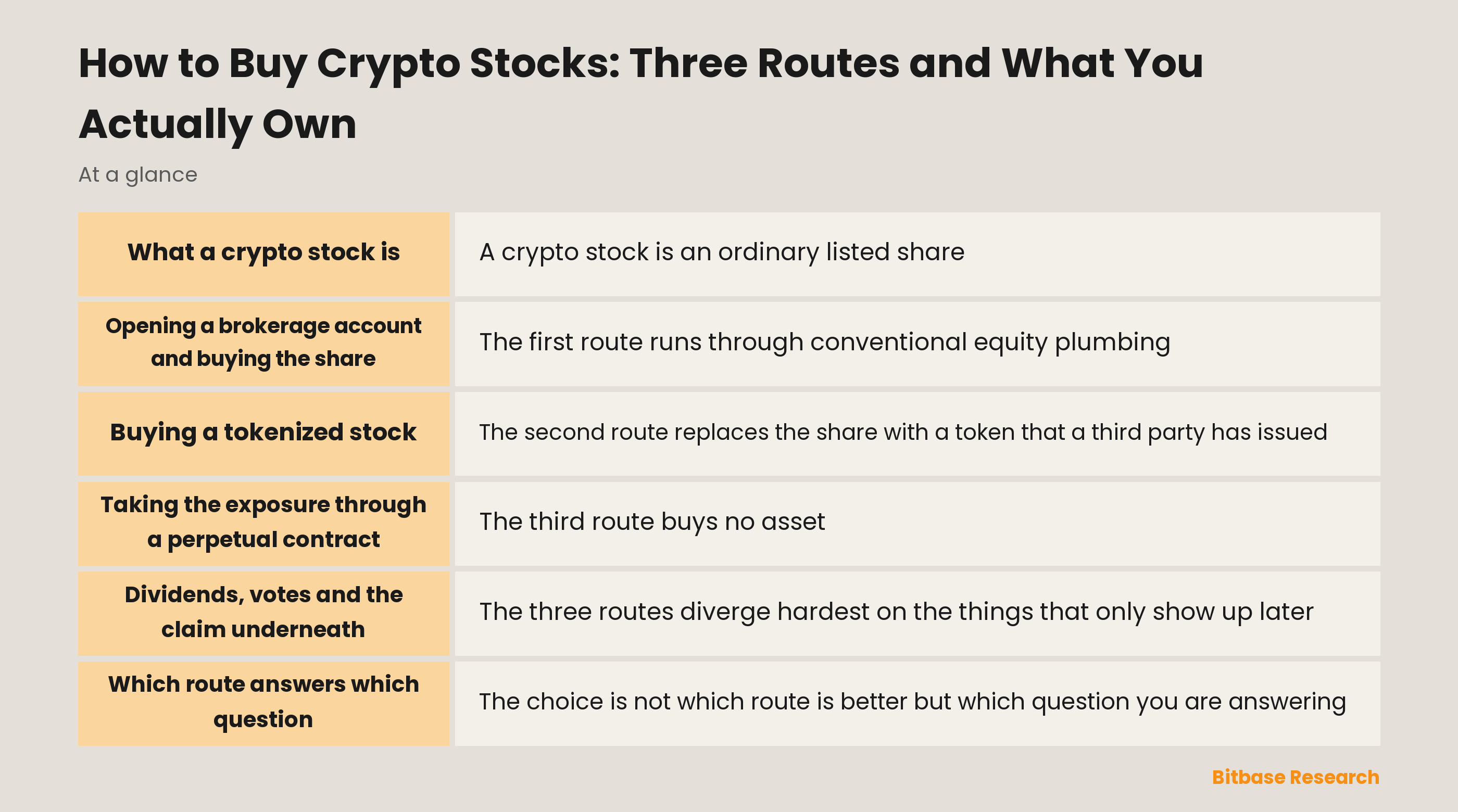
A crypto stock is an ordinary listed share, and what makes it a crypto stock is the business behind it: an exchange or broker paid on trading activity, a miner turning electricity into coins, a company holding bitcoin on its balance sheet, an infrastructure firm whose revenue tracks the sector. It trades on a stock exchange under a stock ticker, inside securities law and the disclosure that comes with it.
That is a different decision from buying cryptocurrency itself. A coin is not a claim on a company; a share is. Settle which of the two you are after first, because the venue follows from that answer rather than the other way round.
Opening a brokerage account and buying the share
The first route runs through conventional equity plumbing. You open an account with a broker that can reach the market where the stock is listed, verify your identity, fund it in your own currency, then search the ticker and send an order. If quoted prices and order books are new vocabulary, the difference between a broker and an exchange decides what the price on your screen means.
Three practicalities come attached to that account.
The hours belong to the listing venue. The regular US session runs from 9:30 a.m. to 4:00 p.m. Eastern, with a pre-market window from 4:00 a.m. and an after-hours window until 8:00 p.m. either side of it. Which order types your broker accepts in those extended windows is set by the broker, not by the stock.
Settlement takes a day. Since May 28, 2024, the standard settlement cycle for most broker-dealer securities transactions in the United States has been one business day after the trade date rather than two. You are committed the moment the order fills, but cash and shares change hands the next business day.
The tradeable unit is one share, unless your broker offers fractional orders.
What the route hands back is a share in the broker's custody chain, carrying whatever rights that share class carries.
Buying a tokenized stock
The second route replaces the share with a token that a third party has issued. The listed company is not the issuer and takes no part in it: what you hold is an instrument built by whoever created the product, on that issuer's terms.
This is where the route stops being one thing, because the issuers are built differently on the points a buyer cares about.
Ondo's documentation states that "one token does not necessarily represent the value of one share, and the price of one token will not always match the price of the underlying asset." Its tokens are structured as total return trackers, so dividends are reinvested net of withholding tax rather than paid out, and holders "do not receive shareholder voting rights, statutory information rights or other shareholder rights." Ondo describes them as generally trading 24/5 with exceptions, and as generally available to non-US investors.
xStocks are shaped differently. They are issued by Backed Assets (JE) Limited, a Jersey company, and the official site describes each xStock as backed 1:1 by the underlying asset held in regulated custody and tradeable 24/7 across chains. The same site states they are not available in the United States or to U.S. persons.
Robinhood's product is not a tokenized share in legal form at all. Its European documentation describes Classic Stock Tokens as "derivative contracts between you and Robinhood," priced at the prices of the underlying securities "without granting rights to them," with the underlying assets owned by Robinhood and held with a US-licensed institution. Where the underlying pays a dividend, Robinhood passes a corresponding amount to eligible holders in cash. Trading runs from Monday 2 a.m. to Saturday 2 a.m. CET.
Dinari's dShare is described as a token 1:1 backed by a security, minted or burned only after the matching brokerage order fills through Alpaca. It runs four session windows rather than one, and its round-the-clock window covers a limited set of tickers with lower liquidity rather than the full list.
Four issuers, four answers to "is it one-for-one" and "can I trade it at the weekend." The symbol on the screen does not tell you which structure you are buying; the issuer's documentation does. The names available in tokenized form are listed in the tokenized stock lineup.
Taking the exposure through a perpetual contract
The third route buys no asset. A perpetual futures contract holds nothing: no share, no token, no claim on the company. It references a price, settles in stablecoin, and exchanges a periodic funding rate between the long and short sides.
You post margin rather than the full notional. That is what the route is for, and it is also why a position can be liquidated while the price you are watching is still short of the level you planned around. Funding accrues while the position is open, so a directionally correct trade held long enough can still lose to the carry.
The contract keeps its own schedule, which can be open while the listing venue is shut. News breaking overnight prices into the contract first, and a position held across that boundary cannot be hedged in the market that is closed.
The three routes side by side
| What you are comparing | Brokerage share | Tokenized stock | Perpetual contract |
|---|---|---|---|
| What you hold | A share, in the broker's custody chain | A third party's instrument | A contract holding no asset |
| Who you are exposed to | The company and the broker | The issuer's structure and custody | The venue and your margin |
| When it settles | One business day after the trade | When the transfer confirms | Continuously, in the margin |
| When it trades | The listing venue's sessions | Set by the issuer, differently at each | The venue's own schedule |
| Smallest order | One share, or a fraction if allowed | A fraction of a token | A fraction of a contract |
| Cost of holding | None beyond the position | None beyond the position | The funding rate, periodically |
Dividends, votes and the claim underneath
The three routes diverge hardest on the things that only show up later.
On the brokerage share, a declared dividend reaches you through the custody chain, you get whatever vote the share class carries, and if the company is wound up you stand where shareholders stand: behind the creditors, with a claim on what is left.
On a tokenized stock none of that transfers automatically, and the answer belongs to the issuer. As the four descriptions above show, a dividend can be reinvested into the token at one issuer and passed on in cash at another, and in neither case does a shareholder's vote come with it. The claim you hold runs against the issuer's structure rather than against the listed company.
On a perpetual contract there is nothing underneath to have rights over. No dividend arrives, no vote exists, no company claim ranks anywhere. What the contract does have is a margin requirement to meet while the position is open.
Which route answers which question
The choice is not which route is better but which question you are answering.
If you want ownership of the company, only one route delivers it, and the settlement cycle and session hours come with it. If you want exposure that keeps moving after the listing venue closes, a tokenized stock addresses that, and the price is taking on the issuer's structure, eligibility rules and redemption terms, all of which the issuer can change. If you want a directional view with a time limit, the perpetual is built for that, and the funding cost belongs in the plan from the first order.
The bottom line
Buying a crypto stock resolves into three questions, not one: which company, which instrument, and what that instrument entitles you to. The brokerage route gives you the share and the rights, on the market's hours and settlement cycle. The tokenized route gives you an issuer's instrument whose terms differ from issuer to issuer, which is why reading that documentation is part of the purchase. The perpetual gives you price exposure with nothing underneath. Decide which of the three you want before you fund an account. To keep learning the fundamentals, follow more from Bitbase Academy.
Related reading
Other Bitbase articles on this topic:
- Crypto Has No Price Per Share: What It Has Instead
- Crypto in the Name Does Not Make It a Crypto Stock
- Crypto or Stocks: The Six Measures That Decide It
- How to Trade SHOP: Shopify, a Canadian Issuer on Nasdaq
- The SOPR Indicator Explained
Disclaimer: This article is educational content from Bitbase Academy, provided for information only. It does not constitute investment, trading, tax, or financial advice. Crypto assets are volatile; assess your own risk. Written as of September 2026; refer to the latest official information.
References
[1] SEC press release 2023-29: the standard settlement cycle for most broker-dealer securities transactions shortened from T+2 to T+1, compliance date May 28, 2024 www.sec.gov
[2] Ondo Stocks overview: backing, shareholder rights and trading hours (Ondo official documentation) docs.ondo.finance
[3] xStocks official site: what an xStock is, 1:1 backing in regulated custody, issuer and eligibility xstocks.com
[4] Robinhood Europe: Classic Stock Tokens described as derivative contracts between the customer and Robinhood, granting no rights to the underlying shares robinhood.com
[5] Dinari documentation: the four dShare trading sessions and the round-the-clock window limited to a subset of tickers docs.dinari.com