You hold USDT rather than dollars in a brokerage account, and you want exposure to a listed company. Where stock markets run alongside crypto markets there are two ways to get it, and they are not variants of one thing: buy a tokenized stock outright on a spot book, or open a stock perpetual. One leaves you holding a token; the other, a contract. Here is how each route fills, what it costs to keep open, and what happens when the underlying market is shut.
Where your stablecoin actually goes
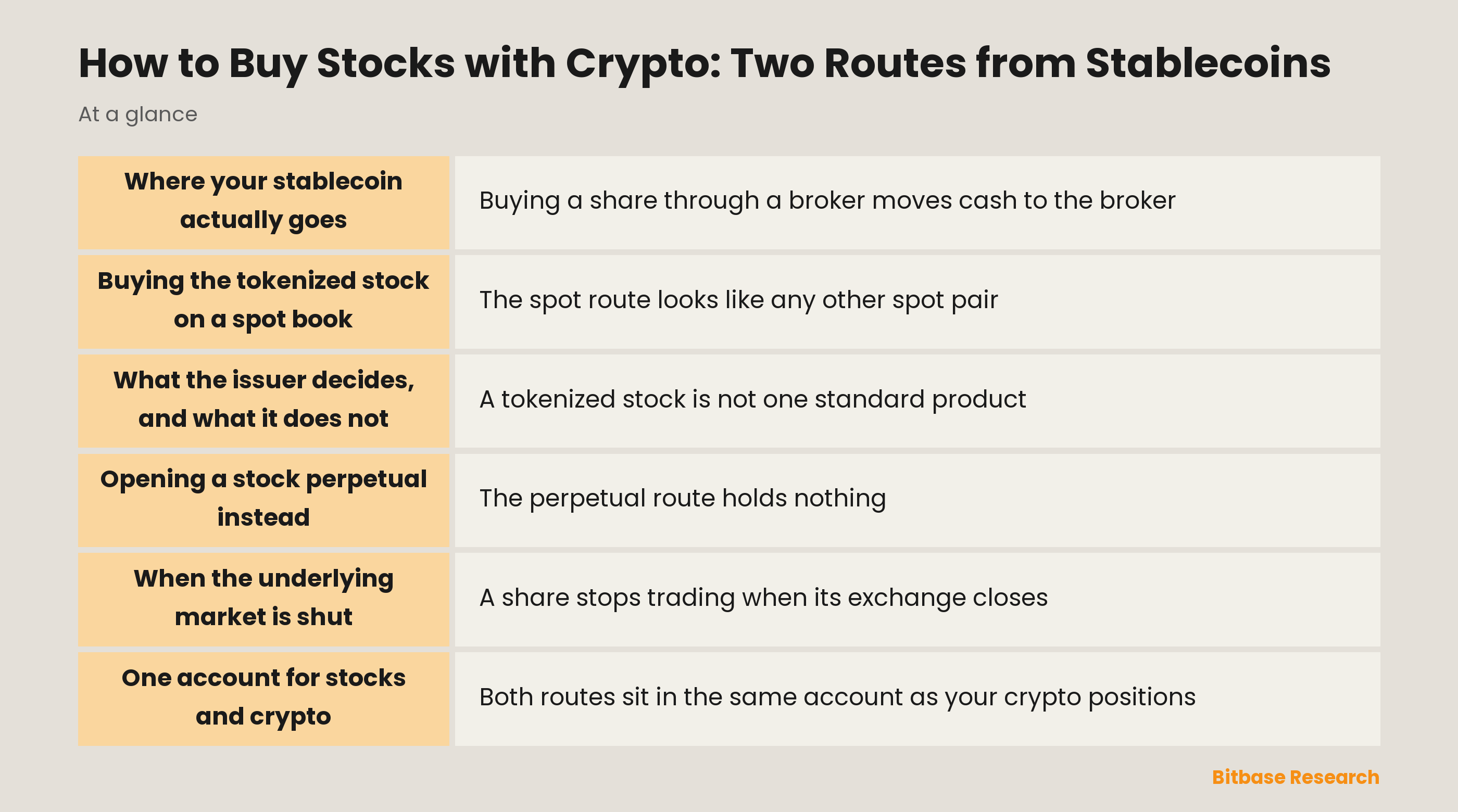
Buying a share through a broker moves cash to the broker, the broker buys the share, and a registrar records you as its owner. None of that happens here: your stablecoin is never converted to fiat, no brokerage account is opened in your name, and no registrar hears about you.
What happens instead depends on the market. On a spot book, the USDT is exchanged for a token that a third-party issuer created and backs under its own structure. On a perpetual futures market the USDT is not exchanged at all: it sits as margin behind a contract whose price references the stock.
That split runs through everything below. In one case you own a token; in the other you are a party to a contract. Neither makes you a shareholder of the listed company, and neither converts into a share on request.
Buying the tokenized stock on a spot book
The spot route looks like any other spot pair: the base asset is a tokenized stock, the quote asset is USDT, and the order types and fill logic are the ones you already use for crypto. The NVIDIA tokenized stock spot market and the Tesla tokenized stock spot market are both quoted against USDT.
Once it fills, you hold the token. No funding is charged against the position, no liquidation level applies to it, and there is no settlement cycle to wait out before the balance is yours. The cost is the fee and the spread on the way in, and again on the way out.
The token belongs to a broader category, tokenized securities, and inherits its caveats: a token is only as sound as its legal wrapper, its issuer and its custodian.
What the issuer decides, and what it does not
A tokenized stock is not one standard product. It is whatever its issuer built, and these issuers built different things. The names you will meet are Ondo, Backed's xStocks, Robinhood and Dinari. On Bitbase the tokenized NVIDIA is an Ondo token and the tokenized Tesla is an xStock, so two orders placed on the same screen can land on two different legal structures.
Ondo's documentation states that one token does not necessarily represent the value of one share, and that the price of one token will not always match the price of the underlying asset. The tokens are total return trackers, with dividends reinvested net of withholding tax rather than paid out, and Ondo states that holders do not receive shareholder voting rights, statutory information rights or other shareholder rights.
Backed describes each xStock as backed one-for-one by the underlying asset held in regulated custody, and names Backed Assets (JE) Limited as the issuer.
What Robinhood offers in Europe is not a tokenized share. Its documentation describes Classic Stock Tokens as derivative contracts between you and Robinhood, priced at the prices of the underlying securities without granting rights to them, and owned by Robinhood.
Dinari describes a dShare as a token backed one-for-one by a security, minted or burned only after the corresponding order fills at its broker, Alpaca.
Eligibility comes from the issuer as well. Ondo describes its tokenized stocks as generally available to non-US investors subject to jurisdictional and other restrictions; Backed states that xStocks are not available in the United States or to US persons; Robinhood offers its product through Robinhood Europe, UAB. So the question before an order is not what the ticker does, but who issued the token and what their documentation says it is. The four structures are set against each other in full under which issuer built the token. Before an order you need less than that: the issuer's name, and its own description of the product.
Opening a stock perpetual instead
The perpetual route holds nothing. A stock perpetual references a price and settles in stablecoin; there is no token, no issuer, and no claim on the company. You post USDT as margin, choose a size, and the position runs until you close it or it is closed for you.
What you gain is leverage, and the ability to be short without borrowing first. What you take on is a funding rate that moves value between the two sides of the contract at set intervals, charged to you or credited to you according to which way it points, plus a maintenance margin level below which the position is liquidated whatever your view is at the time.
That makes the perpetual the natural instrument for a dated opinion and an awkward one for an undated holding: the funding meter runs for every interval the position survives, so the same correct call costs more the slower it works.
The running cost of holding exposure
The two routes differ less in how they fill than in what happens after they do.
| What you are comparing | Tokenized stock spot | Stock perpetual |
|---|---|---|
| What you hold after the fill | A token the issuer created | A contract with the venue |
| What you post | The full amount, in USDT | Margin, in USDT |
| Cost of keeping it open | Fees and spread only | Fees, spread, and funding paid or received |
| What can close it without you | No liquidation level applies | Liquidation at the maintenance margin |
| Getting short | Not possible by holding | Open a short position |
| Rights to the underlying share | Defined by the issuer's documentation | None; the contract references a price |
Read the middle rows together. A spot position is dormant: it costs nothing to keep, and it has no liquidation level. A perpetual is live: metered while open, and carrying a level at which the venue ends it for you. Sizing a perpetual at the notional you would have bought in spot is where the two routes diverge fastest.
When the underlying market is shut
A share stops trading when its exchange closes. The token does not, or at least not on the same schedule, and that mismatch changes how a position behaves overnight and at weekends.
The schedules come from the issuer, not from the venue you trade on, and they differ. Ondo puts trading at 24/5 and says it can pause for corporate actions and risk limits, with a smaller group of assets tradeable outside those hours. Backed describes xStocks as tradeable 24/7 on-chain. Robinhood's window runs from Monday to Saturday in European time. Dinari runs the regular US session plus pre-market, after-hours and overnight windows that accept limit orders only, with a continuous on-chain channel available for part of its lineup.
Two consequences follow. News that arrives outside exchange hours is absorbed by the token or the contract before the share itself reprices, and there is nowhere to hedge until the share reopens. And with that market closed, or the underlying halted, the price on your screen has less to anchor to: the spread widens, and a stop sized against a weekday spread is a different order on a Sunday.
One account for stocks and crypto
Both routes sit in the same account as your crypto positions. The stablecoin funding a stock perpetual is the stablecoin sitting next to your BTC. There is no transfer to a brokerage first, no second onboarding, and no separate platform to learn before placing the order.
The gains are practical. Collateral is in one place, so a hedge does not begin with a withdrawal. One interface covers both, so the order types transfer. And exposure across the two asset classes shows up in one risk view rather than two, which is worth having on the days when equities and crypto move together.
What a single account does not do is change what each instrument is. It does not turn a token into a share, and it does not make a perpetual less leveraged. The Bitbase TradFi suite spans stocks, indices and commodities in two forms, spot and perpetual futures; the TradFi markets page is where to check which form a given name trades in.
The bottom line
Buying stocks with crypto resolves into two answers rather than one. To hold exposure and leave it alone, the spot route behaves like holding: no funding accrues against it, and no liquidation level applies. For leverage, for a short, or for a position with a deadline, the perpetual is built for the job, and funding is what it costs to leave open.
Both start from the same USDT balance, and both stop short of owning a share. Before the spot order, read what the issuer says its token is; before the perpetual, read the contract specification. Both are published, and both say things the ticker does not. To keep learning the fundamentals, follow more from Bitbase Academy.
Related reading
Other Bitbase articles on this topic:
- Crypto in the Name Does Not Make It a Crypto Stock
- Crypto or Stocks: The Six Measures That Decide It
- Crypto Tickers Collide and Stock Symbols Do Not
- How to Buy and Trade SPY: The ETF Trust and the Perpetual
- Token Age Consumed and Coin Days Destroyed Explained
Disclaimer: This article is educational content from Bitbase Academy, provided for information only. It does not constitute investment, trading, tax, or financial advice. Crypto assets are volatile; assess your own risk. Written as of September 2026; refer to the latest official information.
References
[1] Ondo Stocks overview: backing structure, holder rights and trading hours (Ondo official documentation) docs.ondo.finance
[2] xStocks official site: one-for-one backing, regulated custody, issuer and availability xstocks.com
[3] Robinhood Europe: Classic Stock Tokens are derivative contracts, with hours and issuing entity robinhood.com
[4] Dinari documentation: what a dShare is, one-for-one backing and the broker order path docs.dinari.com
[5] Dinari documentation: trading sessions, limit-only windows and the continuous on-chain channel docs.dinari.com