For an account funded in USDT rather than dollars, buying a US stock is not one transaction with one outcome. Stablecoin settlement reaches equity prices through instruments issued by third parties or written as contracts with a counterparty, and the differences between them decide what you can claim, when you can trade, and what can close the position without asking you. This piece covers what each route gives you, what moves it once you hold it, and how to check the structure against the issuer's own documents.
What Buying a US Stock With USDT Actually Means
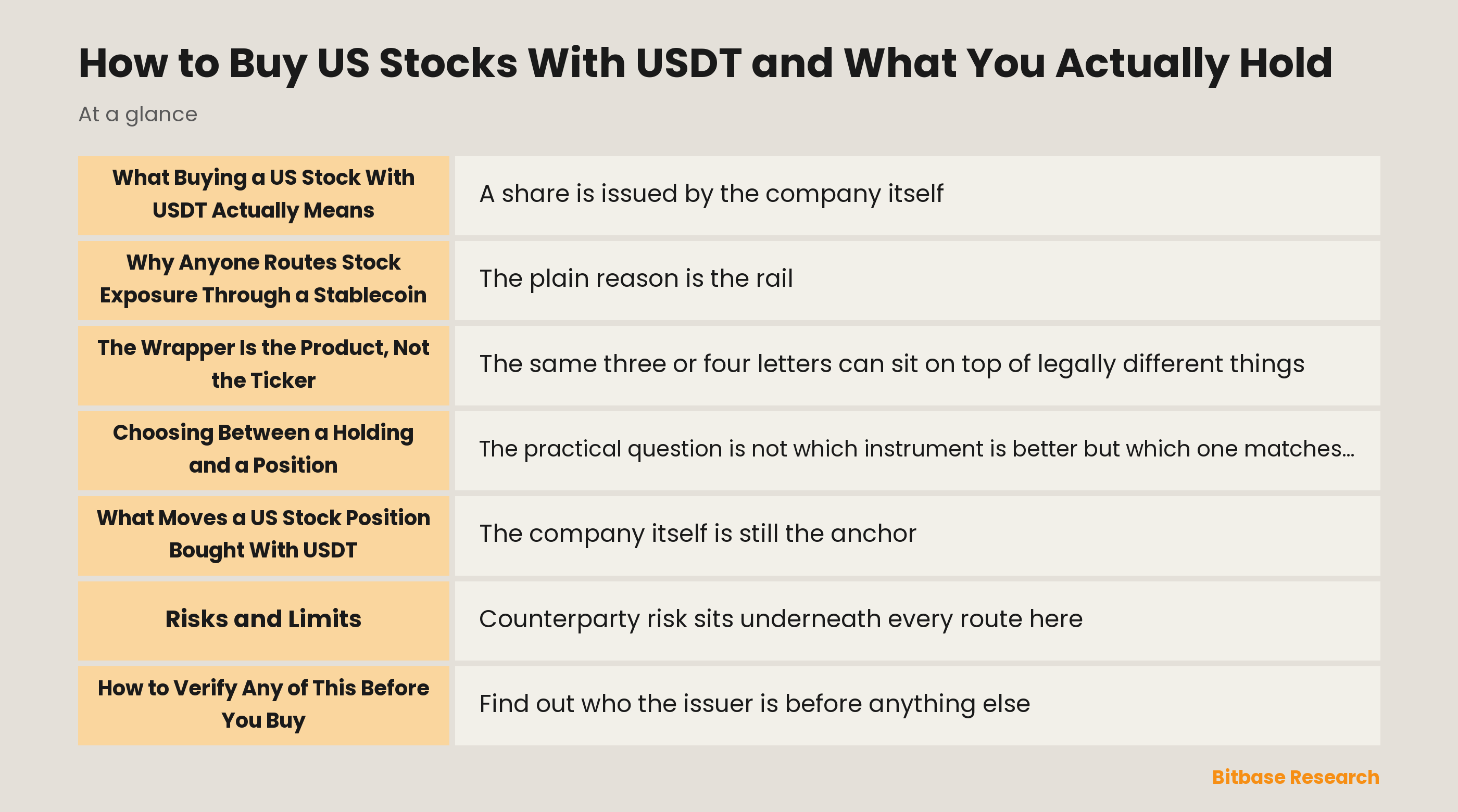
A share is issued by the company itself, and the rights attached to it — a vote, a claim on the dividend, the statutory information rights — are granted by that company to whoever appears on its register. Settling in USDT does not put you on that register, and nothing on the crypto side changes that: the register is maintained through regulated intermediaries that settle in dollars.
What stablecoin settlement can reach is a set of instruments that reference the same price, and they fall into two families. One is a token issued by a third party that has taken on an obligation tied to the stock, bought and held on a spot market like any other token. The other is a futures contract that follows the price, margined and settled in stablecoin, holding no share at all.
Both families will quote you a number that follows the stock. Neither answers the question of what you own the way a brokerage share does, and almost every surprise people meet with these products comes from assuming otherwise.
Why Anyone Routes Stock Exposure Through a Stablecoin
The plain reason is the rail. A balance already held in USDT does not have to be converted to fiat, wired to a broker and cleared before it can buy anything; it can be put to work where it sits.
Access is often the real reason. Opening a brokerage account that can buy US-listed shares depends on where you live, which documents you hold, and which firms take clients from your jurisdiction. Stablecoin-settled instruments have eligibility rules too, but those are set by the issuer rather than by a broker, and they do not draw the same map.
Collateral is part of it too: one settlement asset covering a crypto position and an equity-referenced position is simpler than two funded accounts in two currencies, and rotating between them becomes a decision rather than a transfer. And some of these instruments are open when the primary market is not, or allow a short or a leveraged view without a margin agreement at a broker — an advantage only for someone who understands what they are holding while the primary market is shut.
The Wrapper Is the Product, Not the Ticker
The same three or four letters can sit on top of legally different things, and the wrapper decides what you have.
Ondo documents its tokenized stocks as total return trackers rather than one-for-one claims. Its documentation states that “One token does not necessarily represent the value of one share, and the price of one token will not always match the price of the underlying asset,” and that a holder does “not receive shareholder voting rights, statutory information rights or other shareholder rights from the issuer of those securities.” The tokens are meant to give the economics of holding the asset with dividends invested back into the stock, net of withholding taxes, and they generally trade 24/5, with exceptions.
Dinari takes a different shape. Its documentation describes a dShare as “a token 1:1 backed by a security, commonly a U.S. equity,” with minting and burning occurring upon completion of corresponding orders on a brokerage account.
Robinhood Europe UAB is different again, and the difference is legal rather than technical. It describes its Classic Stock Tokens as “derivative contracts between you and Robinhood,” priced at the prices of the underlying securities “without granting rights to them,” with the underlying assets owned by Robinhood and held with a US-licensed institution.
Three issuers, three structures, one underlying price. Reading one issuer's documentation and assuming it describes the others is the mistake this section exists to prevent; if you want the shape of the category before the specifics, tokenized stocks covers it.
A perpetual futures contract sits outside this family altogether. It holds nothing — no share, no token, no claim on the company. It follows a price, settles in stablecoin, and charges or pays a funding rate between longs and shorts instead of expiring.
Choosing Between a Holding and a Position
The practical question is not which instrument is better but which one matches the intention behind the trade.
A token bought on a spot market behaves like a holding. There is no funding payment, no maintenance margin and no liquidation price; it sits in the account until it is sold, and what you carry is the issuer's structure and the price of the underlying. That suits exposure held over weeks or months by someone who accepts an issuer standing between themselves and the company.
A perpetual behaves like a position. It has a funding cost that accrues whether the trade is working or not, a margin requirement that moves with the price, and a liquidation level that ends the trade without asking. That suits a directional view with a time limit, or a hedge against something else in the account, and it suits nothing that begins with the phrase “I want to own some of this company.”
Which instruments exist under a given name differs by name and is not worth assuming; the TradFi listings are where that is published.
What Moves a US Stock Position Bought With USDT
The company itself is still the anchor. Earnings, guidance, regulatory decisions and the ordinary noise of a listed business move the underlying price, and every instrument described here inherits that movement whether or not it holds a share.
Around that, the session matters. While the listing venue is open, these instruments follow a reference that is itself trading; while it is shut, they are pricing a stock that is not. A headline landing on a weekend gets expressed in whatever is open, on thinner books, and the primary market confirms or contradicts it when it reopens.
Issuer-level events move the wrapper rather than the underlying. Corporate actions, redemption arrangements, custody and risk pauses are decided by the issuer, and they can put distance between the token and the share for reasons that have nothing to do with the company.
On the perpetual, the crowd moves the cost of holding. When one side is heavily positioned, funding flows against it, and a directionally correct trade can still bleed while it is being paid for.
The stablecoin leg is a variable of its own. The quote is denominated in USDT, so what you read on the screen is a relationship between two assets rather than one.
Risks and Limits
Counterparty risk sits underneath every route here. A token depends on the issuer's structure holding up — its backing arrangement, its custodian, its solvency — and none of those is the company whose name is on the ticker. A perpetual depends on the venue and its margin engine. A share held through a broker has its own exposures, but the token issuer's structure is not among them.
Rights do not come with the wrapper. Where an issuer states plainly that holders receive no shareholder voting or statutory information rights, that is the whole answer, and it does not soften because the token is widely held. Terms belong to the issuer as well: eligibility, redemption paths, supported jurisdictions and trading hours are theirs to alter, so a structure checked once is not checked forever.
Hours create gap risk in both directions. A position held across a closed primary session is exposed to news that cannot be hedged in the primary market until it reopens.
Leverage compounds all of it. A liquidation triggered in thin overnight trading is a real outcome, and stock-referenced contracts can move abruptly around scheduled company events.
How to Verify Any of This Before You Buy
Find out who the issuer is before anything else. The instrument's own listing names it, and that name is not decoration — it decides which set of documents applies to what you are about to buy.
Then read that issuer's documentation rather than a summary of it. Backing structure, whether the token is one-for-one, what rights a holder receives, when it trades, how redemption works and who is eligible are all stated there, and the answers differ between issuers whose products look identical from the outside.
Company facts come from filings. The SEC's EDGAR system gives free public access to the documents filed by publicly traded companies, including the annual report and the risk factors the company names in it.
Contract terms come from the venue. Margin requirements, funding intervals and settlement rules are published on the product page for the specific contract, and they change; a general description of how perpetuals work is no substitute for that page.
And check the date on whatever you read, this article included.
Conclusion
Buying US stocks with USDT is possible, and it is not the same thing as owning them. The stablecoin buys either an obligation from a third party or a contract with a venue, and which of the two you hold decides what rights you have, when you can trade, and whether the position can be closed without your consent. These instruments are useful precisely because they are not shares: they are open when the primary market is not, they accept collateral a broker will not, and they can express a short or a leveraged view. Treating them as shares is what turns that usefulness into a surprise. Read the issuer's documents, size the position for the structure rather than for the ticker, and the rest is an ordinary trading decision.
Related reading
Other Bitbase articles on this topic:
- Crypto in the Name Does Not Make It a Crypto Stock
- Crypto or Stocks: The Six Measures That Decide It
- Crypto Tickers Collide and Stock Symbols Do Not
- How to Trade Stock Indices Without Owning the Index
Disclaimer: This article is educational content from Bitbase Academy, provided for information only. It explains what a company or fund does and how the instruments referenced here differ from one another; it does not constitute investment, trading, tax, or financial advice, and it is neither a recommendation nor an endorsement of any security, token, or trading strategy. A tokenized stock is issued by a third party and is designed to give economic exposure to an underlying asset: it is not a share, it carries no shareholder rights, and it depends on the issuer's structure, eligibility rules, and redemption terms, which the issuer can change. Perpetual futures are leveraged derivatives that hold no underlying asset and can be liquidated, and trading hours, product availability, and eligibility differ by instrument and by jurisdiction and can change at any time. Written as of September 2026; verify everything yourself through company filings, the issuer's own documentation, and the product pages of the venue you trade on.
References
[1] Ondo: Ondo Stocks overview (token structure, holder rights, trading hours) docs.ondo.finance
[2] Dinari: what a dShare is (one-for-one backing, minting and burning) docs.dinari.com
[3] SEC: EDGAR filing search, free public access to company filings www.sec.gov