Apple is filed under hardware, and that label explains less of the business each year: the fastest-growing part of it is the commission and subscription layer sitting on an installed base that already exists. On Bitbase the AAPL ticker resolves to a tokenized stock price page and a perpetual futures contract, and neither registers a share in your name.
What Is Apple (AAPL)?
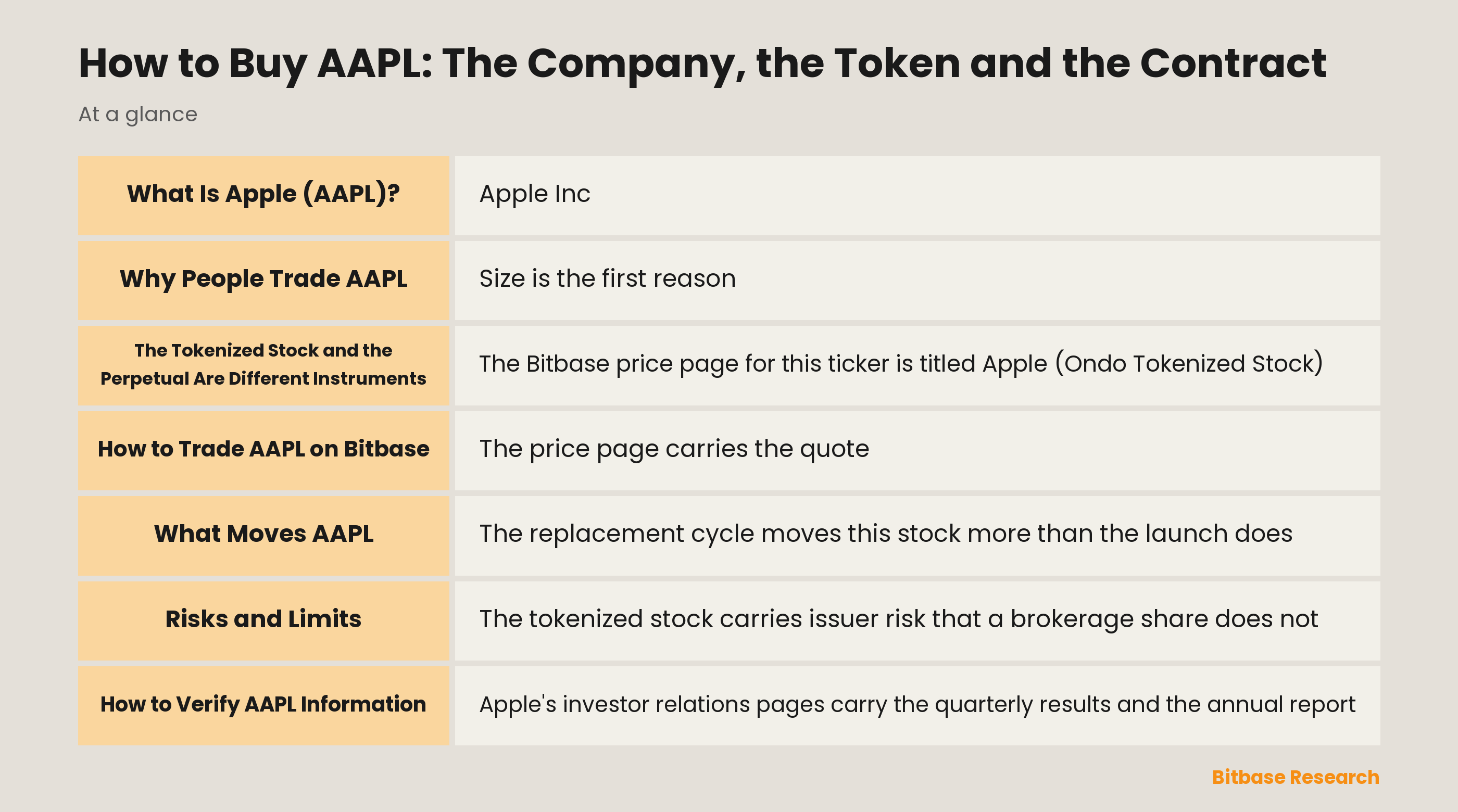
Apple Inc. designs consumer hardware and the operating systems and services that run on it. It trades on Nasdaq under AAPL and sits in the Dow Jones Industrial Average as well as the S&P 500 and the Nasdaq-100.
Revenue is reported in five lines: iPhone, Mac, iPad, Wearables Home and Accessories, and Services. iPhone is the largest, and the installed base it builds is what the other lines sell into. Services covers the App Store, iCloud, advertising, AppleCare, payment services and licensing, and Apple reports its gross margin separately from Products. That margin has run structurally higher, so a shift in the mix moves profit even when revenue does not.
The fiscal year ends in late September, which puts the holiday quarter in fiscal Q1 rather than Q4.
Why People Trade AAPL
Size is the first reason, and it is passive. A broad US index fund is already a position in Apple, so a deliberate trade in the ticker is an overweight, a hedge, or a short-dated view on something already held indirectly.
The crypto connection is not the one people assume. Apple holds no crypto on its balance sheet and reports no crypto revenue. Its contact with the sector runs the other way: App Store rules decide what wallets, exchanges and on-chain features may do on iOS, which is why Apple's developer terms are read closely by companies that never appear in Apple's own results.
The Tokenized Stock and the Perpetual Are Different Instruments
The Bitbase price page for this ticker is titled Apple (Ondo Tokenized Stock), trading under the symbol AAPLON. The issuer name is the load-bearing part of that title, because what the page tracks is not a share.
Ondo's own documentation is direct about the structure. One token does not necessarily represent the value of one share, and a token's price will not always match the price of the underlying asset. The tokens are built as total return trackers, so dividends are reinvested net of withholding tax rather than paid out. Holders receive no shareholder voting rights, no statutory information rights and no other shareholder rights. Ondo describes trading as generally running 24/5, with pauses possible around corporate actions and risk limits, and the product as generally available to non-US investors.
A perpetual futures contract is a third structure and shares nothing with the first two except a price. It holds no share and no token: it tracks a quote, settles in stablecoin, exchanges a periodic funding payment between longs and shorts, and is closed out by the venue if margin runs out. So "owning Apple" has three answers, and only a share bought through a broker carries the rights the word normally implies.
How to Trade AAPL on Bitbase
The price page carries the quote, the chart and the market data for the tokenized stock. Reading it commits nothing.
The perpetual futures market is where a directional position is opened with leverage. Funding is paid or received at each interval depending on which side is crowded, and a liquidation price sits under the position from the first order onward. That suits a view with a deadline, and the cost of holding a perpetual belongs in the plan before the entry.
Which tickers carry a spot market as well differs by name; the tokenized stock listings page is where that gets checked rather than assumed.
What Moves AAPL
The replacement cycle moves this stock more than the launch does. New models arrive on an annual cadence, so the launch itself is not news; the variable is how long owners wait before replacing a device they still find adequate, and a cycle that lengthens by a few months spreads its effect over several quarters.
Mix moves it as much as growth. Because Services carries the higher gross margin, revenue shifting toward it raises profit without a single additional unit shipping, which makes App Store commission terms an earnings variable rather than a policy footnote.
Regulation therefore lands on the highest-margin part of the business. In the European Union, Apple is designated a gatekeeper under the Digital Markets Act, obliged to allow alternative app marketplaces and to loosen its grip on developer payments; the EU General Court dismissed Apple's challenge to that designation. In the United States, the search antitrust case against Google reached the payments Apple receives for default search placement: the district court declined to ban them and required instead that the default agreements be rebid each year, and the case went on to appeal.
Greater China counts twice, as a demand market with capable domestic handset competition and as the place where a large share of assembly sits, so tariffs and export policy reach the company through two doors at once. A continuous buyback alongside a dividend also means the share count trends down, so per-share figures can improve while the business is flat.
Risks and Limits
The tokenized stock carries issuer risk that a brokerage share does not. Its value depends on the issuer's structure holding, there is no shareholder claim beneath it, and eligibility and redemption terms can be changed by the issuer.
The 24/5 schedule creates gap risk against a market session shorter still. Apple reports results after the Nasdaq close, and a token still trading into that news prices it before the primary market reopens, so a position held across that boundary cannot be hedged where the shares trade, and a perpetual referenced to that price gaps with it.
The perpetual adds funding cost and forced closure: funding accrues whether or not the direction is right, and leverage shortens the distance to the level at which the position is closed for you.
How to Verify AAPL Information
Apple's investor relations pages carry the quarterly results and the annual report, where the category and geographic breakdowns appear in the company's own numbers. The SEC's EDGAR database carries the filings themselves, including the risk factors, where Apple sets out its regulatory and supply chain exposures.
For the tokenized instrument, the issuer's documentation is the authority on what the token is, what rights it does not carry, when it trades and who may hold it. On Bitbase, the price page carries the current quote and the futures market page carries the contract specification: funding interval, margin requirement and leverage limits. For the regulatory thread, the European Commission publishes its Digital Markets Act decisions and US court dockets are public.
Conclusion
AAPL is a hardware franchise with a high-margin services layer attached, and the second part is where both the growth and the legal exposure now sit. On Bitbase the ticker offers a price page for a tokenized stock issued by a third party and a perpetual futures contract, and neither is share ownership: one gives economic exposure without shareholder rights, the other leveraged price exposure without holding anything. Which route fits depends on holding period, and on whether the rights a share carries matter to the reason for the position.
Related market pages
Bitbase pages for the tokenized stocks named in this article:
- AAPL: View price · Perpetual market
Related reading
Other Bitbase articles on this topic:
- Crypto Tickers Collide and Stock Symbols Do Not
- How to Buy Crypto Stocks: Three Routes and What You Actually Own
- How to Buy Stocks with Crypto: Two Routes from Stablecoins
- How to Trade UBER: What Uber Keeps From Every Trip
Disclaimer: This article is educational content from Bitbase Academy, provided for information only. It explains what a company or fund does and how the instruments referenced here differ from one another; it does not constitute investment, trading, tax, or financial advice, and it is neither a recommendation nor an endorsement of any security, token, or trading strategy. A tokenized stock is issued by a third party and is designed to give economic exposure to an underlying asset: it is not a share, it carries no shareholder rights, and it depends on the issuer's structure, eligibility rules, and redemption terms, which the issuer can change. Perpetual futures are leveraged derivatives that hold no underlying asset and can be liquidated, and trading hours, product availability, and eligibility differ by instrument and by jurisdiction and can change at any time. Written as of September 2026; verify everything yourself through company filings, the issuer's own documentation, and the product pages of the venue you trade on.
References
[1] Apple Investor Relations: quarterly results and the annual report, with the product-category and geographic breakdowns investor.apple.com
[2] SEC EDGAR: Apple annual filings, including the risk factors on regulation and supply chain concentration www.sec.gov
[3] Ondo Stocks overview: backing, shareholder rights and trading hours (Ondo official documentation) docs.ondo.finance