Buying AMD anywhere buys exposure to three businesses that do not move together: the accelerators and server processors in its Data Center segment, the PC and console silicon in Client and Gaming, and the programmable parts in Embedded. On Bitbase the ticker opens onto two surfaces, a price page for a tokenized stock and a perpetual futures contract, and neither of them puts a share in your name.
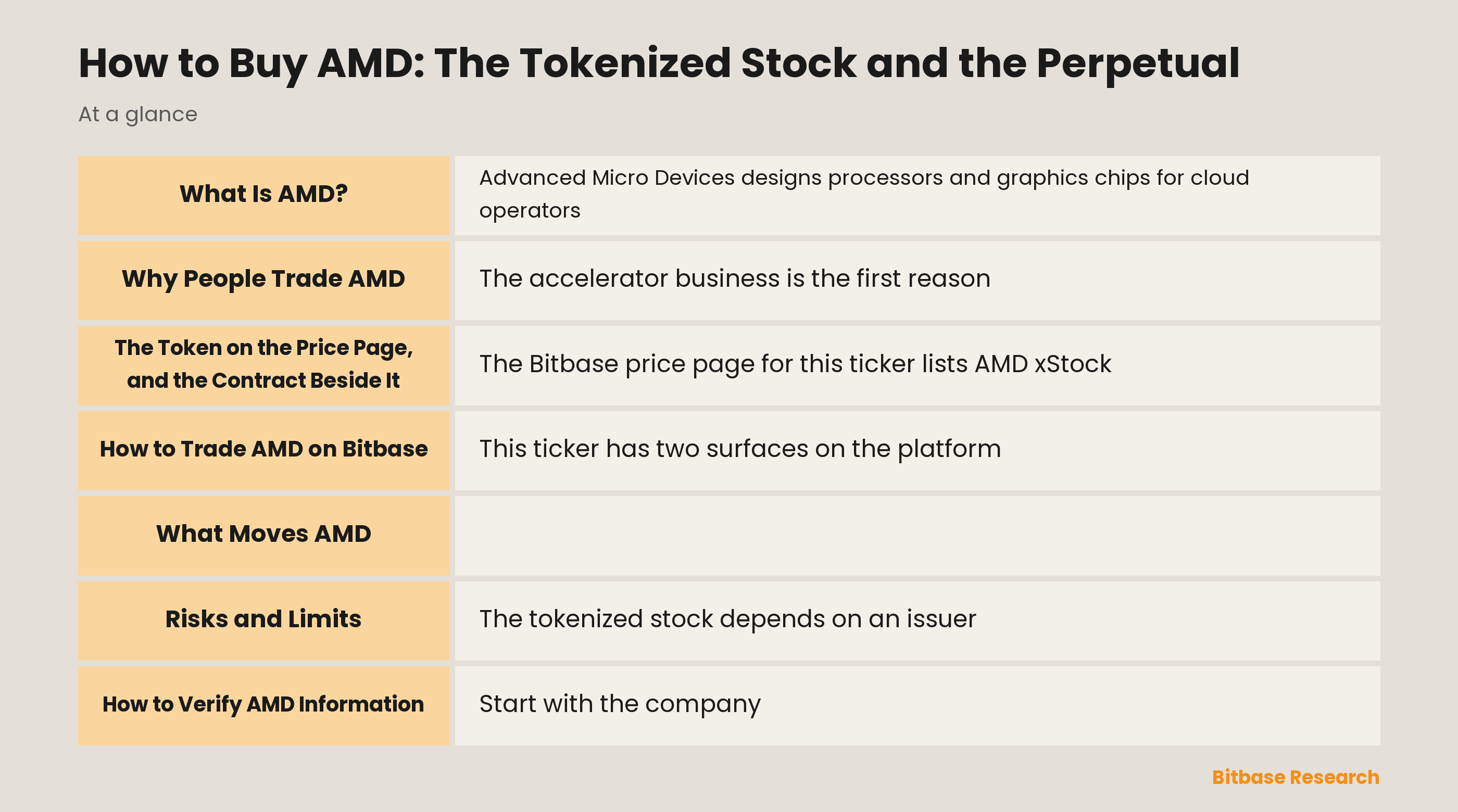
What Is AMD?
Advanced Micro Devices designs processors and graphics chips for cloud operators, PC makers, console manufacturers and industrial customers. Its stock trades on the Nasdaq Global Select Market under AMD.
It reports in three segments, and they decide where a quarter's surprise belongs. Data Center covers "AI accelerators, CPUs for servers" and the networking and SoC parts sold with them. Client and Gaming covers desktop and notebook processors, graphics cards, and the "semi-custom SoC products" inside the PlayStation 5 and Xbox Series consoles. Embedded covers FPGAs, system-on-modules and adaptive SoCs for industrial customers.
AMD does not own the wafer fabs. The wafers behind its high-performance, FPGA and adaptive SoC products come from Taiwan Semiconductor Manufacturing Company, and two joint ventures cover part of assembly and test.
ROCm belongs in the description too. In AMD's own words it is "the AMD open software stack for GPU-accelerated computing", and it decides how fast existing code moves onto an AMD accelerator, a different question from how fast that accelerator is.
Why People Trade AMD
The accelerator business is the first reason. AMD's annual report names the buyers: cloud providers and "hyperscale private data centers directly and indirectly purchase a substantial portion of our data center-focused products." That makes a position in AMD a position on share of a budget being spent anyway, rather than on the size of the budget.
The second is that AMD is not only an AI company: console silicon, notebook processors and embedded parts earn on cycles unrelated to model training.
The link to crypto is thinner than it was. Graphics cards were once the hardware for mining the networks that could be mined with them, and Ethereum's switch to proof-of-stake ended that demand. What ties AMD to crypto markets now is a shared sensitivity to liquidity, not any token price.
The Token on the Price Page, and the Contract Beside It
The Bitbase price page for this ticker lists AMD xStock, quoted under the symbol AMDX. The issuer is Backed, whose structure is not shared by the other tokenized stock programs on the platform.
Backed describes xStocks as tokenized representations of specific US equities and ETFs, each one "backed 1:1 by the underlying asset held in regulated custody." The issuing entity is Backed Assets (JE) Limited, a Jersey private limited company. Its site describes the tokens as tradeable around the clock on-chain, a statement about the token rather than about any venue's opening hours, and says they are not offered to US persons.
What the token does not obviously carry is the bundle of rights attached to a registered share. Backed's materials frame it as exposure to the value of the collateral rather than to the rights that come with it, and redemption runs to the issuer rather than through a broker.
A perpetual futures contract is a different structure again. It holds no share and no token; it references a price, settles in stablecoin, and passes a periodic funding rate between the long and short sides. So "buying AMD" covers three unrelated things: a share bought through a broker, a token issued by Backed, and a contract that references the price of both without touching either.
How to Trade AMD on Bitbase
This ticker has two surfaces on the platform, and only one of them takes an order.
The price page holds the quote, the chart and the market data for the tokenized stock. Nothing is bought there and no margin is involved.
The perpetual futures market is where a directional position is taken with leverage: funding passes between the two sides at each interval, a maintenance margin requirement applies, and a liquidation price sits at the level where the position is closed for you. Funding is charged for as long as the contract is open, which makes holding period the first decision rather than the last. Which surfaces exist differs from ticker to ticker, and the tokenized stock lineup is the page that says which.
What Moves AMD
Customer allocation decisions come first. The annual report warns that "a small number of customers will continue to account for a substantial part of AMD's revenue and receivables in the future," and in the data center line those customers are cloud providers. One buyer shifting part of a build-out is a company-level event, which is why this stock can reprice on a single disclosure.
The software stack is second. Competitive silicon does not become revenue until a customer's code runs on it without a rewrite, so how much of a workload ROCm already covers is itself a revenue variable, and it moves with a lag behind the hardware.
The console generation is third and it is slow. The semi-custom chips in the current consoles sit inside Client and Gaming, and console volumes follow a long hardware generation that thins out late in its life, inside a ticker whose headlines are about AI.
The PC replacement cycle is fourth. Notebook and desktop processors sell into corporate refresh waves and consumer seasonality, set by neither the same buyers nor the same calendar as data center spending.
Embedded demand is fifth and moves on inventory. Programmable parts go to industrial, communications and aerospace customers who order in waves and then work through what they hold, so it can contract while the data center line grows.
Risks and Limits
The tokenized stock depends on an issuer. Backed's structure, eligibility rules and redemption terms are set by the issuer and can be changed by the issuer, and none of them is guaranteed by the venue quoting the price.
The clocks do not line up. The token is described as trading on-chain around the clock while the underlying listing trades in a Nasdaq session, so news breaking outside that session reaches one before the other, and a perpetual on that price inherits the mismatch.
The perpetual adds two costs a share does not have. Funding accrues for as long as the position is held, whether or not the trade is working, and liquidation is not a warning but an execution: once the margin requirement is breached, the position is closed at whatever the market is paying. Results days sharpen both, because a stock-referenced contract can gap across a session boundary.
The business risk is that being right about the product is not the same as being right about the timing. AMD's case rests on share moving in markets where the buyers are few and the qualification cycles are long.
How to Verify AMD Information
Start with the company. AMD's investor relations pages carry the quarterly results and the segment breakdown, and the SEC's EDGAR database carries the filings themselves, where the annual report defines the segments in the company's own words and sets out the customer-concentration and manufacturing risks.
Then the issuer. Whoever issued the token decides what it is, who may hold it and how it is redeemed, and that lives on the issuer's own site rather than in an exchange listing. Token names on a price page look interchangeable and are not.
Then the venue. The price page carries the current quote, and the futures market page carries the contract specification: funding interval, margin requirement and available leverage. Those terms change.
Conclusion
AMD is three reported segments on separate cycles, and the price reflects whichever of them the market is arguing about that week. On Bitbase the ticker appears as a quoted tokenized stock and as a leveraged contract: one is issued by a third party under terms that party sets, the other is an agreement with a venue that can end without your consent. Neither carries the rights of a share, and which one fits depends on whether the question is what AMD is worth or where its price goes by a date you have already picked.
Related market pages
Bitbase pages for the tokenized stocks named in this article:
- AMD: View price · Perpetual market
Related reading
Other Bitbase articles on this topic:
- Crypto Tickers Collide and Stock Symbols Do Not
- How to Buy Crypto Stocks: Three Routes and What You Actually Own
- How to Buy Stocks with Crypto: Two Routes from Stablecoins
- How to Trade V: Visa and the Fee It Sets but Does Not Collect
Disclaimer: This article is educational content from Bitbase Academy, provided for information only. It explains what a company or fund does and how the instruments referenced here differ from one another; it does not constitute investment, trading, tax, or financial advice, and it is neither a recommendation nor an endorsement of any security, token, or trading strategy. A tokenized stock is issued by a third party and is designed to give economic exposure to an underlying asset: it is not a share, it carries no shareholder rights, and it depends on the issuer's structure, eligibility rules, and redemption terms, which the issuer can change. Perpetual futures are leveraged derivatives that hold no underlying asset and can be liquidated, and trading hours, product availability, and eligibility differ by instrument and by jurisdiction and can change at any time. Written as of September 2026; verify everything yourself through company filings, the issuer's own documentation, and the product pages of the venue you trade on.
References
[1] AMD Investor Relations: quarterly results and the segment breakdown ir.amd.com
[2] SEC EDGAR: Advanced Micro Devices annual filings, with the segment definitions and the customer-concentration risk factor www.sec.gov
[3] xStocks: what the tokens are, how they are backed and who may hold them (issuer site) xstocks.com
[4] AMD ROCm documentation: the definition of the open software stack quoted in this article rocm.docs.amd.com