You can hold AMZN on Bitbase as an issuer's token, or take a view on it through a contract that holds nothing at all, and the four letters are the same either way. Amazon itself reports in three segments (North America, International and Amazon Web Services), so the ticker already spans a retailer, an advertising line and a cloud provider. The differences below decide what you own, when it prices, and who is allowed to close it.
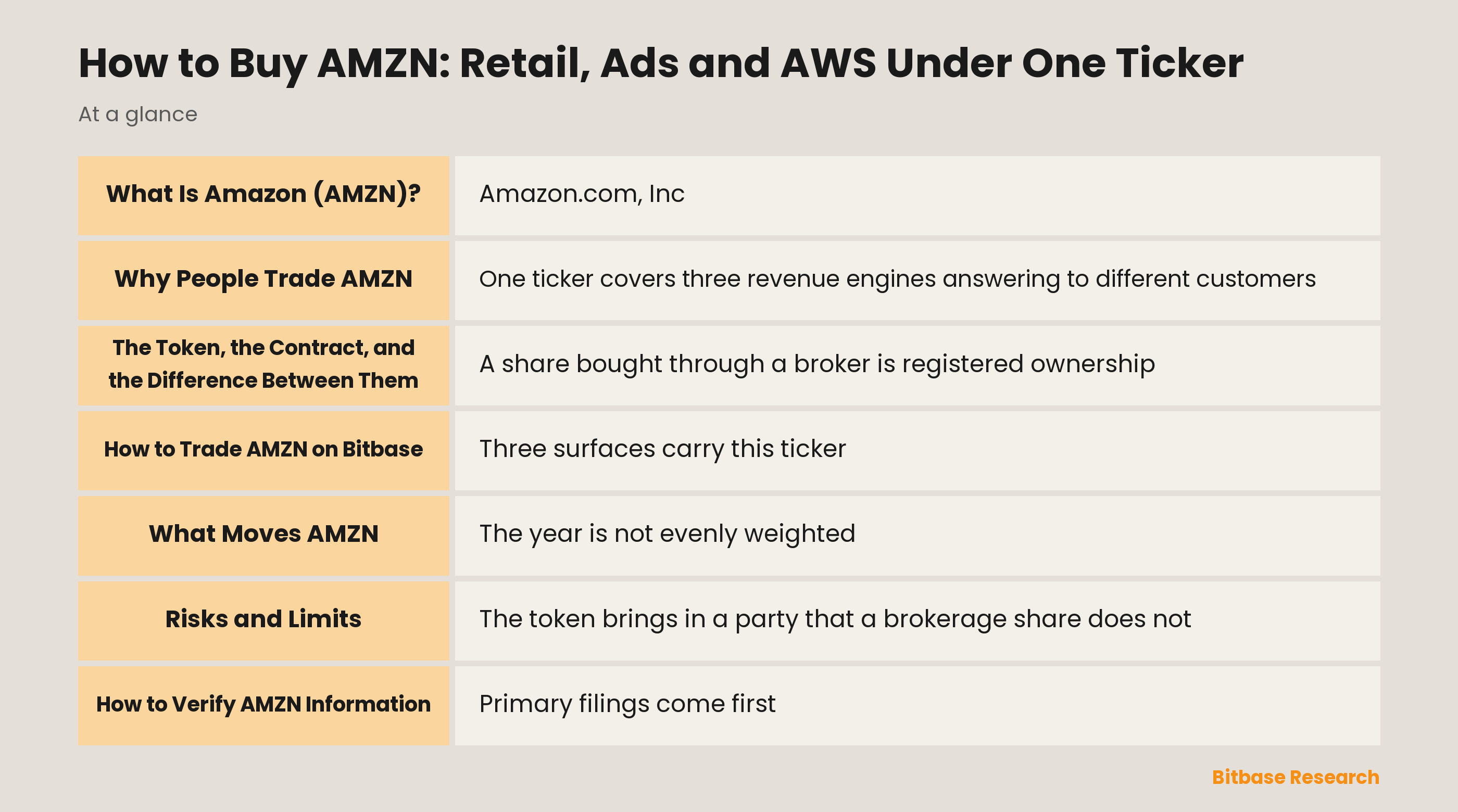
What Is Amazon (AMZN)?
Amazon.com, Inc. is incorporated in Delaware, and its common stock trades on the Nasdaq Global Select Market under AMZN. The annual report states the structure in one line: "We have organized our operations into three segments: North America, International, and Amazon Web Services".
Two of those segments are geographies and the third is a different business. North America and International cover the retail operation: the online stores, the physical stores, and the services sold to third-party sellers who list on the site. AWS, in the filing's own words, "offers a broad set of on-demand technology services, including compute, storage, database, analytics, artificial intelligence and machine learning, and other services."
Advertising runs across the retail side as its own reported revenue line rather than as a segment: "We provide advertising services to sellers, vendors, publishers, authors, and others, through programs such as sponsored ads, display, and video advertising." Scale is easier to place by index membership than by any figure that changes with the close: Amazon is a Nasdaq-listed company that also sits in the Dow Jones Industrial Average, which it joined in February 2024 in place of Walgreens Boots Alliance.
Why People Trade AMZN
One ticker covers three revenue engines answering to different customers: households buying goods, brands buying placements, and engineering teams buying compute. Someone holding AMZN for the cloud business and someone holding it for the holiday retail season own the same line for reasons that need not move together, and one release can satisfy both or neither.
The crypto connection here is thin, and it is worth saying so directly. None of the reported revenue lines, from online stores and third-party seller services through to AWS, is denominated in a token, so AMZN is not a proxy for crypto in the way a miner's revenue or an exchange's fee income can be. What it shares with crypto assets on Bitbase is a quoting convention: it is quoted against a stablecoin rather than in dollars through a broker.
The Token, the Contract, and the Difference Between Them
A share bought through a broker is registered ownership: it carries shareholder rights and trades when the exchange is open. Neither instrument on Bitbase is that, and the two are not versions of each other.
The price page for this ticker carries the Ondo tokenized stock, quoted under AMZNON, and Ondo's documentation is specific about what that token is not. It is not a one-for-one claim on a share: "One token does not necessarily represent the value of one share, and the price of one token will not always match the price of the underlying asset." It is built as a total return tracker, so dividends are reinvested into the value of the token, net of withholding tax, instead of being paid out.
Rights are stated just as plainly: holders "do not receive shareholder voting rights, statutory information rights or other shareholder rights". Trading runs on a 24/5 schedule rather than a continuous one, with pauses around corporate actions and risk controls, and a smaller set of tickers additionally available in an off-hours window. Minting and burning are instant, and Ondo describes a purchase or a sale as delivering tokens or stablecoins "in a single atomic transaction". The product is described as generally available to non-US investors, subject to jurisdictional and other restrictions. "Tokenized stock" names a category rather than a standard, so what holds here does not carry over to another ticker's token.
The perpetual futures contract is a different instrument, not a different wrapper on the same one. It holds no share and no token. It tracks a price, settles in stablecoin, exchanges a funding rate between the two sides at intervals, and carries a level at which the venue closes the position against the margin posted for it.
How to Trade AMZN on Bitbase
Three surfaces carry this ticker, and two of them lead to the same instrument.
The price page is the reference point: quote, chart and market data for the tokenized stock, with no position required to read it.
The tokenized stock spot market is where that token is bought and held outright. There is no funding payment and no liquidation level; the position stays in the account until it is sold, and the issuer's terms are the terms of what is held.
The perpetual futures market is where a leveraged directional position is opened, against funding, a maintenance margin requirement and a level at which the position is closed for you. It fits a view with a time limit better than an intention to own something.
Which tickers have which of these surfaces differs by name, and the tokenized stock and ETF listings are where to check.
What Moves AMZN
The year is not evenly weighted, and the company says so itself: "Our business is affected by seasonality, which historically has resulted in higher sales volume during our fourth quarter, which ends December 31." The same discussion notes that holiday sales lift cash and marketable securities to their highest level of the year at that date. A quarter landing short in that window is not the same event as one landing short in the spring.
Three segments report separately and can point in different directions in the same release. Retail volume and AWS demand are measurements of different customers, so one set of results can read as strong or weak depending on which line the reader came for.
Advertising moves without inventory behind it. It is reported inside the retail segments but sold to sellers, vendors, publishers and authors rather than to shoppers, which makes it a separate source of demand, priced on placements instead of on goods.
Spending is a disclosed source of variability rather than an outside narrative. Among the reasons the filing gives for results fluctuating is "the extent to which we invest in technology and infrastructure, fulfillment, and other expense categories", so a decision about building capacity lands in the same reported line as customer demand does.
Litigation runs on a court calendar. The Federal Trade Commission and seventeen state attorneys general sued Amazon.com, Inc. in September 2023 in the U.S. District Court for the Western District of Washington, alleging that the company illegally maintains monopoly power. A case produces dated filings and hearings, which arrive on a clock unrelated to the earnings calendar.
Risks and Limits
The token brings in a party that a brokerage share does not: the issuer. Ondo writes the structure, the eligibility rules and the redemption terms and can change them, and none of that sits in the venue's listing. Because the design is a total return tracker rather than a one-for-one claim, a gap between the token's price and the share price is a property of the instrument to understand in advance rather than a fault to report.
Hours create gap risk in both directions. The token trades on a 24/5 schedule and pauses around corporate actions, the perpetual runs continuously, and the shares themselves trade in the Nasdaq session. News arriving while one of those is shut prices into the others first, and a position held across that boundary can move with nowhere to hedge it.
The perpetual adds funding cost and forced closure. Funding accrues for as long as the contract is open, so a directionally correct position held long enough can still lose money, and a dated release can move the reference price faster than a leveraged position can be adjusted.
The business itself is disclosed as variable. Amazon's risk factors are headed "We Experience Significant Fluctuations in Our Operating Results and Growth Rate", and the competition factor observes that "the internet and other technologies including artificial intelligence facilitate competitive entry and comparison shopping". A reader following only one of the three businesses is following part of the position.
How to Verify AMZN Information
Primary filings come first. The annual report on Form 10-K carries the segment definitions, the revenue lines, the seasonality statement and the risk factors, and it sits on the SEC's EDGAR database rather than in any summary of it. Quarterly results and the court docket for the antitrust case are records of the same kind: a filing date is checkable, and commentary about what it means is not.
Amazon's investor relations pages carry the quarterly release, the webcast and the shareholder letter, where management's own framing of segment performance appears in full rather than in quotation.
For the token, read the issuer. Ondo's documentation is the authority on how its tokenized stock is priced against the underlying, which rights it does not carry, when it trades and who may hold it. An explainer written about a different issuer's product is not a substitute for it.
For the instruments, the market pages carry the contract specifications, including margin and funding terms for the perpetual. Those change, which is a reason to read them at the point of sizing rather than once.
Conclusion
Amazon is a retailer, an advertising business and a cloud provider filed under one ticker, on a calendar whose heaviest quarter closes the year. Bitbase reaches that company through two instruments: an Ondo tokenized stock, shown on a price page and traded on a spot market, and a perpetual futures contract that holds nothing. The token's terms are written by Ondo and can be changed by Ondo, so the issuer's documentation belongs in the decision next to the company's filings. Read both before choosing which of the two instruments to use.
Related market pages
Bitbase pages for the tokenized stocks named in this article:
- AMZN: View price · Tokenized stock spot · Perpetual market
Related reading
Other Bitbase articles on this topic:
- How to Buy Crypto Stocks: Three Routes and What You Actually Own
- How to Buy Stocks with Crypto: Two Routes from Stablecoins
- How to Buy US Stocks With USDT and What You Actually Hold
- VIX Futures Trading: The Index Itself Is Not Tradable
Disclaimer: This article is educational content from Bitbase Academy, provided for information only. It explains what a company or fund does and how the instruments referenced here differ from one another; it does not constitute investment, trading, tax, or financial advice, and it is neither a recommendation nor an endorsement of any security, token, or trading strategy. A tokenized stock is issued by a third party and is designed to give economic exposure to an underlying asset: it is not a share, it carries no shareholder rights, and it depends on the issuer's structure, eligibility rules, and redemption terms, which the issuer can change. Perpetual futures are leveraged derivatives that hold no underlying asset and can be liquidated, and trading hours, product availability, and eligibility differ by instrument and by jurisdiction and can change at any time. Written as of September 2026; verify everything yourself through company filings, the issuer's own documentation, and the product pages of the venue you trade on.
References
[1] Amazon annual report on Form 10-K: the three reportable segments, the descriptions of AWS and of advertising services, the seasonality statement and the risk factors www.sec.gov
[2] S&P Dow Jones Indices announcement that Amazon.com replaces Walgreens Boots Alliance in the Dow Jones Industrial Average, effective before the open on 26 February 2024 press.spglobal.com
[3] Federal Trade Commission press release of 26 September 2023: the FTC and 17 state attorneys general sue Amazon.com, Inc. in the U.S. District Court for the Western District of Washington www.ftc.gov