Two payments follow a single Arm design: a licence fee when a customer takes the technology, and a royalty booked in the quarter that customer ships the finished chips. Arm Holdings plc is incorporated in the United Kingdom, and the Nasdaq line under those three letters is a depositary share rather than the ordinary share itself. On Bitbase that line is wrapped once more, as an Ondo tokenized stock with a price page, a spot market for the token, and a perpetual futures contract beside it. Not one of the three carries the rights attached to the ordinary share underneath.
What Is Arm Holdings (ARM)?
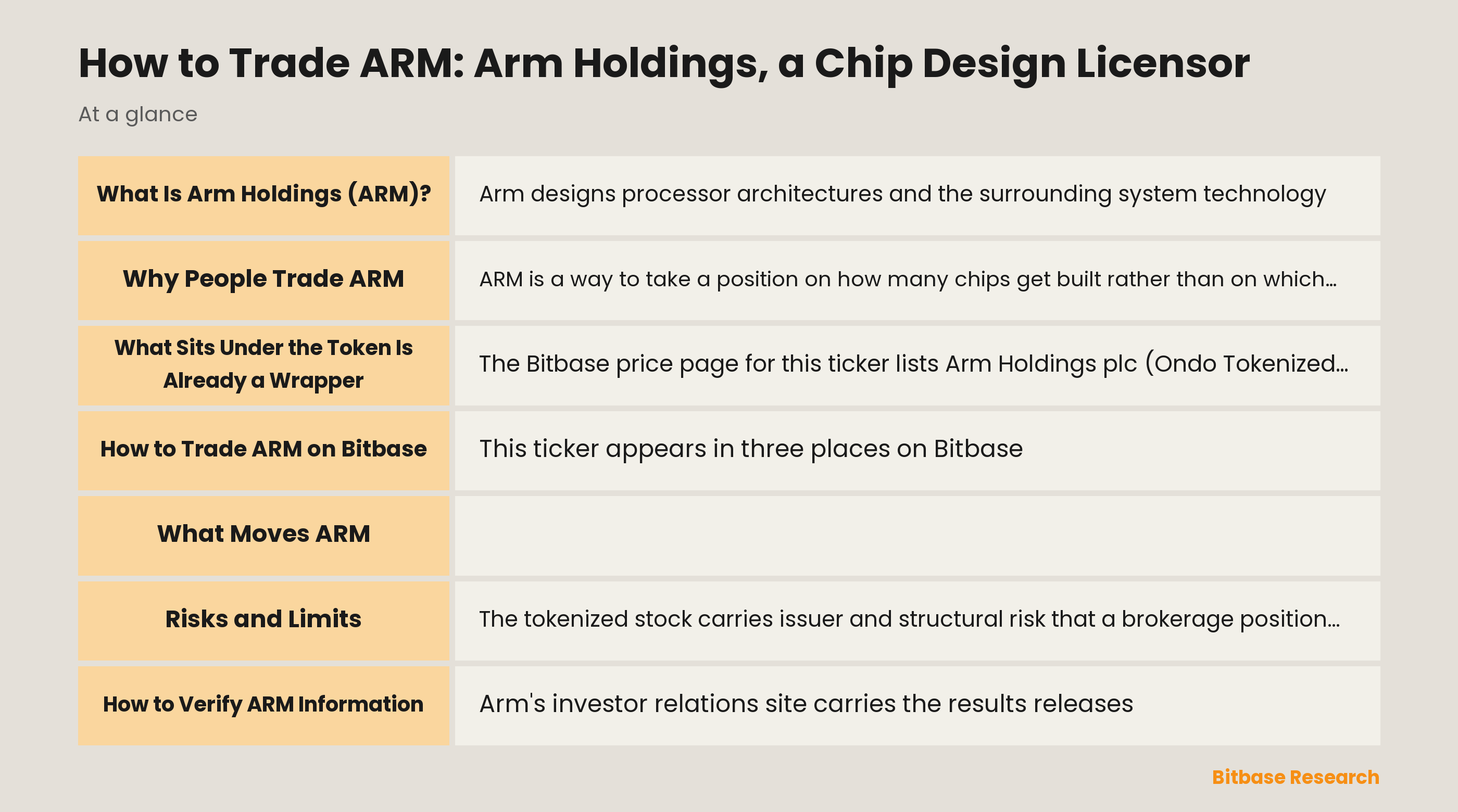
Arm designs processor architectures and the surrounding system technology, then licenses that work to the companies that build chips. It runs no fabrication plant and sells no chips of its own. Its annual report puts the dependency plainly: the IP business relies on Arm's customers to design, manufacture and sell chips incorporating Arm's products. The registered office is in Cambridge, United Kingdom.
Revenue arrives on two lines, earned at different moments. Licence and other revenue comes from granting access to the technology. Where an arrangement gives a customer standing access to a library of designs, Arm treats the obligation as a stand-ready one, because the timing of delivery of the underlying IP is within the customer's control, and recognizes the consideration ratably over the term of the contract. Royalty revenue comes later, from the chips themselves: royalties are recognized on an accrual basis in the quarter in which the customer ships its products, based on the Arm technology those products contain.
The royalty is not a flat fee per unit. Arm's filings state that the royalty revenue per chip generally decreases as the volume of sales increases, subject to an agreed minimum royalty per chip. A licensee shipping in very large numbers pays less for each one than a licensee shipping in small numbers, down to a floor written into the contract.
Where the shares trade needs stating precisely, because the listed line is not the share. Arm lists American Depositary Shares on the Nasdaq Stock Market under the ticker ARM, each representing a single ordinary share of the UK company. Arm is a foreign private issuer, so its annual report is a Form 20-F rather than the Form 10-K a US domestic filer uses, and its fiscal year ends on March 31 rather than in December.
Ownership is concentrated by design. The annual report names SoftBank Group Corp. as Arm's controlling shareholder and states that Arm is a controlled company within the meaning of the Nasdaq corporate governance rules, a status that allows exemptions from some board independence requirements.
Why People Trade ARM
ARM is a way to take a position on how many chips get built rather than on which company builds them. Arm is paid when its licensees ship, and its filings describe those licensees as putting Arm technology into chips used in smartphones, consumer electronics and other embedded chips. A view on device volumes can therefore be expressed without a view on which vendor captures them.
The two revenue lines also give one ticker two rhythms. Licence revenue reflects decisions taken now by companies designing products for later; royalty revenue reflects shipments happening now from designs licensed earlier. Both land in the same set of results and can point in opposite directions, which is why the two lines have to be read apart rather than as one total.
The link to crypto here runs through the wrapper, not the business. Arm collects licence fees and royalties, and nothing in that chain touches a token price. What puts these three letters beside crypto markets is that the exposure has been packaged as tokenized securities and as a stablecoin-settled perpetual, which is a statement about the plumbing rather than about the company.
What Sits Under the Token Is Already a Wrapper
The Bitbase price page for this ticker lists Arm Holdings plc (Ondo Tokenized Stock), under the symbol ARMON. The issuer name is the load-bearing part of that string, because the issuer writes the terms.
Ondo's documentation states that one token does not necessarily represent the value of one share, and that the price of one token will not always match the price of the underlying asset. The tokens are total return trackers: dividends are reinvested net of withholding tax rather than paid out. Holders receive no shareholder voting rights, no statutory information rights and no other shareholder rights. Ondo describes minting and burning as instant and atomic, trading as running 24/5 with pauses possible around corporate actions and risk limits, and the product as generally available to non-US investors.
Now stack that on what the Nasdaq line already is. The share entered on the register is the UK ordinary share; the Nasdaq listing is a depositary share issued over it; the token references that listed line. A token holder is two structures away from the register, and each structure is set out in a document written by a different party.
A perpetual futures contract is a different kind of thing again. It holds nothing at all, neither ordinary share nor depositary share nor token, and tracks a price while exchanging periodic funding between the long and short sides. It can be liquidated. Nasdaq's session covers a fraction of the week, so the mark price the contract is valued against does much of its work while the primary market for the underlying is closed.
How to Trade ARM on Bitbase
This ticker appears in three places on Bitbase, and each asks something different of you.
The price page carries the quote, the chart and the market data for the tokenized stock. Nothing has to be opened to read it, and it is where the token's full name and issuer label can be checked.
The tokenized stock spot market is where the token is bought outright and held. No funding accrues against it and no liquidation price applies; the position sits in the account until it is sold. It suits exposure without leverage, for someone who accepts an issuer-structured instrument in place of a registered share.
The perpetual futures market is where a leveraged directional position is opened. Funding is paid or received periodically depending on which side is crowded, a maintenance margin requirement applies, and a liquidation price sits at a distance set by leverage. That suits a view with a deadline, not an intention to hold.
Coverage differs from ticker to ticker, and the TradFi coverage page is where to see which surfaces exist for a given name.
What Moves ARM
The royalty line is an estimate before it is a number. Arm accrues royalties in the quarter its customers ship, working from historical sales trends, macroeconomic factors and the royalty reports and forecasts its customers supply. Its filings then say what follows: adjustments to revenue are required in subsequent periods to reflect changes in estimates as new information becomes available, primarily the actual amounts the licensees report afterwards. A quarter can be revised by other people's paperwork, and the revision lands in a later period than the one it describes.
Signings and shipments run on different clocks. Consideration from stand-ready licence arrangements is recognized ratably across the term of the contract, while royalties appear only once a licensee ships. Heavy signing does not show up as a spike in the licence line, and heavy shipping does not require a new licence. Two lead times sit inside one income statement.
Unit growth and revenue growth are not the same line. Because the per-chip royalty generally falls as a licensee's volume rises, subject to that contractual minimum, the same additional units are worth less at a very large customer than at a small one. Reading a shipment forecast straight into a revenue forecast can overstate the result.
A March year-end sets the calendar. Arm's fiscal year ends on March 31, so a full year here closes where a US calendar-year filer's first quarter closes, and interim reporting is furnished on Form 6-K rather than the quarterly form a domestic filer uses. Anyone lining ARM up against a US-domiciled chip company is comparing two calendars whose period labels do not cover the same months.
The route into China is a separate company. Arm's filings state that it uses its commercial relationship with Arm Technology (China) Co. Limited to access the PRC market. One large end market therefore sits behind an arrangement rather than a direct channel, and news about that arrangement is company news for ARM in a way it would not be for a firm selling into that market itself.
Risks and Limits
The tokenized stock carries issuer and structural risk that a brokerage position does not. Its value depends on the issuer's arrangement holding together, eligibility and redemption terms are the issuer's to set and to change, and the issuer states outright that the token price will not always match the price of the underlying asset. No shareholder claim sits underneath it, and no statutory information right.
The 24/5 schedule creates gap risk against a shorter primary session. Arm publishes results outside Nasdaq trading hours, and a token position held across that boundary is repriced before the primary market reopens, with no way to hedge it there meanwhile.
The perpetual adds funding cost and liquidation to that picture. Funding accrues on a schedule whether the view turns out right or wrong, and leverage decides how far the price may travel before the position closes itself. A stock-referenced perpetual can gap hard around a scheduled release that lands while the primary market is shut.
The business risks are the ones the filings themselves name. Arm depends on its customers to design, manufacture and sell the chips that generate its royalties, so a slowdown at a licensee reaches Arm after it reaches the licensee. The annual report adds that a significant portion of total revenue comes from a limited number of customers, and that this exposes Arm to greater risks than a more diversified customer base would. Access to the PRC market runs through a separate company. And the governance is a controlled company's: an ordinary shareholder's vote sits alongside a controlling holder's, while a token holder has no vote at all.
How to Verify ARM Information
Arm's investor relations site carries the results releases, the investor presentations and the shareholder materials, and it is the first place a date or a headline should be checked. The filings sit in the SEC's EDGAR database. For a foreign private issuer the annual report is the Form 20-F, which holds the revenue definitions, the description of the depositary shares, the controlled-company statement and the risk factors in the company's own words. Interim results are furnished on Form 6-K, where the royalty accrual policy and its adjustment language can be read directly.
For the token, the issuer's documentation is the authority on what the instrument is, which rights it does not carry, when it trades and who may hold it. That is a different document from anything a trading venue publishes, and it is the one that governs what you hold.
For the instruments on Bitbase, the price page carries the current quote and the contract page the specifications, including funding and margin terms. Those change, and they are the terms to read before sizing anything.
Conclusion
Arm sells designs and collects on the chips those designs end up inside, which makes ARM a claim on other companies' shipments rather than on a plant of its own. On Bitbase that claim arrives through two wrappers: a depositary share on Nasdaq, and an Ondo tokenized stock referencing it, with a spot market and a perpetual contract alongside. The token offers economic exposure without a vote or an information right; the perpetual offers direction, with funding and a liquidation price attached. Which fits is a question about holding period, and about whose terms you are willing to hold under.
Related market pages
Bitbase pages for the tokenized stocks named in this article:
- ARM: View price · Tokenized stock spot · Perpetual market
Related reading
Other Bitbase articles on this topic:
- How to Buy Crypto Stocks: Three Routes and What You Actually Own
- How to Buy Stocks with Crypto: Two Routes from Stablecoins
- How to Buy US Stocks With USDT and What You Actually Hold
- How to Buy WMT: A Walmart dShare and a Perpetual
Disclaimer: This article is educational content from Bitbase Academy, provided for information only. It explains what a company or fund does and how the instruments referenced here differ from one another; it does not constitute investment, trading, tax, or financial advice, and it is neither a recommendation nor an endorsement of any security, token, or trading strategy. A tokenized stock is issued by a third party and is designed to give economic exposure to an underlying asset: it is not a share, it carries no shareholder rights, and it depends on the issuer's structure, eligibility rules, and redemption terms, which the issuer can change. Perpetual futures are leveraged derivatives that hold no underlying asset and can be liquidated, and trading hours, product availability, and eligibility differ by instrument and by jurisdiction and can change at any time. Written as of September 2026; verify everything yourself through company filings, the issuer's own documentation, and the product pages of the venue you trade on.
References
[1] Arm Holdings plc, Form 20-F: the IP business model, the per-chip royalty, the depositary shares, foreign private issuer status, the controlling shareholder and the risk factors www.sec.gov
[2] Arm Holdings plc, Form 6-K: the royalty accrual policy, the estimates behind it and the adjustments made when licensees report actual amounts www.sec.gov