ASML sells the machines that print circuit patterns onto silicon wafers, and its own product pages state that EUV lithography is unique to ASML. On Bitbase the ticker resolves to two surfaces: a price page carrying Robinhood's tokenized stock label, and a perpetual futures market. Neither is a share, and Robinhood defines what sits behind that label as a derivative contract.
What Is ASML Holding NV (ASML)?
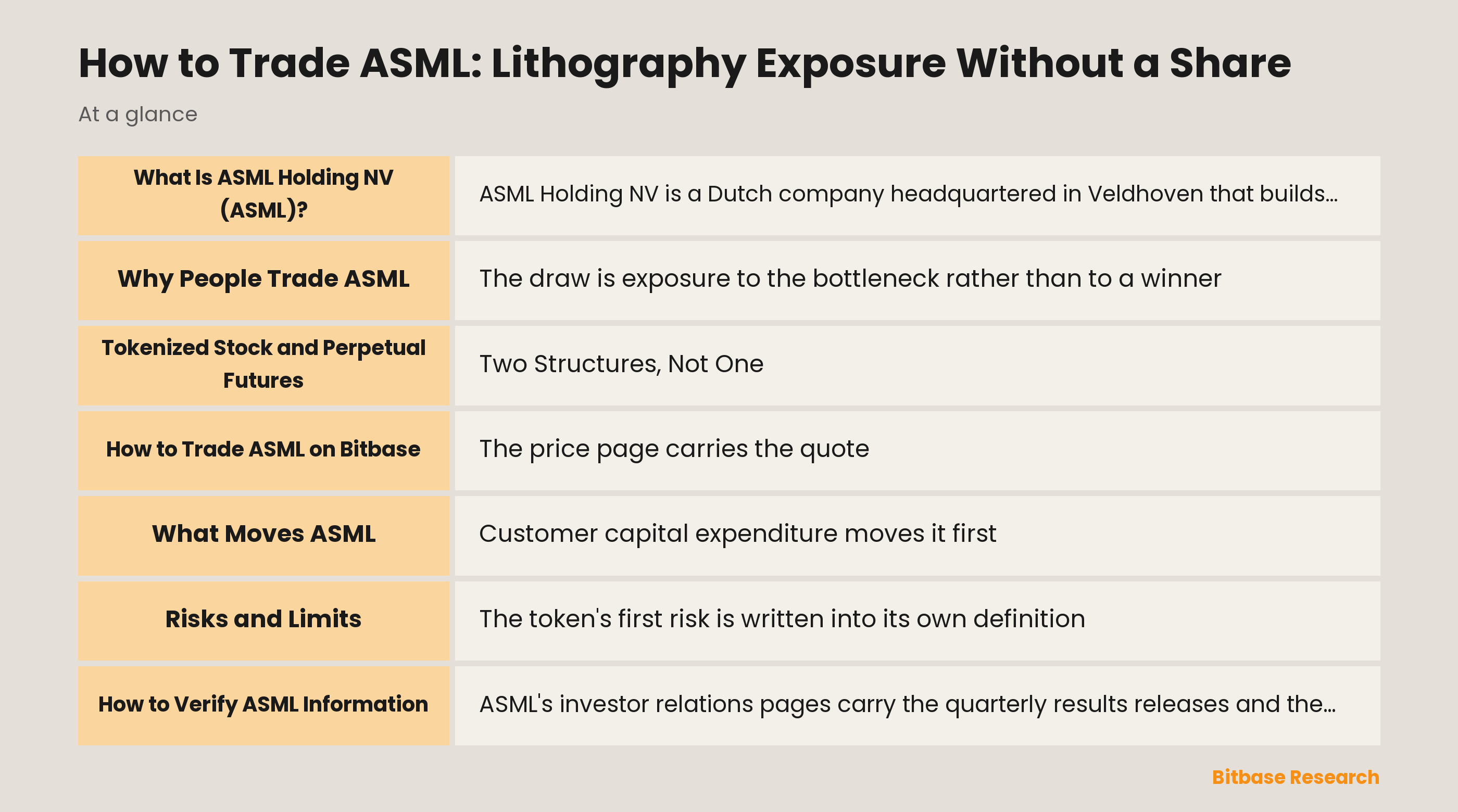
ASML Holding NV is a Dutch company headquartered in Veldhoven that builds lithography systems: the machines chipmakers use to print circuit patterns onto silicon wafers. It does not make chips; it makes the tool that prints them, then keeps earning from the tools already installed. Total net sales split between system sales and Installed Base Management sales, which ASML defines as its net service and field option sales.
At the leading edge two tiers of tool sit underneath: deep ultraviolet immersion systems handle the advanced layers that do not need EUV. Extreme ultraviolet systems print the hardest layers, and ASML's product pages describe chipmakers using its NXE systems for the foundation layers of their most advanced nodes. A next-generation platform raises the numerical aperture of the optics, which the company calls High NA.
The shares are listed on Euronext Amsterdam and on Nasdaq, and the company reports in euros.
Why People Trade ASML
The draw is exposure to the bottleneck rather than to a winner. Logic and memory makers compete for the same customers, but the equipment they all need at the leading edge comes from a far shorter list of suppliers, and for EUV the company says that list is one name long. It is also a position on export policy: rules on semiconductor equipment reach this company by product model number, and ASML names the affected systems in its own statements.
For traders arriving from a crypto book, this is not a crypto-correlated name: no coin treasury, no mining fleet, no exchange fee take. What it shares with that side of the screen is appetite for artificial intelligence infrastructure risk.
Tokenized Stock and Perpetual Futures: Two Structures, Not One
The Bitbase price page lists ASML Holding NV as a Robinhood Tokenized Stock, and the naming matters, because Robinhood's structure differs from the other issuers whose tokens sit alongside it.
Robinhood describes its Classic Stock Tokens as derivative contracts between you and Robinhood, priced at the prices of the underlying securities without granting rights to them. The underlying assets, it says, are owned by Robinhood and held with a US-licensed institution. The token is therefore not a claim on ASML or on a share held for you; it is a contract with a broker whose price references the share. Where the underlying pays a dividend, Robinhood says it passes a corresponding amount to eligible holders in cash.
The trading week is defined rather than continuous: Robinhood states that Classic Stock Tokens trade from Monday 2 AM CET/CEST to Saturday 2 AM CET/CEST. The issuer is Robinhood Europe, UAB, authorised and regulated by the Bank of Lithuania as a financial brokerage firm, a crypto-asset service provider and a payment institution, and the product is offered to eligible investors in the European Union. That names the counterparty; it does not describe how the instrument behaves.
A perpetual futures contract is a different structure again. It holds nothing: no share, no token, no contract with an issuer. It tracks a price, settles in stablecoin, exchanges a periodic funding rate between longs and shorts, and carries a liquidation price set by leverage and margin.
How to Trade ASML on Bitbase
The price page carries the quote, the chart and the market data for the tokenized stock. It requires no position.
The perpetual futures market is where a leveraged directional position is opened. Funding is exchanged periodically between the two sides, initial and maintenance margin apply, and the liquidation price sits at a distance set by leverage. It costs funding for as long as it is held and never becomes ownership of anything, which makes it a tool for a view with a deadline.
Which tickers carry a spot market alongside these two varies, and the tokenized stock list sets that out.
What Moves ASML
Customer capital expenditure moves it first, and it arrives in lumps: ASML sells to the short list of companies building leading-edge logic and memory capacity, and the results releases report new and used lithography systems sold in units. A quarter can turn on the timing of a handful of shipments, so order intake is read for the next year while revenue reports the last one.
Export licensing moves it second. ASML has stated that its TWINSCAN NXT:1970i and 1980i deep ultraviolet immersion systems require export licences from the Dutch government rather than the US government, that the requirement was already in place for the NXT:2000i and subsequent immersion systems, and that EUV systems are also subject to licence requirements. Announcements on this file reprice the stock before any reported number changes.
The adoption curve for EUV moves it third. Whether customers take High NA at the next node or stretch existing EUV with additional patterning steps changes the mix between what ASML ships and what it services.
The installed base is the ballast underneath all three. Service and upgrade revenue follows machines already in the field, so a pause in new orders does not empty the whole revenue line at once.
Risks and Limits
The token's first risk is written into its own definition: a derivative contract with Robinhood performs if Robinhood performs. No share underneath it belongs to you, and eligibility rules, redemption terms and product availability are set by the issuer and can be changed by the issuer.
The second is the seam between schedules. ASML's shares trade in an Amsterdam session and a Nasdaq session; the token trades a longer week than either. News landing while both primary markets are closed prices into the token first.
The perpetual adds funding cost and liquidation. Funding accrues whether or not the direction is right, and a stock-referenced perpetual is exposed to the gaps that scheduled company events create. Behind both instruments sits the business itself: few customers, one leading-edge technology, and a licence regime timed by governments.
How to Verify ASML Information
ASML's investor relations pages carry the quarterly results releases and the annual report, where that revenue split is set out. Export licence changes are described first in its press releases, with the affected model numbers named, and as a foreign private issuer ASML also files with the SEC, reachable through EDGAR.
Robinhood's European product pages define what a Classic Stock Token is, who owns the underlying and when it trades. On Bitbase, the price page carries the current quote and the futures market page carries the contract specification, including funding and margin terms.
Conclusion
ASML is a position on how much capacity the world's chipmakers decide to build, taken through the one company that supplies a step none of them makes for itself. On Bitbase that position comes in two forms, and neither is a share: a token that is a contract with a broker priced off the share, and a perpetual that holds nothing and charges funding for as long as it is open. Choosing between them is a question about holding period.
Related market pages
Bitbase pages for the tokenized stocks named in this article:
- ASML: View price · Perpetual market
Related reading
Other Bitbase articles on this topic:
- How to Buy Crypto Stocks: Three Routes and What You Actually Own
- How to Buy Stocks with Crypto: Two Routes from Stablecoins
- How to Buy US Stocks With USDT and What You Actually Hold
- HUT Stock Explained: Power, Data Centres and Bitcoin
Disclaimer: This article is educational content from Bitbase Academy, provided for information only. It explains what a company or fund does and how the instruments referenced here differ from one another; it does not constitute investment, trading, tax, or financial advice, and it is neither a recommendation nor an endorsement of any security, token, or trading strategy. A tokenized stock is issued by a third party and is designed to give economic exposure to an underlying asset: it is not a share, it carries no shareholder rights, and it depends on the issuer's structure, eligibility rules, and redemption terms, which the issuer can change. Perpetual futures are leveraged derivatives that hold no underlying asset and can be liquidated, and trading hours, product availability, and eligibility differ by instrument and by jurisdiction and can change at any time. Written as of September 2026; verify everything yourself through company filings, the issuer's own documentation, and the product pages of the venue you trade on.
References
[1] ASML, EUV lithography systems: what EUV prints and the High NA platform (official product page) www.asml.com
[2] ASML press release: the Dutch government export licence requirement and the systems it covers www.asml.com
[3] ASML Investor Relations: quarterly results releases, the annual report and the Euronext and Nasdaq listings www.asml.com
[4] Robinhood Europe: what Classic Stock Tokens are, who owns the underlying, dividends and trading hours robinhood.com