Buying the AVGO ticker means answering two questions at once: which half of Broadcom you are taking a view on, and which instrument you use to take it. On Bitbase the same four letters lead to a tokenized stock price page, a spot market for that token, and a perpetual futures contract. None of the three registers a share in your name, and the differences decide what you hold, when it trades, and what can close the position without asking.
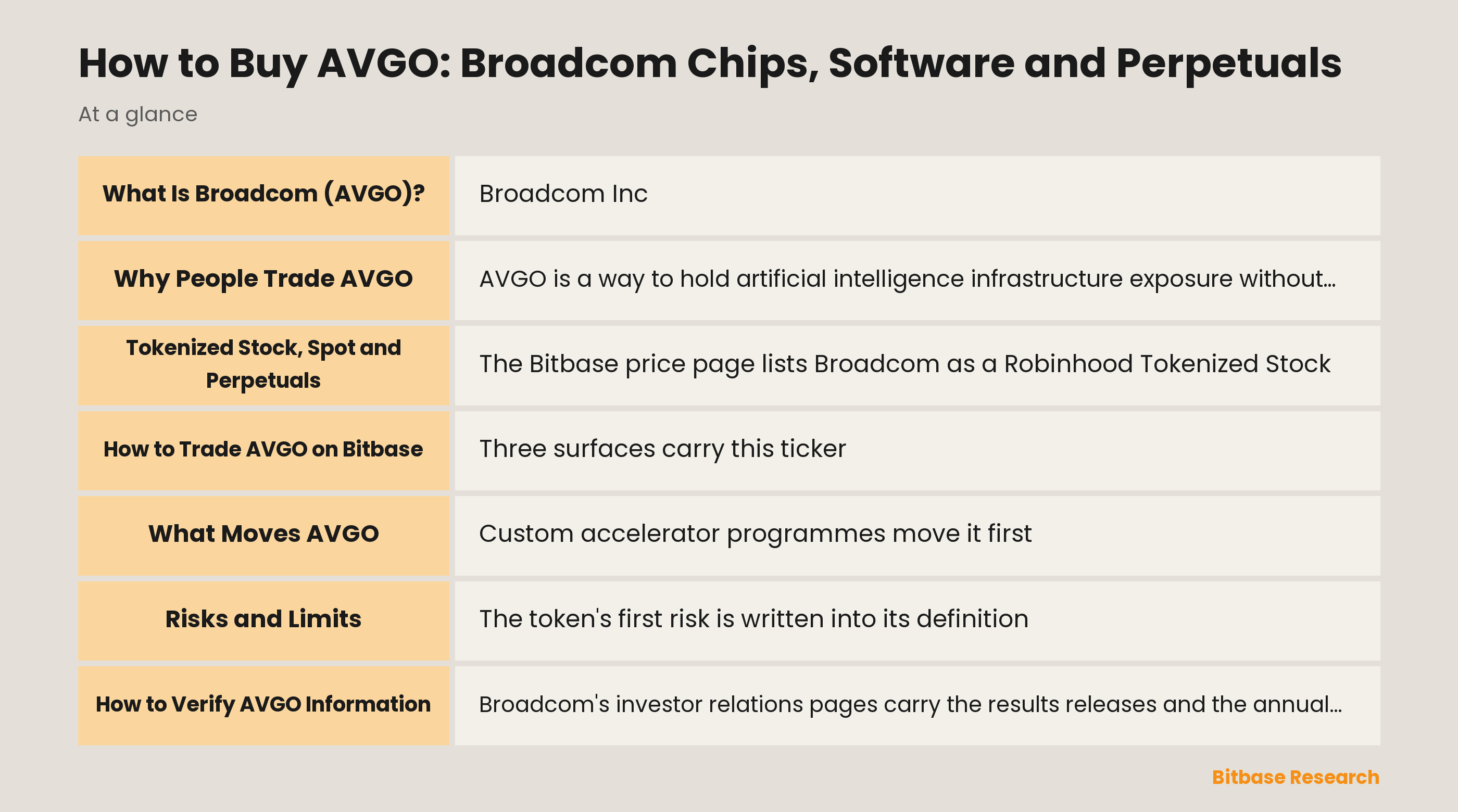
What Is Broadcom (AVGO)?
Broadcom Inc. is a Delaware company headquartered in Palo Alto, California, listed on Nasdaq under AVGO and a component of the S&P 500 and the Nasdaq-100. It reports in two segments, and that split is the first thing to get straight.
Semiconductor solutions is the larger and better known half. Its own filing describes the artificial intelligence portfolio as custom accelerators or XPUs, Ethernet switching and routing silicon, network interface cards, physical layer devices and optical components, plus racks and systems built on those XPUs. Around that sit the older franchises: broadband and set-top box silicon, radio frequency parts for phones, and the connectivity that attaches storage to servers.
Infrastructure software is the other half, and it is not a rounding error. Broadcom groups it into five portfolios — private cloud, mainframe software, cybersecurity, enterprise software and Fibre Channel storage area network management — with VMware Cloud Foundation at the centre of the private cloud line. That is renewal-cycle software revenue, sold to many of the same buyers who take the chips, on entirely different terms.
Why People Trade AVGO
AVGO is a way to hold artificial intelligence infrastructure exposure without buying a merchant chip vendor. Its accelerator business is custom work: silicon co-designed with one customer for that customer's workload, sold into programmes negotiated years before anything ships. Beside it sits the Ethernet silicon that ties those machines together — a bet on how clusters get wired, not on what runs inside them.
The software half changes the character of the position. Renewal revenue does not follow the semiconductor order cycle, so AVGO carries a cash-flow shape a pure chip designer does not have. Traders who want full sensitivity to the capital expenditure cycle read that as dilution; those who want the theme with less amplitude read it as the reason to hold this name.
Its link to crypto is thin: no coin treasury, no mining fleet, no exchange fees — only a shared dependence on the same appetite for long-duration risk.
Tokenized Stock, Spot and Perpetuals
The Bitbase price page lists Broadcom as a Robinhood Tokenized Stock, and the issuer's name changes what the instrument is: Robinhood's structure differs from that of the other issuers whose tokens sit beside it.
Robinhood describes its Classic Stock Tokens as derivative contracts between you and Robinhood, priced at the prices of the underlying securities without granting rights to them. It states that the underlying assets are owned by Robinhood and held with a US-licensed institution, and that the tokens grant no rights to the underlying shares or ETPs. The token is therefore not a share kept in custody for you; it is a contract with a broker whose price references the share. Nor does a dividend reach you as a shareholder distribution — Robinhood says it passes a corresponding amount to eligible holders in cash.
The trading week is defined rather than continuous: Robinhood states that these tokens trade from Monday 2 AM CET/CEST to Saturday 2 AM CET/CEST. The issuing entity is Robinhood Europe, UAB, authorised and regulated by the Bank of Lithuania as a financial brokerage firm, a crypto-asset service provider and a payment institution, and the product is offered to eligible investors in the European Union.
A perpetual futures contract is a third structure. It holds nothing: no share, no token, no contract with an issuer. It tracks a price, settles in stablecoin, exchanges a periodic funding rate between the two sides of the book, and is closed out against a mark price when margin runs short.
How to Trade AVGO on Bitbase
Three surfaces carry this ticker. The price page is the reference: quote, chart and market data for the tokenized stock, requiring no position.
The tokenized stock spot market is where that token is bought and held outright. There is no funding to pay and no liquidation level to watch; the position sits in the account until it is sold. It is the route for exposure without leverage, for someone content to hold an issuer's contract rather than a registered share.
The perpetual futures market is where leveraged directional positions are opened. It carries a funding payment, a margin requirement, and a liquidation level set by leverage rather than by anything Broadcom does. It suits a view with a deadline, not an intention to own part of the company.
Which tickers carry which of these surfaces differs by name, and the list of tokenized stocks is where to check.
What Moves AVGO
Custom accelerator programmes move it first, and in steps rather than along a trend. These are multi-year projects with a short list of buyers — the company's own annual report says a relatively small number of customers account for a significant portion of its net revenue — so the stock reprices when a programme is won, widened or lost, long before it reaches a revenue line.
Networking is a second and separate driver. Broadcom sells the switching and routing silicon that ties accelerators together, so whether clusters standardise on Ethernet or on proprietary interconnects moves this company independently of how many accelerators ship.
The software half moves on a calendar of its own. Renewal terms, bundling decisions and customer reaction around VMware land on this segment, and they can move the stock for reasons unrelated to the theme a holder bought it for. It is the part of AVGO that surprises anyone who files it under chips.
Outsourced capacity caps the rest. The company states that it outsources a majority of its manufacturing operations, using third-party foundry, assembly and test capabilities, so a design win becomes revenue only as fast as someone else's capacity allows. A supply-constrained period and a demand-constrained one look alike in the reported numbers and mean opposite things.
Then there is the calendar itself. Broadcom operates on a 52- or 53-week fiscal year ending on the Sunday closest to October 31, so its results land on their own schedule rather than on the standard quarter ends — a date worth knowing before a leveraged position is opened rather than after.
Risks and Limits
The token's first risk is written into its definition: a derivative contract with Robinhood performs if Robinhood performs. No share underneath it belongs to you, and eligibility, availability and terms are set by the issuer, who can change them.
The second is the seam between schedules: the Nasdaq session is a subset of the token's week, so news landing while the primary market is shut prices into the token first and into the share later.
The perpetual adds funding cost and forced closure. Funding accrues whether or not the direction is right, a stock-referenced perpetual is exposed to the gaps that scheduled company events create, and leverage decides how close the liquidation level sits.
The business itself carries two risk profiles under one ticker: a licensing dispute in enterprise software and a lost accelerator programme are unrelated events, and either can move a position taken for the other reason.
How to Verify AVGO Information
Broadcom's investor relations pages carry the results releases and the annual report, where the segment split and the manufacturing model appear in the company's own words. The filings sit in the SEC's EDGAR database, with the risk factors that name customer concentration and export regulation.
For the token, Robinhood's European product pages are the authority on what a Classic Stock Token is, who owns the underlying, how dividends are handled and when it trades: an exchange listing does not define the instrument, the issuer's documentation does. On Bitbase, the price page carries the quote and the market pages carry the contract specifications, including funding and margin terms.
Conclusion
Broadcom is two businesses under one ticker: custom accelerators and networking silicon on one side, software renewals on the other, and a holder gets both whether or not both were the point. On Bitbase it reaches you as a tokenized stock, as a spot market in that token, or as a perpetual that holds nothing — and the first two are a contract with Robinhood, not a share in Broadcom. Choosing between them is a question about holding period, and about how much issuer structure and leverage you carry on top of the company risk.
Related market pages
Bitbase pages for the tokenized stocks named in this article:
- AVGO: View price · Tokenized stock spot · Perpetual market
Related reading
Other Bitbase articles on this topic:
- How to Buy US Stocks With USDT and What You Actually Hold
- How to Choose Crypto Stocks: Four Checks Before Any List
- How to Buy AAPL: The Company, the Token and the Contract
- Is Crypto on the Stock Market? Three Places the Two Connect
Disclaimer: This article is educational content from Bitbase Academy, provided for information only. It explains what a company or fund does and how the instruments referenced here differ from one another; it does not constitute investment, trading, tax, or financial advice, and it is neither a recommendation nor an endorsement of any security, token, or trading strategy. A tokenized stock is issued by a third party and is designed to give economic exposure to an underlying asset: it is not a share, it carries no shareholder rights, and it depends on the issuer's structure, eligibility rules, and redemption terms, which the issuer can change. Perpetual futures are leveraged derivatives that hold no underlying asset and can be liquidated, and trading hours, product availability, and eligibility differ by instrument and by jurisdiction and can change at any time. Written as of September 2026; verify everything yourself through company filings, the issuer's own documentation, and the product pages of the venue you trade on.
References
[1] Robinhood Europe: what Classic Stock Tokens are, who owns the underlying, dividends and trading hours robinhood.com
[2] Broadcom Inc., Form 10-K: the two segments, the AI product line, the outsourced manufacturing model, customer concentration and the fiscal calendar www.sec.gov
[3] SEC EDGAR: Broadcom Inc. annual filings index (CIK 0001730168), where the segment reporting and risk factors are filed www.sec.gov