Two share classes carry the Berkshire Hathaway name, and they are not interchangeable: a Class B share holds 1/1,500 of the dividend and distribution rights of a Class A share and 1/10,000 of its vote. On Bitbase the ticker resolves to a perpetual futures contract, a third structure that holds no share of either class. This profile covers what Berkshire owns, what moves the stock, and what the perpetual route does and does not give you.
What Is Berkshire Hathaway (BRK.B)?
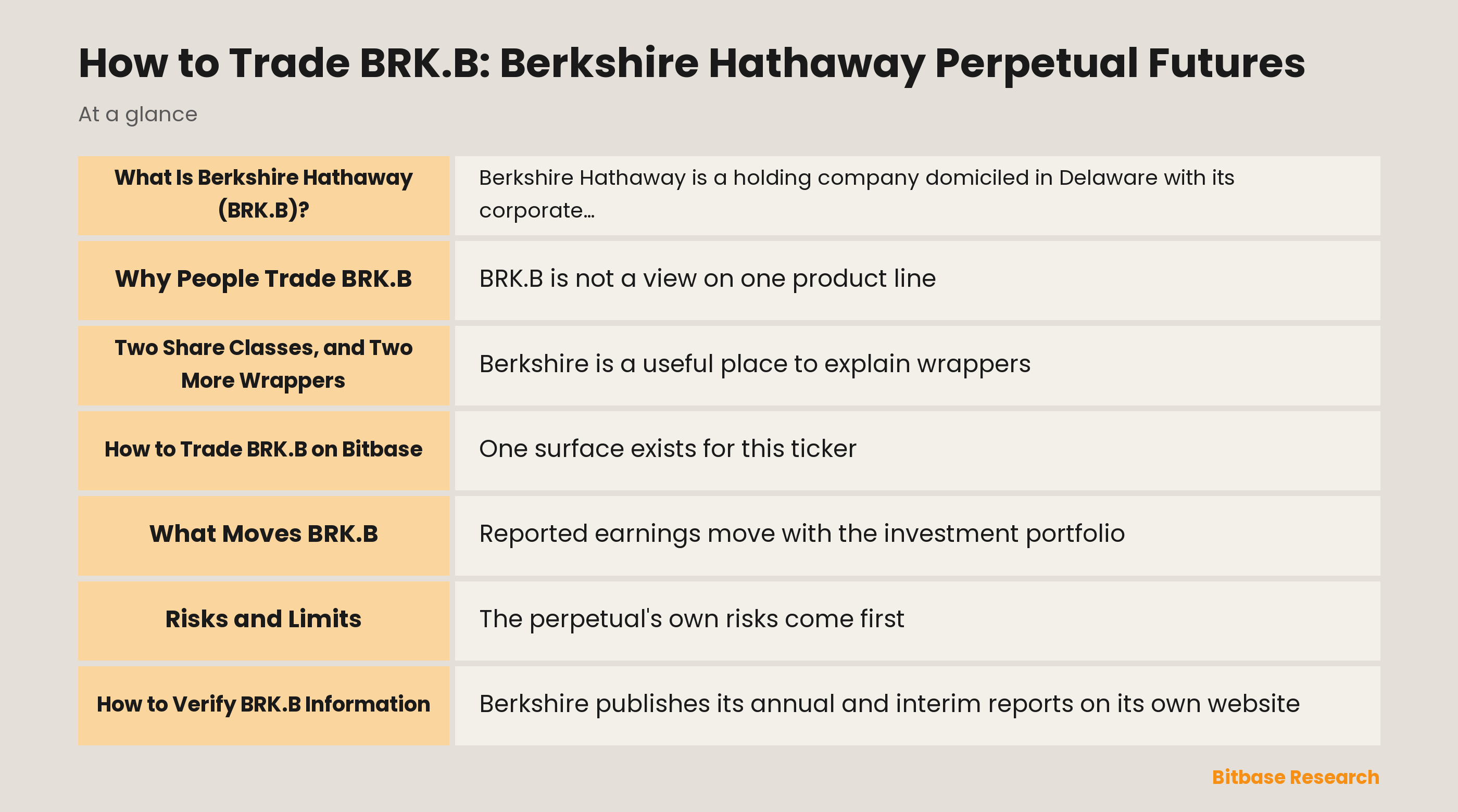
Berkshire Hathaway is a holding company domiciled in Delaware with its corporate headquarters in Omaha, Nebraska. Its own annual report describes the most important of its businesses as insurance, conducted on both a primary and a reinsurance basis, a freight rail transportation business, and a group of utility and energy generation and distribution businesses. Around those sit manufacturing, service and retailing companies. Class A and Class B common stock are both listed on the New York Stock Exchange, under BRK.A and BRK.B.
Three of those subsidiaries are worth naming. GEICO's principal business is private passenger automobile insurance, sold mainly through direct response marketing rather than through an agency sales force. BNSF, based in Fort Worth, operates one of the largest freight rail transportation systems in North America. Berkshire Hathaway Energy is a holding company in its own right, with regulated US utilities and interstate natural gas pipelines underneath it.
The mechanism that ties the insurance side to everything else is float: premiums arrive before losses are paid, and the money in between is invested. That is why the balance sheet carries an equity portfolio and a large short-term Treasury Bill position alongside the operating companies. Berkshire is a group of businesses and an investment portfolio at once, and the two halves do not behave alike.
Why People Trade BRK.B
BRK.B is not a view on one product line, one end market or one policy environment. It is a claim on an allocation process: insurance underwriting on one side, wholly owned industrial, service and retailing businesses on the other, and a marketable securities portfolio sitting on top of both. The subsidiaries are managed on what the company calls an unusually decentralized basis, while significant capital allocation and investment decisions are the responsibility of the Chief Executive Officer.
That also sets it apart from the rest of a tokenized stock lineup. Berkshire's revenue does not depend on token prices, on trading volume or on hashrate, and no part of the group is in the business of issuing, custodying or mining anything. Traders who already hold crypto exposure sometimes reach for it precisely because it is not another expression of the same view.
The second reason is structural and easy to miss. Berkshire has not declared a cash dividend since 1967, so the whole return has to arrive through the share price. There is no yield to collect while waiting and no distribution to reinvest; capital comes back to holders through repurchases, on terms the company sets itself.
Two Share Classes, and Two More Wrappers
Berkshire is a useful place to explain wrappers, because it already has one. Class A and Class B are claims on the same company with deliberately different economics: the B share carries a small fraction of the A share's dividend and distribution rights and a far smaller fraction of its vote. A Class A share converts into Class B at the holder's option, and the conversion does not run the other way. Class B is registered stock, not a derivative, but the point stands that the ticker already encodes a decision about what the holder gets.
A tokenized stock is a further wrapper, and it is issued by a third party rather than by the company. The tokenized stocks on Bitbase come from several different issuers, and their structures are not the same. One issuer states plainly that a token does not necessarily represent the value of one share. Another issues what its own documentation calls derivative contracts between the holder and the issuer, priced at the price of the underlying security without granting rights to it. Others describe their tokens as backed one-for-one by the underlying asset held in regulated custody. Trading hours differ by issuer, and so do the rules about who may hold the product. Tokenized stock is the name of a category, not of a single instrument.
A perpetual futures contract is a third structure, and the easiest to describe: it holds nothing. No share of either class, no token, no claim on Berkshire. It tracks a price, settles in stablecoin, exchanges a periodic funding rate between longs and shorts, and can be liquidated when margin runs out. It expresses a direction with leverage, and it ends when the collateral supporting it does.
So the phrase buying BRK.B covers three different transactions. It can mean a registered Class B share held at a broker, a third-party token that references one, or a contract that references the price of one. Only the first of those is stock.
How to Trade BRK.B on Bitbase
One surface exists for this ticker: the perpetual futures market.
A perpetual has no expiry, so there is no quarterly roll and no settlement date to plan around. What replaces them is funding, a payment exchanged periodically between the two sides depending on which one is crowded, plus a maintenance margin requirement and a liquidation price that both move as the position and the collateral move.
That combination suits a view with a time limit. The case for owning Berkshire is a case measured in years; the cost of holding a perpetual is charged in funding intervals, and a directionally correct trade held long enough can still lose to the funding account. Anyone bringing a multi-year thesis to a leveraged contract should price that in from the first order.
Which tickers carry which surfaces differs by name; the tokenized stock lineup is where to check.
What Moves BRK.B
Reported earnings move with the investment portfolio, not only with the businesses. Unrealized gains and losses arising from changes in the market prices of Berkshire's equity holdings are included in its reported earnings, which, in the company's own words, significantly increases the volatility of its periodic net earnings. A quarter in which those marks fall can show a consolidated loss while every operating subsidiary earns money. Reading the headline earnings number as a measure of how the businesses performed misreads what it contains.
Underwriting is the second driver, and it arrives as weather. A catastrophe season lands in the insurance result irregularly and in size, and it is uncorrelated with anything else in the same portfolio. GEICO's automobile margins run on their own cycle of claim costs and pricing, separate again from the reinsurance book.
Short-term interest rates are the third, and they work against the intuition. Berkshire carries a substantial position in short-term US Treasury Bills, among the largest lines on its balance sheet, so a falling policy rate compresses investment income directly, while its effect on the equity portfolio on the other side of the balance sheet runs the other way. Two forces point in opposite directions inside one company.
The regulated businesses add a slower, legal driver. PacifiCorp, a wholly owned subsidiary of Berkshire Hathaway Energy, operates as a regulated electric utility in Utah, Oregon, Wyoming and other Western states, and it is party to a variety of legal actions arising from wildfires. Utility wildfire liability moves in courtrooms and state legislatures rather than in quarterly demand, on a schedule of its own.
Capital allocation is now a two-person process, and it is written into the buyback rule. The repurchase program was amended in 2025 to permit repurchases at any time the Chief Executive Officer, after consultation with the Chairman of the Board, believes the price is below intrinsic value, conservatively determined. Before that amendment the judgment belonged to Warren Buffett alone, who held both offices. Greg Abel became Chief Executive Officer on January 1, 2026, with Buffett continuing as Chairman. Since repurchases are the only route by which cash returns to holders, the pace of buybacks now depends on a conversation between two people rather than on one.
Risks and Limits
The perpetual's own risks come first, because they can end the position independently of the thesis. Funding accrues whether or not the price moves, and a leveraged position carries a liquidation price that a share does not. Stock-referenced contracts can also gap around scheduled disclosure, and a Berkshire quarter contains a mark-to-market swing that has nothing to do with the operating businesses. A large reported number in either direction is an ordinary event here.
Hours are the second. The New York Stock Exchange session is short and the perpetual runs continuously, so news breaking while the primary market is closed prices into the contract first. A position held across that boundary cannot be hedged in the primary market.
Reaching for a tokenized stock instead changes the risks rather than removing them. A tokenized stock depends on a third-party issuer's structure, eligibility rules and redemption terms, all of which the issuer sets and can change. It is not a registered share, and what it entitles the holder to differs from one issuer to the next.
The company risk is the quiet one. Berkshire is spread across industries but concentrated in decision-making, in catastrophe exposure, and in a securities portfolio whose sheer magnitude, in the company's own accounting, moves the consolidated result on its own. Diversified describes the subsidiary list, not the risk carried by a leveraged position on the stock.
How to Verify BRK.B Information
Berkshire publishes its annual and interim reports on its own website, and the same documents are filed with the SEC and retrievable through EDGAR. The share class mechanics sit in the common stock note of any recent report; the repurchase rule and the dividend history are in Item 5 of the annual report on Form 10-K; the wildfire litigation is set out in the note on legal proceedings. Those are the company's own words, and they are more specific than any summary of them.
The annual proxy statement answers the governance questions: who holds which office, how the board is composed, and what voting power each class of stock carries.
For the contract itself, the product page of the venue you are trading on carries the specification, including the funding interval, the margin tiers and the liquidation method. Those terms change, and they belong in the plan before the order rather than after it.
Conclusion
Berkshire Hathaway is an allocation process wrapped in an insurance company, and BRK.B is the share class engineered to make that process purchasable in ordinary size. On Bitbase the route to it is a perpetual futures contract, which references the price and holds nothing at all. The mismatch worth noticing is one of duration: a company whose case is made over years, reached through an instrument whose cost is charged in funding intervals. So the first thing to settle is how long the position is meant to live, because everything else about the route follows from that.
Related market pages
Bitbase pages for the tokenized stocks named in this article:
- BRK.B: Perpetual market
Related reading
Other Bitbase articles on this topic:
- How to Buy US Stocks With USDT and What You Actually Hold
- How to Choose Crypto Stocks: Four Checks Before Any List
- How to Buy AAPL: The Company, the Token and the Contract
- RIOT Stock Explained: The Miner That Gets Paid to Pause
Disclaimer: This article is educational content from Bitbase Academy, provided for information only. It explains what a company or fund does and how the instruments referenced here differ from one another; it does not constitute investment, trading, tax, or financial advice, and it is neither a recommendation nor an endorsement of any security, token, or trading strategy. A tokenized stock is issued by a third party and is designed to give economic exposure to an underlying asset: it is not a share, it carries no shareholder rights, and it depends on the issuer's structure, eligibility rules, and redemption terms, which the issuer can change. Perpetual futures are leveraged derivatives that hold no underlying asset and can be liquidated, and trading hours, product availability, and eligibility differ by instrument and by jurisdiction and can change at any time. Written as of September 2026; verify everything yourself through company filings, the issuer's own documentation, and the product pages of the venue you trade on.
References
[1] Berkshire Hathaway: 2025 annual report on Form 10-K (business description, Item 5 on dividends and the repurchase program) www.berkshirehathaway.com
[2] Berkshire Hathaway: 2026 second quarter report (Note 18 on common stock, the note on legal proceedings, and the balance sheet) www.berkshirehathaway.com
[3] SEC EDGAR: Berkshire Hathaway 2026 proxy statement (voting rights by class, conversion of Class A, and the offices held) www.sec.gov