Coinbase earns money in two very different ways, and knowing which one you are buying changes what COIN is as a position. On Bitbase the ticker resolves to two things: a tokenized stock price page and a perpetual futures contract. This profile covers what the company sells, what actually moves the stock, and what each route on Bitbase does and does not give you.
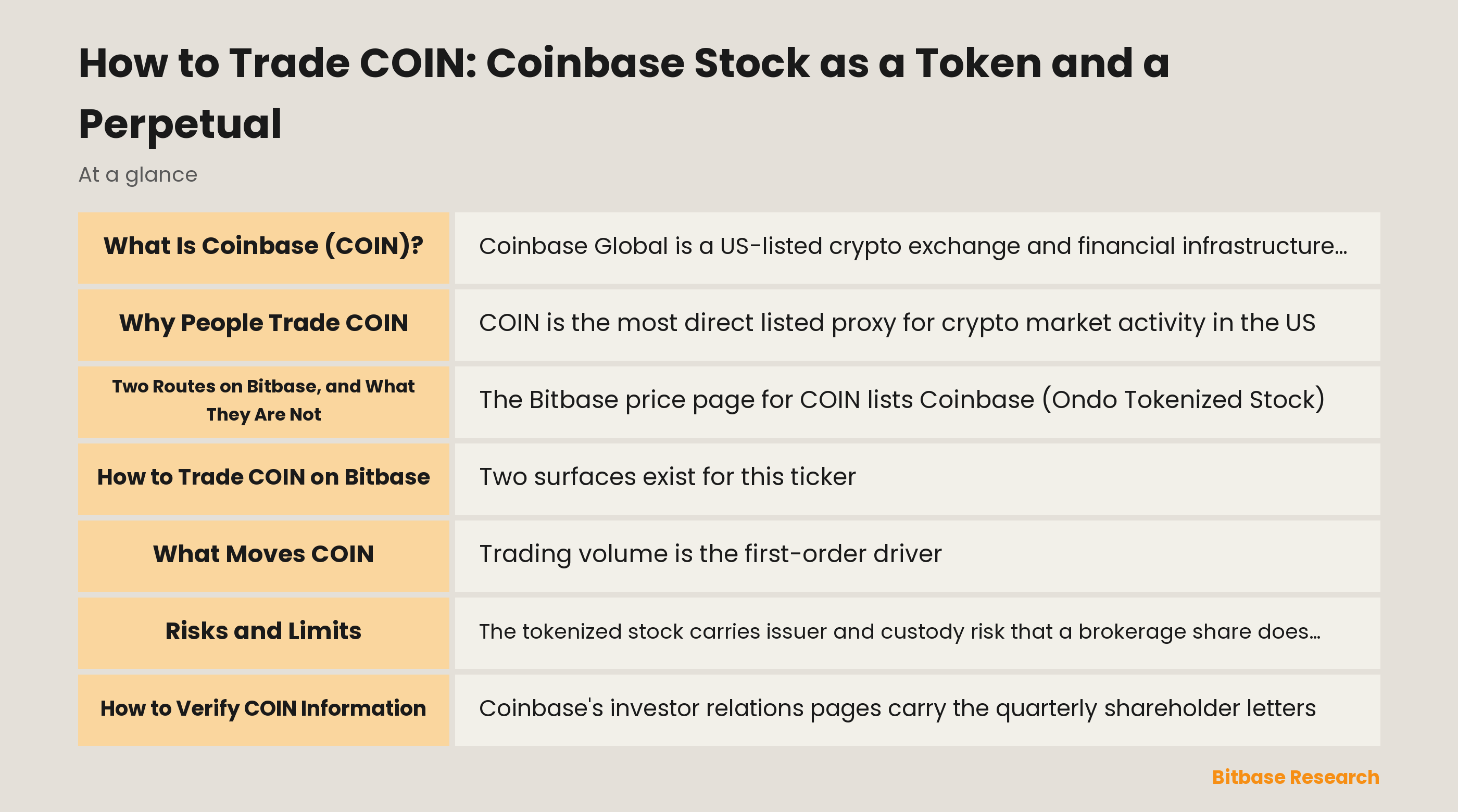
What Is Coinbase (COIN)?
Coinbase Global is a US-listed crypto exchange and financial infrastructure company. It trades on Nasdaq under COIN and joined the S&P 500 on May 19, 2025, the first crypto-native company admitted to that index.
Its revenue arrives in two lines, and they behave nothing alike. Transaction revenue is the fee take on trading, and it rises and falls with volume, which in turn rises and falls with volatility and with retail attention. Subscription and services is everything else: stablecoin reserve income, staking and blockchain rewards, custody fees, interest and finance fee income. That second line is the one management points at when it argues the business is less cyclical than it looks.
The stablecoin piece deserves naming because it is unusual. Under Coinbase's arrangement with Circle, Coinbase receives all of the reserve interest income on USDC held on its own platform and half of the residual reserve income on USDC circulating elsewhere, with terms running through 2029. That makes a meaningful slice of Coinbase's income a function of short-term interest rates rather than of crypto prices.
Coinbase also operates Base, a layer-2 network, and a set of institutional services under Coinbase Prime. Neither is a trading fee, and both are part of the argument that the company is building something wider than an exchange.
Why People Trade COIN
COIN is the most direct listed proxy for crypto market activity in the US. Not for the crypto price, for the *activity*: the business is paid on volume, so a flat market with heavy churn can be better for Coinbase than a quiet rally.
That distinction is what most people get wrong about it. Traders reach for COIN as a leveraged bitcoin substitute, and the correlation is real enough to encourage the habit, but the transmission runs through volumes and through rate-sensitive stablecoin income, not through the coin price directly. Two quarters with the same average bitcoin price and different volumes will not look the same in the revenue line.
It is also one of the few large-cap ways to take a regulatory view. Rulemaking that widens or narrows what a US exchange may list, custody, or offer lands on this company before it lands on most of the sector.
Two Routes on Bitbase, and What They Are Not
The Bitbase price page for COIN lists Coinbase (Ondo Tokenized Stock), trading under the symbol COINON. That naming carries the whole point: what the page tracks is not a share.
Ondo's documentation is explicit that one token does not necessarily represent the value of one share, and that a token's price will not always match the underlying. The tokens are structured as total return trackers, so dividends are reinvested net of withholding tax rather than paid out, and holders receive no shareholder voting rights, no statutory information rights, and no other shareholder rights. Ondo describes trading as generally running 24/5, with pauses possible around corporate actions and risk limits, and the product as generally available to non-US investors.
A perpetual futures contract is a different structure again. It holds nothing: no share, no token, no claim on Coinbase. It tracks a price, settles in stablecoin, exchanges a periodic funding rate between longs and shorts, and can be liquidated. It is an expression of direction with leverage, and nothing more.
So "buying COIN" resolves to two answers here, and neither of them is ownership of a share in Coinbase Global.
How to Trade COIN on Bitbase
Two surfaces exist for this ticker.
The price page carries the quote, the chart and the market data for the tokenized stock. It is the reference point, and the only one of the two that requires no position.
The perpetual futures market is where leveraged directional positions are opened. Funding is paid or received periodically depending on which side is crowded; a maintenance margin requirement and a liquidation price apply. That makes it suited to a view with a time limit, and unsuited to "I want to hold some Coinbase."
Which tickers carry a spot market as well, and which carry only these two, differs by name; the tokenized stock lineup is where to check.
The practical consequence is worth stating plainly: on Bitbase, COIN is available to watch and to trade with leverage, and the funding cost belongs in the plan from the first order rather than as a surprise three weeks in.
What Moves COIN
Trading volume is the first-order driver, and it is more volatile than the crypto prices themselves. Volume concentrates into a handful of violent weeks a year, which is why quarterly results for this company are lumpy in a way that a subscription business never is.
Short-term interest rates are the second driver, and they are the counterintuitive one. Because a substantial part of subscription and services income comes from stablecoin reserves, a cutting cycle compresses that line at the same time as it usually lifts risk assets — the two effects point in opposite directions inside a single stock.
Regulation is the third. Approvals and enforcement both reprice this name on the news rather than on the numbers, and the direction is not always the obvious one: a rule that raises compliance costs across the industry can favour the largest compliant venue.
Competition is the slow one. Fee compression from zero-fee brokers and from offshore venues works on the transaction line quarter after quarter without ever being a headline, and take rate is the number analysts watch for it.
Risks and Limits
The tokenized stock carries issuer and custody risk that a brokerage share does not. Its value depends on the issuer's structure holding, and there is no shareholder claim underneath it. Eligibility, redemption paths and jurisdictional limits are set by the issuer and can change.
The 24/5 schedule creates gap risk against a Nasdaq session that is shorter still. News breaking while the primary market is closed prices into the token first, and a position held across that boundary cannot be hedged in the primary market.
The perpetual adds funding cost and liquidation. Funding accumulates: a directionally correct trade held long enough can still lose to it. Leverage shortens the distance to liquidation, and a stock-referenced perpetual can gap around earnings harder than crypto perpetuals usually do.
The business risk is concentration. COIN is a single-name bet on crypto market activity, on US regulatory outcomes, and on the durability of one revenue-sharing arrangement. Sizing it like a diversified financial holding is the common mistake.
How to Verify COIN Information
Coinbase's investor relations pages carry the quarterly shareholder letters, where the transaction and subscription-and-services lines are broken out; the SEC's EDGAR database carries the filings themselves, including the risk factors that describe the Circle arrangement and the regulatory exposures in the company's own words.
For the tokenized instrument, the issuer's documentation is the authority on what the token is, what rights it does not carry, when it trades and who may hold it. That is a different document from anything the exchange publishes.
For the instruments on Bitbase, the price page carries the current quote and the market pages carry the contract specifications, including funding and margin terms. Those change, and they are the numbers to read before sizing anything.
Conclusion
COIN is a bet on crypto market activity wrapped in a business that also earns from interest rates, and on Bitbase it comes in two forms, neither of which is a share. The tokenized stock gives economic exposure without shareholder rights; the perpetual gives leveraged price exposure without holding anything at all. Which one fits is a question about holding period and about how much of the instrument's own structure you are willing to take on, and it is cheaper to answer before the order than after.
Related market pages
Bitbase pages for the tokenized stocks named in this article:
- COIN: View price · Perpetual market
Related reading
Other Bitbase articles on this topic:
- How to Buy US Stocks With USDT and What You Actually Hold
- How to Choose Crypto Stocks: Four Checks Before Any List
- How to Buy AAPL: The Company, the Token and the Contract
- SOXX ETF Explained: Thirty Slots and a Sector Definition
Disclaimer: This article is educational content from Bitbase Academy, provided for information only. It explains what a company or fund does and how the instruments referenced here differ from one another; it does not constitute investment, trading, tax, or financial advice, and it is neither a recommendation nor an endorsement of any security, token, or trading strategy. A tokenized stock is issued by a third party and is designed to give economic exposure to an underlying asset: it is not a share, it carries no shareholder rights, and it depends on the issuer's structure, eligibility rules, and redemption terms, which the issuer can change. Perpetual futures are leveraged derivatives that hold no underlying asset and can be liquidated, and trading hours, product availability, and eligibility differ by instrument and by jurisdiction and can change at any time. Written as of September 2026; verify everything yourself through company filings, the issuer's own documentation, and the product pages of the venue you trade on.
References
[1] Coinbase Investor Relations: quarterly shareholder letters with the transaction and subscription-and-services breakdown investor.coinbase.com
[2] SEC EDGAR: Coinbase annual filings, including the risk factors on regulation and the Circle arrangement www.sec.gov
[3] Ondo Stocks overview: backing, rights and trading hours (Ondo official documentation) docs.ondo.finance