When you pay Costco's annual fee, you are buying the right to shop at a markup the company deliberately keeps small, and Costco is collecting a revenue line that arrives before any merchandise moves. That split is what makes COST an unusual retail ticker: the shelves carry the sales, the membership carries much of the operating profit. Bitbase lists the name as an Ondo tokenized stock with its own price page and as a perpetual futures contract; neither is registered stock, and the difference shows up first in what happens to a dividend.
What Is Costco (COST)?
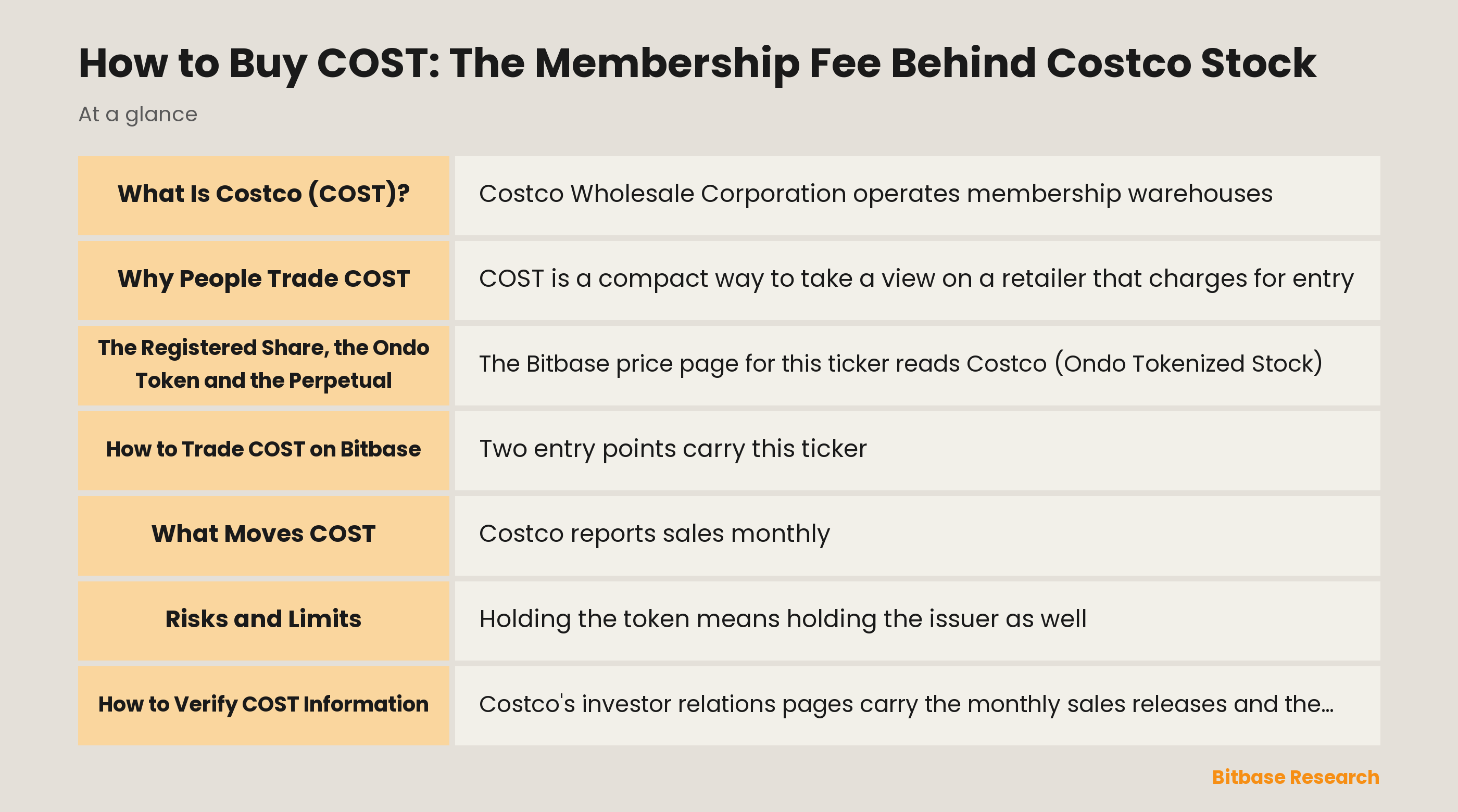
Costco Wholesale Corporation operates membership warehouses. Its common stock trades on the Nasdaq Global Select Market under the symbol COST, and its annual report describes the company as principally engaged in that business in the United States and Puerto Rico, Canada, Mexico, Japan, the United Kingdom, Korea, Australia, Taiwan, China, Spain, France, Sweden, Iceland and New Zealand.
The format is the whole argument. The 10-K says that offering low prices on a limited selection of nationally branded and private-label products lets the company "operate profitably at significantly lower gross margins (net sales less merchandise costs) than most other retailers." A narrow range in large pack sizes turns over quickly, and quick turnover tolerates a smaller markup.
Two revenue lines follow from that, and the income statement keeps them apart. Merchandise sales are by far the larger figure and run on thin margins by design. Membership fees are the smaller figure, and Costco recognises them ratably over the membership period rather than at the moment the card is sold. Kirkland Signature crosses both: the company describes its own label as priced generally below national brands while generally earning higher margins. Gasoline, sold at the warehouses, prices off the fuel market rather than off anything happening inside the building.
Why People Trade COST
COST is a compact way to take a view on a retailer that charges for entry. A conventional chain has to win each transaction on price and margin at once; this one collects the fee first and then competes on price with little markup left to give. Holding it is a bet that members keep deciding the fee earns itself back.
The stock also gets read as evidence about households rather than about the company. Renewal rates, traffic and average basket are treated as information on how consumers are behaving, and the monthly sales releases put that reading on a monthly cadence instead of a quarterly one.
Its connection to crypto is close to non-existent. Costco's revenue comes from merchandise, fuel and membership fees, and none of those move with token prices. What puts these four letters on a crypto venue is the wrapper around them, not the business inside them, which makes COST a different proposition from a miner or an exchange operator whose own results are denominated in the asset.
The Registered Share, the Ondo Token and the Perpetual
The Bitbase price page for this ticker reads Costco (Ondo Tokenized Stock), trading under the symbol COSTON. That issuer name is the load-bearing part of the title. Three structures carry these four letters, and they are not versions of one another.
A share bought through a broker is registered stock. It carries shareholder rights, and it receives in cash whatever the board decides to distribute. Costco pays a regular quarterly dividend and has additionally declared special cash dividends at long and irregular intervals, five of them between 2012 and the end of 2023, each announced alongside results rather than on a published schedule. Cash leaving the company is the part of a Costco position that changes shape first once the position is wrapped.
Ondo's documentation refuses the obvious reading of its own product. "One token does not necessarily represent the value of one share, and the price of one token will not always match the price of the underlying asset," it states. What the token tracks is a total return: dividends go back into it, net of withholding tax, instead of being paid out. The cash a registered holder receives therefore has no counterpart here, because the same economics sit inside the price rather than in an account.
Four further terms come from the same source. Holders "do not receive shareholder voting rights, statutory information rights or other shareholder rights." Trading generally runs 24/5; Ondo notes that corporate actions and risk limits can pause it, and that a smaller group of assets trades outside those hours. Minting and burning are instant, settling in a single atomic transaction. And the product is generally available to non-US investors, subject to jurisdictional and other restrictions. The broad shape of this — an on-chain claim tracking something registered off-chain — is what real-world asset tokenization covers; the terms that bind are always the issuer's, and here they are Ondo's.
The perpetual futures contract is the third structure, and it owns nothing at all: not a share, not a token, not a claim on Costco. It follows a price, is margined and settled in stablecoin, passes a periodic funding rate payment from the crowded side of the book to the other, and is closed out by the venue if margin falls short. No distribution reaches it in any form, because there is nothing underneath it for one to land on.
How to Trade COST on Bitbase
Two entry points carry this ticker, and only one of them opens a position.
The price page holds the quote, the chart and the market data for the tokenized stock. It is a reading surface rather than a trading one, and it is where to watch how the token prices while the Nasdaq session is closed.
The perpetual futures market is the one that puts capital at risk. Which side of the book is crowded decides whether funding is paid or collected, margin has to stay above a maintenance level, and below that level the position is closed for you. A view with a date on it — a monthly sales release, a quarterly result, a fee announcement — fits that instrument better than a long hold does, since funding runs for as long as the position does.
Not every name in this part of the platform carries the same entry points, so the TradFi listings page is worth checking before assuming a particular route exists.
What Moves COST
Costco reports sales monthly, not only quarterly. Each release covers a retail month of four or five weeks ending on a Sunday, so the reporting period drifts against the calendar month and a five-week month is not comparable to a four-week one without adjustment. The fiscal year is built the same way, running 52 or 53 weeks and ending on the Sunday nearest the end of August, so a 53-week year adds a full week of sales to the annual comparison. That gives twelve dated sales disclosures a year rather than four, and each one is an event a leveraged position has to sit through.
The headline sales figure carries two things management does not control. Costco publishes comparable sales both as reported and adjusted for changes in gasoline prices and foreign exchange, because fuel is sold at the warehouses and because a meaningful share of the business is transacted in other currencies. A period can look stronger or weaker than the underlying member behaviour on those two inputs alone, which is why the adjusted figure is the one to read first.
Membership economics move on a clock of their own. Because fees are recognised ratably across the membership period, a change in the annual fee phases into the income statement over roughly a year instead of landing in one quarter; the increase in the United States and Canada announced in July 2024 took effect that September, and the one before it had taken effect in June 2017. The renewal rate is disclosed with results and read as a verdict on whether the fee still justifies itself.
Merchandise mix moves gross margin without sales moving at all. Costco says Kirkland Signature is priced generally below national brands while generally earning higher margins, so a shift between own-label and branded goods changes what a given basket is worth to the company. In a business whose merchandise margin is thin by construction, small movements in mix, freight or shrink travel a long way down to the operating line.
Distributions arrive without a calendar. Alongside the regular quarterly dividend the board occasionally declares a special one, and the five that fell between 2012 and the end of 2023 were disclosed with results rather than scheduled in advance, so there is no date to position around. For anyone holding the tokenized version rather than the share, such an announcement changes what the underlying is worth without producing any cash.
Risks and Limits
Holding the token means holding the issuer as well. Its value depends on Ondo's structure continuing to work, and it is not a one-for-one claim on anything: Ondo says in its own documentation that one token does not necessarily represent the value of one share. Who may hold it, how it is redeemed and where it is available are the issuer's terms, and the issuer can rewrite them.
The 24/5 window and the Nasdaq session are two different clocks, and Costco's own calendar answers to neither. Sales releases, results and dividend declarations are timed around the primary market, so a token position can face news during hours in which the underlying cannot be traded at all. The distribution gap is the second mismatch, and it is structural: whoever wanted COST partly for the cash it returns holds something that returns none.
On the perpetual the two costs are funding and forced closure. Funding runs while the position is open, so being right about direction and wrong about duration can still lose money, and higher leverage puts the liquidation level closer to the entry. A stock-referenced contract can also gap across a scheduled release, because the underlying market is shut for part of the week while the contract keeps trading.
The business risk is that thin margins leave little room for error. A model built on low markups depends on volume, on cost control and on members renewing at a rate the company has to keep earning. The format is also concentrated by design: one way of selling, replicated across markets, with no second engine to carry a bad year.
How to Verify COST Information
Costco's investor relations pages carry the monthly sales releases and the quarterly results, including the condensed income statement in which membership fees appear as a line separate from net sales. That statement is where any claim about the balance between the two can be checked directly rather than taken on trust.
For the filings themselves, go to the SEC's EDGAR database. The Form 10-K names the exchange and the symbol, defines the 52/53-week fiscal calendar, lists the countries where warehouses operate, and sets out the risk factors in Costco's own words.
Backing, rights, trading hours and eligibility are answered by the issuer's own documentation and by nothing a trading venue publishes, so read Ondo's pages for those. On Bitbase itself, the quote sits on the price page, and the funding and margin terms sit in the contract specifications on the market pages.
Conclusion
COST is a position on a retailer that sells access before it sells anything else: merchandise moves at a markup the company keeps deliberately small, and the membership fee carries much of what reaches the operating line. Two of the three structures above are available here, and neither is a share. The Ondo token hands you economic exposure without shareholder rights and without cash, tracking a total return instead of one share's price; the perpetual hands you leveraged price exposure and holds nothing. Choosing between them is largely a question of how long the position is meant to live, and of whether the cash Costco pays out was part of why you wanted it.
Related market pages
Bitbase pages for the tokenized stocks named in this article:
- COST: View price · Perpetual market
Related reading
Other Bitbase articles on this topic:
- How to Choose Crypto Stocks: Four Checks Before Any List
- How to Buy AAPL: The Company, the Token and the Contract
- How to Buy AMD: The Tokenized Stock and the Perpetual
- Stablecoin and Infrastructure Stocks: What You Are Buying
Disclaimer: This article is educational content from Bitbase Academy, provided for information only. It explains what a company or fund does and how the instruments referenced here differ from one another; it does not constitute investment, trading, tax, or financial advice, and it is neither a recommendation nor an endorsement of any security, token, or trading strategy. A tokenized stock is issued by a third party and is designed to give economic exposure to an underlying asset: it is not a share, it carries no shareholder rights, and it depends on the issuer's structure, eligibility rules, and redemption terms, which the issuer can change. Perpetual futures are leveraged derivatives that hold no underlying asset and can be liquidated, and trading hours, product availability, and eligibility differ by instrument and by jurisdiction and can change at any time. Written as of September 2026; verify everything yourself through company filings, the issuer's own documentation, and the product pages of the venue you trade on.
References
[1] SEC EDGAR: Costco Wholesale annual filings on Form 10-K, including the business description, fiscal calendar and risk factors www.sec.gov
[2] Costco Wholesale Investor Relations: monthly sales releases, quarterly results and the condensed income statement in which membership fees are a separate line investor.costco.com
[3] Ondo Stocks overview: backing, shareholder rights, trading hours and eligibility (Ondo official documentation) docs.ondo.finance