The business behind USDC is now a listed stock, and on Bitbase that ticker does not resolve to a share. CRCL appears here in two forms: a tokenized stock price page and a perpetual futures contract. Circle earns most of its revenue from the interest on the reserves that back USDC, which makes this an unusual equity to hold and a stranger one to trade with leverage.
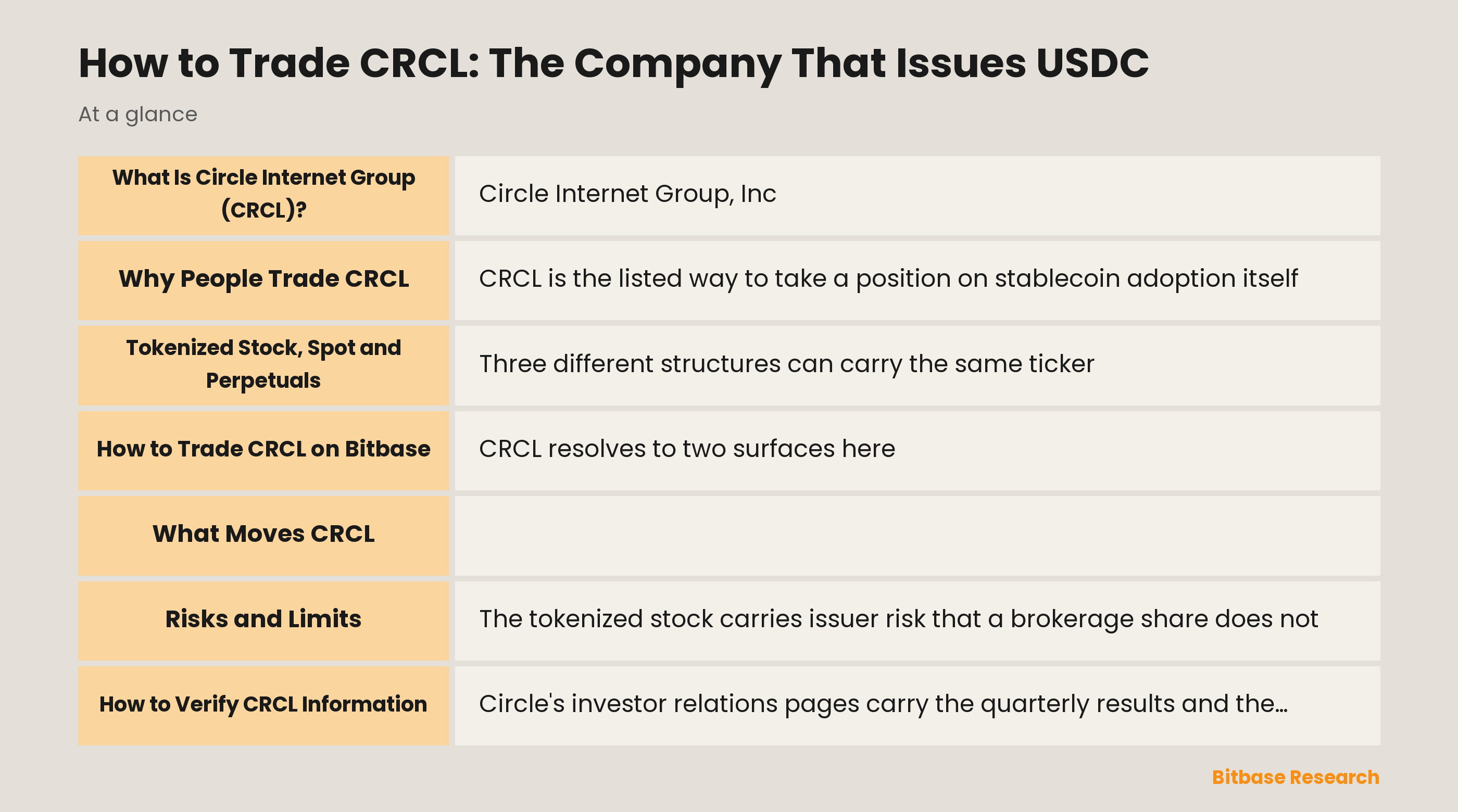
What Is Circle Internet Group (CRCL)?
Circle Internet Group, Inc. issues USDC and EURC through regulated affiliates and describes itself as a global financial technology firm that enables businesses to use digital currencies and public blockchains for payments, commerce and financial applications. Its Class A common stock began trading on the New York Stock Exchange on June 5, 2025 under the ticker CRCL.
One line dominates the business. When someone buys USDC, Circle takes the dollar and holds it in reserve. Circle states that USDC is 100% backed by highly liquid cash and cash-equivalent assets, with the majority of the reserve invested in the Circle Reserve Fund, an SEC-registered 2a-7 government money market fund custodied at The Bank of New York Mellon and managed by BlackRock. The interest those reserves earn is reserve income, by a wide margin the largest revenue line in the company's filings.
The other half of the picture is what Circle pays to keep USDC circulating. Distribution and transaction costs are booked against that income: the platforms that hold and distribute the token are compensated out of the yield. Circle's own filings describe its stablecoins as supported by digital asset exchanges and marketplaces, from neo-banks and brokerages to payment providers and commerce companies. That distribution is why USDC is everywhere, and also why a growing float does not translate one for one into a growing profit. The general version of this arrangement is the subject of how stablecoin issuers make money; CRCL is that model with a share price attached to it.
Circle is not only the reserve: it has also built Arc, which it describes as a new open Layer-1 blockchain designed from the ground up to serve the next era of stablecoin-native applications, with USDC as native gas. Whether that second business ever reaches the income statement is an open question.
Why People Trade CRCL
CRCL is the listed way to take a position on stablecoin adoption itself: not on a token price, because USDC is engineered not to move, but on the size of the float and on what that float earns.
The revenue identity is unusually legible for an equity: in rough terms it is circulating balances multiplied by a short-term interest rate, less what goes to distribution partners. Two of those three inputs are observable without waiting for a quarterly report, because circulation updates continuously on-chain and the policy rate is set in meetings on a published calendar.
The complication is that the two visible inputs frequently move against each other. A rate-cutting cycle tends to lift risk assets and grow stablecoin balances while compressing the yield on every dollar of them; a tightening cycle does the reverse. Buying CRCL as a leveraged proxy for crypto therefore imports a rates position whether or not that was the intention.
Tokenized Stock, Spot and Perpetuals
Three different structures can carry the same ticker, and they are not interchangeable.
A registered share is equity in the company: held through a broker, traded during exchange hours, carrying shareholder rights.
A tokenized stock is a token on a public blockchain designed to give economic exposure to an underlying asset. What backs it, when it trades and what it entitles the holder to are decided by its issuer, and issuers differ on every one of those points.
A perpetual futures contract is a derivative. It holds no share and no token, it tracks a price, it settles in stablecoin, it exchanges funding between longs and shorts, and it can be liquidated. A CRCL perpetual settles in the same category of instrument the underlying company issues, which changes nothing about the mechanics.
The Bitbase price page for this ticker lists Circle Internet Group (Ondo Tokenized Stock), trading under the symbol CRCLON. The naming identifies the issuer, and its documentation is where the specifics live. Ondo is explicit that one token does not necessarily represent the value of one share and that a token's price will not always match the price of the underlying asset. The tokens are structured as total return trackers, so dividends are reinvested net of withholding tax rather than paid out to holders. Holders receive no shareholder voting rights, no statutory information rights and no other shareholder rights. Ondo describes trading as running 24/5, with pauses possible around corporate actions and risk limits, and describes the product as generally available to non-US investors.
A tokenized stock spot market is the third form these tickers can take. Which tickers carry one differs from name to name, and the tokenized stock listings are where to check that.
How to Trade CRCL on Bitbase
CRCL resolves to two surfaces here, and they answer different questions.
The price page carries the quote, the chart and the market data for the tokenized stock. It costs nothing and commits nothing, and for a name whose fair value is a function of an interest rate and a circulating supply, watching is a use in itself.
The perpetual futures market is where a directional position is opened with leverage. Funding is exchanged periodically between the two sides depending on which one is crowded, a maintenance margin requirement applies, and leverage decides how far the liquidation price sits from the entry. That structure suits a view with a deadline attached. It does not suit the intention of owning a piece of Circle, because the contract owns nothing.
One consequence is specific to this ticker: rate decisions and quarterly results are scheduled events, and the cost of holding a leveraged position through one belongs in the plan before the first order.
What Moves CRCL
Short-term interest rates. Reserve income is the yield on a government money market portfolio, so a change in policy rates lands on the revenue line close to mechanically, with a lag measured in weeks rather than quarters. It is the driver that would still be there if the crypto market went quiet for a year.
USDC in circulation. The second multiplier, and the one that runs on crypto's clock. Balances grow when exchanges need dollar collateral, when payment corridors settle in stablecoin, when on-chain markets are busy, and they shrink when leverage comes out of the system. Circulation is observable in near real time, which is why this stock can reprice on data arriving outside the reporting calendar.
Where the balances sit. Distribution costs scale with the token held on partner platforms rather than with total circulation, so the same growth in float converts into different profit depending on where it lands. Of the drivers listed here, this is the one with no public real-time series behind it.
Stablecoin regulation. The GENIUS Act, Public Law 119-27, approved July 18, 2025, provides for the regulation of payment stablecoins in the United States. A federal framework cuts both ways for an incumbent issuer: it legitimises the product and opens bank distribution, and it defines a licensed path for new entrants, banks among them. Rulemaking under that framework moves this name in a way it moves very little else listed on an exchange.
Competition for distribution. Issuers compete on how much of the reserve yield they hand back to the platforms carrying their token, so Circle can lose margin without losing a unit of circulation, and margin lost that way does not show up in market-share figures.
Product expansion. Arc and the wider platform business are the argument that Circle is more than a rates trade. Progress there will not explain any particular week, but it is what a long-horizon position underwrites.
Risks and Limits
The tokenized stock carries issuer risk that a brokerage share does not. Its value depends on the issuer's structure holding up, there is no shareholder claim underneath it, and eligibility, redemption paths and jurisdictional limits are set by the issuer and can be changed by it.
Hours create gap risk in two places at once. The token trades 24/5, the perpetual trades continuously, and the New York Stock Exchange session is shorter than either. Stablecoin news respects none of those calendars: on-chain flows, reserve disclosures and regulatory statements arrive at all hours, and a position carried across the boundary cannot be hedged while the primary market is shut.
The perpetual adds funding cost and liquidation. Funding accrues whether the trade is working or not, so a directionally correct position held long enough can still finish behind, and leverage shortens the distance to the liquidation price. A stock-referenced contract can also gap around scheduled events such as quarterly results and rate decisions.
The business risk is concentration of a particular kind: a single-product company whose product is a claim on short-term interest rates, distributed through a limited set of partners, in a market regulators have only recently defined. Any one of those can turn, and none is diversified away by the others.
How to Verify CRCL Information
Circle's investor relations pages carry the quarterly results and the presentations that split revenue into reserve income and everything else, and the SEC's EDGAR database carries the filings themselves, including the risk factors where the company describes its dependence on interest rates and on distribution partners in its own words.
The reserve has a public trail of its own. Circle publishes monthly reserve attestations by a Big Four accounting firm, daily portfolio reporting for the Circle Reserve Fund is available through BlackRock, and Deloitte and Touche LLP is named as Circle's independent auditor. Those are where the revenue line can be watched forming between quarters.
For the token, the issuer's documentation is the authority on backing, rights, hours and eligibility, and it is a different document from anything a trading venue publishes.
For the instruments on Bitbase, the price page carries the current quote and the market pages carry the contract specifications, including funding and margin terms. Those change, and they are what to read before sizing anything.
Conclusion
Circle earns the interest on other people's dollars and pays part of it away to keep those dollars circulating, and CRCL is the listed claim on the difference. On Bitbase that claim arrives in two forms, neither of which is a share: a tokenized stock giving economic exposure without shareholder rights, and a perpetual giving leveraged price exposure without holding anything. Which fits depends on the horizon: a view on where policy rates and USDC circulation go over several quarters is a different trade from a view on where the price goes this week, and only one of the two is built to be held that long.
Related market pages
Bitbase pages for the tokenized stocks named in this article:
- CRCL: View price · Perpetual market
Related reading
Other Bitbase articles on this topic:
- How to Choose Crypto Stocks: Four Checks Before Any List
- How to Buy AAPL: The Company, the Token and the Contract
- How to Buy AMD: The Tokenized Stock and the Perpetual
- VTI ETF Explained: A Sample of the Whole US Stock Market
Disclaimer: This article is educational content from Bitbase Academy, provided for information only. It explains what a company or fund does and how the instruments referenced here differ from one another; it does not constitute investment, trading, tax, or financial advice, and it is neither a recommendation nor an endorsement of any security, token, or trading strategy. A tokenized stock is issued by a third party and is designed to give economic exposure to an underlying asset: it is not a share, it carries no shareholder rights, and it depends on the issuer's structure, eligibility rules, and redemption terms, which the issuer can change. Perpetual futures are leveraged derivatives that hold no underlying asset and can be liquidated, and trading hours, product availability, and eligibility differ by instrument and by jurisdiction and can change at any time. Written as of September 2026; verify everything yourself through company filings, the issuer's own documentation, and the product pages of the venue you trade on.
References
[1] Circle Investor Relations: quarterly results and the presentations that split revenue into reserve income and everything else investor.circle.com
[2] Circle press release on the pricing of its initial public offering: New York Stock Exchange listing under the ticker CRCL from June 5, 2025 www.circle.com
[3] Circle USDC page: reserve composition, the Circle Reserve Fund, custody, monthly attestations and the independent auditor www.circle.com
[4] SEC EDGAR: Circle Internet Group filings, including the revenue breakdown and the risk factors on interest rates and distribution partners www.sec.gov
[5] Ondo Stocks overview: backing, rights and trading hours (Ondo official documentation) docs.ondo.finance
[6] GENIUS Act, Public Law 119-27, approved July 18, 2025: an act to provide for the regulation of payment stablecoins (GovInfo) www.govinfo.gov