Salesforce's core products are billed per user per month, and the AI agents it now sells are billed partly by how much work they do rather than only by the seat. Whether the second way of charging grows faster than the first sits underneath much of what is argued about this company. On Bitbase the ticker resolves to two surfaces — a tokenized stock price page and a perpetual futures contract — and neither is a share. This profile covers what Salesforce sells, which number its results turn on, and what each route does and does not give you.
What Is Salesforce (CRM)?
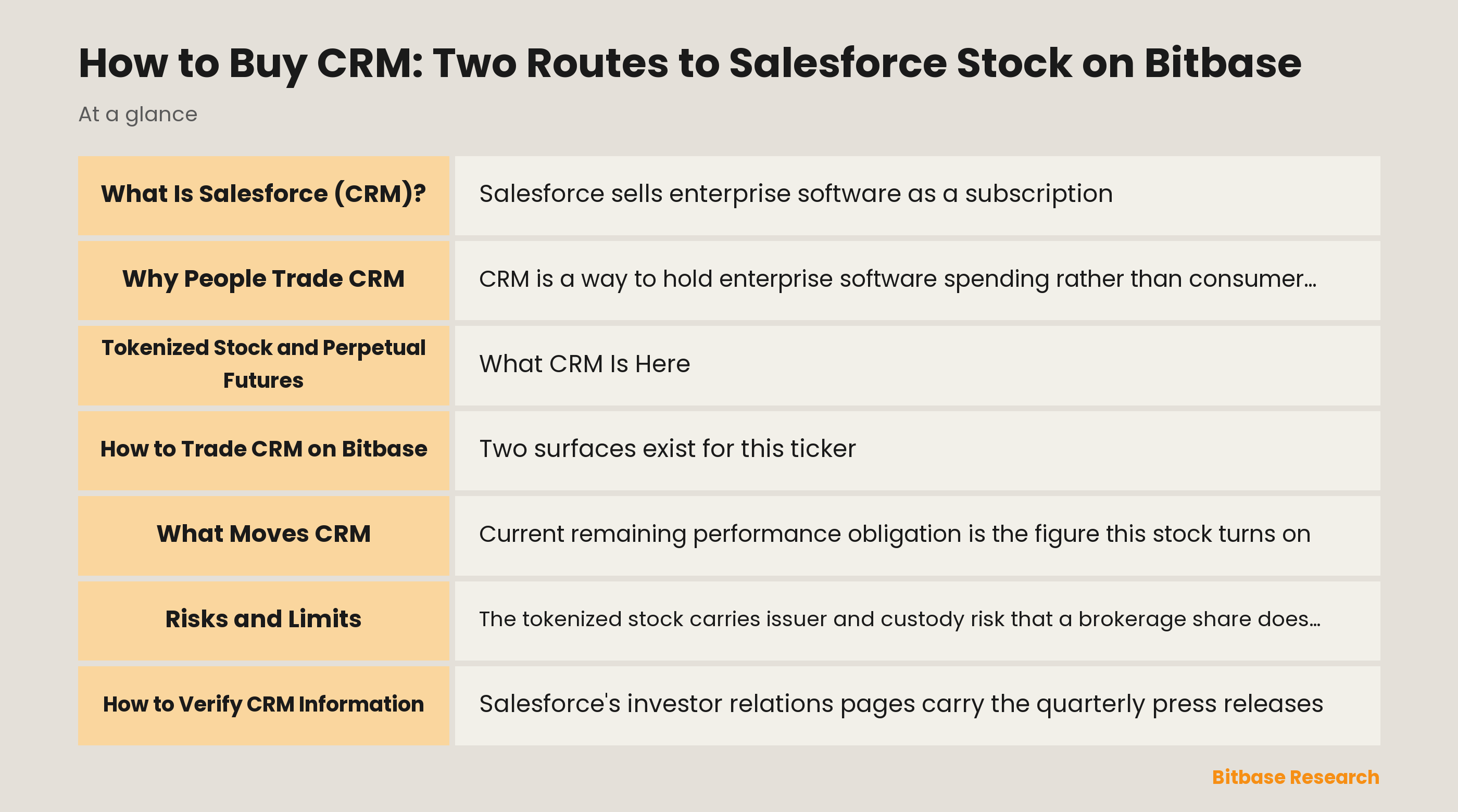
Salesforce sells enterprise software as a subscription: applications for sales teams, service teams, marketing and commerce, plus the platform and data tools those applications sit on. The company is listed on the New York Stock Exchange under CRM and is a component of both the S&P 500 and the Dow Jones Industrial Average, which it joined in August 2020.
Revenue is reported in two lines. Subscription and support is the recurring one, contracted in advance and recognised over the life of the agreement. Professional services and other covers implementation and training, delivered as work rather than as access. When the market values this company it is valuing the first line.
Much of the product range arrived by acquisition rather than by internal development: Slack, Tableau and MuleSoft earlier, Informatica and Contentful more recently. Every deal adds a revenue line and an argument about what was paid for it.
Why People Trade CRM
CRM is a way to hold enterprise software spending rather than consumer technology or semiconductors. Because the revenue is contracted in advance and recognised over time, the business reprices slowly, and bad news arrives as gradually as good news.
It also has an unusual link to white-collar employment. Seat-based pricing means the bill scales with how many salespeople, support agents and marketers a customer employs. A company that freezes hiring does not cancel Salesforce, it stops adding seats, and the growth rate registers that a few quarters later.
Its relationship to crypto is close to none: Salesforce revenue does not depend on token prices or on trading volume, so a position here is not a second crypto position under a different name.
Tokenized Stock and Perpetual Futures: What CRM Is Here
The Bitbase price page for CRM lists Salesforce (Ondo Tokenized Stock), trading under the symbol CRMON. The naming carries the point: it is not a share.
Ondo's documentation is explicit that one token does not necessarily represent the value of one share, and that a token's price will not always match the price of the underlying asset. The tokens are structured as total return trackers, so dividends are reinvested net of withholding tax rather than paid out. Salesforce does pay a dividend, so that is a live detail here and not a footnote: the cash never reaches the holder as cash. Holders receive no shareholder voting rights, no statutory information rights and no other shareholder rights. Ondo describes minting and burning as instant and atomic, trading as generally running 24/5 with pauses possible around corporate actions and risk limits, and the product as generally available to non-US investors.
A perpetual futures contract is a different structure again. It holds nothing: no share, no token, no claim on Salesforce. It tracks a price, settles in stablecoin, exchanges a periodic funding rate between longs and shorts, and can be liquidated.
So "buying CRM" resolves to two answers here, and neither is ownership of a share in Salesforce.
How to Trade CRM on Bitbase
Two surfaces exist for this ticker. The price page carries the quote, the chart and the market data for the tokenized stock. It is the reference point, and the only one of the two that requires no position.
The perpetual futures market is where leveraged directional positions are opened. Funding is paid or received periodically depending on which side is crowded, and a maintenance margin requirement and a liquidation price apply. That fits a view with a deadline attached, such as a results date. It does not fit "I want to hold some Salesforce for a few years."
Which tickers carry a spot market as well, and which carry only these two, differs by name; the tokenized stock lineup is where to check.
What Moves CRM
Current remaining performance obligation is the figure this stock turns on, and it is not revenue. It measures contracted work expected to be recognised as revenue over the next twelve months, which makes it a read on bookings before those bookings reach the income statement. In results that otherwise describe a quarter already finished, it is the forward-looking line.
The fiscal calendar shifts the whole rhythm. Salesforce closes its books on January 31, so the fourth quarter is reported in late winter and the annual report on Form 10-K is filed each March. Anyone reading this company against software peers on a December year-end is comparing quarters that do not line up.
Then there is the pricing question the company set itself. The core clouds are sold per user per month; Agentforce, its agent product, is sold with consumption pricing alongside per-user licences. An agent that does work a seat used to do therefore need not bill like the seat did, and whether consumption growth replaces seat growth is unresolved. That question is specific to a company whose revenue is counted in logins.
Margin and capital return are the fourth driver. Activist pressure in 2023 pushed operating margin, buybacks and, later, a dividend into the story alongside growth, and each new acquisition reopens the argument about which the company is being run for.
Risks and Limits
The tokenized stock carries issuer and custody risk that a brokerage share does not. Its value depends on the issuer's structure holding, and there is no shareholder claim underneath it. Eligibility, redemption paths and jurisdictional limits are set by the issuer, not the exchange, and can change.
The 24/5 schedule creates gap risk against a New York Stock Exchange session that is shorter still. Results and guidance are published outside that session and price into the token first, and a position held across that boundary cannot be hedged in the primary market.
The perpetual adds funding cost and liquidation. Funding accumulates, so a directionally correct trade held long enough can still lose to it, and leverage shortens the distance to the liquidation price. A stock-referenced perpetual can also gap hard around a results date.
The business risk is that a subscription base protects against a fast decline and not at all against a slow one: seats leave one renewal at a time.
How to Verify CRM Information
Salesforce's investor relations pages carry the quarterly press releases, where subscription and support revenue and the current remaining performance obligation are stated with the company's own definitions, and the SEC's EDGAR database carries the annual report for a year ended January 31.
For the tokenized instrument, the issuer's documentation is the authority on what the token is, what rights it does not carry, when it trades and who may hold it.
For the instruments on Bitbase, the price page carries the quote and the market pages carry the contract specifications, including funding and margin terms. Those change, and they are the numbers to read before sizing anything.
Conclusion
CRM is a position on enterprise software spending, and on whether one company can sell AI agents without undercutting the seat count it bills for. On Bitbase it arrives in two forms, and neither is a share: the tokenized stock gives economic exposure without shareholder rights, the perpetual gives leveraged price exposure without holding anything. Holding period decides which one fits, and that is cheaper to answer before the order than after.
Related market pages
Bitbase pages for the tokenized stocks named in this article:
- CRM: View price · Perpetual market
Related reading
Other Bitbase articles on this topic:
- How to Choose Crypto Stocks: Four Checks Before Any List
- How to Buy AAPL: The Company, the Token and the Contract
- How to Buy AMD: The Tokenized Stock and the Perpetual
- What Is Perle? Human-Verified AI Data and PRL
Disclaimer: This article is educational content from Bitbase Academy, provided for information only. It explains what a company or fund does and how the instruments referenced here differ from one another; it does not constitute investment, trading, tax, or financial advice, and it is neither a recommendation nor an endorsement of any security, token, or trading strategy. A tokenized stock is issued by a third party and is designed to give economic exposure to an underlying asset: it is not a share, it carries no shareholder rights, and it depends on the issuer's structure, eligibility rules, and redemption terms, which the issuer can change. Perpetual futures are leveraged derivatives that hold no underlying asset and can be liquidated, and trading hours, product availability, and eligibility differ by instrument and by jurisdiction and can change at any time. Written as of September 2026; verify everything yourself through company filings, the issuer's own documentation, and the product pages of the venue you trade on.
References
[1] Salesforce Investor Relations: quarterly press releases with subscription and support revenue and current remaining performance obligation investor.salesforce.com
[2] SEC EDGAR: Salesforce annual reports on Form 10-K for fiscal years ended January 31, with the risk factors www.sec.gov
[3] Ondo Stocks overview: backing, shareholder rights, trading hours and eligibility (Ondo official documentation) docs.ondo.finance