Copying is the whole job of the trust behind DIA. It holds the thirty stocks of the Dow Jones Industrial Average in the weights the average gives them, it cannot drop a company because that company is in trouble, and its trustee is barred from lending the portfolio out. A perpetual futures contract does none of that, and on Bitbase the contract is where this ticker trades. What follows is what the trust owns, what moves the average underneath it, and what a contract on the price gives you instead.
What Is the Dow Jones Industrial Average ETF (DIA)?
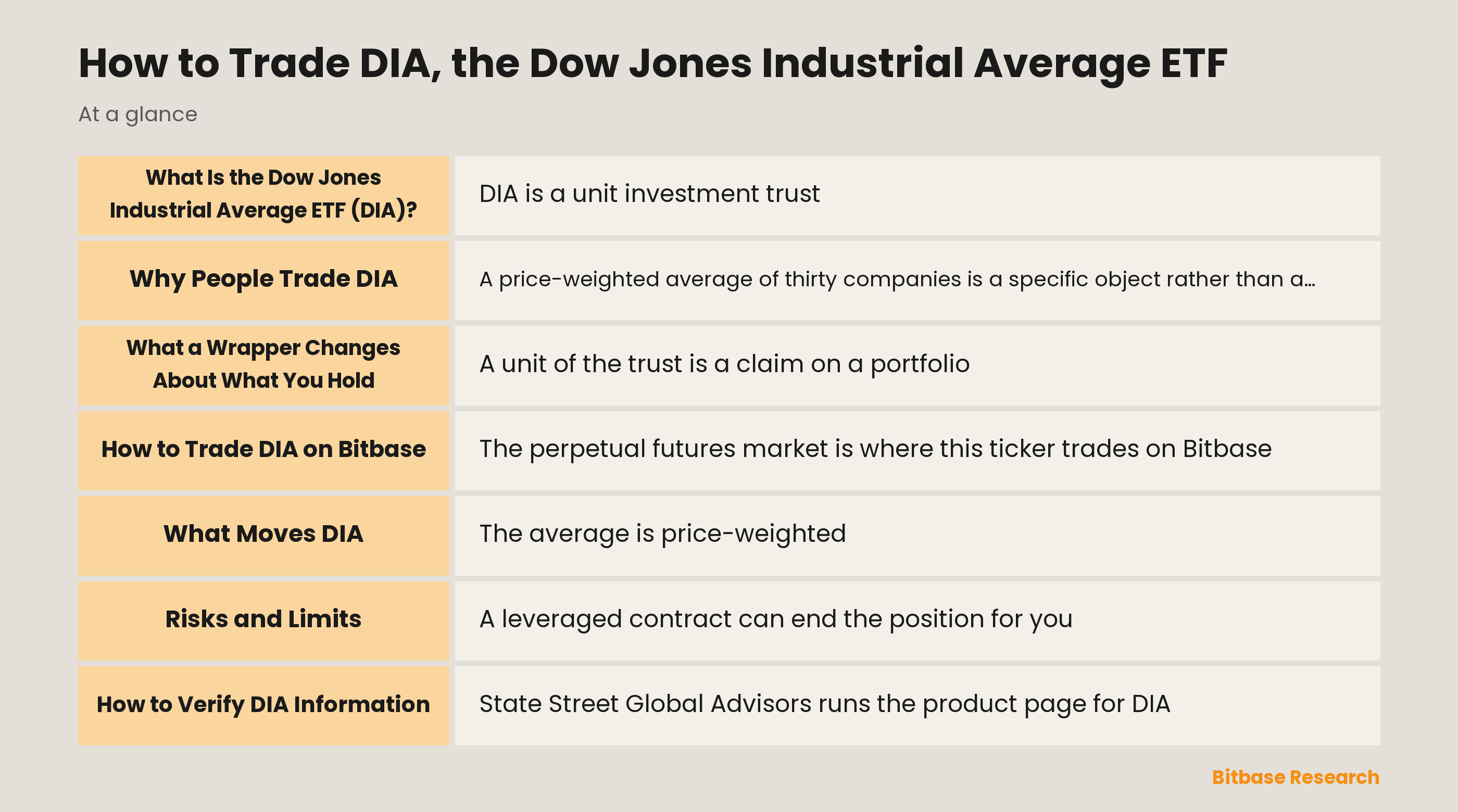
DIA is a unit investment trust, and that phrase is a set of rules rather than a label. Its shares represent ownership in the SPDR Dow Jones Industrial Average ETF Trust, which seeks investment results that, before expenses, correspond generally to the price and yield performance of the Dow Jones Industrial Average. Units are bought and sold on NYSE Arca under the symbol DIA, where they have traded since 1998.
The portfolio is the thirty stocks in the average, with the weight of each stock substantially corresponding to its weight in the index. Nobody chooses. The prospectus says the trust is not actively managed, then draws out the consequence that is easiest to miss: because it is not actively managed, the adverse financial condition of an issuer will not result in that issuer's elimination from the portfolio unless S&P removes it from the average.
Two further constraints come with the structure. The trustee may not engage in securities lending or repurchase transactions on behalf of the trust, so the holdings generate no lending income. And dividends are paid monthly, on the Monday preceding the third Friday of the next calendar month, which is a schedule you can look up rather than estimate.
The trust itself deals only with institutions. Certain institutional investors, typically market makers or other broker-dealers, may purchase or redeem Units directly with it, and only in blocks of 50,000 Units called Creation Units exchanged for in-kind securities and cash that substantially replicate the index. Everyone else meets DIA on an exchange, at the price the exchange prints.
Why People Trade DIA
A price-weighted average of thirty companies is a specific object rather than a proxy for the market, and DIA is the way to hold that object as one line instead of thirty. The alternative is assembling the same list, in the same proportions, by hand.
The membership rules narrow it further. The first criterion the prospectus lists for a component is that the company is not a utility or in the transportation business, so two whole sectors sit outside the average by construction. What remains is a curated group the prospectus calls leaders in their respective industries. That is a judgment made by people, and buying DIA is partly buying their judgment.
There is also the payout rhythm. Distributions land monthly, on a date set by rule rather than announced each time, which matters if the position is meant to produce cash and not only a direction.
What a Wrapper Changes About What You Hold
A unit of the trust is a claim on a portfolio. It receives what the portfolio receives, on the trust's own schedule, and it exists for as long as the trust does.
A tokenized stock or tokenized ETF is a different object, issued by a third party rather than by the fund, and the issuers do not build them the same way. One states plainly that a token does not necessarily represent the value of one share, and that a token's price will not always match the price of the underlying asset. Another issuer's Classic Stock Tokens are, by its own description, derivative contracts between you and that issuer, priced at the prices of the underlying securities without granting rights to them. Others describe their tokens as backed one-for-one by the underlying asset held in regulated custody. Trading hours differ by issuer, and so do the rules about who may hold the product. Tokenized stock is the name of a category, not of an instrument.
A perpetual futures contract is the easiest of the three to describe, because it holds nothing at all: no shares, no units, no claim on any trust or any issuer. It tracks a price, settles in stablecoin, exchanges a periodic funding payment between the two sides depending on which one is crowded, and can be liquidated when the margin behind it runs out.
A ticker survives all three wrappers unchanged. What you are holding does not, and that is worth settling before an order goes in.
How to Trade DIA on Bitbase
The perpetual futures market is where this ticker trades on Bitbase.
A perpetual has no expiry, so there is nothing to roll and no settlement date to plan around. In their place sits funding, paid or received periodically depending on which side is crowded, alongside a maintenance margin requirement and a liquidation price that both move as the position and the collateral move.
Sizing is where an index contract behaves differently from a single-name one. An average absorbs part of what its members do: two of them moving a dollar in opposite directions cancel exactly, whatever either company is worth. That cancellation is the reason to hold an index at all, and it costs something on a leveraged contract, because funding is charged on elapsed time rather than on being right.
Bitbase's tokenized stock and ETF markets page is where each ticker's own listing can be checked.
What Moves DIA
The average is price-weighted, which means its component stocks are accorded relative importance based on their prices. A dollar counts the same wherever it comes from, so a member quoted high moves the level more than a member quoted low, regardless of what either company is worth. Earnings day at an expensive share is a larger event for DIA than an equally dramatic day at a cheap one, and company size never enters it.
A stock split changes nothing about a business and everything about its place in the average. The divisor is adjusted for corporate actions that change the price of a component share, and a split is the most frequent reason for such an adjustment. The level is held continuous across the change; the weights on either side of it are not. That divisor, and the dated Dow index futures written on the same average, are worked through separately.
Index Securities are changed by S&P from time to time, and the trust follows without discretion. A substitution arrives with the incoming company's share price already attached, and that price is its weight from the first day.
Two things move the fund's result away from the average rather than with it. Expenses and the transaction costs incurred in adjusting the portfolio are the reason the prospectus gives for the trust's return possibly not matching the index. And a dividend paid by a component sits with the trust until the Monday preceding the third Friday of the next month, so the cash arrives on the trust's calendar rather than the company's.
Funding is a driver on the contract side and nowhere else. It is a payment between traders rather than a property of the average, so a level that never moves can still cost or pay over a week.
Risks and Limits
A leveraged contract can end the position for you. Maintenance margin and a liquidation price move as the collateral and the mark move, so a directionally correct view can be closed out before it pays anything.
Sessions do not line up. The thirty component stocks trade on a New York schedule, and the average is computed from the prices they are actually printing. A contract's own market can be open when they are not, so a level quoted then is what that market thinks, not a reading of the average.
Thirty names is a narrow list, and price weighting makes it narrower than the count suggests, because the members quoted highest carry the most of the level. Concentration here has nothing to do with company size, which makes it easy to misjudge from familiar names.
The trust cannot defend itself: a component in serious trouble stays in the portfolio until S&P removes it from the average. The trustee is also barred from securities lending and repurchase transactions, so no lending income offsets the trust's expenses.
The exchange price is not the portfolio. Creation and redemption run through institutions in whole Creation Units, so the mechanism holding the traded price near what the portfolio is worth is somebody else's business, and tracking error is what is left when it works imperfectly.
How to Verify DIA Information
State Street Global Advisors runs the product page for DIA, where the prospectus, the holdings file and the distribution schedule are published.
The trust's filings sit on SEC EDGAR under the fund's own name. Read the current prospectus there rather than a summary of it: that is also where any change to it is dated.
S&P Dow Jones Indices publishes the methodology for the Dow Jones Averages and announces component changes. A change to the average becomes a change to the portfolio, because the trust has no say in it.
On Bitbase, the futures market page for this ticker carries the contract specification, the funding history and the current mark. Those numbers belong to the contract rather than to the fund, and a position is sized against them.
Conclusion
DIA is a rule rather than a strategy: thirty share prices, a divisor, and a trust not permitted to hold an opinion about either. That makes the fund easy to reason about and moves the decisions elsewhere, to the index provider that picks the thirty and to the wrapper you hold them through. On Bitbase that wrapper is a perpetual futures contract: the price with leverage, none of the ownership, and a funding charge for the time you spend on the view.
Related market pages
Bitbase pages for the tokenized stocks named in this article:
- DIA: Perpetual market
Related reading
Other Bitbase articles on this topic:
- How to Buy AMD: The Tokenized Stock and the Perpetual
- How to Buy AMZN: Retail, Ads and AWS Under One Ticker
- How to Trade ARM: Arm Holdings, a Chip Design Licensor
Disclaimer: This article is educational content from Bitbase Academy, provided for information only. It explains what a company or fund does and how the instruments referenced here differ from one another; it does not constitute investment, trading, tax, or financial advice, and it is neither a recommendation nor an endorsement of any security, token, or trading strategy. A tokenized stock is issued by a third party and is designed to give economic exposure to an underlying asset: it is not a share, it carries no shareholder rights, and it depends on the issuer's structure, eligibility rules, and redemption terms, which the issuer can change. Perpetual futures are leveraged derivatives that hold no underlying asset and can be liquidated, and trading hours, product availability, and eligibility differ by instrument and by jurisdiction and can change at any time. Written as of September 2026; verify everything yourself through company filings, the issuer's own documentation, and the product pages of the venue you trade on.
References
[1] SPDR Dow Jones Industrial Average ETF Trust prospectus, filed with the SEC: objective, unit investment trust structure, portfolio weights, securities lending ban, monthly dividends and Creation Units www.sec.gov
[2] State Street Global Advisors product page for DIA: unit investment trust wording, NYSE Arca listing since 1998 and the monthly distribution frequency www.ssga.com
[3] Earlier SEC-filed prospectus of the same trust: the DJIA as a price-weighted index, the divisor and the corporate actions that adjust it, and the component selection criteria www.sec.gov