Its film studios, its sports network and its cruise ships all report into one annual filing, and they do not sell to the same customer. The Walt Disney Company divides itself into Entertainment, Sports and Experiences, so a single ticker carries three demand cycles that can move apart. On Bitbase, DIS is carried as a perpetual futures contract, with a price page beside it carrying a Robinhood Token label.
What Is The Walt Disney Company (DIS)?
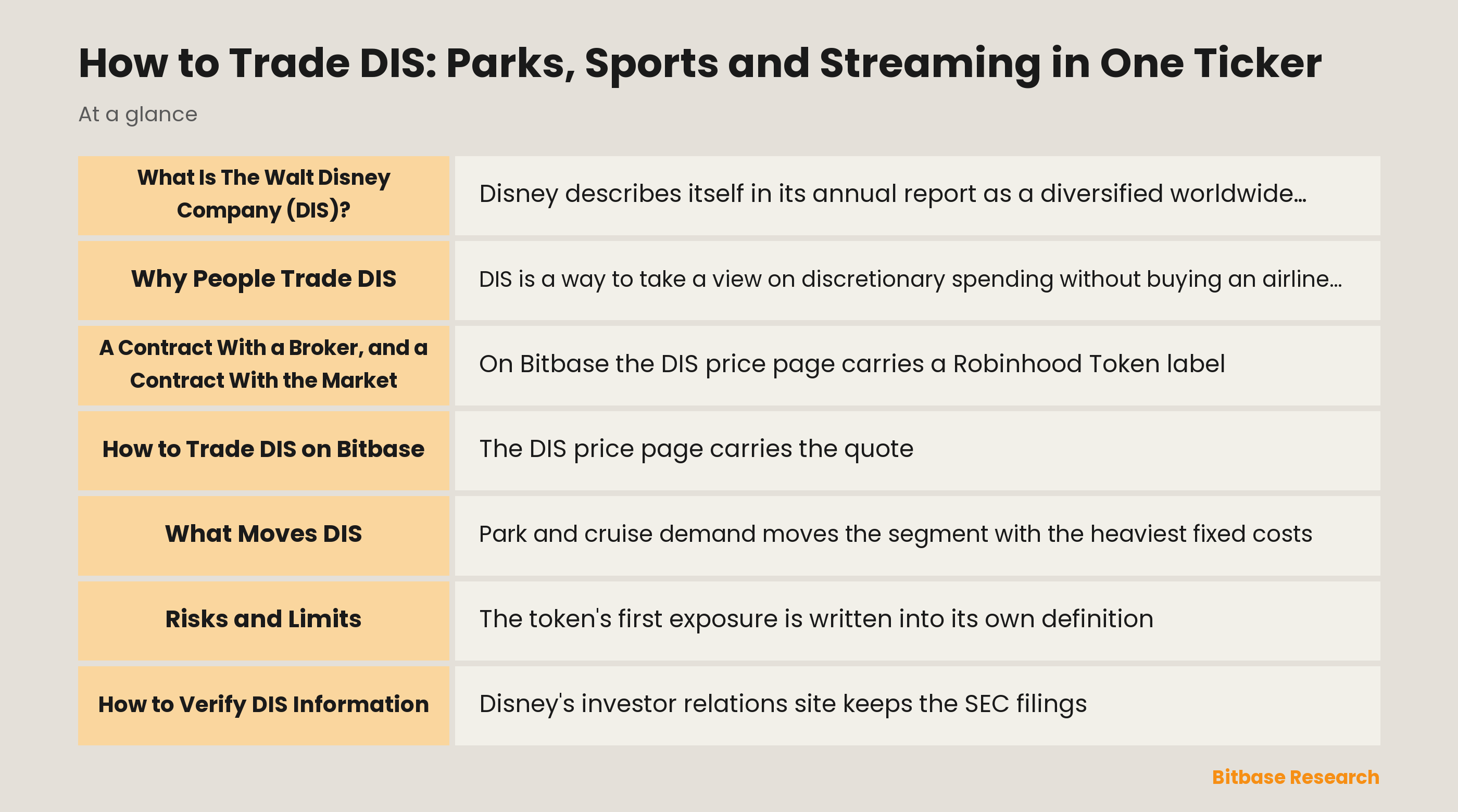
Disney describes itself in its annual report as a diversified worldwide entertainment company with operations in three segments: Entertainment, Sports and Experiences. The common stock trades on the New York Stock Exchange under the symbol DIS, and the company reports on a fiscal year that does not end in December: fiscal 2025 closed on 27 September 2025.
Entertainment covers the non-sports film and episodic content the company produces and distributes, and it divides again into linear networks, a direct-to-consumer line carrying Disney+ and Hulu, and content sales and licensing. The studios feeding it include Pixar, Marvel and Lucasfilm. Sports is the ESPN side: sports-focused television and streaming, produced and distributed globally. Experiences is the physical business, running theme parks and resorts, Disney Cruise Line and Disney Vacation Club, with a consumer products line selling merchandise and publishing alongside them.
The three segments do not share a cost structure. Entertainment and Sports acquire or make content and then distribute it; Experiences builds ships and parks, staffs them, and sells admission. A year that is good for one is not automatically good for another, which is the first thing to understand about holding the ticker.
Why People Trade DIS
DIS is a way to take a view on discretionary spending without buying an airline or a hotel chain. The Experiences segment sells holidays: park admission, hotel rooms, cruise cabins, and the merchandise people carry home from them. Disney describes the segment's results as depending on consumer spending, travel, vacation patterns and economic conditions, which makes the ticker a read on whether households are still booking.
Layered on top of that is the media transition. Disney runs two revenue models at once: the older one, where a pay television distributor pays a per-subscriber fee to carry a channel, and the newer one, where a household pays Disney directly for Disney+, Hulu or ESPN's own streaming service. How fast the second replaces the first is a live argument, and it prices into DIS long before it settles in the accounts.
For traders arriving from a crypto book, this is not a crypto-correlated name. There is no coin treasury, no mining fleet and no exchange fee take, so it carries none of the direct bitcoin exposure a miner or a treasury company does. What it offers a crypto-heavy portfolio is the opposite of that: a business whose customers are counted in park turnstiles and monthly subscriptions.
A Contract With a Broker, and a Contract With the Market
On Bitbase the DIS price page carries a Robinhood Token label, and that label decides what the instrument behind it actually is. Robinhood does not describe its Classic Stock Tokens as shares held on your behalf. It describes them as derivative contracts between you and Robinhood, priced at the prices of the underlying securities without granting rights to them. The underlying assets of Classic Stock Tokens, it says, are owned by Robinhood and held with a US-licensed institution, and the tokens do not grant any rights to the underlying shares or ETPs.
Read that slowly, because it changes what the position is: a contract with a broker, priced off the share, rather than a claim on the share. It also sits apart from the wider family of tokenized securities, where the legal wrapper and the rights attached to it differ from one issuer to the next. Here the counterparty is named. The issuer is Robinhood Europe, UAB, authorised and regulated by the Bank of Lithuania as a financial brokerage firm, a crypto-asset service provider and a payment institution, and the product is offered to eligible investors in the European Union. Where the underlying pays a dividend, Robinhood says it passes on a corresponding amount to eligible holders in cash. The trading week is defined rather than continuous, running from Monday 2 AM CET/CEST to Saturday 2 AM CET/CEST.
A perpetual futures contract is a different structure again, and a simpler one to describe. It holds nothing at all: no share, no token, no claim on an issuer. It tracks a price, settles in stablecoin, exchanges a periodic funding rate between longs and shorts, and closes automatically if the margin behind it runs out.
How to Trade DIS on Bitbase
The DIS price page carries the quote, the chart and the market data for the token. It is a reference surface: reading it costs nothing and commits nothing.
The perpetual futures market is where a directional position on DIS is opened. Size is set by margin rather than by cash outlay, so a position can be larger than the balance behind it, and that is the whole trade-off. Funding is exchanged periodically between longs and shorts, initial and maintenance margin apply for as long as the position is open, and a liquidation price sits at a distance set by the leverage chosen. Because the contract never becomes ownership of anything, the useful question before opening one is how long the view is meant to last: cost accrues with time here, while a share sitting in a brokerage account does not charge rent.
What is listed for each ticker is set out on the TradFi markets page, which is also where the rest of the tokenized stock and index lineup sits.
What Moves DIS
Park and cruise demand moves the segment with the heaviest fixed costs. The spending that meets that demand is committed years earlier: a cruise ship is ordered long before its first sailing, and a park expansion is built long before it sells a ticket. So the revenue line is cyclical while the cost line underneath it is not, and travel data, booking windows and consumer confidence reach DIS through that gap.
Sports moves on rights contracts. ESPN's programming and production costs include the amortization of licensed sports rights, and rights are bought years ahead of the seasons they cover, so the segment commits spending long before it knows what the audience will be. Ownership of those rights can move too: in October 2025 ESPN and NFL Enterprises LLC reached a binding agreement for ESPN to acquire the NFL Network and certain other media assets, including the NFL's RedZone Channel pay television distribution and NFL Fantasy, in exchange for a 10% noncontrolling interest of ESPN. News of that shape reprices the stock before any quarterly figure changes.
The streaming build-out moves the revenue mix. ESPN began selling a US subscription service directly, on two plans called ESPN Select and ESPN Unlimited, in August 2025, which puts live sport on the same billing relationship as Disney+ and Hulu. On the other side of the same shift, Disney combined certain Hulu Live TV assets with Fubo in October 2025 and retained a controlling interest in the combined entity. Each step moves money out of the affiliate-fee column and into the subscription column, and the two columns do not fill at the same rate.
The reporting calendar sets the dates. Because fiscal 2025 closed on 27 September 2025, Disney's quarters run ahead of the calendar quarters and its results land on a schedule of their own. Anyone trading DIS around earnings is trading a calendar that has to be looked up rather than assumed.
Risks and Limits
The token's first exposure is written into its own definition. A derivative contract with Robinhood performs if Robinhood performs; no share of Disney sits underneath it in your name, and the eligibility rules, redemption terms and product availability around it are set by the issuer and can be changed by the issuer.
The second is the seam between clocks. The New York Stock Exchange has a session, the token has a trading week that stops and restarts on Saturday, and the perpetual runs without a break. A studio announcement, a park closure or a rights decision that lands while the exchange is shut prices into the crypto-side instruments first, and the difference shows as a jump when the primary market reopens.
The perpetual adds a cost and an ending you may not choose. Funding accrues whether or not the direction is right, and if equity falls toward the maintenance level the position draws a margin call and then a forced close. Leverage decides how much room sits between the entry and that point.
Behind both instruments sits the business, and three segments mean three separate ways to disappoint: a soft travel season, a rights contract that costs more than the audience it buys, and a streaming line that grows more slowly than the linear one shrinks. They do not have to arrive together, and they do not have to cancel out.
How to Verify DIS Information
Disney's investor relations site keeps the SEC filings, the quarterly results releases and the annual reports on separate pages. The primary document is the Form 10-K, filed under CIK 0001744489 and readable in full through SEC EDGAR; the segment names, the lines of business inside each segment and the fiscal year end used above all come from it. The quarterly results releases are where segment revenue and operating income are updated, and they are the right place to look for current figures rather than any article.
For the token, Robinhood's European product pages define what a Classic Stock Token is, who owns the underlying, how dividends are handled and when it trades. On Bitbase, the DIS price page carries the current quote and market data, and the futures market page carries the contract specification, including funding intervals and margin requirements.
Conclusion
DIS is one ticker over three businesses that answer to different customers: a studio and a streaming operation, a sports network buying rights years in advance, and a travel business made of parks and ships. On Bitbase that exposure arrives in a form that is not a share. The price page carries a token that Robinhood defines as a derivative contract with itself, and the perpetual futures market carries a leveraged contract that holds nothing and charges funding for as long as it stays open. Neither one puts your name on Disney's share register. The choice between them is a decision about holding period, and about how much of the exit you are willing to hand to margin.
Related market pages
Bitbase pages for the tokenized stocks named in this article:
- DIS: View price · Perpetual market
Related reading
Other Bitbase articles on this topic:
- How to Buy AMD: The Tokenized Stock and the Perpetual
- How to Buy AMZN: Retail, Ads and AWS Under One Ticker
- How to Trade ARM: Arm Holdings, a Chip Design Licensor
- What Is POND? Marlin, Oyster, and Asset Boundaries
Disclaimer: This article is educational content from Bitbase Academy, provided for information only. It explains what a company or fund does and how the instruments referenced here differ from one another; it does not constitute investment, trading, tax, or financial advice, and it is neither a recommendation nor an endorsement of any security, token, or trading strategy. A tokenized stock is issued by a third party and is designed to give economic exposure to an underlying asset: it is not a share, it carries no shareholder rights, and it depends on the issuer's structure, eligibility rules, and redemption terms, which the issuer can change. Perpetual futures are leveraged derivatives that hold no underlying asset and can be liquidated, and trading hours, product availability, and eligibility differ by instrument and by jurisdiction and can change at any time. Written as of September 2026; verify everything yourself through company filings, the issuer's own documentation, and the product pages of the venue you trade on.
References
[1] The Walt Disney Company, Form 10-K for the fiscal year ended September 27, 2025 (SEC EDGAR, CIK 0001744489) www.sec.gov
[2] The Walt Disney Company, About: the three business segments and the studios inside them (official corporate site) thewaltdisneycompany.com
[3] The Walt Disney Company investor relations, SEC filings (quarterly results and annual reports sit on their own pages) investors.thewaltdisneycompany.com
[4] Robinhood Europe, what a Classic Stock Token is: a derivative contract, who owns the underlying, dividends and trading hours (official EU product page) robinhood.com