You are not buying thirty companies in proportion to their size when you trade YM. The Dow Jones Industrial Average weights its members by share price alone, so a stock that trades high carries more of the average than a far larger company whose shares are cheap, and the futures contract built on top inherits that arithmetic exactly. This piece covers what YM and MYM are, what moves the average underneath them, and why the divisor makes index points behave differently from percentages.
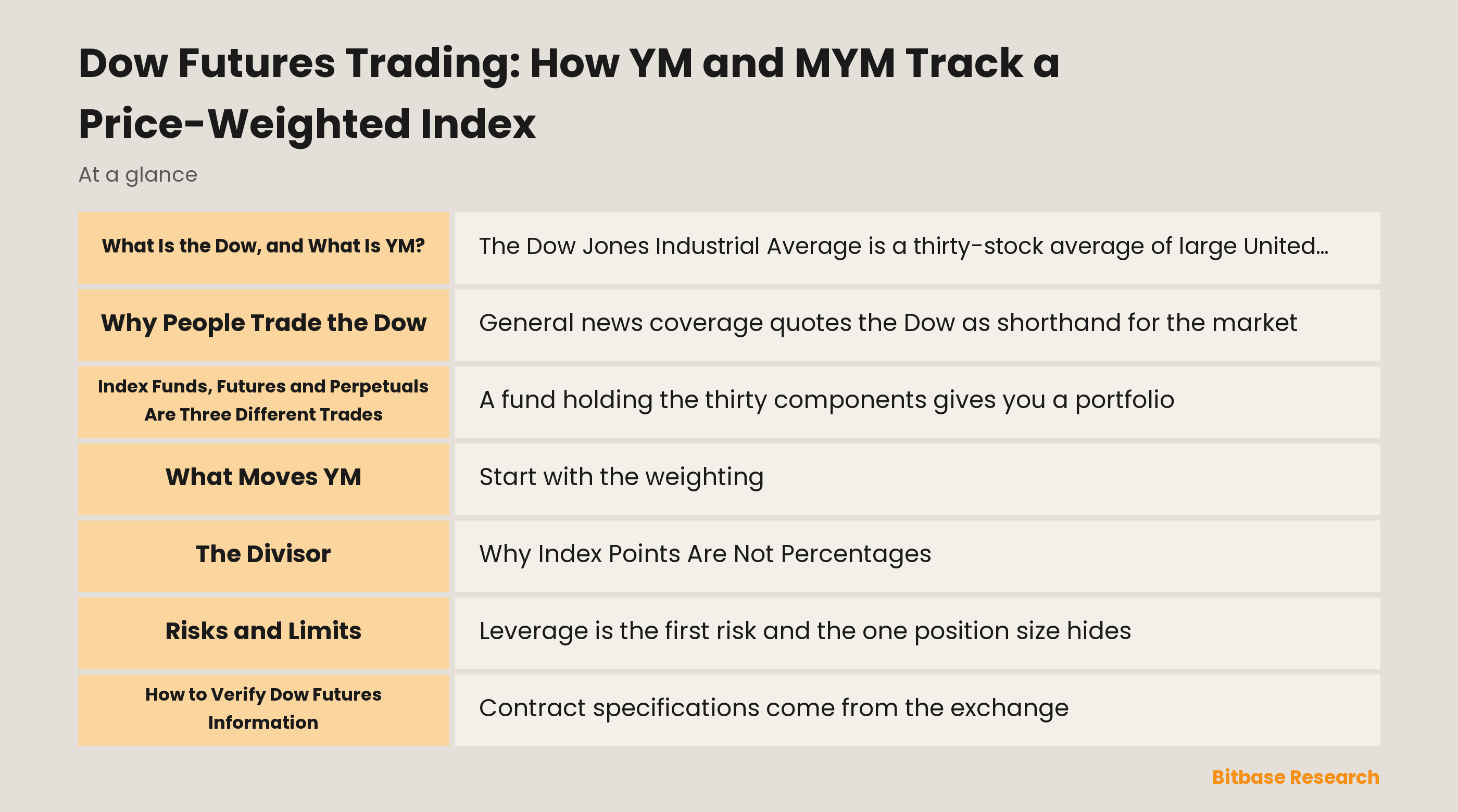
What Is the Dow, and What Is YM?
The Dow Jones Industrial Average is a thirty-stock average of large United States companies. YM is the E-mini futures contract written on it, listed at the Chicago Board of Trade, part of CME Group. MYM is the Micro E-mini version, one-tenth the size, on the same average and the same calendar.
The weighting rule is what separates the Dow from a market-value benchmark such as the S&P 500. Constituent weights are determined solely by the prices of the constituent stocks, with shares outstanding set to a uniform number across the average. Market value does not enter the calculation at all, so a company worth several times another can still count for less, simply because its shares are quoted lower.
Membership is decided rather than computed. S&P Dow Jones Indices runs an Averages Committee for the Dow, and stock selection is not governed by a strict set of rules; the committee weighs a company's reputation, its record of sustained growth, its interest to investors and how it represents its sector. There is no scheduled rebalance date and no market-value threshold that admits a company automatically.
YM settles in cash, because an average of prices is not a portfolio anyone can deliver. Contracts are listed for March, June, September and December, and final settlement is made against a Special Opening Quotation of the average, calculated from the opening prices of the component stocks on the third Friday of the contract month.
Why People Trade the Dow
General news coverage quotes the Dow as shorthand for the market, which puts the level in front of an audience that never looks at index construction: headline moves draw positioning from those readers, and trading YM is partly trading that attention.
The exposure is also built differently from a cap-weighted benchmark, since weight follows share price rather than company size. Futures add access on top: the contract runs a near-continuous weekday schedule, so news landing after the closing bell reaches YM hours before the equity market reopens.
Index Funds, Futures and Perpetuals Are Three Different Trades
A fund holding the thirty components gives you a portfolio. Dividends arrive, there is no expiry, there is no margin call, and it trades during exchange hours.
A futures contract holds nothing. It is a margined agreement about a future price, marked to market daily, and it expires. No dividends are received, though dividend expectations and financing costs sit in the gap between the contract and the average it tracks, which is one reason the two do not move in lockstep.
A perpetual contract on an equity index, where a crypto venue offers one, is a third structure: no expiry and therefore no roll, and a continuous charge through periodic funding payments instead of a term curve.
Tokenized stocks are a fourth thing, and not a route to the Dow. Each one is issued by a third party to give economic exposure to a single company's shares, so the list of tokenized stocks and ETFs on a venue is a list of individual names and funds. No token holds an average, because there is nothing there to hold.
What Moves YM
Start with the weighting, because it reorders everything else. In a price-weighted average a one-dollar move contributes the same amount whichever member makes it. A high-priced component therefore turns a given percentage move into far more index points than a low-priced one does, and its earnings report matters more to YM than an equally dramatic report from a member with cheaper shares and a bigger business behind them. The committee watches the spread closely enough to monitor whether the highest-priced stock in the average trades at more than ten times the lowest.
Stock splits move influence around without anything happening to a business. A split cuts a share price and cuts that member's weight in the same proportion, permanently, on the day it takes effect. In a market-value index a split is a non-event. In the Dow it is a redistribution: every other member's share of the average rises, and the company that split becomes a smaller part of the number YM settles against.
Committee decisions are a driver specific to this contract. Additions and removals are discretionary and unscheduled, and because an incoming stock's price sets its weight immediately, a single substitution can change the character of the average more than a year of ordinary trading would.
Everything that moves large-cap United States equities as a bloc applies on top: scheduled inflation and employment releases, central bank decisions, and the financing conditions that set the basis between contract and average. Those arrive at published times. The structural drivers above do not.
The Divisor: Why Index Points Are Not Percentages
The average is calculated by adding the thirty share prices together and dividing by a figure called the divisor, and that divisor is not a constant. It is adjusted for any price-impacting corporate action on a member stock, including price adjustments, special dividends, stock splits and rights offerings, and adjusted again whenever a component is added or removed.
Every one of those adjustments preserves continuity of the level, not of the weights. After a split the average does not jump, because the divisor absorbs the change; the weights on either side of it are nonetheless different, and a long chart of the Dow is a series whose composition has been quietly re-proportioned many times.
For a YM position the consequence is that index points and percentages are not interchangeable. Each index point is worth a fixed amount of money per contract, set by the contract specification, so a position sized in points holds its cash sensitivity while the average sits at very different levels. The arithmetic cuts both ways: two members moving one dollar in opposite directions cancel exactly, whatever the companies are worth, so a Dow that closes flat is not evidence that the market was quiet.
Risks and Limits
Leverage is the first risk and the one position size hides. Initial margin on an index future is a fraction of the contract's notional value, so the position is much larger than the cash posted against it, and daily mark-to-market turns an adverse move into a same-day cash requirement rather than an unrealised loss.
Expiry is an operational risk, not only a cost. A position still open in an expiring contract is settled in cash against the Special Opening Quotation whether or not that was anyone's plan, and staying exposed past expiry means closing one contract and opening the next while liquidity migrates between them over a window of days.
Gaps are the other structural exposure. The contract does not trade through the weekend, and news arriving while it is closed is expressed as a single jump when it reopens, with no prices in between at which anyone could have exited.
Thirty names is a narrow list, and price weighting makes it narrower in practice than the count implies. Nor does an equity index position sit outside crypto conditions in any fixed way: whether the two move together is a statement about a chosen sample and window, so treat risk appetite as something to measure rather than a relationship to assume.
How to Verify Dow Futures Information
Contract specifications come from the exchange. CME Group publishes product pages for the E-mini Dow and the Micro E-mini Dow, and the CBOT rulebook carries a chapter for each contract setting out the contract unit, minimum price increment, trading hours, listed months and final settlement procedure. Margin requirements are published separately and change, and a broker may require more than the exchange minimum.
Index methodology comes from the index provider. S&P Dow Jones Indices publishes the methodology for the Dow Jones Averages, which sets out the divisor rules, the treatment of corporate actions and the committee process, and where component changes are announced. For individual members, company filings sit on the United States Securities and Exchange Commission's EDGAR system.
For any instrument you are about to trade, the specification published by the venue you trade on is the one that binds, not a general description of index futures and not this article.
Conclusion
YM is a cash-settled, quarterly contract, traded on margin, written on an average of thirty share prices rather than on a portfolio of thirty companies. That last clause is the one that survives: price weighting decides which members matter, splits and substitutions redraw the answer without warning, and the divisor keeps the level continuous while the composition underneath it is not. MYM is the same instrument at a tenth of the size, which changes what a position costs and nothing about how the average behaves.
Related reading
Other Bitbase articles on this topic:
- How to Buy AMD: The Tokenized Stock and the Perpetual
- How to Buy AMZN: Retail, Ads and AWS Under One Ticker
- How to Trade ARM: Arm Holdings, a Chip Design Licensor
Disclaimer: This article is educational content from Bitbase Academy, provided for information only. It explains what a company or fund does and how the instruments referenced here differ from one another; it does not constitute investment, trading, tax, or financial advice, and it is neither a recommendation nor an endorsement of any security, token, or trading strategy. A tokenized stock is issued by a third party and is designed to give economic exposure to an underlying asset: it is not a share, it carries no shareholder rights, and it depends on the issuer's structure, eligibility rules, and redemption terms, which the issuer can change. Perpetual futures are leveraged derivatives that hold no underlying asset and can be liquidated, and trading hours, product availability, and eligibility differ by instrument and by jurisdiction and can change at any time. Written as of September 2026; verify everything yourself through company filings, the issuer's own documentation, and the product pages of the venue you trade on.
References
[1] CME Group: E-mini Dow futures contract specifications www.cmegroup.com
[2] CME Group: Micro E-mini Dow futures contract specifications www.cmegroup.com
[3] S&P Dow Jones Indices: Dow Jones Averages methodology, committee process and divisor rules www.spglobal.com
[4] S&P Dow Jones Indices: Index Mathematics methodology, price-weighted indices and divisor adjustments www.spglobal.com