Choosing between GOOGL and GOOG turns on a vote. Alphabet's Class A common stock trades on Nasdaq as GOOGL and has one vote per share, while the Class C capital stock listed beside it as GOOG has no voting rights. Bitbase quotes that same Class A ticker as an xStocks tokenized stock on a price page and lists a perpetual futures contract against it, and neither of those is a share registered in your name.
What Is Alphabet (GOOGL)?
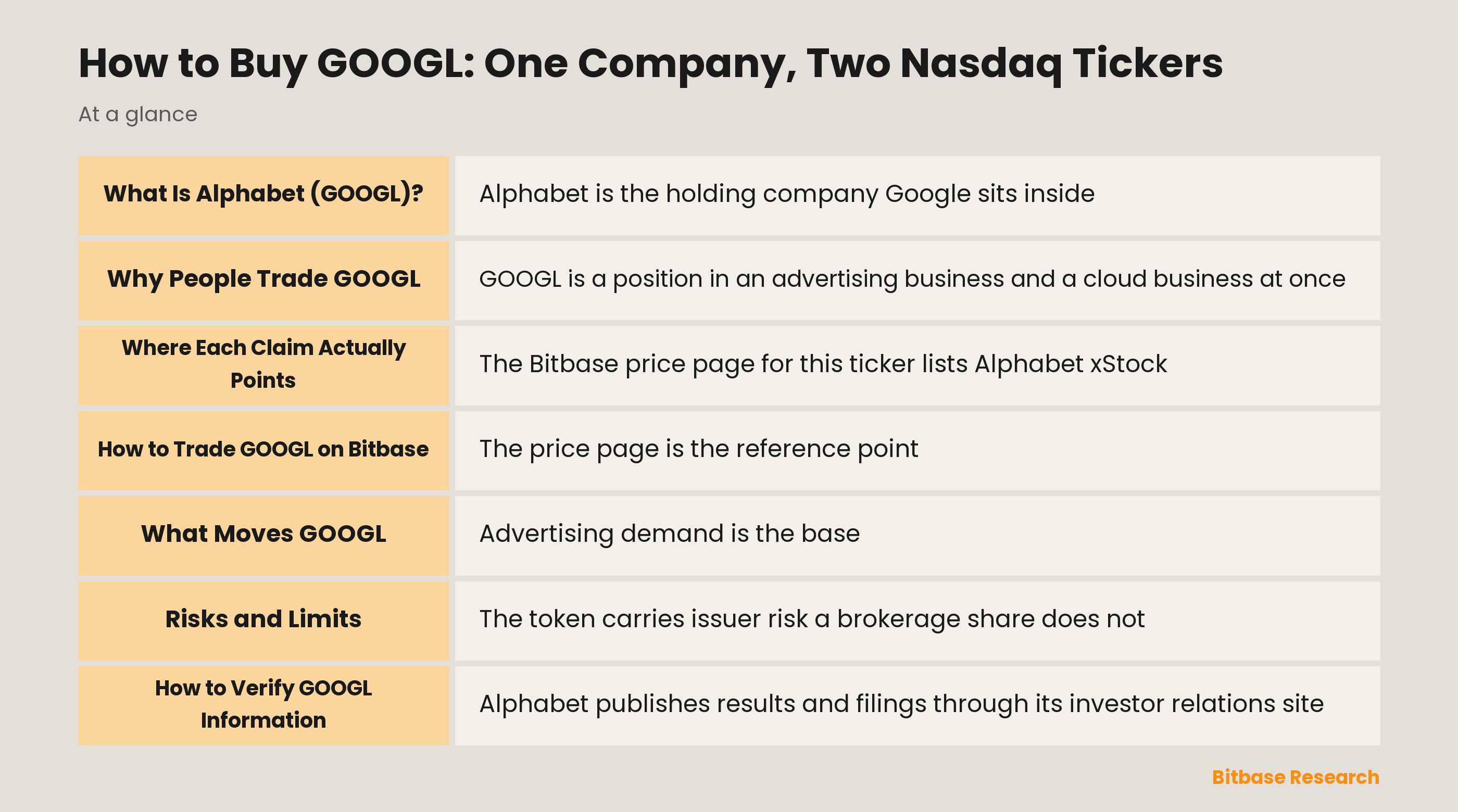
Alphabet is the holding company Google sits inside, and its annual report gives the structure in one line: "We report Google in two segments, Google Services and Google Cloud, and all non-Google businesses collectively as Other Bets."
Google Services is the advertising estate. The filing says it "generates revenues primarily by delivering both performance and brand advertising that appears on Google Search & other properties, YouTube, and Google Network partners' properties," alongside consumer subscriptions, platforms and devices. Google Cloud earns "primarily from consumption-based fees and subscriptions" for cloud infrastructure, platforms and applications. The weighting is what shapes the position: Alphabet's report for 2025 says the company "generated more than 70% of total revenues from online advertising" that year.
The share classes are the other structural fact. Alphabet has three and only two of them trade. Class A common stock is listed on Nasdaq as GOOGL and has one vote per share; Class C capital stock is listed as GOOG and has no voting rights; Class B common stock has 10 votes per share and, in the company's own filing, "is not listed on any stock market or exchange." Of the two lines a buyer can actually reach, only Class A carries a vote.
Why People Trade GOOGL
GOOGL is a position in an advertising business and a cloud business at once, wrapped in one ticker. Advertising revenue follows what advertisers are willing to spend; cloud revenue is described by the company as consumption-based, so it follows what customers are actually running. A quarter can be strong on one side and unremarkable on the other, and the ticker prices the sum.
It is also a position in an antitrust outcome. The Department of Justice announced on 2 September 2025 that the U.S. District Court for the District of Columbia had ordered remedies, after finding in its August 2024 opinion that "Google is a monopolist, and it has acted as one to maintain its monopoly." The remedies bar Google from "entering or maintaining exclusive contracts relating to the distribution of Google Search, Chrome, Google Assistant, and the Gemini app" and require it to "make certain search index and user-interaction data available to rivals and potential rivals." Those are terms set by a court rather than by a negotiation, and they land on the advertising side of the business.
Then there is one concrete reason to pick this ticker over the other. Anything that has to hold voting stock cannot substitute GOOG for GOOGL, because the Class C line has no vote to hold. That distinction exists at the exchange, and it is worth knowing what becomes of it once the exposure is wrapped in something else.
Where Each Claim Actually Points
The Bitbase price page for this ticker lists Alphabet xStock, quoted under the symbol GOOGLX. The label carries information, because tokenized stock ranges are not built the same way and are not interchangeable.
xStocks describes its tokens as "tokenized representations of specific US equities and ETFs," each one "backed 1:1 by the underlying asset held in regulated custody." The issuer is Backed Assets (JE) Limited, a Jersey private limited company, whose site describes the tokens as tradeable around the clock on-chain and states that xStocks are not available in the United States or to U.S. persons.
Backed frames the instrument as a claim on the value of the collateral rather than on the rights attached to it, and redemption runs through the issuer. That is worth pausing on here: the vote is the thing GOOGL has and GOOG does not, and it is not something this route is described as passing along. The issuer's own documentation is the place to settle that question, not a summary like this one. Tradeable around the clock on-chain needs the same care, being a statement about the token itself; the hours that bind you are the ones published by the venue where your account lives.
A perpetual futures contract is a different object again. It holds no share, no token and no claim on Alphabet; it tracks a price and settles in stablecoin. What it gives you is exposure to that price and the leverage you chose, and what it withholds is any relationship with the company behind it.
How to Trade GOOGL on Bitbase
The price page is the reference point: quote, chart and market data for the tokenized stock, with the instrument and its issuer named on the page, and nothing at risk in reading it.
The perpetual futures market is where a leveraged directional view gets placed. A funding rate is paid or received periodically depending on which side of the book is crowded, a maintenance margin requirement applies, and a liquidation price is attached from the moment the position exists. Funding accrues for every hour the position stays open, which suits a view with a deadline better than an intention to hold Alphabet exposure indefinitely.
Coverage differs from one name to the next, so the tokenized stock listings are worth reading rather than assumed.
What Moves GOOGL
Advertising demand is the base, and Alphabet splits it into surfaces that need not move together: Google Search and other Google properties, YouTube, and the Network partners' properties. A quarter in which one grows while another shrinks reads differently from one in which all three drift the same way, even when the total lands in the same place.
Distribution has become a legal variable rather than a commercial one. Exclusive deals for the distribution of Search, Chrome, Google Assistant and the Gemini app are barred by court order, and search index and user-interaction data have been ordered made available to rivals. Where the queries come from is now settled on a legal calendar, and nothing about that calendar lines up with earnings dates.
Cloud moves on usage rather than on headcount. Consumption-based pricing means revenue tracks what customers actually run, so it responds to their capacity decisions rather than to a seat count.
The infrastructure bill is the counterweight. Alphabet's filing is direct about it: "We have invested and expect to significantly expand our investment in property and equipment, including our technical infrastructure, and we expect these assets to benefit our business over their estimated useful lives". Spending of that shape lands ahead of the revenue it is meant to support and then sits in depreciation for years, which means an advertising and cloud business also has to be judged on a capital cycle.
Risks and Limits
The token carries issuer risk a brokerage share does not. Backing, eligibility and redemption terms are set by Backed and can be changed by Backed, and the claim runs against that structure rather than against Alphabet. The issuer also states that xStocks are not available in the United States or to U.S. persons, so who you are decides whether the route exists for you at all.
Hours create gap risk, and here they cut in one direction. Alphabet's results and the court dates now shaping its search business land on a US calendar, while an instrument that keeps trading when the primary market is shut prices that news first. A position carried across the boundary cannot be hedged where the shares themselves change hands.
The perpetual adds funding cost and liquidation. Funding accumulates whether the view turns out right or wrong, so a correct call held long enough can still finish behind, and leverage shortens the distance to a forced exit.
One business risk cannot be answered from inside the company. A court can change how Search is distributed and what data has to be shared with rivals, and no product decision at Alphabet reverses that.
How to Verify GOOGL Information
Alphabet publishes results and filings through its investor relations site, and the filings sit in the SEC's EDGAR database. The annual report on Form 10-K is where the segment structure, the advertising share of revenue and the share class descriptions appear in the company's own words. The antitrust record is separate: the Department of Justice's Antitrust Division publishes the case documents and the press releases describing what the court ordered.
For the token, the authority is the issuer, whose own site describes backing, custody, eligibility and redemption. For the markets on Bitbase, the price page carries the current quote and the contract specifications carry funding and margin terms; both change, and both belong in front of you before anything gets sized.
Conclusion
Alphabet is an advertising business with a cloud business attached and a court supervising the part that pays for both. GOOGL is the Class A line, the one with a vote, and on Bitbase it appears as a tokenized stock on a price page and as a perpetual futures contract. Neither is a share registered in your name, and the vote that distinguishes this ticker from the other is not something either route is described as handing over. They differ in what they cost to hold and in whose terms you are relying on, and both are cheaper to settle before the order than after it.
Related market pages
Bitbase pages for the tokenized stocks named in this article:
- GOOGL: View price · Perpetual market
Related reading
Other Bitbase articles on this topic:
- How to Buy AMZN: Retail, Ads and AWS Under One Ticker
- How to Trade ARM: Arm Holdings, a Chip Design Licensor
- How to Trade ASML: Lithography Exposure Without a Share
- The DATA Foundation, Formerly Story Protocol: the IP to DATA Token Migration
Disclaimer: This article is educational content from Bitbase Academy, provided for information only. It explains what a company or fund does and how the instruments referenced here differ from one another; it does not constitute investment, trading, tax, or financial advice, and it is neither a recommendation nor an endorsement of any security, token, or trading strategy. A tokenized stock is issued by a third party and is designed to give economic exposure to an underlying asset: it is not a share, it carries no shareholder rights, and it depends on the issuer's structure, eligibility rules, and redemption terms, which the issuer can change. Perpetual futures are leveraged derivatives that hold no underlying asset and can be liquidated, and trading hours, product availability, and eligibility differ by instrument and by jurisdiction and can change at any time. Written as of September 2026; verify everything yourself through company filings, the issuer's own documentation, and the product pages of the venue you trade on.
References
[1] SEC EDGAR: Alphabet Inc. annual reports on Form 10-K, including the segment disclosure, the share of revenue from online advertising and the securities registered on the cover page www.sec.gov
[2] Alphabet Inc., Description of Securities filed as an exhibit to the Form 10-K: the votes per share of each class and the listing status of the Class B stock www.sec.gov
[3] US Department of Justice press release, 2 September 2025: the remedies ordered by the U.S. District Court for the District of Columbia in the search case www.justice.gov
[4] xStocks official site: what an xStock is, the 1:1 backing and regulated custody, the issuing entity and availability xstocks.com
[5] Alphabet Investor Relations: quarterly results, filings and governance materials abc.xyz