Whoever holds GS is holding a fee stream that is only booked once a transaction is finished. Goldman Sachs writes that rule into its own accounting policy: fees from financial advisory assignments are "recognized in revenues when the services related to the underlying transaction are completed under the terms of the assignment." Bitbase carries the ticker as a Dinari tokenized stock with its own price page, and as a perpetual futures contract quoted against it. Neither of them is the registered share.
What Is Goldman Sachs Group (GS)?
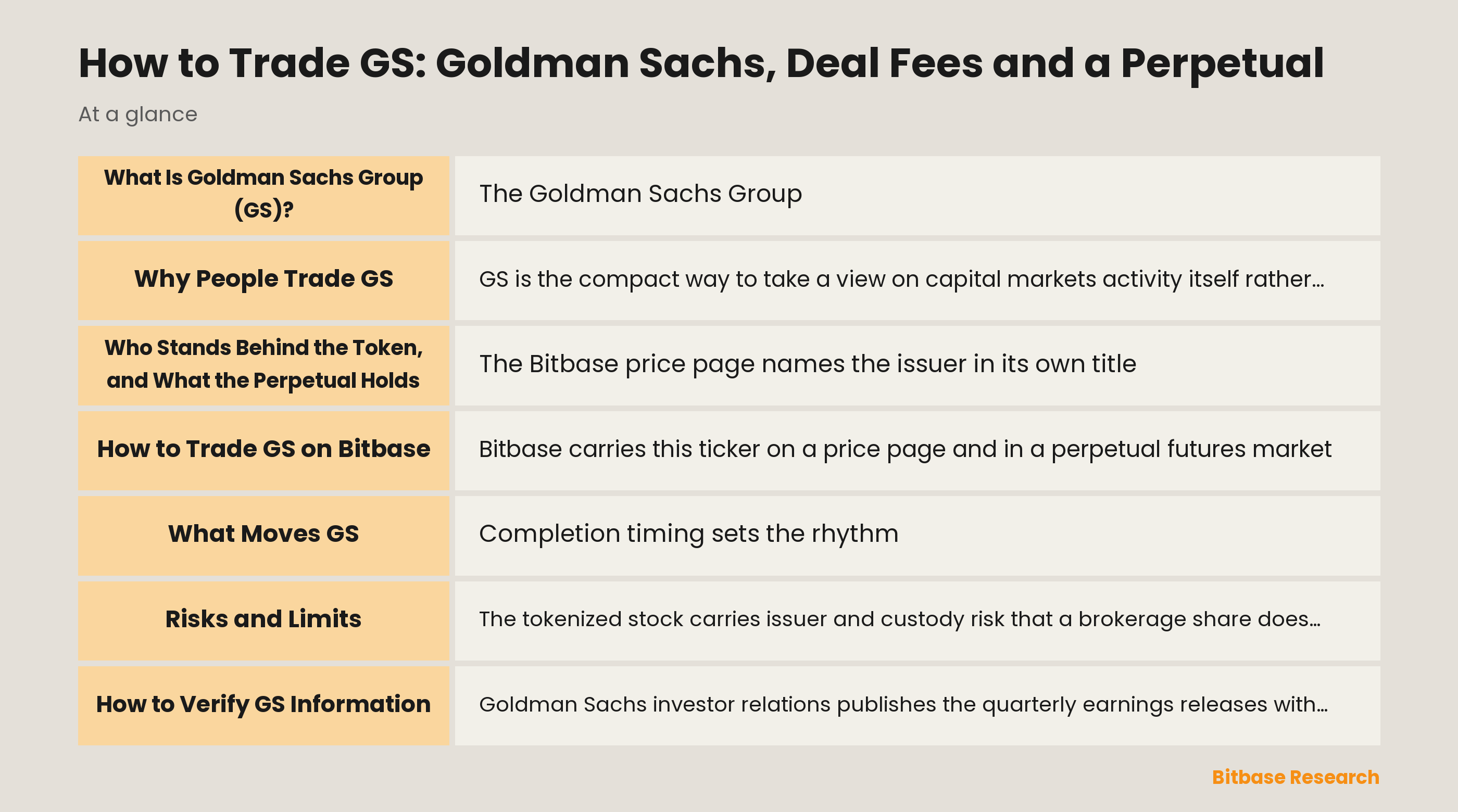
The Goldman Sachs Group, Inc. is a Delaware corporation that its own annual report calls "a leading global financial institution." Its common stock trades on the New York Stock Exchange under the symbol GS.
The firm reports its activities in three segments. Global Banking & Markets carries the work the name is known for: advisory assignments on mergers, divestitures, corporate defense and restructurings, equity and debt underwriting, and the intermediation and financing businesses in fixed income, currencies, commodities and equities. Asset & Wealth Management manages assets and sells investment products, reporting management fees, incentive fees, private banking and lending, and investments. Platform Solutions is the segment in transition: the annual report describes issuing credit cards through a partnership arrangement with Apple and raising deposits from Apple Card customers, while the firm's quarterly release refers to the Apple Card loan portfolio, which was transferred to held for sale in the fourth quarter of 2025.
One line in the accounting policy explains more about this company's rhythm than any segment label does. Advisory fees are recognized when the services related to the underlying transaction are completed, and underwriting fees "upon completion of the underlying transaction based on the terms of the assignment." Announcements do not pay. Closings do.
Why People Trade GS
GS is the compact way to take a view on capital markets activity itself rather than on a product cycle or a consumer franchise. When boards are transacting and issuers are pricing deals, that arrives in one income statement; when they stop, the same lines empty out.
The reporting draws a second distinction that matters through a quiet stretch. Goldman splits both FICC and Equities into intermediation and financing, and reports the halves separately. Intermediation depends on clients choosing to transact; financing rests on balances that persist between decisions.
The link to crypto is thinner than the ticker's presence on a crypto venue suggests. None of the revenue lines Goldman reports is denominated in a token or indexed to one. What puts these two letters on a crypto screen is the wrapper rather than the business: an issuer created a token that tracks the share, and a venue listed a contract on the price.
Who Stands Behind the Token, and What the Perpetual Holds
The Bitbase price page names the issuer in its own title: Goldman Sachs Group (Dinari Tokenized Stock). That name is the specification. Tokenized securities are a family of structures rather than one product, and their issuers are built differently from one another, so the only terms that apply here are Dinari's.
Dinari's documentation defines a dShare as "a token 1:1 backed by a security, commonly a U.S. equity," and a token is minted or burned only after a corresponding order fills at the broker it routes through, Alpaca. The trading calendar is not one window but four: regular US market hours; a pre-market and after-hours session that accepts limit orders only; an overnight session, also limit orders only; and an on-chain window that runs around the clock for a subset of tickers, with thinner liquidity. Market orders placed outside regular hours become marketable limit orders, which may fill in full, in part, or not at all. Dividends are calculated and distributed once the cash from the underlying arrives, direct holders receiving them in USD+, and eligibility is the issuer's to set.
A perpetual futures contract is a different construction with a different counterparty. It holds no share and no token. It tracks a price, settles in stablecoin, exchanges a periodic funding payment between the long and short sides, and is closed out by the venue when margin falls below maintenance. Nothing in it involves the token's issuer. It is the leveraged route, which is why the cost of holding a perpetual is a separate question from the direction of the stock.
How to Trade GS on Bitbase
Bitbase carries this ticker on a price page and in a perpetual futures market, and only one of those involves a position.
The price page is the reference surface: quote, chart and market data for the tokenized stock. Opening it commits nothing, and it is the practical way to see how the token is pricing against the New York session rather than assuming the two agree at every hour.
The perpetual futures market is where a leveraged directional position is opened and closed. Funding is exchanged periodically depending on which side is crowded, a maintenance margin requirement sits under the position, and a liquidation level sits under that. It suits a view with a date attached — a results release, a policy decision, a deal announcement — better than one held indefinitely, because funding accrues while the contract stays open.
Which tickers carry which surfaces is not uniform, so the tokenized stock listings are the place to check rather than assuming a route from the ticker alone.
What Moves GS
Completion timing sets the rhythm. Because fees are recognized when the underlying transaction is completed rather than when it is announced, the run of announced deals leads the revenue line by however long the closings take. A busy announcement season and a strong quarter can land in different quarters.
The two underwriting lines do not open together. Goldman reports equity underwriting and debt underwriting separately, and the conditions that make issuers want to sell shares are not the conditions that make them refinance debt. A market shut for one can be busy for the other.
Intermediation and financing pull in different directions. Client activity across fixed income, currencies, commodities and equities is episodic and rises when positions are being moved, while financing revenue attaches to balances that stay on the books between those decisions.
Marks on the firm's own positions move results without a client doing anything. Asset & Wealth Management reports an investments line beside its fee lines, so revaluations can swing a quarter while the fee businesses are unchanged. No fee schedule predicts that.
The consumer chapter closes on its own schedule. Goldman's quarterly release describes markdowns recognized in net revenues on the Apple Card loan portfolio, which was moved to held for sale in the fourth quarter of 2025. Exit accounting moves a segment for reasons unconnected to how the remaining businesses performed.
Risks and Limits
The tokenized stock carries issuer and custody risk that a brokerage share does not. The token exists because Dinari issues it against a security, and its supply mechanism depends on orders filling at the broker behind it. Eligibility, redemption and hours are the issuer's terms rather than the venue's, and the issuer can change them.
Hours are a structural gap, not a detail. Most of the schedule follows US market sessions, the round-the-clock on-chain window covers only a subset of tickers, and outside regular hours an instruction that would have been a market order becomes a marketable limit order that may not fill. Results and deal news arrive on a calendar that ignores whichever window you are in.
The perpetual adds funding cost and forced closure. Funding accrues while the position is open, so a directionally correct trade held long enough can still finish behind, and leverage shortens the distance to the liquidation level. A contract referenced to a stock also inherits that stock's event calendar.
The business risk is that this revenue depends on other people deciding to transact. When boards stop announcing and issuers stop pricing, the advisory and underwriting lines do not merely slow, they wait; and the investments line carries risk the firm has taken onto its own balance sheet.
How to Verify GS Information
Goldman Sachs investor relations publishes the quarterly earnings releases with the segment tables, the source for how each segment's revenue lines are named and split. The SEC's EDGAR database carries the annual report, where the description of business note lists the three segments and the accounting policies note states when fees are recognized.
For the token, the issuer's documentation is the authority on backing, trading hours, dividends and eligibility, and nothing a venue publishes replaces it. On Bitbase, the price page carries the quote for the tokenized stock and the futures market page carries the contract specifications, including funding and margin terms.
Conclusion
GS is a claim on transactions being completed, priced through an accounting rule that pays on closings rather than on announcements. On Bitbase it appears in two forms and neither is the registered share: a Dinari-issued token whose terms belong to the issuer, and a perpetual contract that holds nothing and can be closed by the venue. The first asks you to accept an issuer's structure; the second asks you to fund a position for as long as you keep it. Which fits follows from your holding period more than from your view on the company.
Related market pages
Bitbase pages for the tokenized stocks named in this article:
- GS: View price · Perpetual market
Related reading
Other Bitbase articles on this topic:
- How to Buy AMZN: Retail, Ads and AWS Under One Ticker
- How to Trade ARM: Arm Holdings, a Chip Design Licensor
- How to Trade ASML: Lithography Exposure Without a Share
Disclaimer: This article is educational content from Bitbase Academy, provided for information only. It explains what a company or fund does and how the instruments referenced here differ from one another; it does not constitute investment, trading, tax, or financial advice, and it is neither a recommendation nor an endorsement of any security, token, or trading strategy. A tokenized stock is issued by a third party and is designed to give economic exposure to an underlying asset: it is not a share, it carries no shareholder rights, and it depends on the issuer's structure, eligibility rules, and redemption terms, which the issuer can change. Perpetual futures are leveraged derivatives that hold no underlying asset and can be liquidated, and trading hours, product availability, and eligibility differ by instrument and by jurisdiction and can change at any time. Written as of September 2026; verify everything yourself through company filings, the issuer's own documentation, and the product pages of the venue you trade on.
References
[1] SEC EDGAR: The Goldman Sachs Group, Inc., annual report on Form 10-K for 2025, description of business note and significant accounting policies note www.sec.gov
[2] SEC EDGAR: The Goldman Sachs Group quarterly earnings results filed as an exhibit to a Form 8-K, with the segment revenue lines and the Apple Card portfolio note www.sec.gov
[3] Dinari documentation: what a dShare is, how it is backed, and how tokens are created and redeemed docs.dinari.com
[4] SEC EDGAR: annual filings of The Goldman Sachs Group, Inc., including the risk factors the company writes in its own words www.sec.gov