Intel has put into its own annual report the condition on which it would step back from the leading edge: if it cannot secure a significant external foundry customer for Intel 14A, its next-generation node, it says it may pause or discontinue that node and the leading-edge process technologies after it. That is what makes INTC a position on a manufacturing business rather than only on a chip brand. On Bitbase it is reachable through three instruments that differ in what they hold and what they cost to keep.
What Is Intel (INTC)?
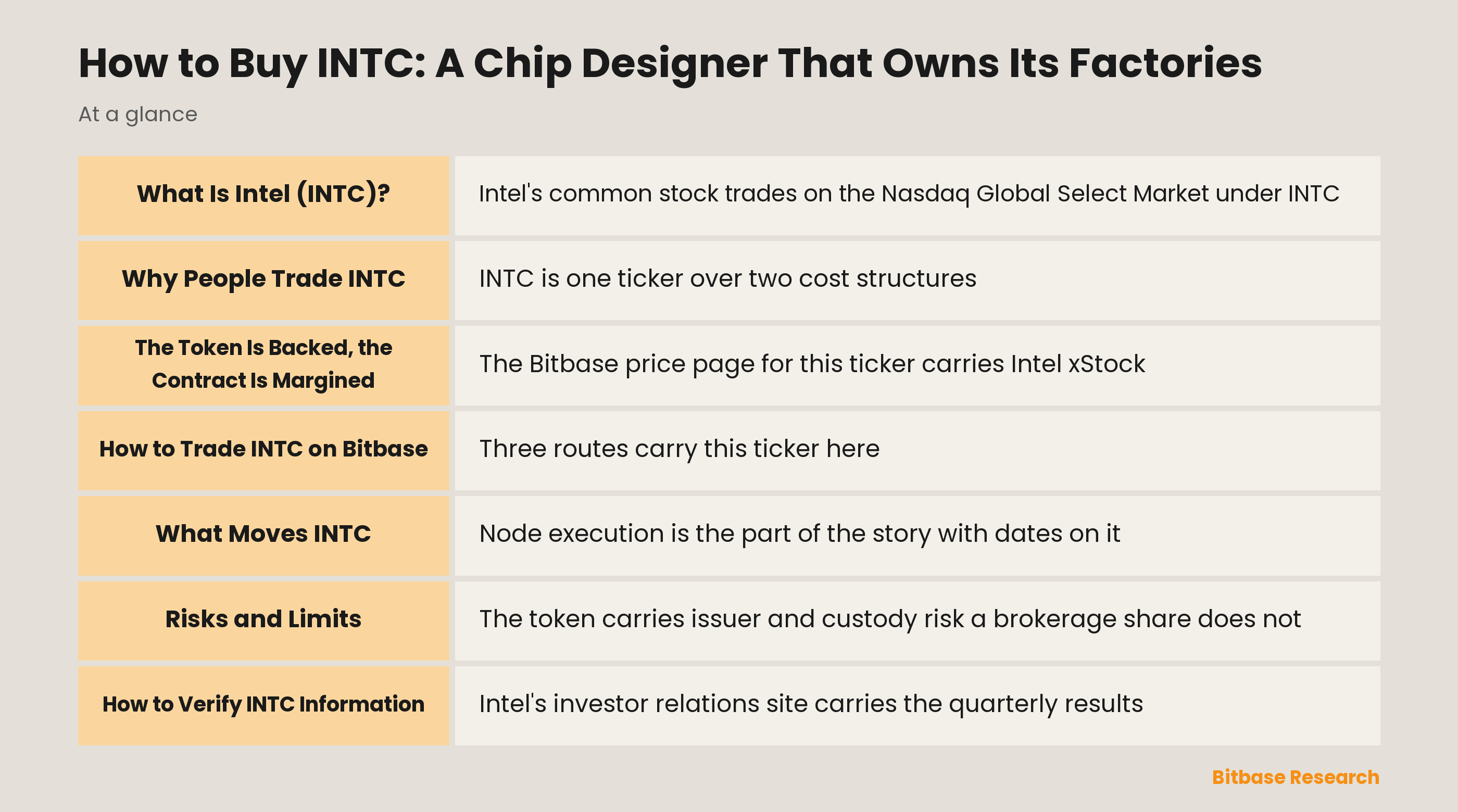
Intel's common stock trades on the Nasdaq Global Select Market under INTC. The company calls itself a US-based integrated design manufacturer: besides designing CPUs and other semiconductor products, it develops the leading-edge process technologies, or nodes, and the advanced packaging behind them, and predominantly manufactures its products in its own facilities. It says it plans to keep manufacturing the majority of its products in its own factories.
Results come in three segments. Client Computing Group delivers the platforms and processors that power PCs and edge devices for consumer and commercial markets. Data Center and AI delivers workload-optimised solutions built on the x86 architecture, from CPUs to AI accelerators, network cards and custom ASICs. Intel Foundry is technology development, manufacturing and foundry services, and Intel states that at present nearly all of it supports internal manufacturing for Intel Products, while the company offers those services externally and aims to build a more significant external business. One segment of the three is, for now, mostly Intel selling to Intel, reported that way so the factories have to earn their keep in public.
Why People Trade INTC
INTC is one ticker over two cost structures. Designing chips costs engineering and go-to-market money; manufacturing them costs buildings, equipment and the depreciation that follows for years after the cash has gone. Intel is both, and its segment reporting now shows the two beside each other rather than blended into one line.
That makes the argument here testable rather than atmospheric: whether a named node reaches production, and whether an outside customer signs for the node after it. There is also a reason to look at INTC on a crypto venue that runs the other way from the crypto side of a book, because none of the three segments earns from token prices, block rewards or trading volume.
The Token Is Backed, the Contract Is Margined
The Bitbase price page for this ticker carries Intel xStock, quoted under the symbol INTCX. The label names the issuer, and the issuer, not the venue showing the quote, defines what the instrument is.
Backed describes xStocks as tokenized representations of specific US equities and ETFs, each backed one for one by the underlying asset held in regulated custody, issued by Backed Assets (JE) Limited, a Jersey company. They are described as tradeable around the clock on-chain, which is a statement about the token and not a promise about any venue's hours, and they are not available in the United States or to US persons. Backed's own material frames what a holder has as a claim on the value of the collateral rather than on the rights attached to it, and redemption runs through the issuer on the issuer's terms. Other tokenized securities follow other designs.
A perpetual futures contract holds nothing: no share, no token, no claim on Intel. It tracks a price, settles in stablecoin, exchanges a periodic funding payment between the two sides, and carries a liquidation price from the moment it exists. Backing and margin are not two words for one idea: backing is what stands behind an asset, margin is what you keep posted to keep a position alive.
How to Trade INTC on Bitbase
Three routes carry this ticker here, and they answer different questions.
The price page is the reference point: quote, chart and market data for the tokenized stock, with the instrument and its issuer named on it.
The tokenized stock spot market is where that token is bought and sold against a stablecoin. What settles into the account is the token, on the issuer's terms, with no funding to pay and no liquidation price attached.
The perpetual futures market is where a leveraged directional position is opened. Funding is paid or received depending on which side is crowded, a maintenance margin requirement applies, and a liquidation price exists from the first fill. Funding accrues for every hour the position stays open, so the intended holding period belongs in the plan.
Which tickers carry which of these routes differs by name, and the tokenized stock listings are where that is set out.
What Moves INTC
Node execution is the part of the story with dates on it. Intel released its initial Intel Core Ultra Series 3 processors in 2025, the first products manufactured using the Intel 18A process technology. A node either yields working parts in volume on the schedule given for it or it does not, which is a manufacturing fact rather than a view that can be argued indefinitely.
Intel 14A is a commercial question rather than a technical one. That node was designed from inception as an offering to external customers, and Intel announced that if it cannot secure a significant external foundry customer for it, it may pause or discontinue its pursuit of 14A and successor leading-edge technologies. Who signs for that node is news about the shape of the company.
The product segments run on different clocks. Client Computing Group sells into consumer and commercial markets that buy hardware in refresh waves rather than at a constant rate, while Data Center and AI answers to how a data centre budget is divided rather than to how large it is.
Financing belongs on the list too. Intel states that developing and manufacturing modern leading-edge process technologies requires substantial capital investment, and its filings name the US government's acquisition of significant equity interests in the company among the factors that could make results differ from expectations.
Risks and Limits
The token carries issuer and custody risk a brokerage share does not. One-for-one backing describes the issuer's structure, and that structure, from custody to eligibility to redemption terms, is set by the issuer and can change. There is no shareholder claim behind the token, and it is not offered to US persons. Hours open a further gap: it is described as tradeable around the clock on-chain while the primary listing keeps an exchange session.
The perpetual adds costs that owning an asset outright does not have. Funding accumulates quietly and can consume a directionally correct trade held long enough, and leverage shortens the distance between an ordinary move and a forced exit. The business risk underneath both is specific: Intel has stated the condition on which it would step back from leading-edge process development, and factories are fixed costs that do not shrink when demand does.
How to Verify INTC Information
Intel's investor relations site carries the quarterly results, and the SEC's EDGAR database holds the filings behind them. The annual report is where the segment definitions, the integrated design manufacturer description and the 14A statement appear in the company's own words, and that last one is worth reading in full rather than in summary.
For the token, the issuer is the authority on backing, custody, eligibility and redemption. For the instruments, the Bitbase price page carries the live quote and names the issuer, and the market pages carry the perpetual's contract terms, including funding and margin.
Conclusion
Intel is a design company and a manufacturing company reported under one ticker, and it is the second of the two that the company's own 14A statement puts on the table. The company has published the condition on which it would step back from the leading edge, which turns a diffuse story into a question with an answer. Here the ticker reaches you as a token backed by an issuer, a spot market in that token, and a contract that holds nothing at all, so the choice between them is about the structure carrying the view rather than about the view itself.
Related market pages
Bitbase pages for the tokenized stocks named in this article:
- INTC: View price · Tokenized stock spot · Perpetual market
Related reading
Other Bitbase articles on this topic:
- How to Trade ASML: Lithography Exposure Without a Share
- How to Buy AVGO: Broadcom Chips, Software and Perpetuals
- How to Trade BRK.B: Berkshire Hathaway Perpetual Futures
Disclaimer: This article is educational content from Bitbase Academy, provided for information only. It explains what a company or fund does and how the instruments referenced here differ from one another; it does not constitute investment, trading, tax, or financial advice, and it is neither a recommendation nor an endorsement of any security, token, or trading strategy. A tokenized stock is issued by a third party and is designed to give economic exposure to an underlying asset: it is not a share, it carries no shareholder rights, and it depends on the issuer's structure, eligibility rules, and redemption terms, which the issuer can change. Perpetual futures are leveraged derivatives that hold no underlying asset and can be liquidated, and trading hours, product availability, and eligibility differ by instrument and by jurisdiction and can change at any time. Written as of September 2026; verify everything yourself through company filings, the issuer's own documentation, and the product pages of the venue you trade on.
References
[1] Intel Investor Relations: quarterly results and the segment reporting behind them www.intc.com
[2] SEC EDGAR, Intel Form 10-K for the fiscal year ended December 27, 2025: the segment definitions, the integrated design manufacturer description and the Intel 14A statement www.sec.gov
[3] xStocks official site: what an xStock is, the one-for-one backing in regulated custody, the issuing entity and the US restriction xstocks.com